Winter
Kent McFarland
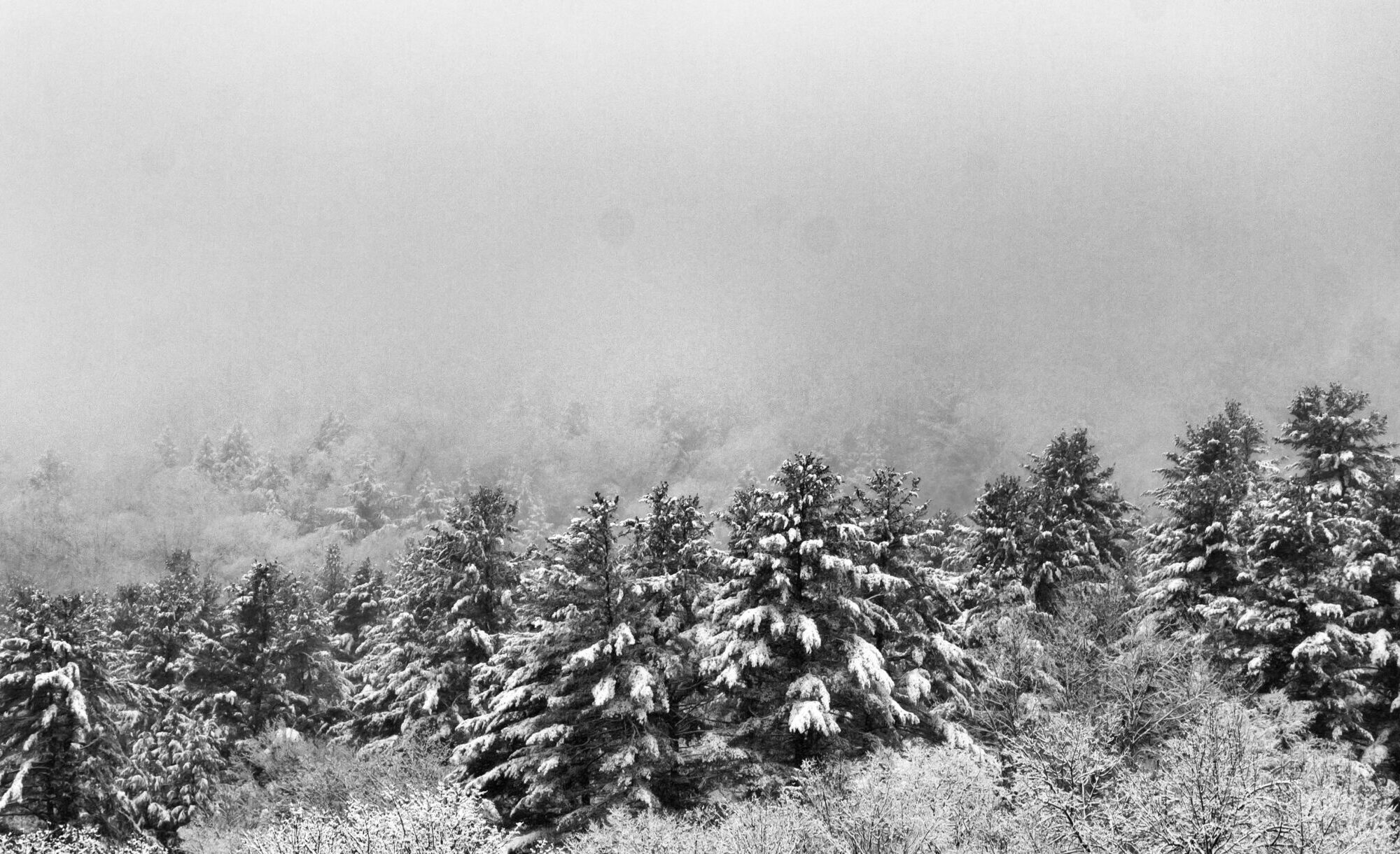
In the deep freeze of a New England January, bees are likely overwintering in your brush piles, birds are feeding on (slightly) fermented winter fruits, and you might spot a fir wave from your seat on the ski lift.
By Jason Hill and Spencer Hardy
The weathered raspberry canes and old sunflower stems reach up through the snow, waving gently in the January winds. A woodpecker hammers at a frozen stump on the edge of your lawn, and the heavy icicles on a dead maple limb draw it slowly toward the ground. All of them, you smile to yourself, are small reminders of your decision to leave the yard a little untidy through the winter—an untidiness that shelters life through the coldest months.
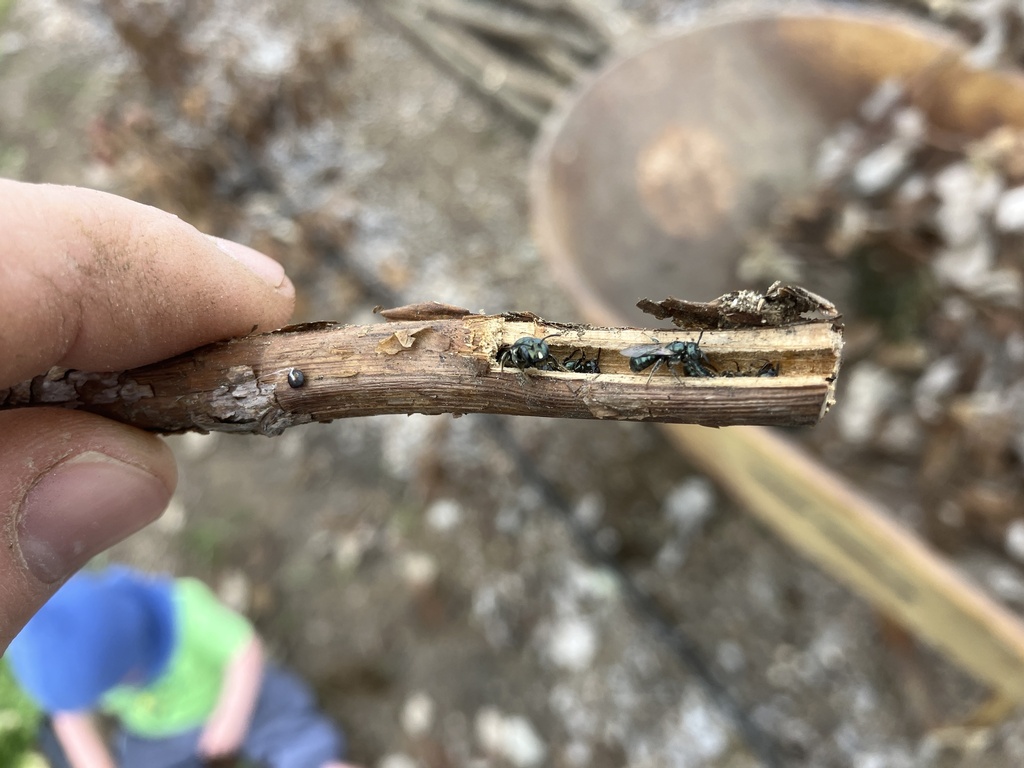
Among the hidden residents in this winter landscape are the carpenter bees, a diverse subfamily (Xylocopinae) of native bees that carve out their homes in wood or pithy stems—a behavior that explains their name.
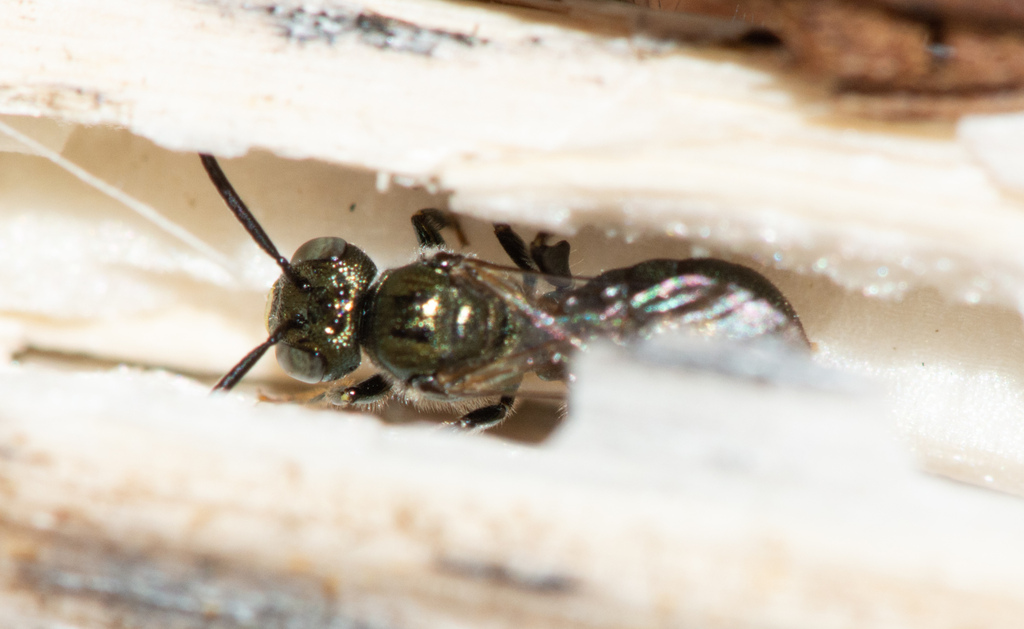
Here in New England, we have four species of small carpenter bees, all in the genus Ceratina, slender iridescent bees that spend their winters tucked inside the hollow stems of blackberries, sumac, and other plants with soft tissue at their core.
We have just one large carpenter bee up here: the Eastern Carpenter Bee (Xylocopa virginica), known for its habit of occasionally excavating tunnels in decks and wooden clapboards. It’s a relative newcomer to Vermont (the first state record dates to 1997), and in just a few decades this large bee has steadily expanded across the warmer two-thirds of the state. Its continued northward spread raises an inevitable question: will warming winters allow it to move statewide in the years ahead?
By contrast, the small carpenter bees (Ceratina) have long been woven into Vermont’s landscapes and are likely among the most abundant native bees in the state. Any messy, open habitat—old fields, garden edges, shrublands, and backyards left a little wild—will almost certainly host at least one—and often all three—of our most common species. One more southern species, the Nimble Small Carpenter Bee (Ceratina strenua), has so far been documented only at a few sites in Bennington County, hinting at another potential range expansion in progress.
Despite their differences in size and choice of winter safe harbors, these bees share a common strategy: both males and females overwinter as adults, often sealed away inside the very tunnels where they developed. By contrast, in bumble and sweat bees, only the females overwinter, often buried below ground.
The Eastern Carpenter Bee maintains winter refuges as long, cylindrical galleries carved into dead wood during the previous summer. After their final foraging flights in autumn, the bees retreat into these tunnels and shift into a months-long period of dormancy. Deep within the gallery, where temperature and humidity fluctuate far less than outside, the bees remain still as the low January sun passes overhead.
Each of these tunnels is a precisely engineered space, bored along the grain of the wood and often reused and expanded across generations. Older galleries may have several branches, broadened or extended each year by a female clearing out debris or adding new brood cells. Such reuse makes ecological sense: excavating wood is expensive work, and a well-protected nest can serve as a nursery for summer offspring and then as a winter den for adults. Even in single-season nests, the reinforced walls and narrow entrances help buffer the interior from wind, moisture, and freezing temperatures.
Inside these chambers, carpenter bees rely entirely on the energy reserves they built up during late summer and autumn. Sharing a single tunnel helps carpenter bees stay warmer and maintain body mass, and individuals of multiple Ceratina species may overwinter together in a hollowed-out stem. Some carpenter bees even live long enough to overwinter twice, a rare feat among bees. Whether alone or in small groups, they remain dormant until warmth and lengthening daylight signal that the season is turning.
By early April the winter silence finally breaks, and males emerge first to take up territories around the entrance holes where females are overwintering. Following spring mating, female carpenter bees may return to the very tunnel where they overwintered. Some will reuse these galleries, clearing out old partitions and extending them deeper, while others start new excavations. Once mated, each female constructs a series of brood cells, stocks them with pollen and nectar, and seals them with chewed plant material. The young develop through spring and early summer, still cared for by their mother, eventually chewing their way out of the partitions and emerging as adults. It is a patient strategy—one that relies on the endurance of both bees and the structures they build.
A few small choices in our yards can help carpenter bees persist in our landscapes. Leaving dead and standing plant material in place creates nesting and overwintering sites for carpenter bees, and increases the chances that the buzz of small wings will greet us in the spring. And if bees aren’t your thing, think about them as winter bird food—woodpeckers and chickadees love to pull sleepy bees out of their stems for a mid-winter protein snack.
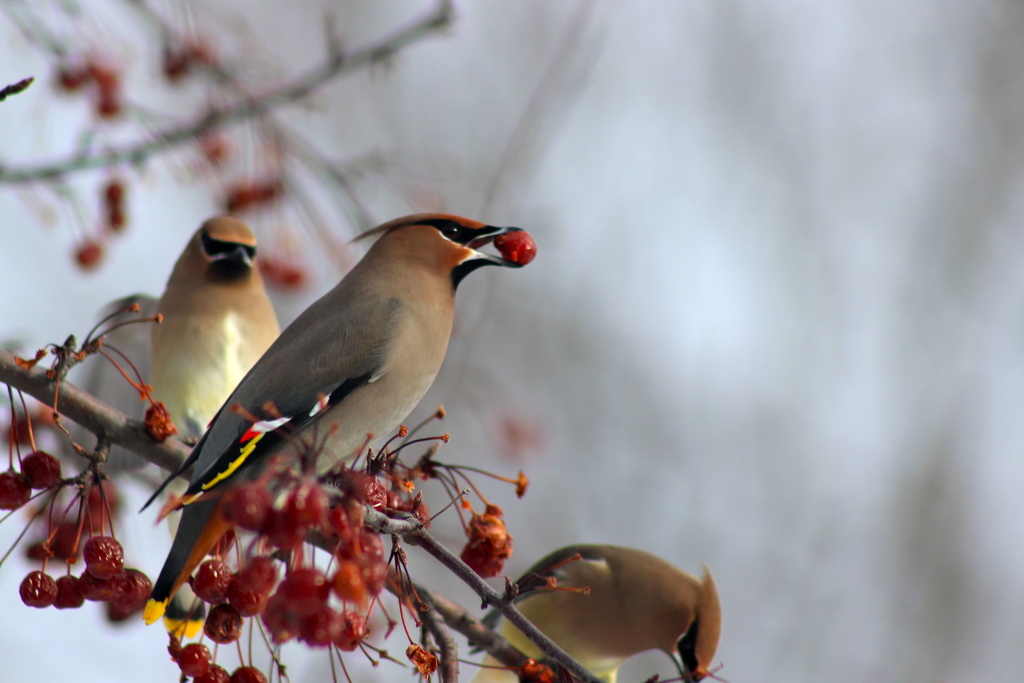
By Jason Hill
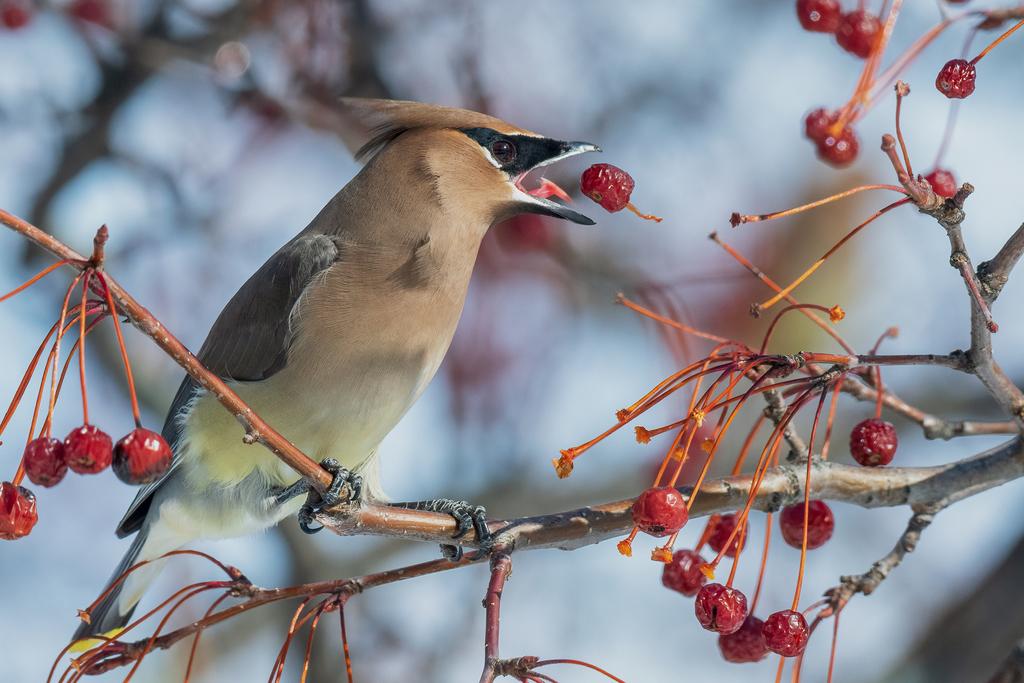
In the depths of January, the fruits of crab apples (Malus spp.) provide a welcome dapple of color against the muted winter landscape. They’re eye-catching to us, but essential to the frugivorous (i.e., fruit-eating) birds that depend on them. Cedar and Bohemian Waxwings (Bombycilla cedrorum and B. garrulus) especially turn to these calorie-rich food sources once freeze–thaw events have softened them, and as other fruits become scarce. Entire flocks can descend upon a single fruiting tree, devouring the fruits with an appropriate urgency to counterbalance the harshness of January.
As winter progresses, the ethanol concentration of fruits hanging on trees increases: sugars break down, wild yeasts consume the sugars and produce a trace of ethanol as a metabolic byproduct—the avian equivalent of a weak beer. Each thaw softens fruit, each freeze concentrates sugars, and each warm spell brings a new pulse of fermentation. Waxwings consume 84% of their calories from fruit throughout the year, and almost 100% during winter and early spring. So they aren’t specifically seeking alcohol; they’re just seeking calories at a challenging time of year when nearly every fermented fruit left hanging contains some ethanol.
Fortunately for them, waxwings are extraordinarily well-adapted to handle this biochemical concoction. They have one of the relatively largest livers of any songbird—4.9% of their body weight—and high activity of alcohol dehydrogenase, the enzyme responsible for metabolizing ethanol. Waxwings break down ethanol more than seven times faster than seed-eating birds, removing it entirely from their system within about two hours post-consumption. Their digestive systems are built for speed and for limiting ethanol uptake: waxwings pass 90% of consumed fruit through their relatively short intestines in little more than half an hour (Borowski 1966), extracting the sugars they need while minimizing additional fermentation in the gut. Waxwing physiology is so efficient that despite relying almost entirely on fermented fruit throughout the winter, their blood alcohol content rarely rises above 0.02% .
It is often repeated that hard fruits become more palatable to birds throughout the winter, but that may be more folk wisdom than fact. In reality, many of the fruits that persist into late winter actually become less attractive as the season progresses. Some fruits desiccate, losing water and concentrating sugars without increasing total energy; others accumulate secondary compounds that make them harder (and more calorically expensive) to digest. Experiments with overwintering fruits—including the Guelder-Rose (Viburnum opulus) found in New England—show that waxwings prefer early-season fruits when given a side-by-side choice, and turn to late-winter options only after higher-quality crops such as crabapple, mountain ash (Sorbus spp.), juniper (Juniperus spp.), hawthorn (Crataegus spp.), and winterberry (Ilex spp.) have been depleted. By March and April, waxwings also start to shift their diet to include the protein-rich catkins of willows and other early-flowering trees.
Given their winter diet of partially-fermented fruit, it is perhaps unsurprising that on rare occasions waxwings ingest enough ethanol to impair their coordination. This usually requires an unusual confluence of events: heavily fermented fruit, a feeding frenzy by a large flock, or an unseasonably warm spell that accelerates fermentation. From a natural-selection perspective, intoxication is clearly maladaptive. A waxwing that can’t fly well, or can’t react quickly, is at greater risk from predation, hypothermia, or injury. Indeed, there have been a handful of published papers documenting group mortality of waxwings following winter fruit consumption.
What’s often missing from these stories of waxwing inebriation and subsequent mortality is what actually causes their deaths: collisions with building façades and windows, vehicles, and other artificial structures. Waxwings slightly dulled by ethanol would likely survive such moments of vulnerability in a natural landscape—without swift-moving cars and large panes of reflective glass. But in our built environments, errors are amplified. What is often presented as a humorous story about “drunk birds” is inaccurate and fails to acknowledge the risks that human-dominated landscapes frequently pose to wildlife.
By Kent McFarland
Economically and ecologically important, Balsam Fir is a keystone species of the eastern North American boreal zone. The official provincial tree of New Brunswick, Canada, it can form dense, single-species stands in some areas of northeastern North America, especially in the high mountains.
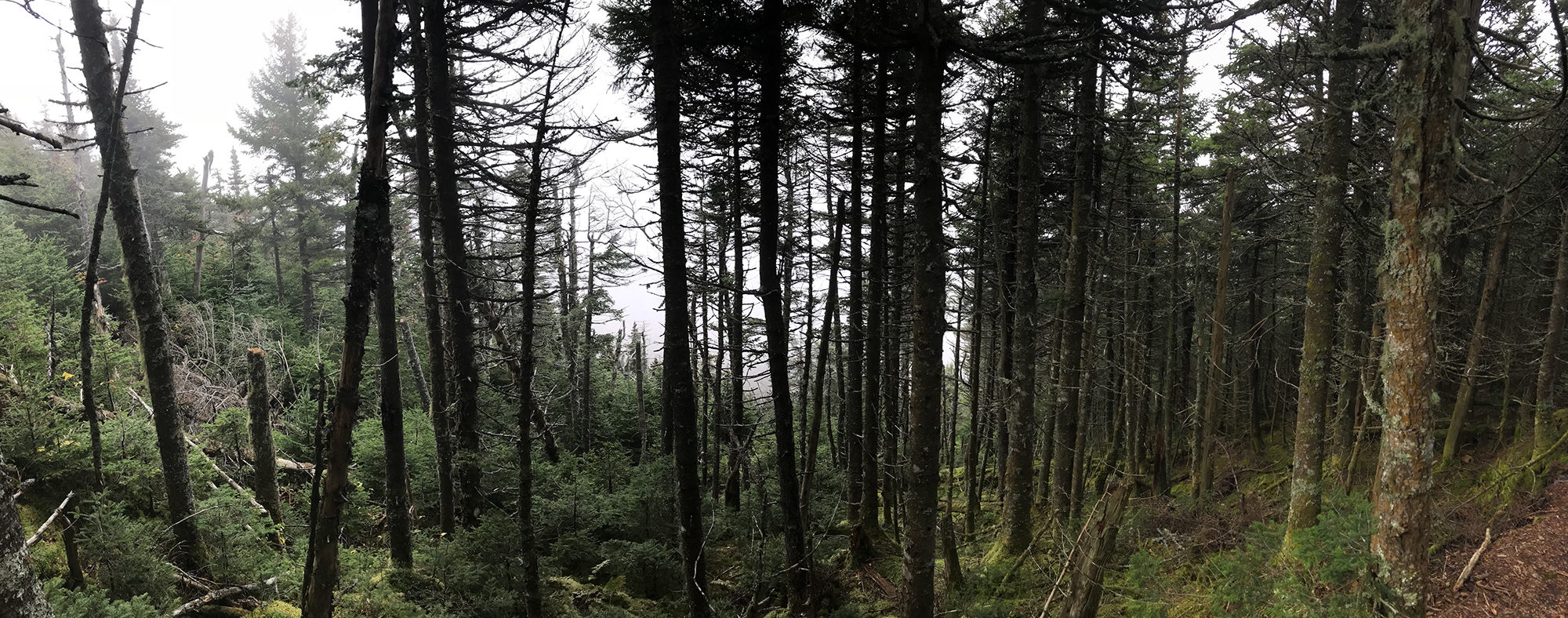
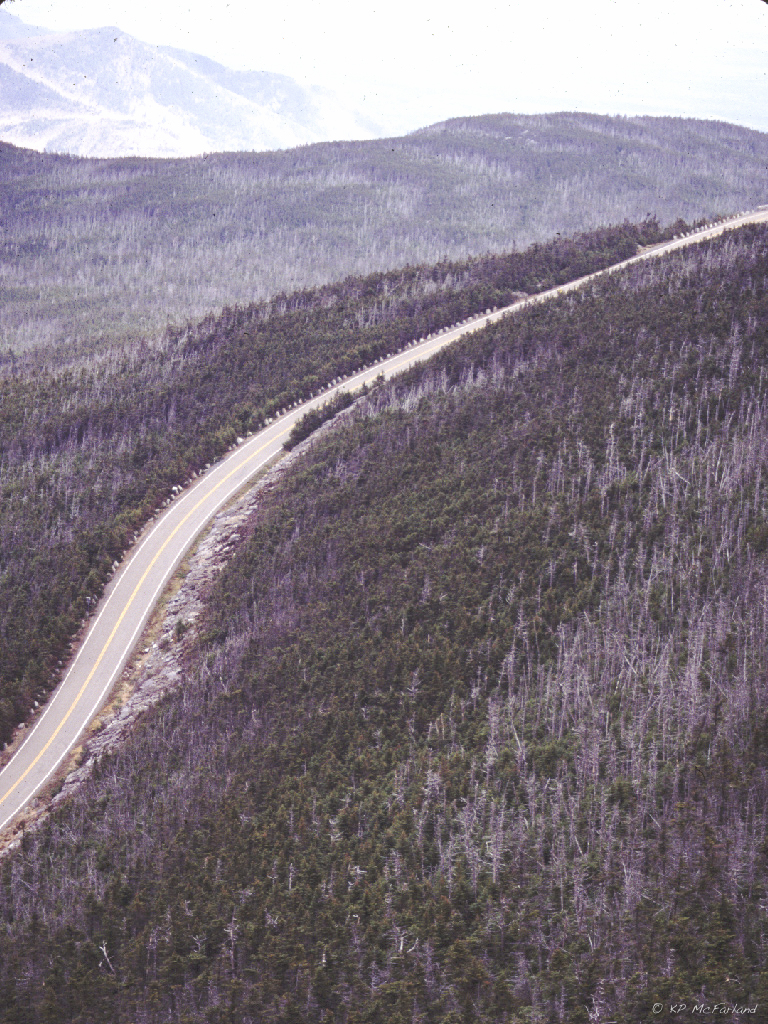
When you’re riding up a ski lift or driving over a mountain pass, you might have noticed that a lot of Balsam Fir seem to have died off. Pests? Environmental disaster? Nope, that’s just a “fir wave.”
Fir waves are crescent-shaped bands of dead trees that you can see in systematic patterns across the sides of the mountains. They move very slowly over decades in the direction of the prevailing wind.
Trees at the leeward edge of a canopy opening are exposed to winds that are over 50% higher than within the forest. Rime ice, which forms on the trees when water droplets in the air hit solid surfaces and instantaneously freeze, also accumulates more on trees exposed to wind.
The trees lose needles and branches due to heavy ice accumulation. Being rocked by the wind while supporting ice loads also causes their fine rootlets—which are important for delivering nutrients to the tree—to break underground. As these trees die, adjacent trees experience the same conditions and begin to die. Then, seedlings begin to grow below the newly opened canopy.
Regeneration of waves occurs at about 60-year intervals. As you move away from the dying front of trees, the trees are older and older until you reach the following wave of dead trees. If you were to take time-lapsed photography of a mountain side, the waves of dead trees would appear to be moving across the mountainside like a wave in the ocean.
So there you go, a bit of natural history to impress your ski-lift mates this winter!