From Mountain Summits to Migration Bottlenecks: Tracking Bicknell’s Thrush
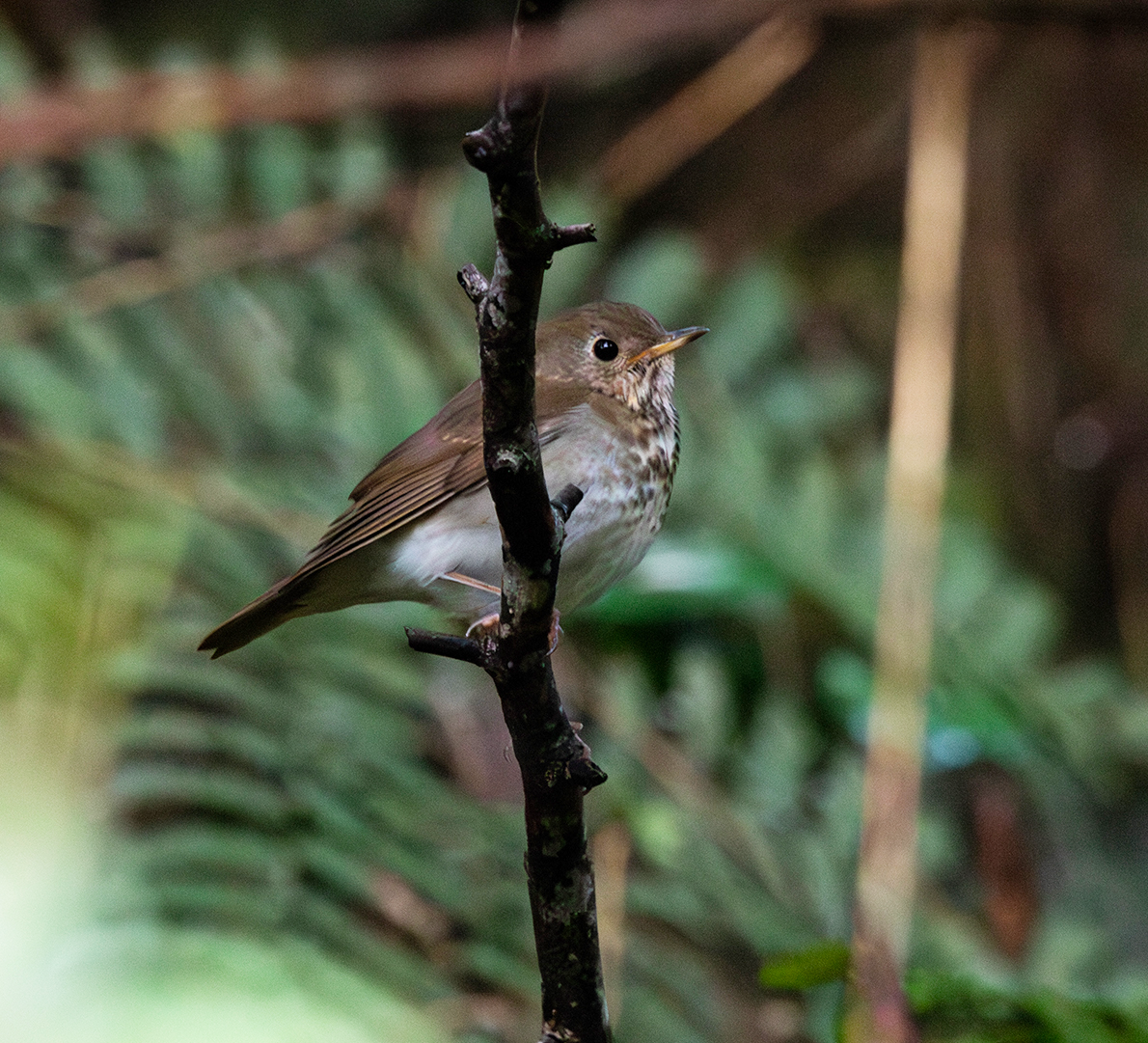
Bicknell’s Thrush photographed by Iván Mota, founder of Cúa Birding in the Dominican Republic. © Iván Mota @cuabirding
Bicknell’s Thrush does not give itself away easily. This modest brown bird of foggy ridgelines and dense cover is more often heard than seen, its strange, ringing song floating over spruce-fir summits.
But stealth has not meant safety. The species has declined by nearly 50% since 2010 in northern New England and eastern New York. Where, exactly, the losses are happening has been a mystery.
In 2025, VCE pushed into two of the least understood stretches of the bird’s annual cycle: the fall stopover in the mid-Atlantic region and the final leg of southbound migration into the Dominican Republic. Together, those efforts are sharpening the picture of migration bottlenecks, the places where a species can be most vulnerable.
In January 2025, VCE deployed a Motus receiving station at Reserva Privada Zorzal in the Dominican Republic, the first Motus station within the Bicknell’s Thrush core wintering range. The system detects signals from tiny coded radio tags, allowing researchers to follow movements without recapturing birds.
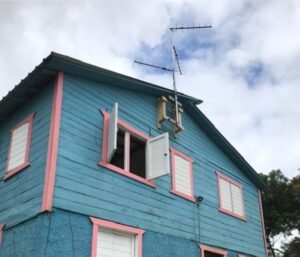
VCE Motus receiver in the Dominican Republic at Reserva Zorzal © Michael Hallworth
“These Motus towers help us figure out where we’re losing birds,” says Jim Goetz, VCE’s Caribbean conservation coordinator. “Are they making it to the coast and failing to fuel up? Are they dying over the ocean? Or are they reaching the Dominican Republic and not surviving there?”
Recent tracking suggests that much of the population funnels into the same mid-Atlantic staging areas, especially on the Delmarva Peninsula and parts of coastal North Carolina, before making the Atlantic crossing.
“We’ve realized that almost the entire population seems to be stopping in the same locations in fall,” VCE Conservation Biologist Desirée Narango says. For a species already confined to a narrow breeding range and a Caribbean winter range, that concentration raises the possibility of a migration choke point.
Narango, Goetz, and VCE Conservation and Data Scientist Mike Hallworth took the search to the field. Working with banding stations in Maryland, they tested new methods to find a bird so hard to study that it leaves only the faintest traces. Blood samples helped distinguish Bicknell’s Thrush from its nearly identical cousin, the Gray-cheeked Thrush, and autonomous recording units (ARUs) captured call notes in places where human observers would have missed them.
The work is beginning to pinpoint where Bicknell’s Thrush is most vulnerable and where conservation efforts could do the most good. What is emerging is a much clearer map of vulnerability: not just where Bicknell’s Thrush breeds or winters, but where its entire migration may bottleneck. For a species living within such narrow limits, that kind of precision could change its ultimate fate.
Next Steps
|
This article is from VCE’s 2025 Annual Report. Read more about what we accomplished in 2025 at the Annual Report homepage!