Every Loon Counts: A New App That Both Biologists and Volunteers Love
On a bitter December day, VCE Loon Biologist Eloise Girard hauled a sled of rescue gear onto the ice at Green River Reservoir toward a shrinking patch of black water. A young loon had been there for days, swimming circles to keep the hole open. But loons are built for open water, not tight quarters. To lift off, they need a runway as long as a quarter mile. Once a loon gets iced in, it can be stranded with no way out.
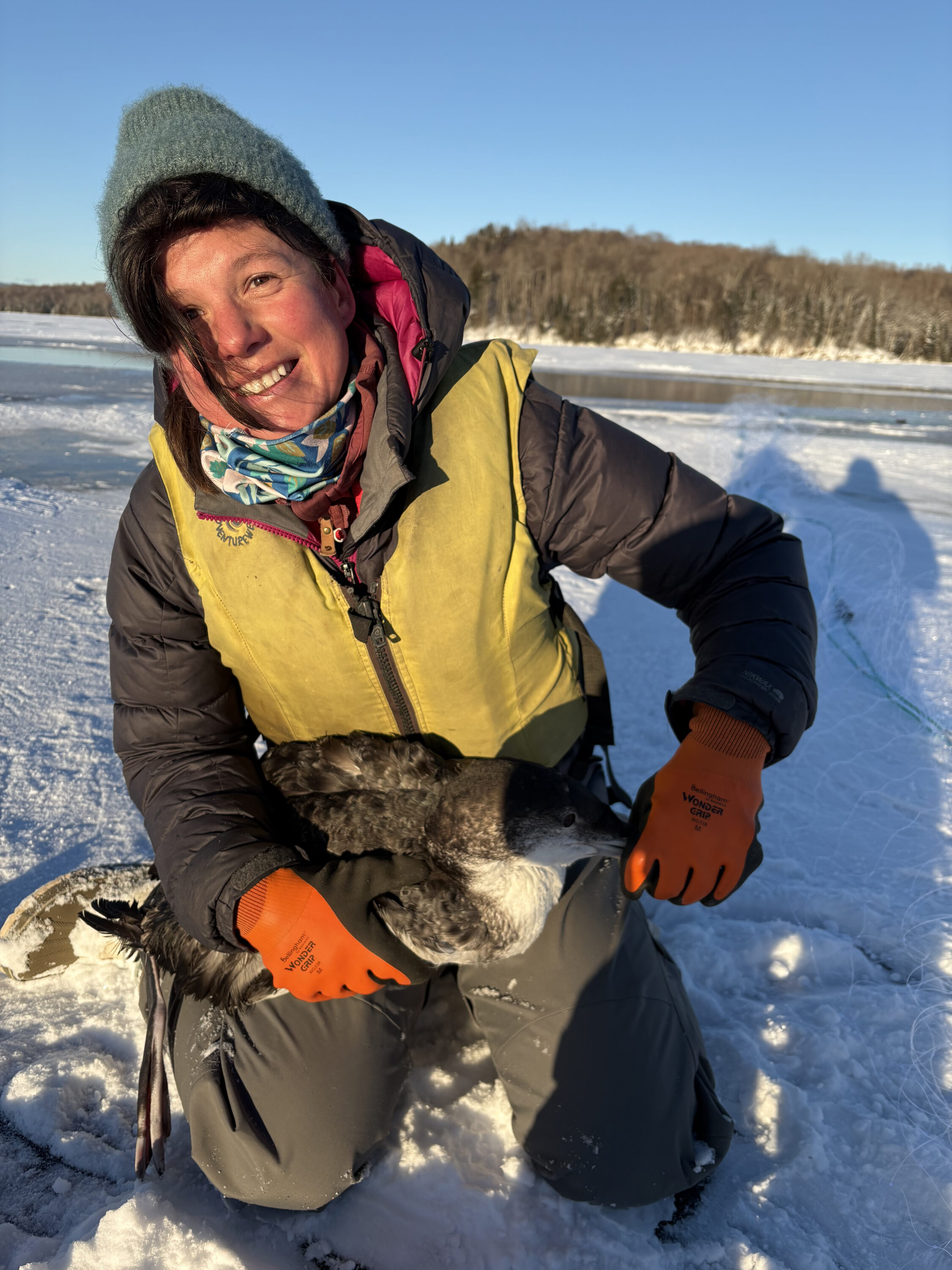
Eloise Girard rescuing a loon from the Green River Reservoir last December © Emma Podolin
Girard, joined by volunteer Emma Podolin, stretched a gill net across the hole and waited for the loon to surface. Then came a splash—a tangle of wings and mesh. The rescuers hauled the heavy, thrashing bird from the water, worked it free, and secured it in a padded transport box. Later, VCE Loon Biologist Eric Hanson drove it to open water on Lake Champlain and released it to join the southbound migration.
Thirty years ago, saving a single loon in Vermont effectively meant saving 10 or 20 percent of the state’s entire population. Today, after four decades of patient work, the state supports 115 breeding pairs.
In 2025, VCE carried out nine loon rescues. The work can be technical, cold, and exhausting. It is also deeply communal. Time after time, volunteers spot the birds, report them, help assess conditions, and sometimes assist with the rescue itself.
“Even now, every loon counts,” Hanson says. “Saving birds is important, but so is keeping people involved in the work of watching over our lakes.”
That spirit of community helped drive one of the year’s biggest advances: LoonWeb, VCE’s new digital platform for loon conservation. For decades, loon-monitoring data management has taken the shape of paper forms, spreadsheets, and endless email chains. Several attempts had been made to digitize the process through the years, but none fully worked. LoonWeb did, in part because it was built with input from the people who would actually use it.
“We built it with our volunteers, who were involved from the ground up,” says Jason Loomis, VCE’s software developer. “That collaborative process is what made it into something that people can trust, use, and help make it better.”
The payoff is already visible. In its first season, 87 percent of Vermont’s annual LoonCount volunteers used the system. LoonWeb lets volunteers explore historical lake data, adopt survey sites, and enter standardized observations that are immediately more useful to staff and researchers.
In past seasons, Hanson and other VCE staff members spent up to two days a week processing volunteer emails by hand. LoonWeb can return much of that time to the field, where biologists can interact with volunteers directly. The platform can also improve the data by giving volunteers an intuitive form to record details such as loons’ reactions to nearby predators. Observations like these can help researchers better understand loon behavior, nesting success, and the threats the birds face.
That matters because the work is not over. Lead fishing gear still kills loons, wakeboats threaten nests and fragile shorelines, and increasingly severe summer storms and floods create turbulent water that can make it harder for loons to find food. With a clearer, more complete view of loon behavior, habitat, and risk, VCE and its volunteers are better equipped to protect a species whose recovery has always depended on careful watching.
This article is from VCE’s 2025 Annual Report. Read more about what we accomplished in 2025 at the Annual Report homepage!