Hidden in Plain Sight: A Closer Look at Vermont’s Wild Bees
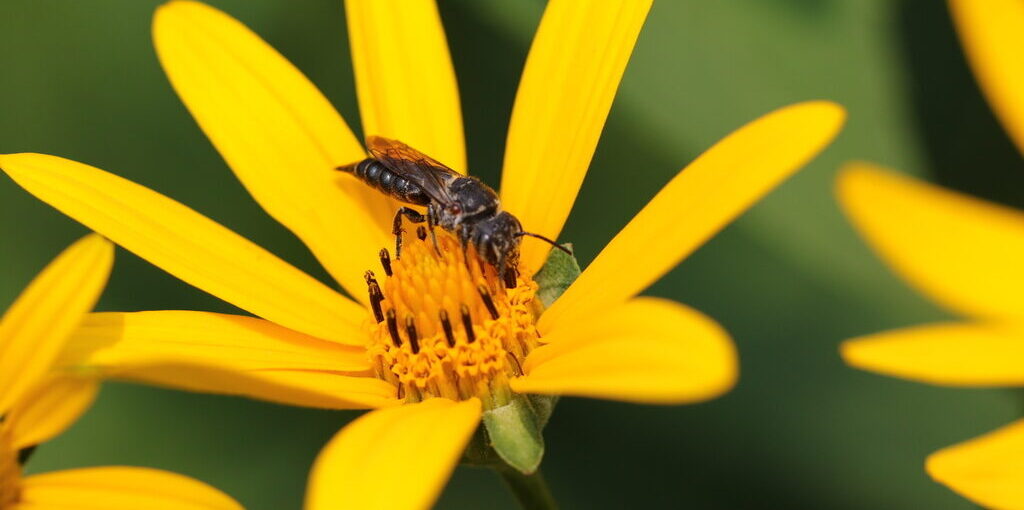
Sunflower Sharptail (Coelioxys alternatus) © Spencer Hardy
In 2019, scientists knew surprisingly little about most of Vermont’s bees. The majority of the state’s native bees—miners, masons, leafcutters, sweat bees—were, as VCE Bee Biologist Spencer Hardy put it, “an unopened box of treasures.”
Six years later, that box is open.
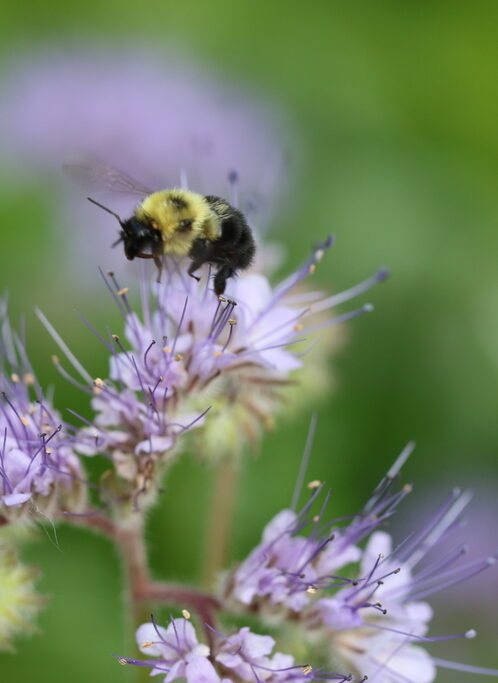
Two-spotted Bumble Bee (Bombus bimaculatus) © Spencer Hardy
In 2025, VCE and its partners published the first comprehensive checklist of Vermont’s wild bees in more than 60 years: 352 species, backed by a database of roughly 80,000 records drawn from field surveys, museum drawers, private collections, and a swelling tide of community science observations. It is both a roll call and a reckoning. More than half of those species appear to need conservation attention. And some more may soon merit state protection.
The project began with curiosity, then deepened into something more urgent. Hardy and colleagues spent four years crisscrossing Vermont, stopping at wetlands, roadsides, mountain clearings, and field edges that most people would drive past without a glance. They slept in cars, chased bloom times, tracked down host plants, and learned to think like bees. At the same time, they worked backward through a century of specimens in museums, asking two deceptively simple questions: Which species were here before, and which are still here now?
These questions changed the scale of the work. The checklist did not merely add names. It revealed patterns, absences, dependencies. Some bees turned out to be tightly bound to a single plant species or small group of plants. Others were hanging on in just one known place. A rare oil-collecting bee, for example, appears tied to Yellow Loosestrife in a preserved riparian park in South Burlington—a tiny outpost that may hold an outsized share of the species’ future in Vermont.
Least Cellophane-Cuckoo (Epeolus minimus) © Spencer Hardy
The findings also scrambled a few commonly held assumptions by the public. Not all bees are honey bees. Not all bees are declining. And some of the most important conservation gains may come not from grand gestures, but from small, smart changes: adding the right native flowers to a restoration mix, protecting an overlooked wetland edge, paying attention to what blooms where and when.
For Hardy—who grows native plants and exotic fruit as a co-owner of the Farm Upstream in Jericho, Vermont—the project kept producing moments of delight. After one talk, an artist showed Hardy stationery decorated with a bumble bee she had drawn from a photo she took years earlier. That image turned out to document Bombus insularis, a parasitic bumble bee never before recorded in Vermont.
Vermont and its bees now have something they lacked before: a robust baseline for research, monitoring, and conservation. What was once fragmentary is now far more legible, giving scientists a stronger foundation for tracking change and guiding action.
Read the Checklist: Hardy, S.P., Veit, M., Milam, J., Ascher, J.S., Sharp, N., Hallworth, M.T., Ferguson, M., Richardson, L., Nicholson, C., Ricketts, T.H., Gibbs, J. and McFarland, K.P. (2025) “An annotated checklist of the bees (Hymenoptera: Apoidea) of Vermont with conservation status and natural history notes”, Northeastern Naturalist, 32(mo27), 1–73.
Next Steps• Survey likely habitats for rare or overlooked bee species still unconfirmed in Vermont. |
This article is from VCE’s 2025 Annual Report. Read more about what we accomplished in 2025 at the Annual Report homepage!