Mentoring Young Biologists
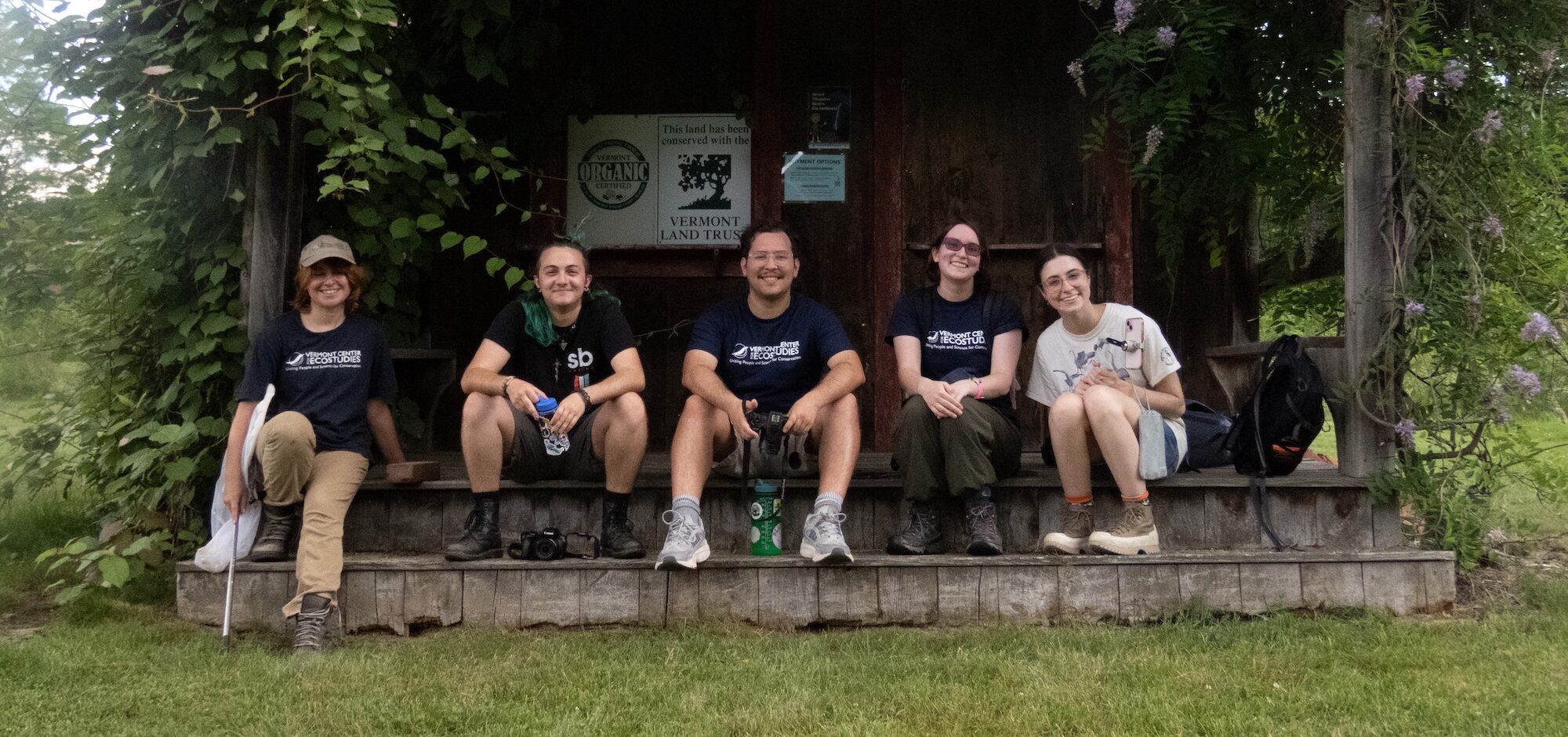
Seasonal Bee and Butterfly Technician Juno Stahl (far left) and the 2025 VCE interns (left to right) Sammi Rizzo, Massimo Gulino, Camilla Price, and Isabella Soddu at Cedar Circle Farm on media training day
Graduate Students
Every year, VCE scientists provide advice and encouragement to graduate students who assist with our science projects and independently conduct their own research related to VCE’s focus areas. This year, Conservation Biologist Desirée Narango advised three graduate students.
Melory Brandao
University of Delaware
Melory Brandao, at University of Delaware, is testing an idea taking root in cities: that dense Miyawaki forests—tiny, fast-growing plantings of closely packed native trees—can outperform traditional plantings. She compares insect communities across these tightly packed urban forests and more conventional green spaces in Boston. Brandao’s research is tracing how restoration choices shape the smallest lives, and, by extension, the larger systems they support.
Laura Costello
University of Vermont
Laura Costello studies plants that keep their secrets. A UVM Field Naturalist graduate student, she split her summer between coding pollinator datasets and chasing a mystery: Who pollinates Vermont’s White Bog Orchids? Using timelapse cameras running day and night, she captured a fuller cast of visitors than anyone had documented locally. “Our understanding is still incomplete,” she writes. Her images—butterflies by day and moths after dark—are beginning to close that gap.
Kevin Dernier
State University of New York at Plattsburgh
After volunteering on Mount Mansfield and studying Bicknell’s Thrush, Kevin Dernier built an independent study around Gray Catbirds at The Putney School, pairing fieldwork with automated telemetry. By tagging birds and reading signals from a Motus tower, he tested whether incubation, normally hidden in dense vegetation, could be tracked remotely, and whether new tools could reveal behavior without disturbing the research subjects. He graduated from SUNY Plattsburgh at the end of 2025.
Summer Interns
Every year, VCE brings in a small group of students and emerging conservation professionals and drops them into the real work of field ecology: long days outdoors and quick pivots to lab work when the weather turns. This year, 250 applicants competed for positions marked by range, rigor, and hands-on experience. Recent investments—made possible by grants and donor support—in housing and a field vehicle have made these opportunities more accessible to students from a broad range of backgrounds and geographies.
Massimo Gulino
Northern Michigan University
Massimo Gulino came to VCE from the shores of Lake Superior, where he leads student crews studying salamanders. In Vermont, he moved among field-research sites and predawn climbs on Mount Mansfield, learning to band birds and set mist nets in the dark. “Being able to handle a bird was equally nerve-wracking, beautiful, and one of the highlights of my young career,” he says. What stays with him are the mornings—the first light over Lake Champlain, a White-throated Sparrow cutting through the dark—and the steady, patient mentoring that sharpened both his science and his sense of direction.
Isabella Soddu
University of Vermont
Isabella Soddu arrived with curiosity but little confidence, worried she had somehow slipped into the internship by mistake. The summer changed that. Through loon surveys, bird banding, insect work, and time in experimental garden plots, she found that good ecologists are built through attention, humility, and sustained wonder. “Two very simple ingredients go a long way,” she says. “Passion and curiosity.” One day, she sent her mother a photo of herself holding a freshly banded bird. “That’s the face of someone who’s found what they love to do,” her mother texted back.
Sammi Rizzo
University of Vermont
Sammi Rizzo moved across a wide sweep of VCE field studies: loon conservation, grassland management, on-farm pollinators, native-plant research, and the Vermont Butterfly Atlas. What stayed with them was the human machinery behind good conservation. In loon monitoring, they saw a project held together not just by science, but by patience, local knowledge, and volunteer effort. Rizzo came away with a clear view of how conservation really happens: through long hours, careful observation, and a community of people willing to keep showing up.
Camilla Price
Colorado State University
Camilla Price’s summer ran on data and miles of pavement. As VCE’s spatial-science intern, she worked through more than 7,000 observations to understand wildlife-vehicle collisions across the Northeast. She built models, mapped migration routes, and translated dense datasets into clear visuals. The work was technical, but the benefits could be tangible: better decisions, safer roads, and fewer dead animals at the edge of the pavement.
This article is from VCE’s 2025 Annual Report. Read more about what we accomplished in 2025 at the Annual Report homepage!