If you’re excited about getting to know the same place over time and collecting detailed field data, Vernal Pool Monitoring offers a hands-on way to follow a single pool through the seasons. If you prefer exploring and discovering new areas, Vernal Pool Atlas lets you contribute through mapping. Both opportunities play an important role in vernal pool conservation, and you can choose one that best fits your interests and schedule!
Vernal Pool Monitor (VPmon)
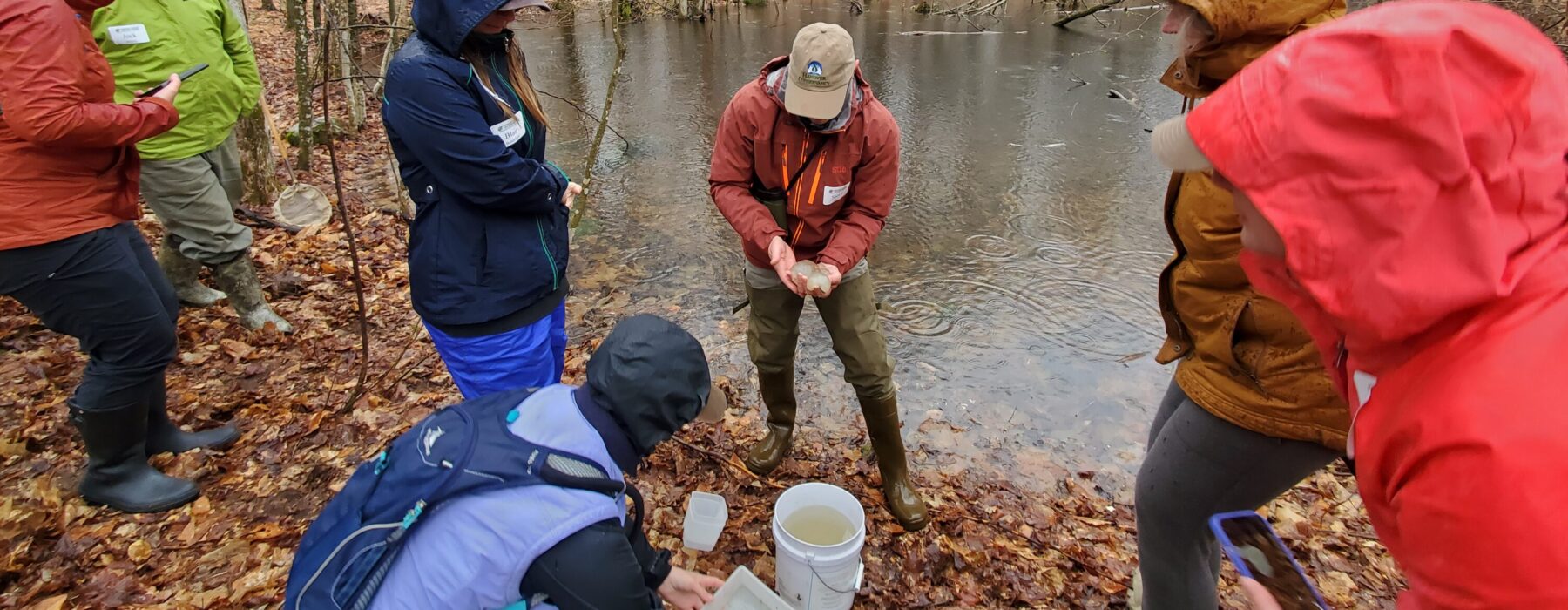
It doesn’t take an expert to monitor a vernal pool, just two enthusiastic citizen scientists with a few free mornings each spring and a willingness to learn something new. Vernal Pool Monitors are volunteers who (perhaps like you) want to be engaged in the conservation of the seasonally-shifting little patches of Vermont known as vernal pools. By adopting a pool near you, you commit as a Monitor to visiting that site four times each year, three times in the spring and once in the fall, to set up equipment and collect data.
Exactly what data are we collecting? Good question! In addition to a few pieces of physical data (like the weather and how deep the pool is), Monitors keep track of:
- Frog call recordings — By setting up an audio recorder, we can automatically record when Wood Frogs and other noisy vernal pool species are chorusing
- Egg mass survey — There are four charismatic species of amphibian that like to lay their egg masses in vernal pools. By recognizing and counting these, Monitors give us a sense of the number of frogs and salamanders breeding in that vernal pool.
- Caddisfly larvae and Fairy Shrimp survey — Monitors keep an eye out for these two different kinds of macroinvertebrate, one highly common and the other quite rare.
- Hydroperiod — By setting out a small, automatic device called a HOBO logger, we can keep track of a pool’s hydroperiod (how long it remains flooded).
Intimidated by the idea of setting up a HOBO logger? Concerned about identifying amphibian egg masses and fairy shrimp? It may seem confusing at first, but the VPMon Coordinator will be there to walk you through each step of the process, from helping to locate a vernal pool for you to monitor, to explaining what you’d do as a VPMon volunteer.
If you’re interested in being a Vernal Pool Monitor, get in touch with our Program Coordinator at vpmon@vtecostudies.org to see if we have any openings!
Vernal Pool Atlas (VPAtlas)
The Vernal Pool Atlas focuses on mapping and documenting vernal pool locations across Vermont. While VPMon volunteers monitor individual pools over time, VPAtlas volunteers help expand statewide knowledge by field-verifying pools that have been identified through remote sensing, or by reporting pools they already know about or discover.
The success of VPAtlas depends on volunteers to help confirm potential vernal pools on the ground. During the first four years of the Vernal Pool Mapping Project (2009–2012), more than 4,800 potential vernal pools were mapped statewide using remote-sensing methods, and nearly 900 of those were field-verified by volunteers.
In 2020, VPAtlas was introduced to archive both field-verified and potential pools and to encourage public participation in increasing our understanding of vernal pool distribution in Vermont.
How to Participate
We welcome visitors to the VPAtlas site and encourage users to register and begin adding pool data. Volunteers can help by:
- Field-verifying mapped pools
- Reporting vernal pools they already know about
- Adding newly discovered pools to the Atlas
For questions or to report software issues, please contact vpatlas@vtecostudies.org. To download data sheets, amphibian identification aids, and additional information, visit the Volunteer Materials page.