Mysterious No More: What’s Pollinating the White Bog Orchid
Laura Costello is a A Field Naturalist graduate student, helping VCE code pollinator datasets, while conducting research on the pollinators of Vermont’s White Bog Orchids. Read in her own words about the exciting discoveries she made:
It’s baking hot on the fen, the sun beating down on the open wetland, my boots sinking into the deep, saturated moss, and three ticks already crawling up my pant leg, but I’m gleeful. I’ve just spotted a fuzzy, grey-and-white butterfly the size of a quarter, nectaring on a half-open flower on a spike of pure-white buds.
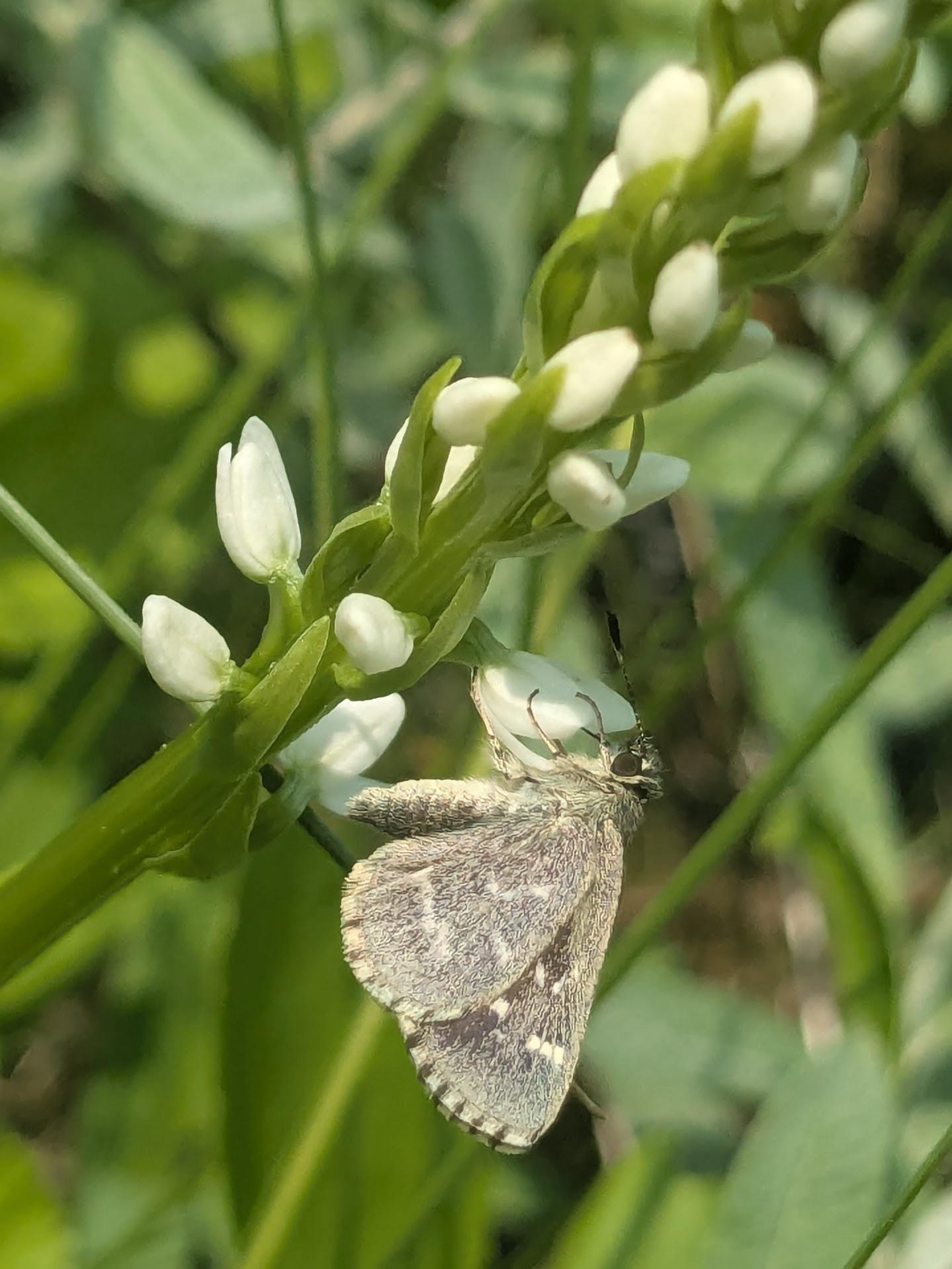
Pepper and Salt Skipper (Amblyscirtes hegon) © Laura Costello
This was only meant to be a scouting trip: meeting Kate and Paul, the stewards of this fen, and doing a quick survey to see if any White Bog Orchids (Platanthera dilatata) were locatable this early in the season. I don’t have any of the cameras I bought for the study with me, but I scramble to snap a picture of the butterfly with my phone. When I get home, I put the photo on iNaturalist and learn that my orchid visitor is a Pepper and Salt Skipper (Amblyscirtes hegon), the first—albeit informal—data point in my master’s research study on insect visitors to this specific orchid species.
North America is home to over 200 species of wild orchid, but for such a beloved group of plants, it’s remarkable how little we know about their insect relationships. Half of our orchids have no known pollinator, and our knowledge is patchy on most of the rest. Both in terms of space—most orchids have only been studied in a few locations across their often-wide ranges, and time—very little is known about visitors at night. That’s where studies like mine, as well as help from community science volunteers, can help fill the gap.
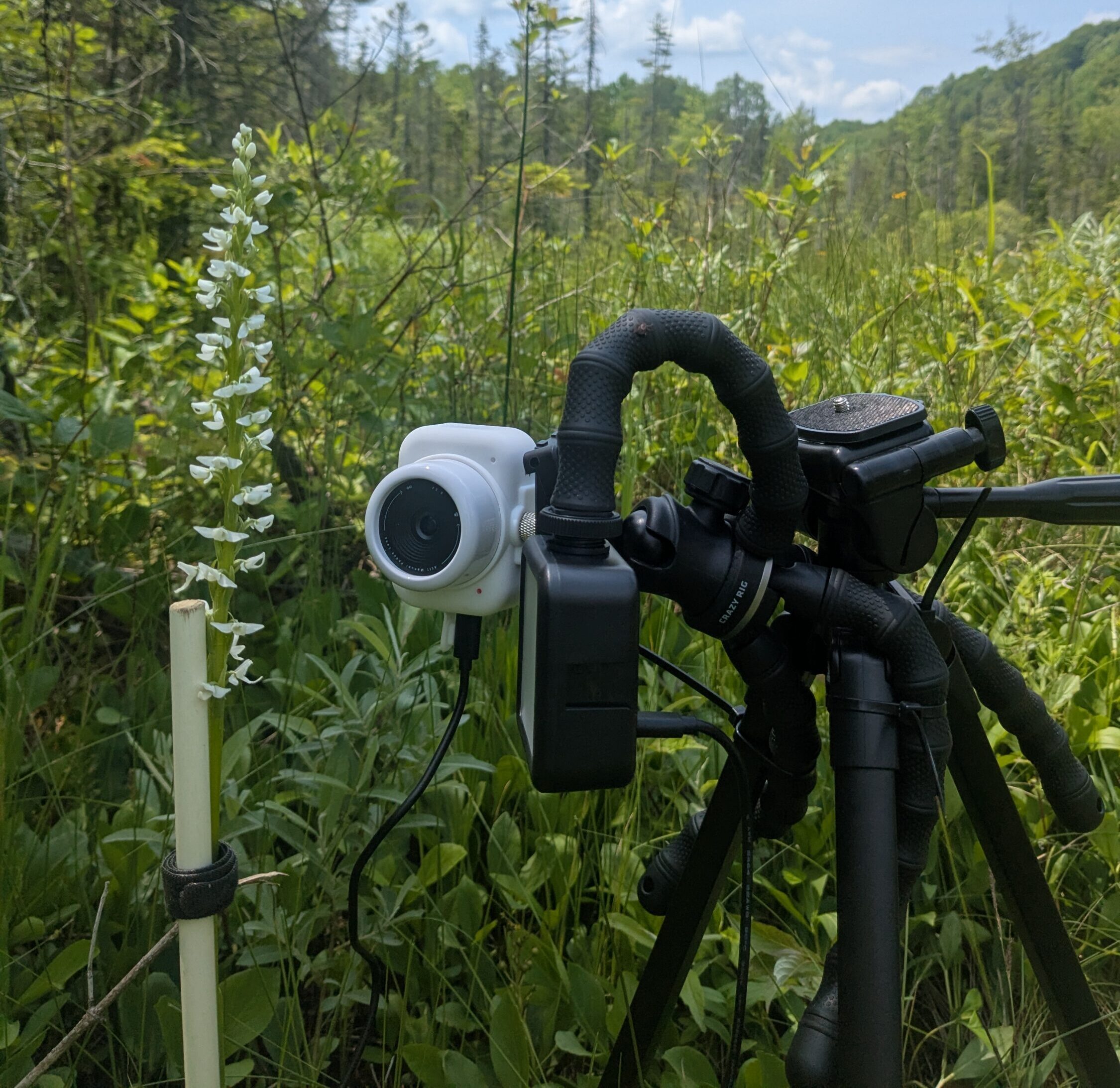
Over the course of June and July, my cameras recorded over 1,300 hours (about 55 days) worth of photos of visitors to White Bog Orchids at four field sites across Vermont. The cameras ran around the clock, taking one photo every minute, capturing a slice of insect visitation all day and all night. I’ve also been scouring iNaturalist for photos of visitors to this and other New England orchid species.
I’m still working on my analysis, but there are some early results. My cameras captured at least 64 different insect species visiting White Bog Orchids from across eight insect orders: Coleoptera (beetles); Diptera (flies); Hemiptera (true bugs); Hymenoptera (bees, ants, and wasps); Lepidoptera (butterflies and moths), Orthoptera (grasshoppers, locusts, and crickets), Plecoptera (stoneflies), and Neuroptera (lacewings and allies). Flies were the most frequent visitors, followed by butterflies and moths. Twice, my cameras caught Two-spotted Skippers (Euphyes bimacula) nectaring on the orchid, which—because of their dependence on fens, bogs, and sedge wetlands—is a rare species in Vermont. They also recorded several Stethobaris beetles, a genus never before reported in the state of Vermont.
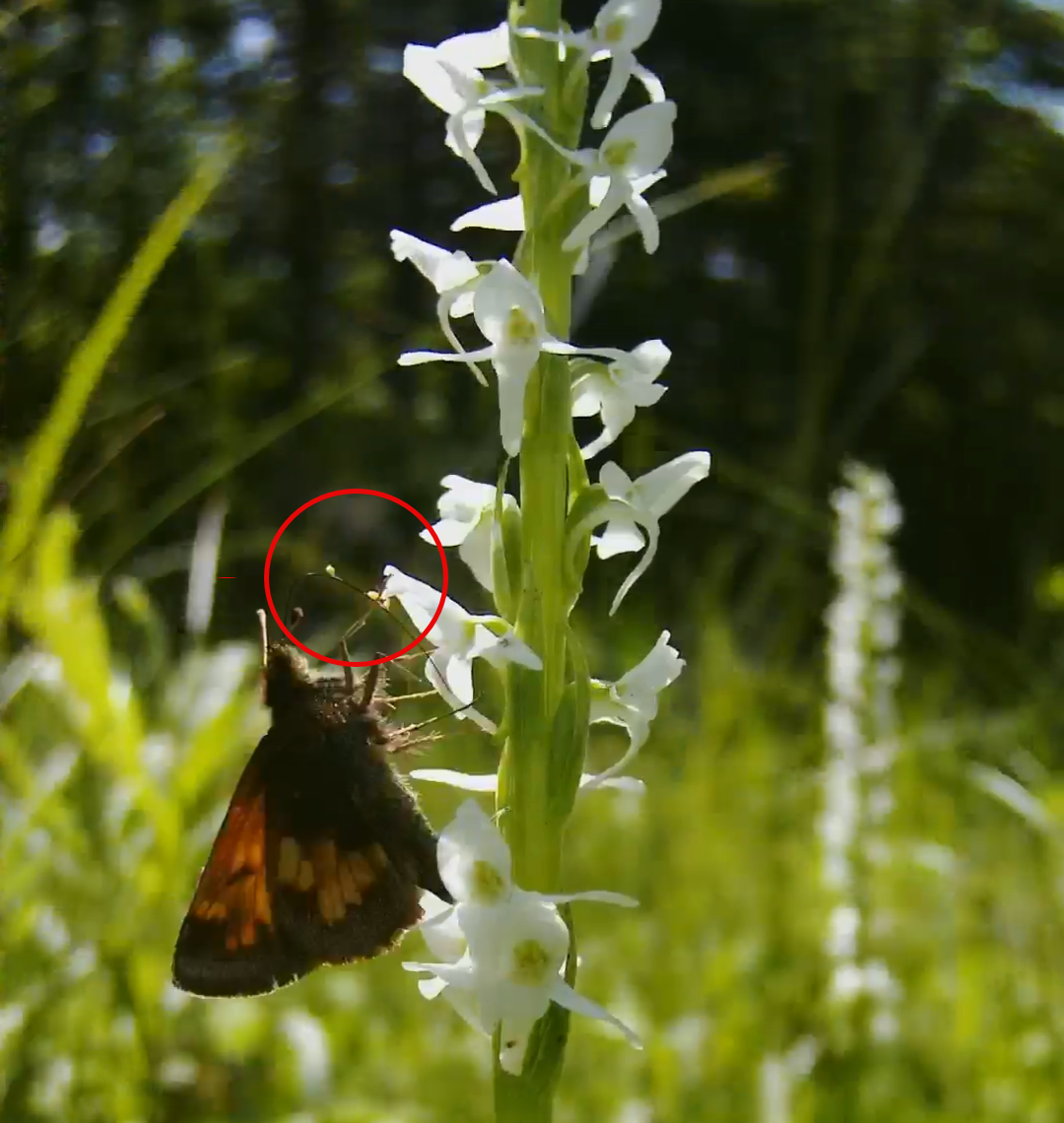
Hobomok Skipper (Lon hobomok) © Laura Costello
I also recorded several new potential pollinators. Most orchids, including White Bog Orchid, package their pollen into masses called pollinia, which are large enough to be visible on an insect’s body in a good photo. Insects visit flowers for many reasons—to drink nectar, gather pollen, deposit eggs, or just rest from flying, among other reasons. But only a few species have the right body shape and behavior to pick up these pollinia and carry them to another flower. Watching which insects leave with pollinia attached helps us identify which visitors are likely true pollinators, rather than just passing visitors. I recorded eight butterfly and moth species carrying pollinia, including six that have not previously been documented as potential pollinators for White Bog Orchid: Hobomok Skipper (Lon Hobomok), Dun Skipper (Ephyes vestris), Long Dash (Limorches mystic), Northern Cloudywing (Cecropterus pylades), Northern Broken-Dash (Polites egeremet), and a Geometridae family moth.
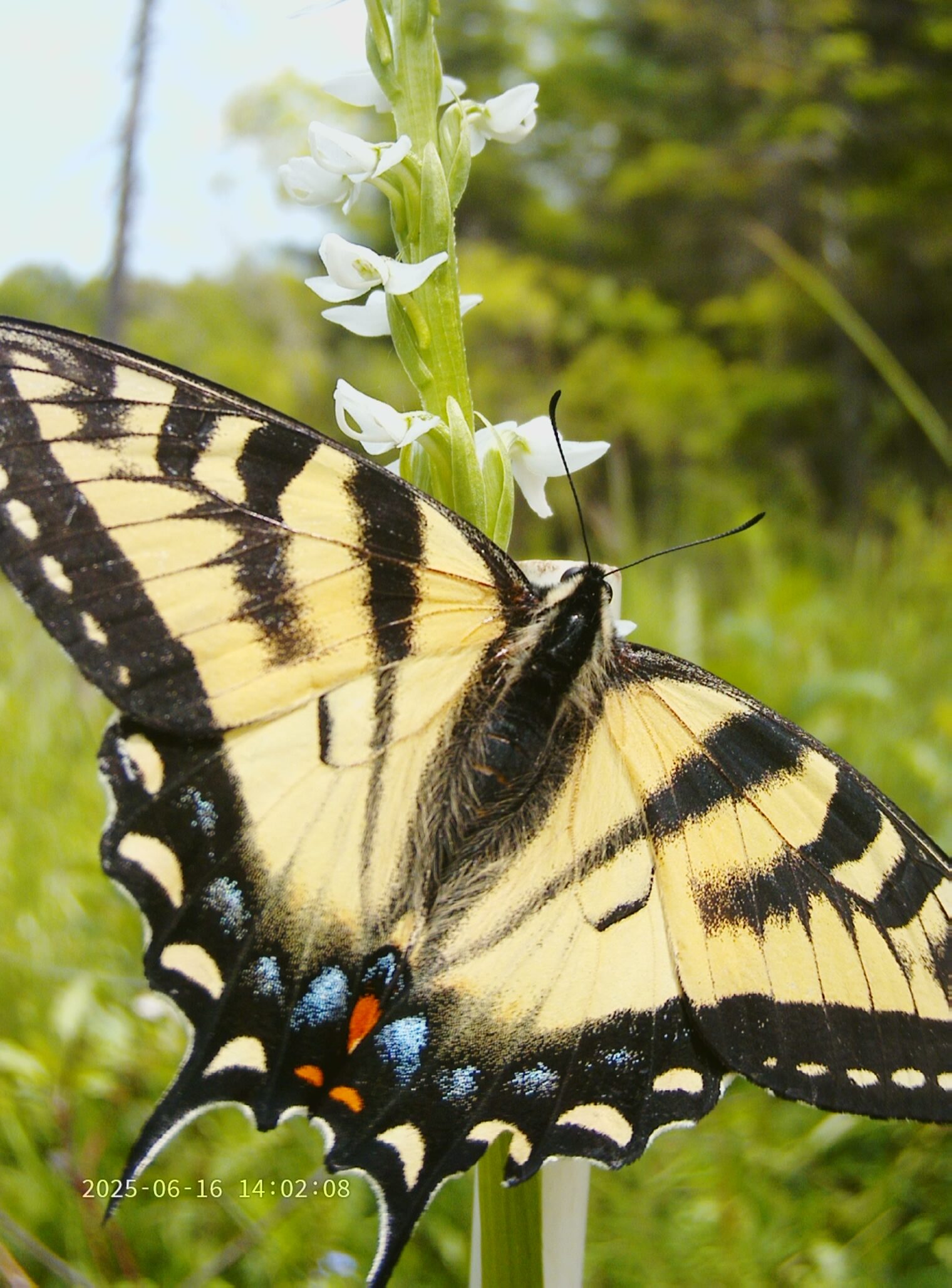
Canadian Tiger Swallowtail (Papilio canadensis) © Laura Costello
Next, I’ll be looking at what the data says about how insect visitation to White Bog Orchid changes through the day and night. Nocturnal ecology is under-studied because of the difficulties of conducting research at night, but several recent studies have highlighted the importance of nocturnal pollinators, including moths. My early results show that, although visitation is lower at night, there is still significant insect activity all around the clock, particularly at dusk. 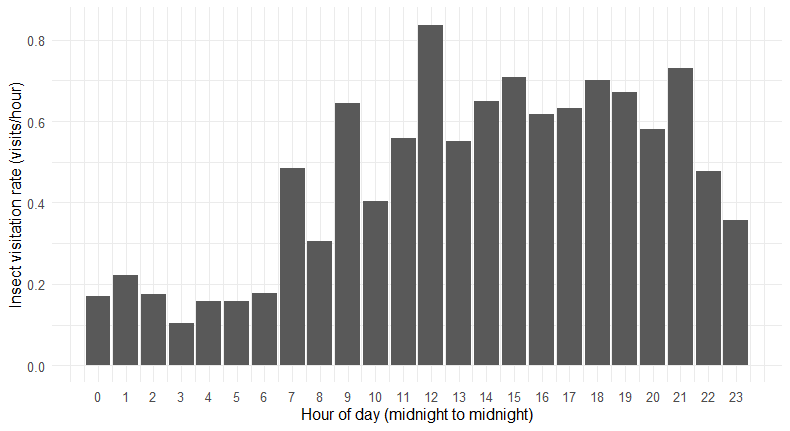
Insects move through the landscape on their own schedules, responding to temperature, light, and season. Understanding their activity helps us appreciate the complexity of these relationships and predict how they will be affected as climate change and human pressures continue to reshape the timing and behavior of insects across the Northeast.
Want to help? Orchids aren’t the only plants for which we need better pollinator information. Join VCE’s Pollinator Interactions on Plants project on iNaturalist and add your observations of insects visiting any flowers you see.
For extra credit, take a wander through your yard or garden in the evening this coming spring and photograph any insects you see visiting flowers. Every one adds to our understanding of the complex and beautiful relationships in our natural world.


Great essay and article and photos. Enjoyed hearing about the project and innovative approach to photo documentation, cool camera set up. Please keep sharing.