A Master Gardener and His Habitat Garden
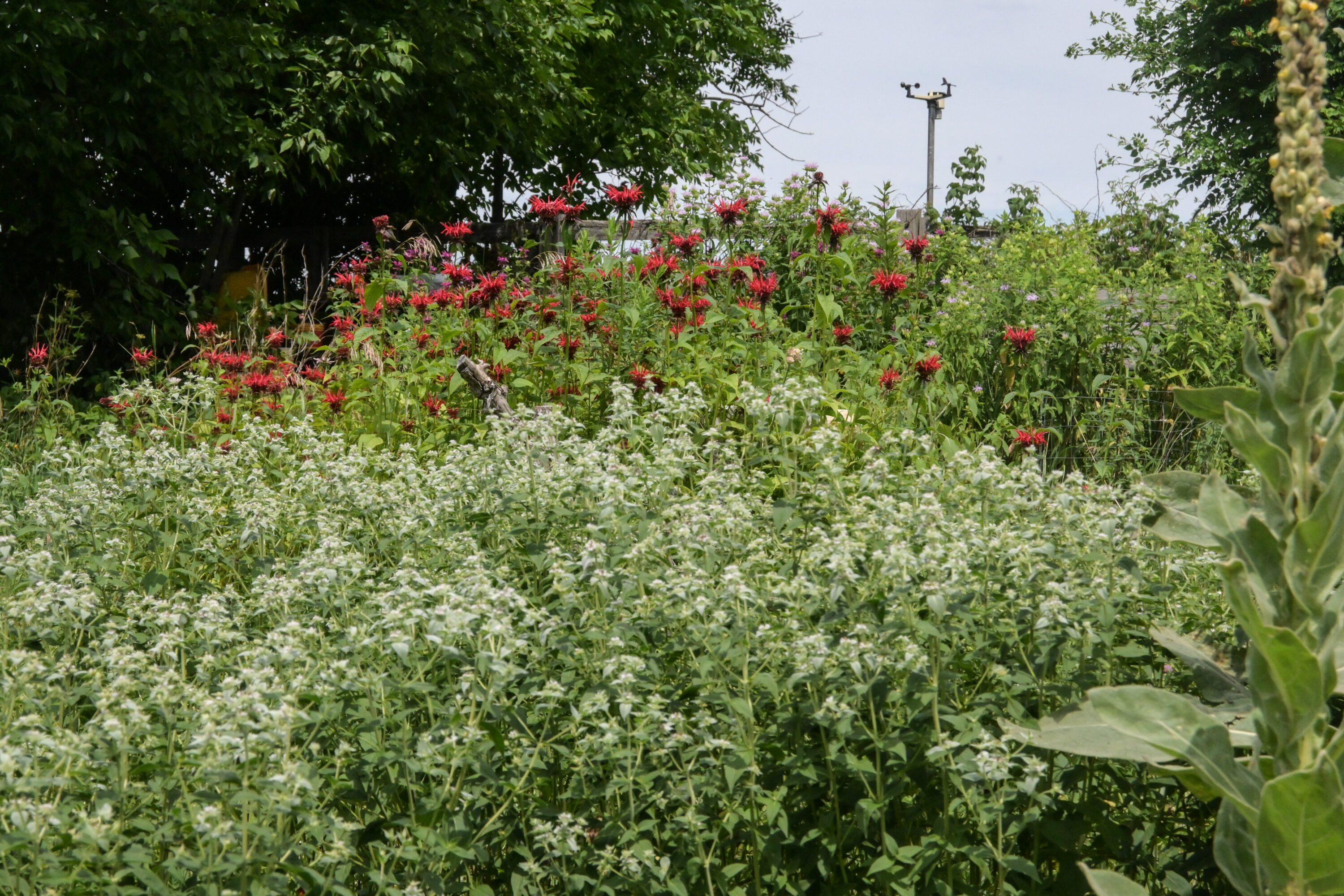
Terry Cecchini’s habitat garden at Shelburne Farms © Alden Wicker
This story ran in Field Notes, the Vermont Center for Ecostudies’ twice-yearly print magazine. Subscribe to receive the next issue in your mailbox.
Shelburne Farms is famous for its Frederick Law Olmsted gardens and its sustainably managed, 1,400-acre working farm. But there’s a special place not open to the public that you might be able to visit if you have a passion for (or just curiosity about) invertebrates.
“I love talking about the garden. And anybody who wants to come, I’ll talk to forever,” says Terry Cecchini, age 79. On a hot July day last year, he met me down the road from the Shelburne Farms visitors center, at the south gate, punching in the code so I could follow him in my car down a long dirt road past rolling, green fields.
We passed the enormous Breeding Barn—until 1939 the largest open-span wooden structure in America—and parked at a small former dog kennel that serves as headquarters for Outreach for Earth Stewardship (OES), Cecchini’s nonprofit wildlife organization that he started in 1987 with his wife. He and his other co-founder Craig Newman shelter and rehabilitate raptors in an aviary down the hill. (Near the end of my visit, Newman passed by on his way to an educational demonstration with a small, fluffy, Eastern Screech Owl on his gloved arm.) To reach the aviary, you first pass through a wooden gate decorated with owls into Cecchini and Newman’s garden, a sanctuary for all manner of Vermont winged things.
In 2011, Cecchini retired from his long career as a senior electrical engineer with Green Mountain Power and decided to become a master gardener. He was interested in cultivating milkweed to support monarchs and noticed an unused field across from OES’s building, so he asked permission to create a little garden.
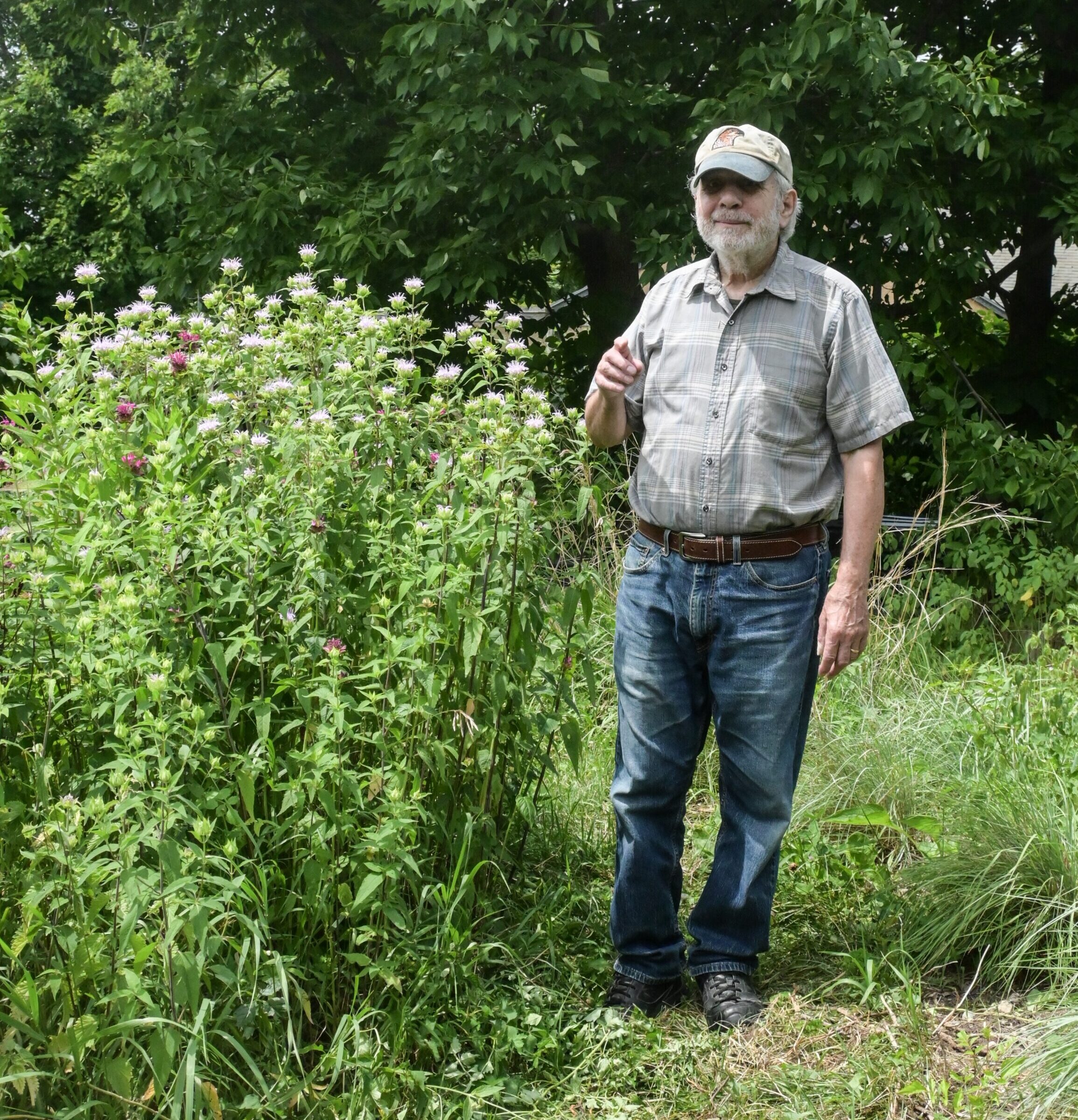
Terry Cecchini in his garden © Alden Wicker
“And of course, monarchs are your entry-level insect,” he says. Cecchini turned to the first Vermont Butterfly Atlas, an effort led by VCE’s co-founder Kent McFarland to catalogue every species of butterfly present in Vermont between 2002 and 2007. Cecchini made a list of almost 40 butterflies (that could be expected to visit this type of fieldlike habitat), as well as their host plants, which served as one aspect of his plant wish list.
He added in host plants for native bees and brought in three yards of sand to create a place for ground-nesting bees to easily burrow into. He found out that moths provide crucial nutrition to birds, bats, spiders, frogs, and toads. Something like 6,000 to 9,000 caterpillars are required to raise one brood of chickadees. “No way are those all butterfly larvae,” he says. He pointed to the Red Oak that towers nearby, which, according to research by VCE scientist Desirée Narango, can host more than 400 species of Lepidoptera (butterflies and moths) in Vermont alone, and 900 nationwide. A Red Oak sapling was planted in a garden bed by a squirrel; now it’s in a more appropriate place and bounded with stakes so it doesn’t get accidentally mowed.
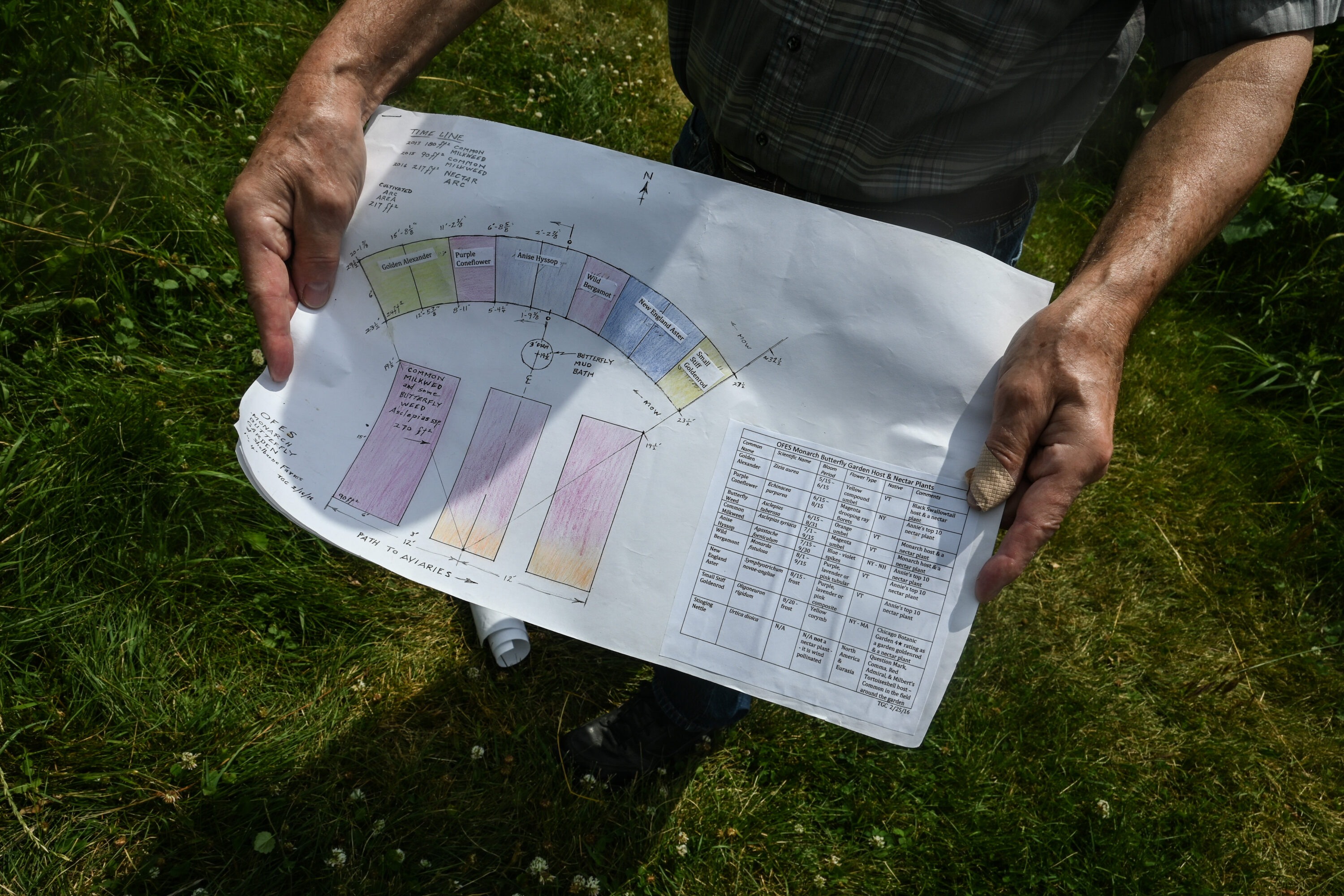
Cecchini’s original garden plan. Things have changed since then. “It turned out that some things were more aggressive than others, like the yarrow, and some things had to be moved,” he says. © Alden Wicker
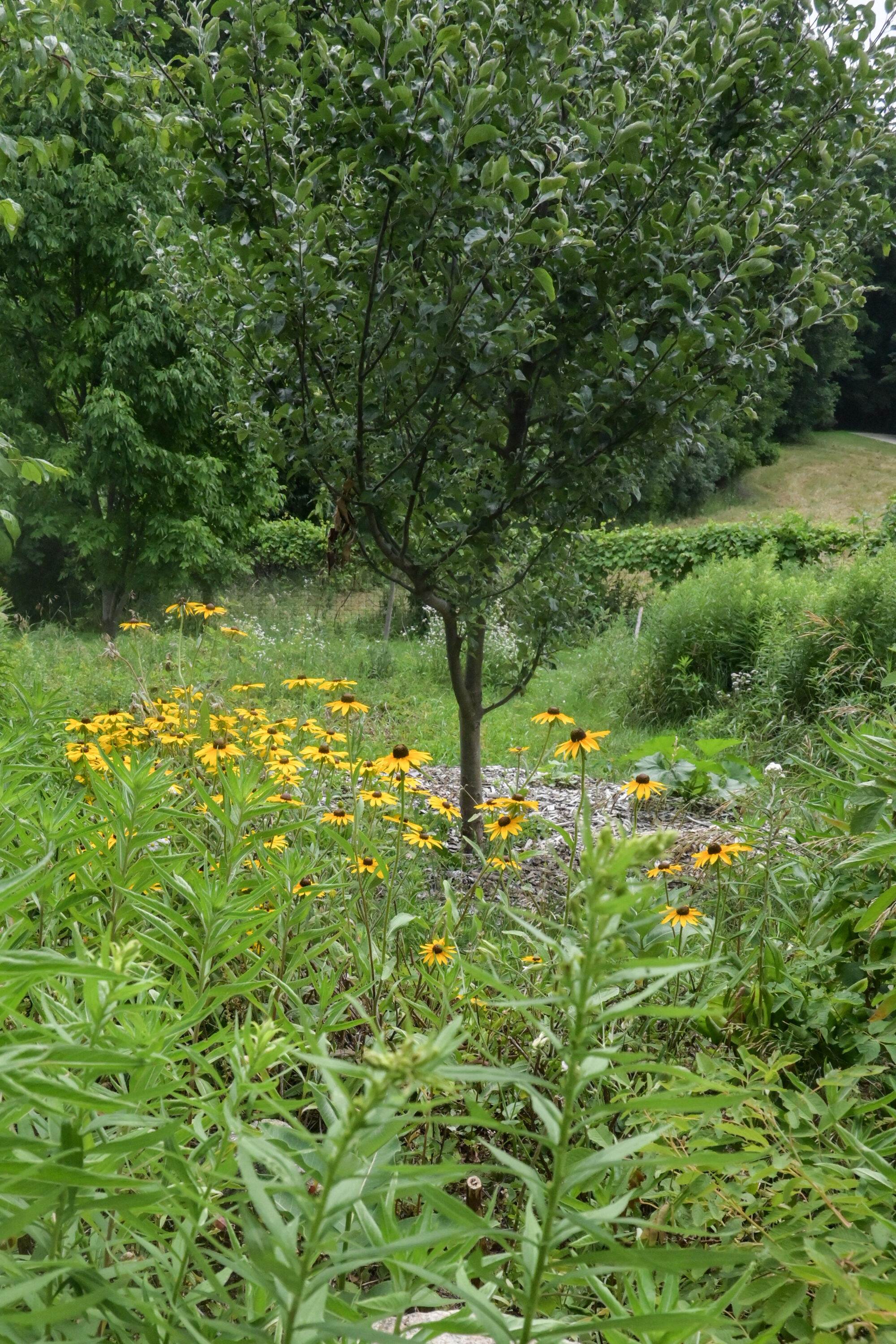
Newman and Cecchini will pounce on free plants offered up on Front Porch Forum (Vermont’s community Listserv) or find them elsewhere on the farm and transplant them. Cecchini estimates he’s planted at least 60 different plant species, including Northern Blue Flag Iris (Iris versicolor), pokeweed (genus Phytolacca), black walnut (genus Juglans), Red Columbine (Aquilegia canadensis), joe-pye weed (genus Eutrochium), and mountain mint (genus Pycnanthemum). They’ve thrived in the rich soil; the organic matter is close to 7% and the pH is seven, likely due to the fact that cattle were kept here in the 1960s. Right now he’s working on creating a hedgerow out of American Black Elderberry (Sambucus canadensis), Alternate-leafed Dogwood (Cornus alternifolia), and Common Ninebark (Physocarpus opulifolius), among others.
© Alden Wicker
“It went from being a monarch way station to [one for] pollinators in general,” Cecchini tells me. “And now it’s really more of an ecogarden. There are hoverflies, multiple kinds of beetles, wasps—not just our yellowjacket friends, but a whole lot of solitary wasps.” The garden now sprawls over about a third of an acre.
Cecchinini is a walking encyclopedia, combining his master gardener’s knowledge of each plant’s height, spread, and cultivation needs (such as soil and moisture, aggressiveness, and bloom and fruiting time) with research on Vermont wildlife preferences to ensure that as many native winged creatures as possible can find what they need here in every season.
Cecchini provides the plants; his colleague Newman documents their visitors, with more than 1,200 observations added to iNaturalist. He’s documented everything from Yellow-Banded Bumblebee (Bombus terricola), which is a State Threatened species after nearly disappearing in the 2000s, to Seven-spotted Lady Beetle (Coccinella septempunctata), Bedstraw Hawkmoth (Hyles gallii), Blueberry Stem Gall Wasp (Hemadas nubilipennis), Northern Leopard Frog (Lithobates pipiens), and, yes, Monarch Butterflies. Turns out the beloved butterflies are one-tenth of the interesting things that live, eat, and breed in this habitat garden.
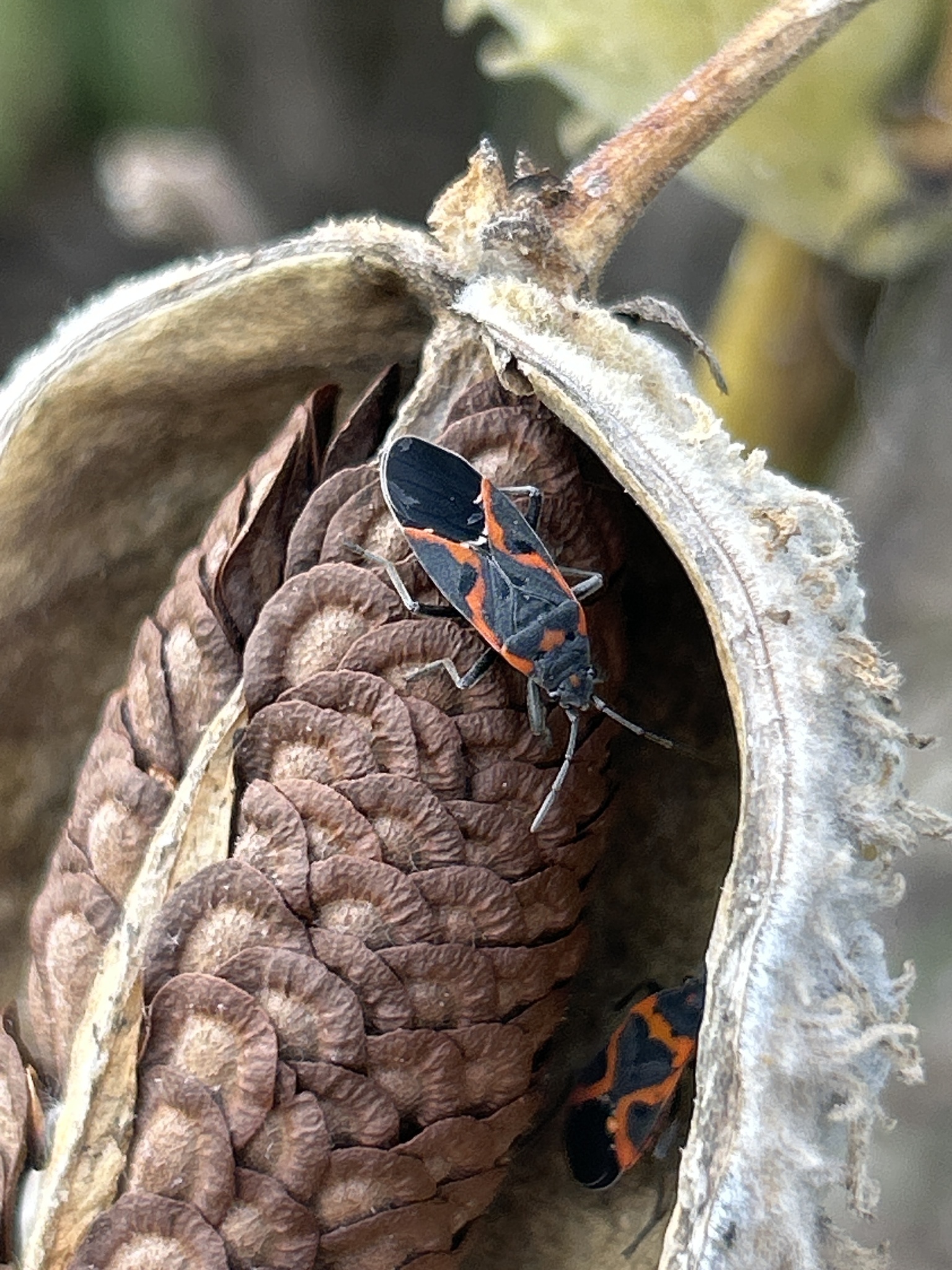
Small Milkweed Bug (Lygaeus kalmii) by Craig Newman on iNaturalist, some rights reserved CC-BY-NC
The Word document where Cecchini’s takes notes on the garden now runs to 50 pages. He comes to the garden to work for an hour or two a day when it’s above 50 degrees and not raining, keeping an eye out for invasives like buckthorn and honeysuckle, weeding the grass that is forever trying to encroach from the fields, and keeping the more aggressive plants in check by cutting them back.
Cecchini estimates this garden is at least 80% native. Nonnatives include a lilac bush that he took from his mother-in-law’s backyard when the house was sold. “You can plant the things you love too,” he says, citing research done by Narango showing that a garden that effectively supports insectivorous birds can have as little as 70% of its biomass composed of native plants.
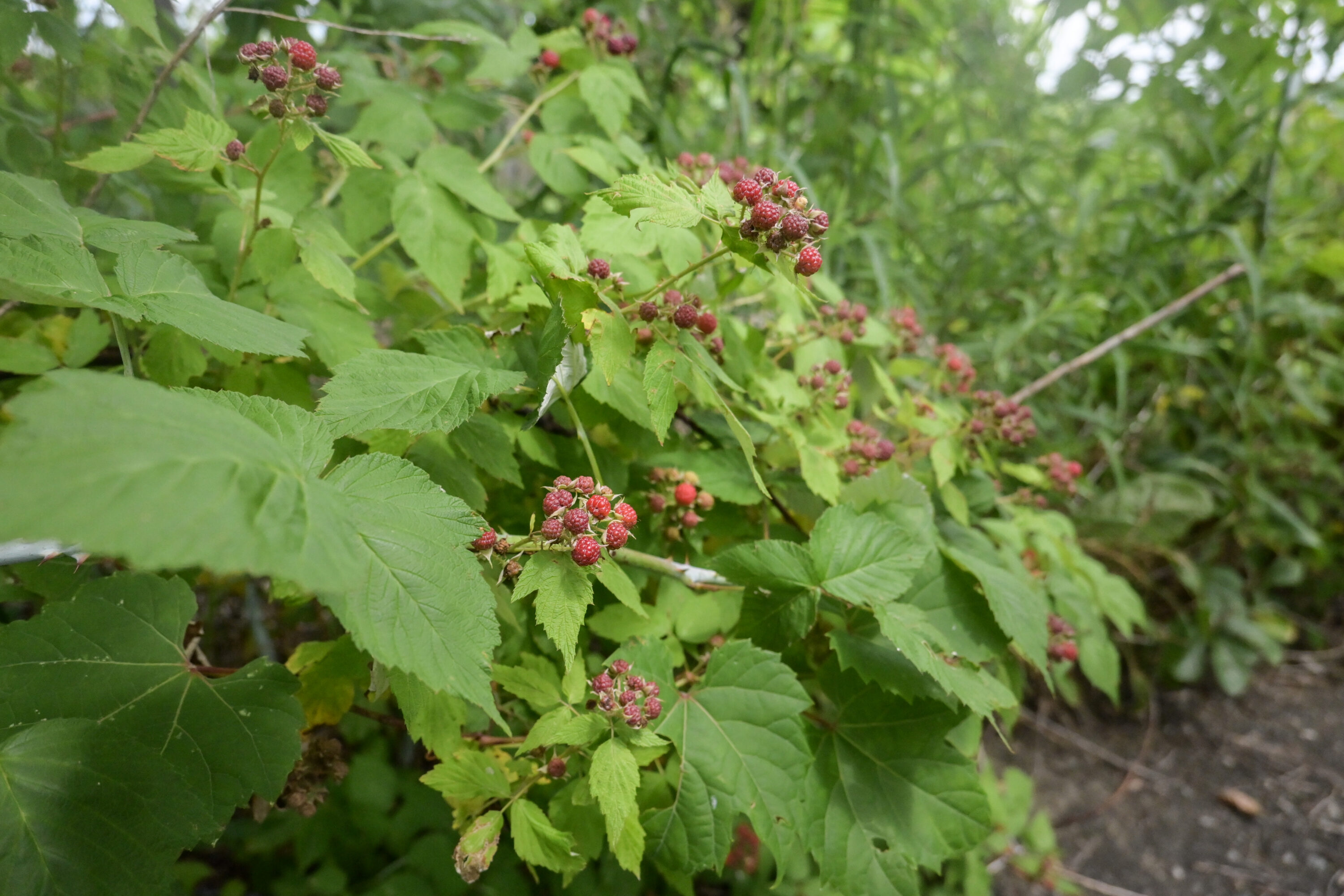
© Alden Wicker
“And then there’s the whole issue of cultivars,” he says. “Cultivars are selections from either the wild or from a breeding program that are generally pleasing to humans. Unfortunately, what’s pleasing to humans can eliminate the pollen- or nectar-producing parts of the plant, so they become sterile.” (Narango, who has studied cultivars, says it’s not common, but can happen.)
Where that doesn’t apply is the Bethel apple tree he received from the Maine Heritage Orchard. Apple trees are cultivars, but bred to produce fruit, so they have plenty to offer pollinators. He also has a Northern Spy apple tree that flowers around the same time, three American Plum trees, and native raspberry bushes, which are beloved by bees, hoverflies, and chipmunks. (He lets the birds and other animals have all the edible berries.) A Prickly Ash is not a normal garden plant—it’s thorny and leggy—but it is the citrus most suited for northern climates and plays host to the Eastern Giant Swallowtail, a southerly species that only showed up in Vermont for the first time in 2010.
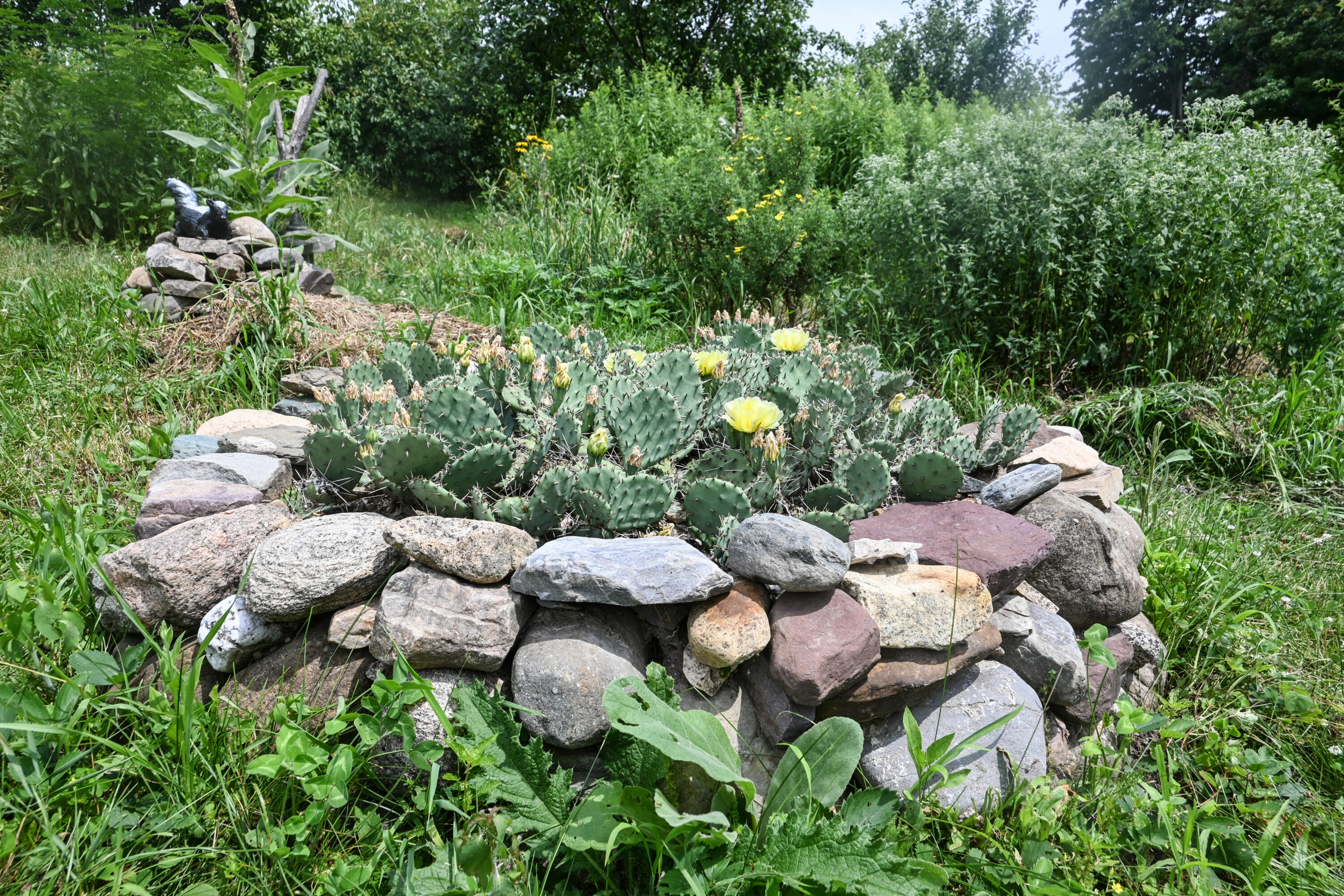
As he gardened, Cecchini pulled rocks out of the soil and built a raised bed for the Eastern Prickly Pear (Opuntia cespitosa), which thrives in the well-drained glacial till. © Alden Wicker
Between the high number of native plants, the lack of cultivars, the lack of mulched beds, and the light touch he has on the plants—for example, leaving spent flowers on their stalks so bees have a place to nest and letting leaves fall where they may—the garden has a wild, untamed look.
“It’s not your grandmother’s garden,” he says. “That look to me is not pretty anymore.” It looks, he says, like a habitat in the middle of succession, maybe a meadow that sprung up after a forest fire on its way to becoming a forest.
Ironically, that milkweed he tried to cultivate from seed at the beginning? It never really took where he put it. It’s a notoriously stubborn and independent-minded plant.
So wherever it pops up, he leaves it, even if it’s in the middle of a path. If you want to support the wildlife, you gotta let things be a little wild.
If you would like to follow Cecchini’s lead, you can use not only the Vermont Butterfly Atlas but also the new, 2025 Annotated Checklist of the Bees (Hymenoptera: Apoidea) of Vermont to look for potential host plants. Looking for more ways to get involved? You can also document visitors to your garden by joining the iNaturalist Project, Pollinator Interactions on Plants (PIP).
This story ran in Field Notes, the Vermont Center for Ecostudies’ twice-yearly print magazine. Subscribe to receive the next issue in your mailbox.


Excellent article. We’ve visited OFES several times to donate poultry parts for Craig’s ambassador birds. We have seen Terry’s garden in person and it is inspirational. 🌱💚🦋🐝