Bicknell’s Thrushes Are Back on Mount Mansfield!
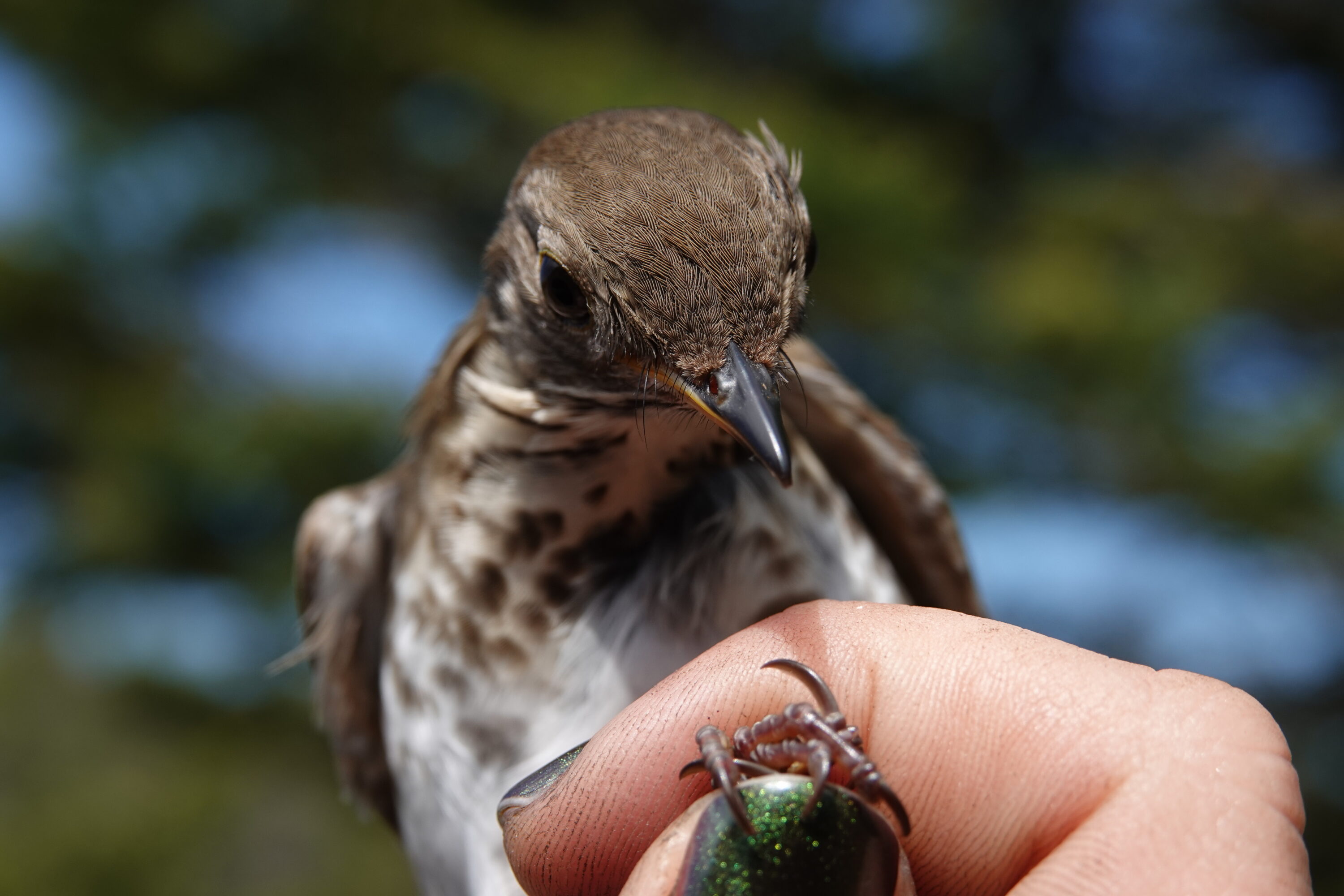
The Bicknell’s Thrush we named Big O’l Balsam has made it back to Mount Mansfield! © Mike Hallworth
Support Mike Hallworth’s research and other projects like this by making a donation to Vermont Center for Ecostudies! Learn about other ways to support VCE here.
In late April and early May, somewhere in the humid forests of Hispaniola, Bicknell’s Thrushes were preparing to return to the highest peaks in the Northeast United States. When the conditions aligned, they departed the tropical climes at night for their trip northward.
In Vermont, we eagerly awaited the first evidence that one of our birds from our Bicknell’s Thrush Race to the Atlantic had survived last fall’s trans-Atlantic flight, then successfully navigated predators during the winter non-breeding period on Hispaniola. These 19 birds were carrying Motus nanotags affixed like tiny backpacks, in the hope that they would be detected by a network of radio-frequency towers. This imperfect but revolutionary detection system detected two-thirds of them as they headed south, but that didn’t mean some hadn’t evaded detection.
At the beginning of 2026, with no more data forthcoming, we declared Trap-happy Travis, who departed the coast on October 16th, the winner of the autumn race.
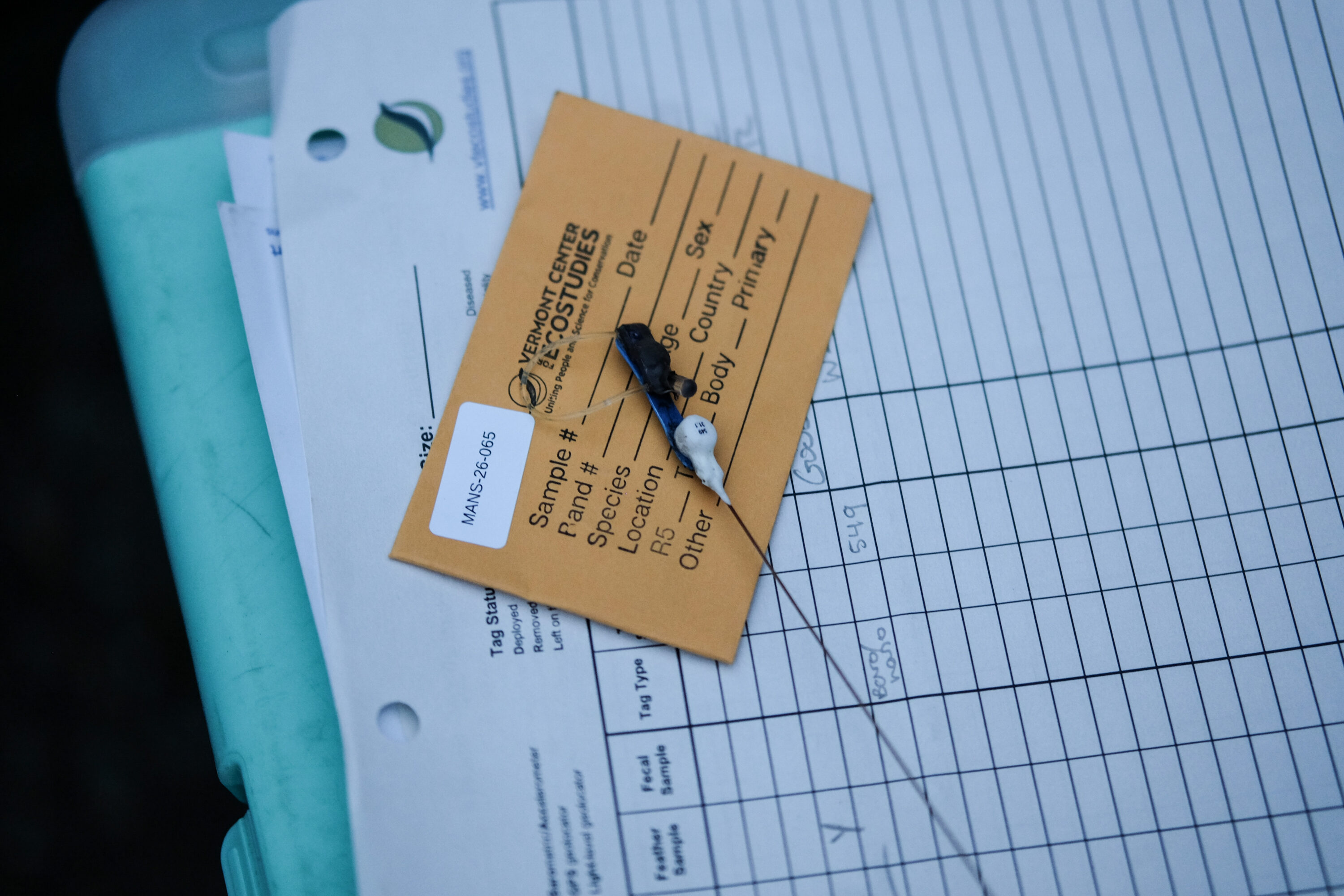
A tracking tag © Alden Wicker
Then we eagerly waited out the radio silence during the long New England winter months. Despite knowing that a Bicknell’s Thrush that has reached the tropics has a good chance of surviving the winter, not knowing whether they successfully navigated a relatively active hurricane season for their southward migration had us on the edge of our seats.
Unfortunately, fewer and fewer Bicknell’s Thrushes are making their way back each spring, and their population is declining as a result. Our long-term data suggest that roughly half survive and return to breed each year. We don’t yet know why birds aren’t surviving, partly because we first need to know where and when to look for clues. Over the past few years, VCE’s scientists have been tracking Bicknell’s Thrushes with tiny devices to reveal their migratory journeys, in hopes of uncovering where the birds face their greatest threats. The tracking data suggest that the entire Bicknell’s Thrush population migrates through the Mid-Atlantic region from Maryland to North Carolina in the fall, spurring VCE’s newest research frontier to identify habitat use and the potential threats they face during a key migratory stopover.

On May 3rd, the long radio silence was broken when Burley Ben was detected at Lucayan National Park in the Bahamas, followed shortly thereafter by a detection in Vero Beach, Florida. Hot on his tail feathers were Oliver the OG (May 5th), Trap-happy Travis (May 6th), Nightingale Nate (May 8th), and Freddy Wet-foot (May 10th), all detected in coastal Georgia, about halfway between Jacksonville, Florida and Savannah, Georgia.
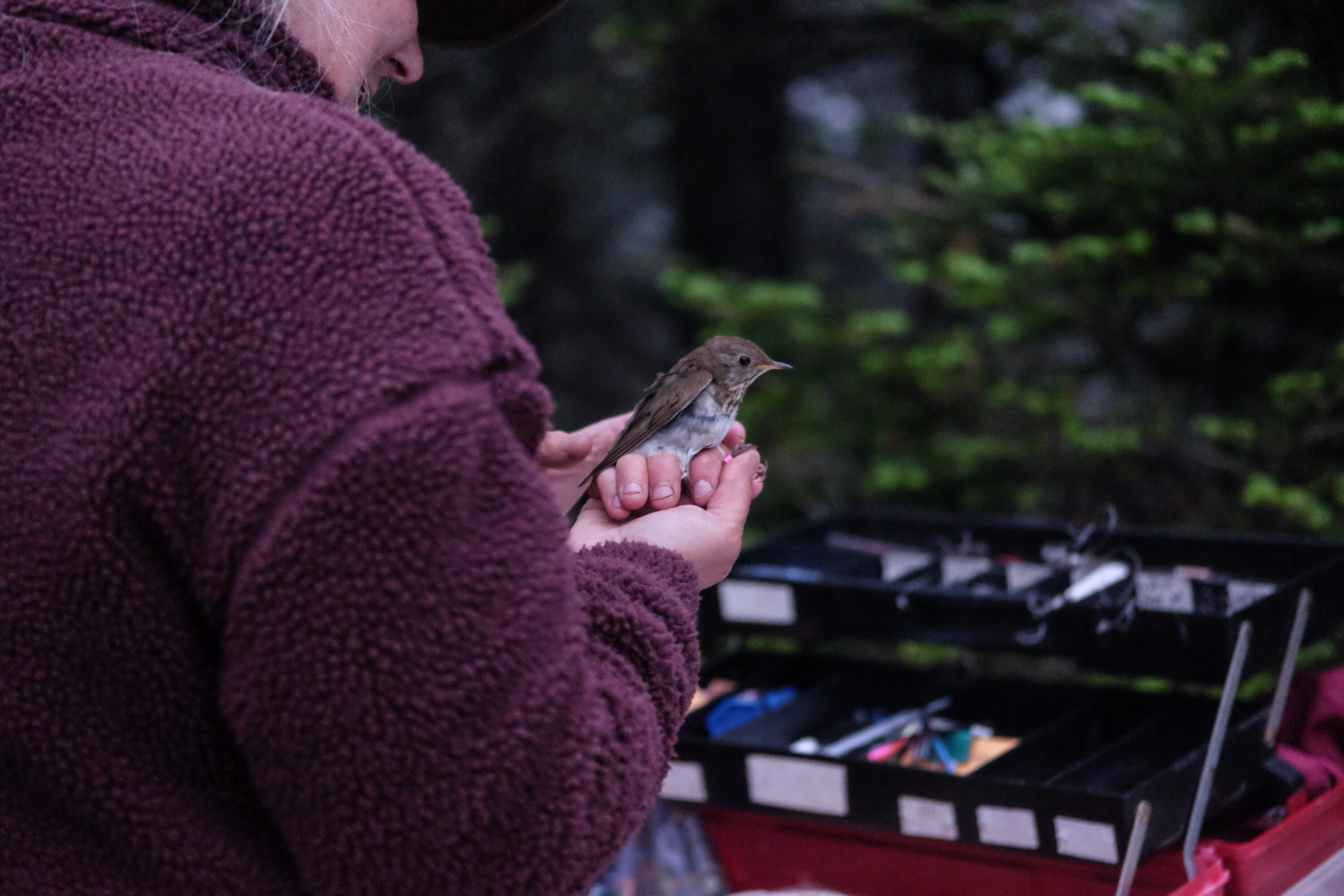
© Alden Wicker
With a few short stops to rest and refuel, the birds raced north, navigating through brightly lit cities with high-rises, and narrowly avoiding windows, outdoor cats, and everything in between. Many birds were detected in western Massachusetts on their way north, including Stowe-side Sally, the clear fan favorite from last fall. They arrived to New England’s highest peaks about two weeks after leaving their tropical territories behind.
It’s become clear that survival was higher than expected last winter. Over 70% (14 of the 19) of the Race to the Atlantic lineup have either been detected via Motus or recaptured on Mount Mansfield so far this season. We also have more information about the potential routes and timing of spring migration than we have in previous years. Twenty-five towers detected at least one of the Race to the Atlantic birds as they migrated north . But several towers, particularly in the Southeastern United States, provided a lot of detections. For example, a coastal station in Georgia, GA_SSI_DOCK (#11347) , and another about 25 km away, Eulonia – Georgia Forestry Commission (#14140) , each detected eight individuals as they arrived into the United States. Together, these two stations alone detected 10 of the 14 returning birds!
Once they arrived to Mount Mansfield, we were rewarded by their dawn chorus, signaling that spring has once again arrived to one of New England’s highest peaks.
We’re hard at work trying to capture and recover as many tags as possible from the Bicknell’s Thrushes that returned to breed. So far this season, after several visits, we’ve captured seven of the birds. Big Ol’ Balsam was the first bird we captured to remove the tracking device. Capturing Capt’n Krumholtz was a pleasant surprise; he hadn’t pinged any towers in either fall or spring. It turns out that his Motus tag had fallen off somewhere along the way.
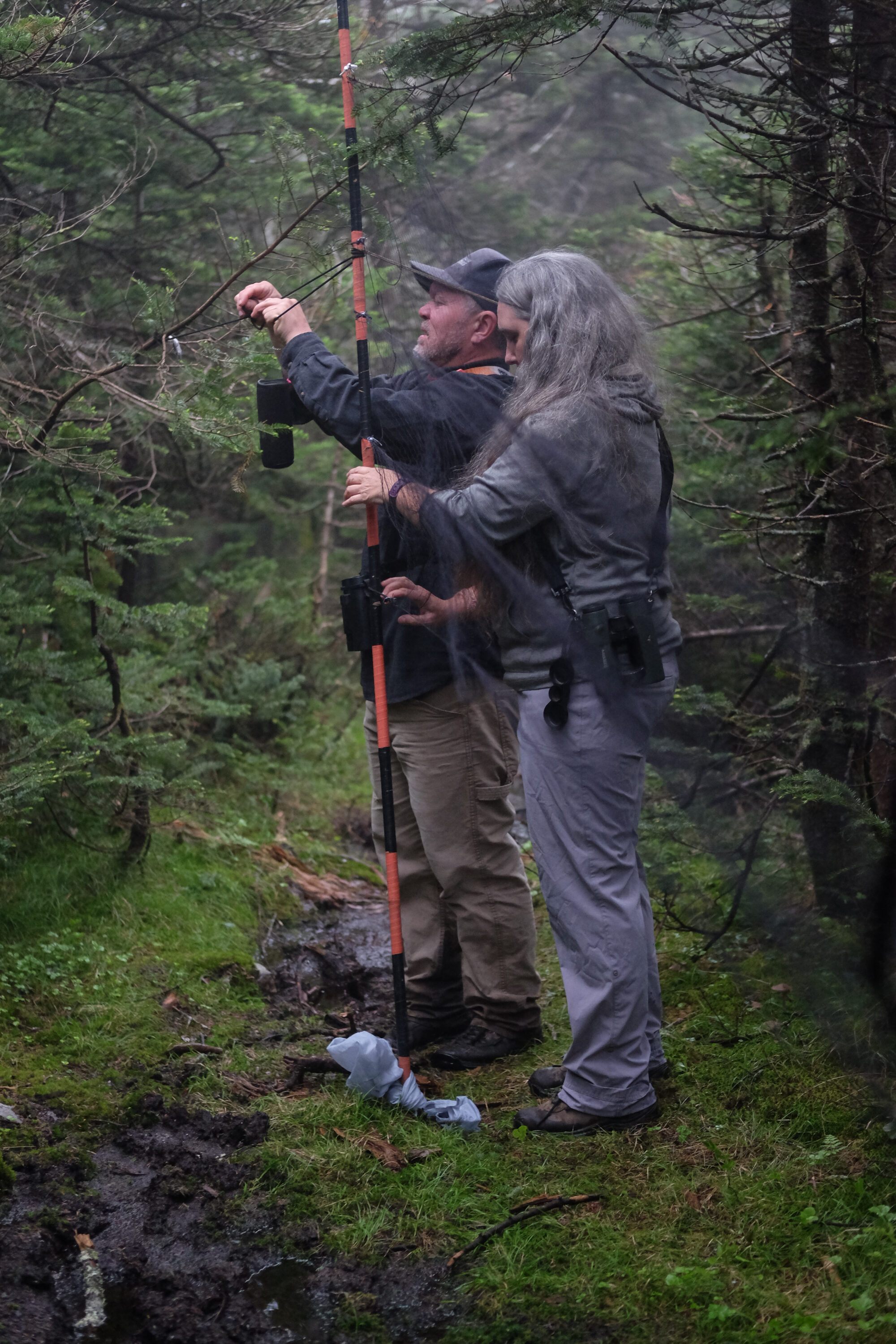
Mike Hallworth and Desirée Narango set up mist nets to catch returning birds on Mount Mansfield © Alden Wicker
We’ll be working tirelessly from now until September trying to recover last year’s tags. Stay tuned, because we’re likely to deploy new tags as well. When we do, we’ll be sure to keep you in the loop. Who knows, perhaps we’ll have a new Race to the Atlantic cohort for the 2026 season that we can cheer on together during their epic migratory journeys. Let us know in the comments below if you’d like to follow along if a new cohort heads south this fall.
Support Mike Hallworth’s research and other projects like this by making a donation to Vermont Center for Ecostudies! Learn about other ways to support VCE here.



Please keep me updated, great work by you all. Thanks.
I would love to follow along. Fabulous news!
So well done
You all
Thank you
A distressed world is now a bit better
Peter K McLean, Ph.D.
Lewes, De
Simply Wonderful!!! I applaud the hard work and dedication of the Scientists.
Great work. Love the names. Surprised the numbers are down. I thought the population was stable. Keep me posted.
Fantastic data that you’ve collected. Yes I would like to follow along.
Fantastic data that you have collected. I would like to follow along with your research study.
Positive news! Thanks for your creativity with names and dedication! Would like to be in the loop!
Keep me updated as to the Bicks journey.
Glad to read about your fantastic work! BT voices are being heard again, and such beautiful songs they are! I would like to be updated on your research study.
Yes please keep me posted! Thanks for this amazing research!
Thank you for your tireless work. The Bicks are tenacious! I’d like to follow along. by