Field Report: We’re Ready to Detect Tagged Bicknell’s Thrush as They Arrive to the Caribbean
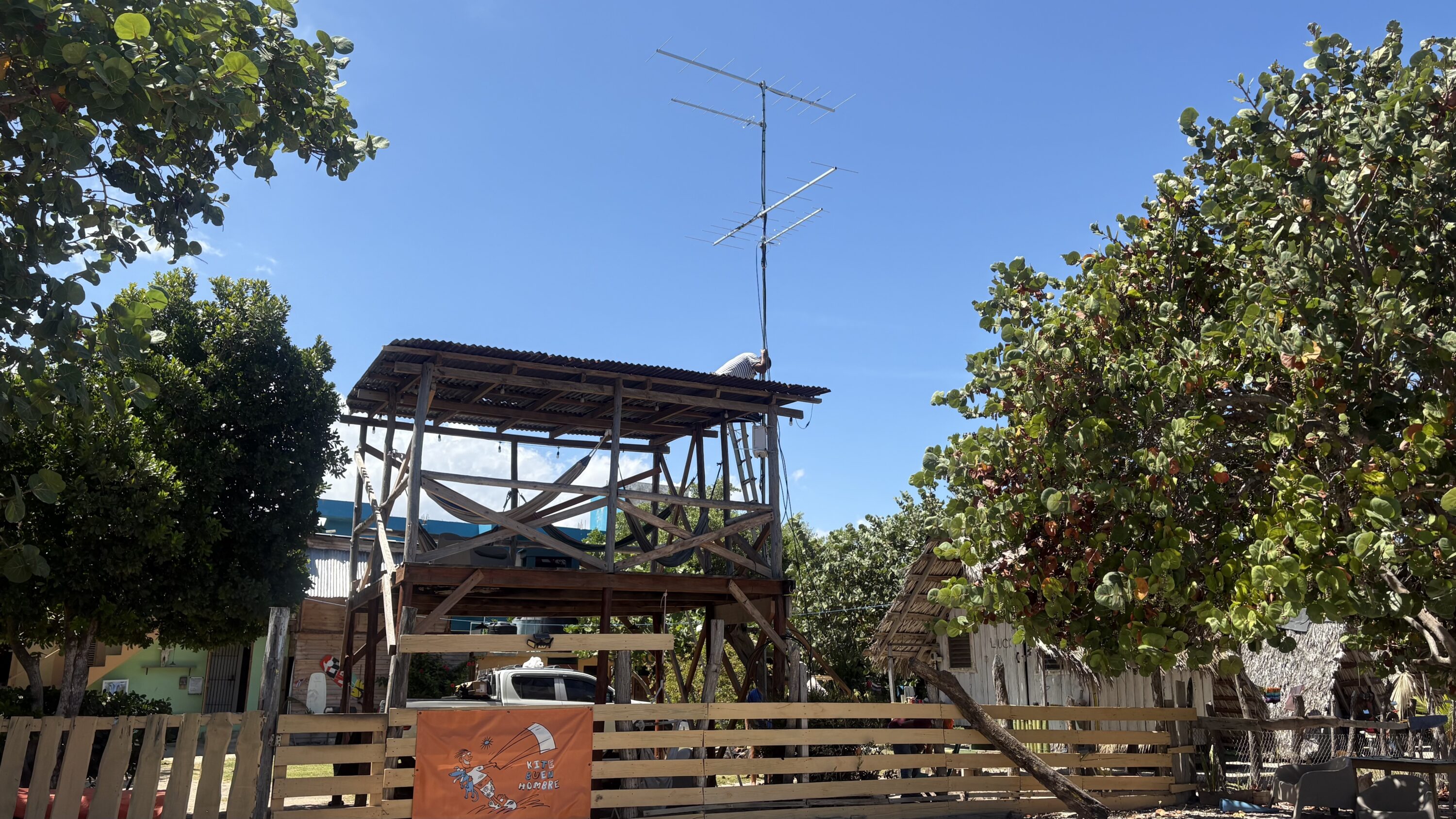
VCE’s Motus tower at the Buen Hombre Kite Surfing School © Jim Goetz
This September, our scientists tagged 17 Bicknell’s Thrushes near the top of Mount Mansfield, Vermont’s highest mountain. As these birds, fitted with tiny receiver backpacks, leave the mountain, they will ping Motus towers like the one seen here, and you can follow along on their migration journey.
It’s sun-up in the small coastal town of Buen Hombre on the north coast of the Dominican Republic, and from the back of a pickup truck we are unpacking two 20-foot poles, two heavy brackets, six antennas, six coaxial cables, support cables and turnbuckles, zip ties, electrical tape and assorted tools.
The ocean is calm and the beach is deserted. When we enter the gate to Buen Hombre Kite Surfing School, half a dozen mixed breed dogs bark at our arrival but quickly lose interest and wander off to nestle into holes in the sand that they dug to keep cool. Helen Vilo, the school’s manager, meets us with a smile and a welcome cup of coffee. As the sun rises and heats the beach, the raucous Village Weaver (introduced to the Caribbean by ships from Africa) is the most prominent singer on my meagre eBird list . Sea grape trees fringe the property, with one single palm tree due east, so we use that as a reference point to align the antennas.
We’re here to set up a Motus tower, part of an international network of automated tracking stations that enable us to monitor the movements of birds and other wildlife during breeding, migration and overwintering seasons.
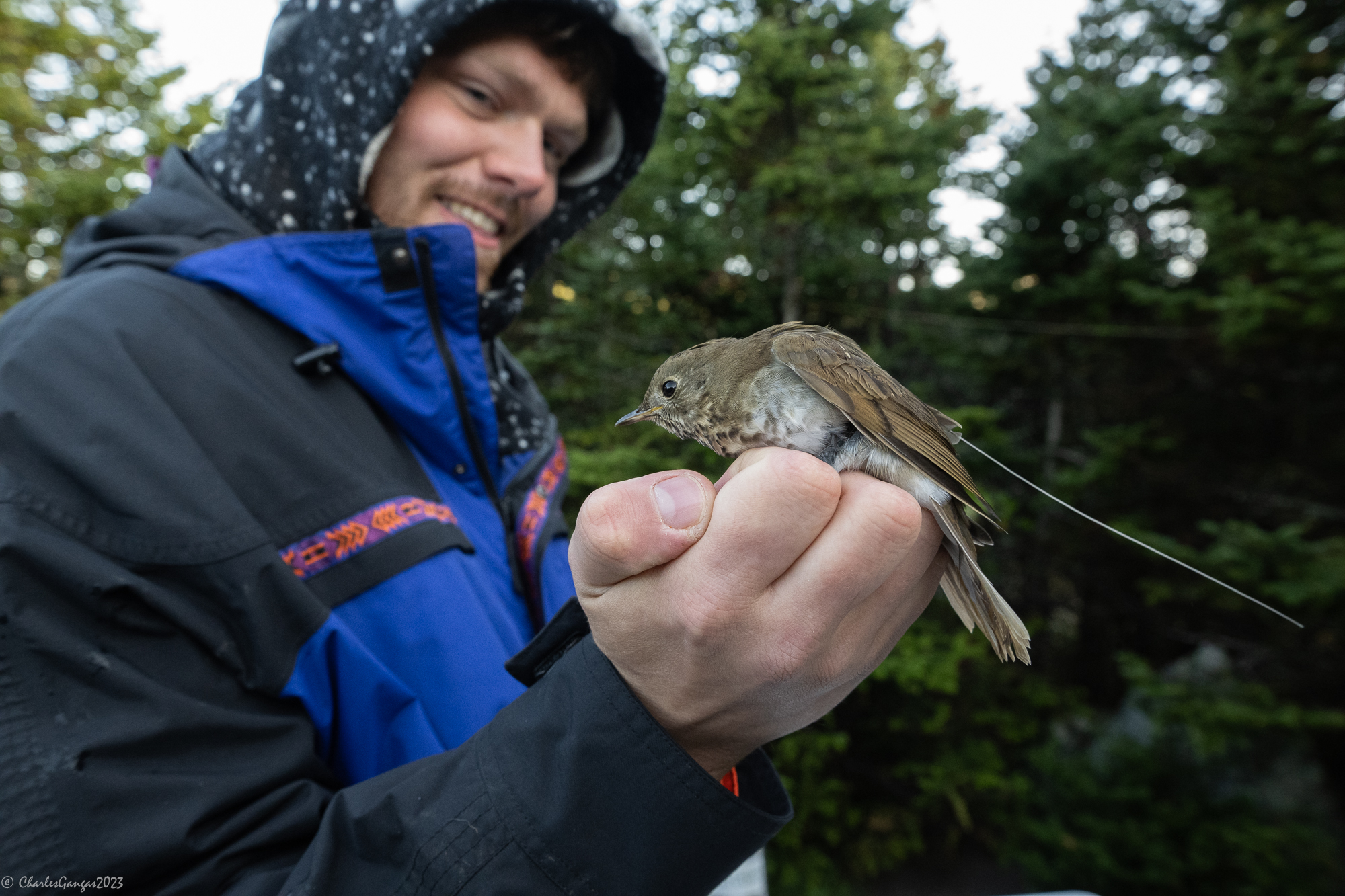
VCE Biologist Kevin Tolan holds a tagged Bicknell’s Thrush on the top of Mt. Mansfield © Charles Gangas
Starting in 2021, VCE scientists began tagging Bicknell’s Thrushes with GPS tags and gathered highly precise data on winter locations. Unfortunately, these GPS tags’ short battery life records only a small number of locations, and the need to recapture each tagged bird means we get data from only the birds that survive, not from the ones that perish—and this data is equally important for conservation action.
For the past decade, VCE has been using Motus tags, too, which has enabled us to track Bicknell’s movements from the breeding grounds to their migratory stopover habitat in the mid-Atlantic States, and then back north in the spring.
Unfortunately, the few scattered Motus tracking stations in the Caribbean fall far short of what we need to track the thrushes all the way to where they spend the winter, mostly on Hispaniola. Our knowledge of bird migration through the Caribbean is scant, and relies too heavily on anecdotes. Of course eBird has helped, but its reach is limited, and each observation is one isolated data point.
Fortunately, thanks to a number of generous donations last fall combined with funds raised in last year’s Bicknell’s Thrush Race to the Atlantic , VCE is able to take big steps towards filling that gap by setting up the first four of a dozen planned stations on the north coast of the island. Other wildlife researchers who tag migratory birds will benefit from these new towers, too.

To select the site for each of these four new stations, the first step was to pore over Google Earth imagery to find potential sites with long clear east-west views and not blocked by hills or ridges, so the antennas could detect tagged birds in migration up to 10 miles away. Ultimately, we found that beachfront hotels, businesses and residences sat at the nexus of good viewsheds, security for the valuable electronics, and access to internet and power. Buildings with flat roofs a few stories high would allow us to avoid the expense of erecting a tower.
Next, to help us with local contacts, we teamed up with our close colleague Dr. Andrea Thomen of Grupo Jaragua , a Dominican non-profit conservation organization. In June, after many emails, Whatsapp messages, and Zoom presentations with potential hosts, Andrea and I took a week to visit a dozen coastal sites and meet with the hosts in person.
At one location with an exceptionally good viewshed, the manager agreed that the Motus project was highly interesting, but let us know that some of the wealthy residents just might have income from sources of questionable legality, and would be unlikely to welcome surveillance equipment of any kind. So, we reluctantly crossed that site off the list. We crossed others off where installation would be complicated by the size or shape or position of the building or by neighboring buildings.
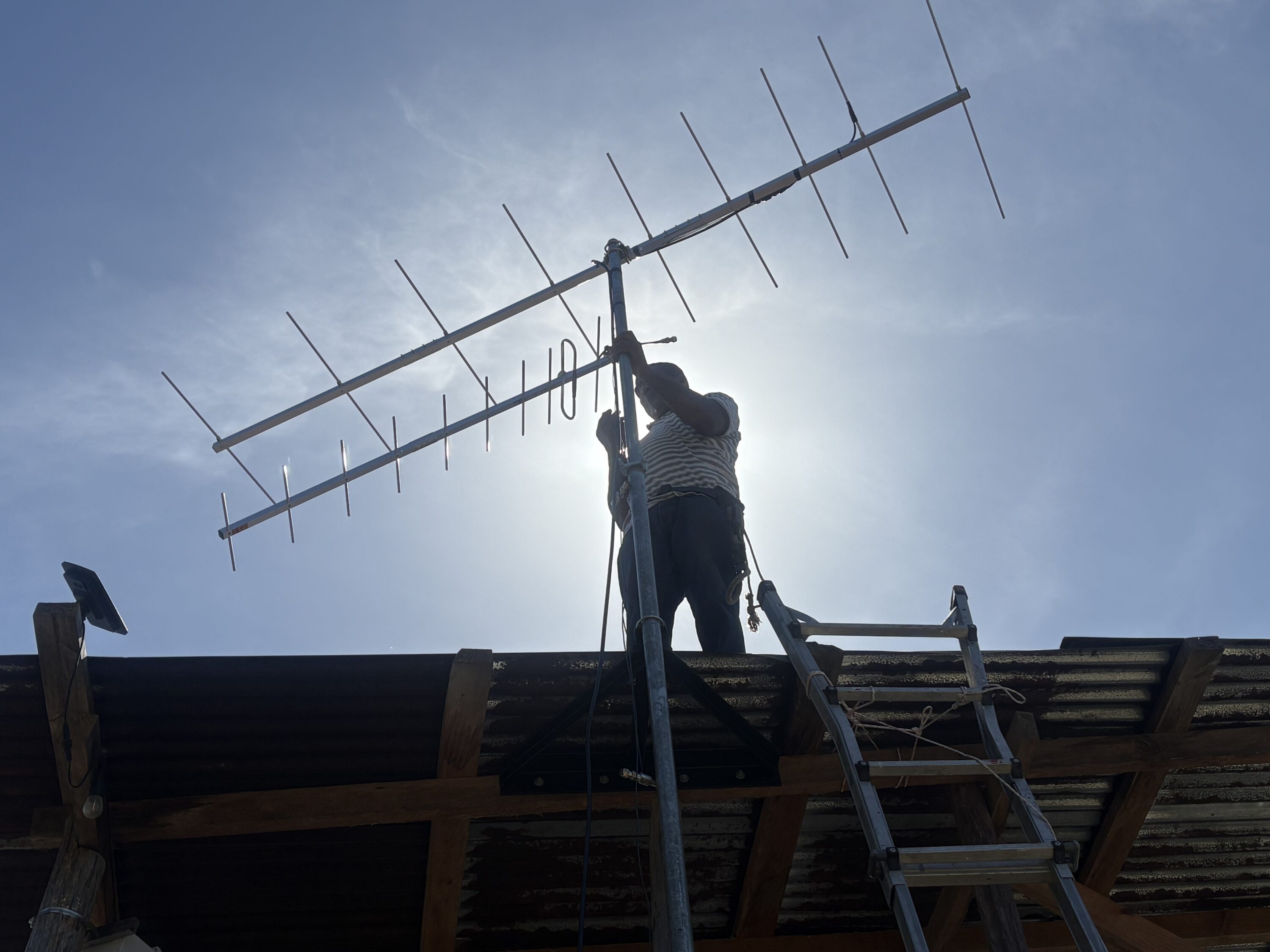
The Buen Hombre Motus tower coming to life thanks to a stellar installation crew © Jim Goetz
Undoubtedly our biggest lucky break has been meeting Constantino Carlo, a friend of a friend of Andrea. Constantino runs a manufacturing company in Santiago, and fortunately for us, is also a serious radio buff with a side business setting up radio towers and antennas. He took us under his wing, putting at our disposal the technical know-how of his stellar crew.
In August, Constantino and Andres Collado, his most excellent tower technician, accompanied Andrea and me to plan the setup for each site. What pleasure to watch these masters at work! Within 10 minutes of arriving, Andres and Constantino had already assessed everything: where to locate the central mast that will hold the antennas, how tall it will be, how to support it, length of the cables, and where to position the power outlet and the control box.
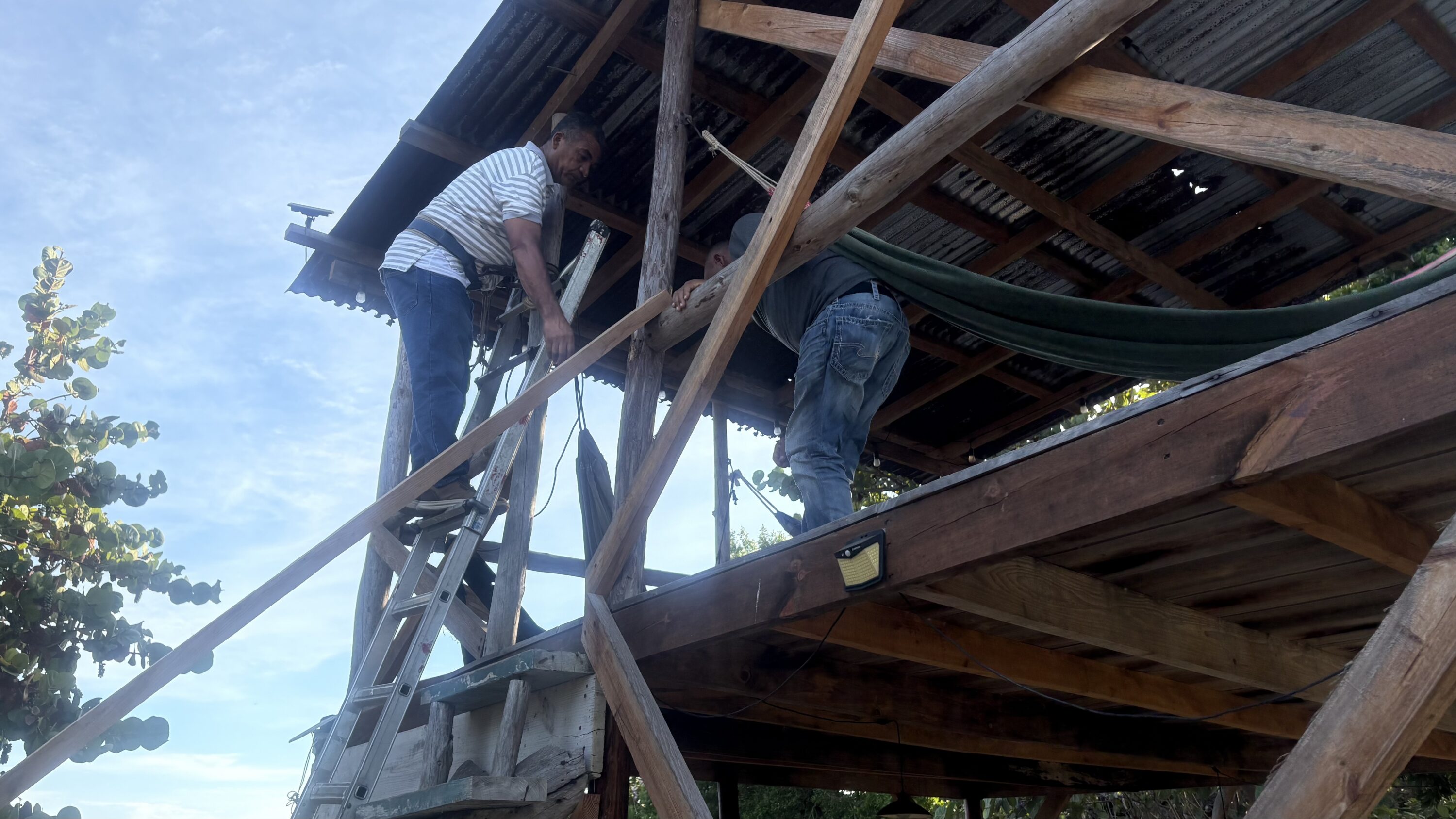
Constantino Carlo and Andres Collado installing the Motus tower © Jim Goetz
On a mid-September morning, we were back to do the install. At 9:30 we were attaching the antennas to the mast and the sun was blazing. By 10:30, the mast was up and the sun was punishing, and I was drinking several glasses of water every hour. By 2 pm all six antennas were up, and we were patting each other on the back and looking forward to setting up the next two stations at Iberostar Waves in Puerto Plata and in Santiago’s Botanical Garden next week.
We have yet to schedule the installation of the fourth and final Motus tower at the boating club. But if that happens as quickly as we hope, when Mike Hallworth joins me at the end of the month we will bring all four stations online, and everything will be ready to detect tagged songbirds full two weeks before the first Bicknell’s Thrushes are likely to arrive on the island.
With these first three beachfront stations in place, we’ll cover roughly 60 miles, or almost a sixth of the island’s 350 mile northern shoreline. No guarantees, but we’ve got our fingers tightly crossed that we will start detecting the first migrants this fall.
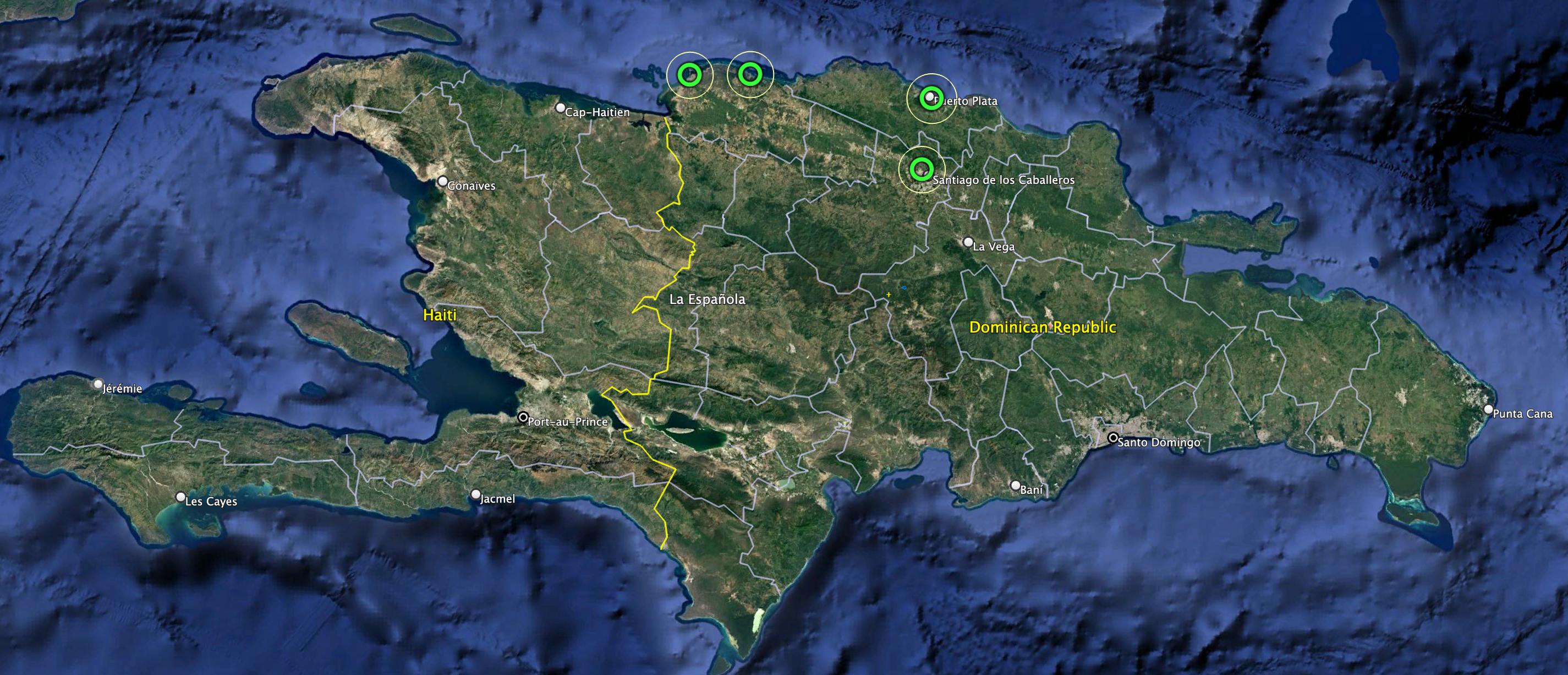
Map of VCE’s four Motus tower locations in the Dominican Republic