How to Find and Confirm Vernal Pools in Your Neighborhood
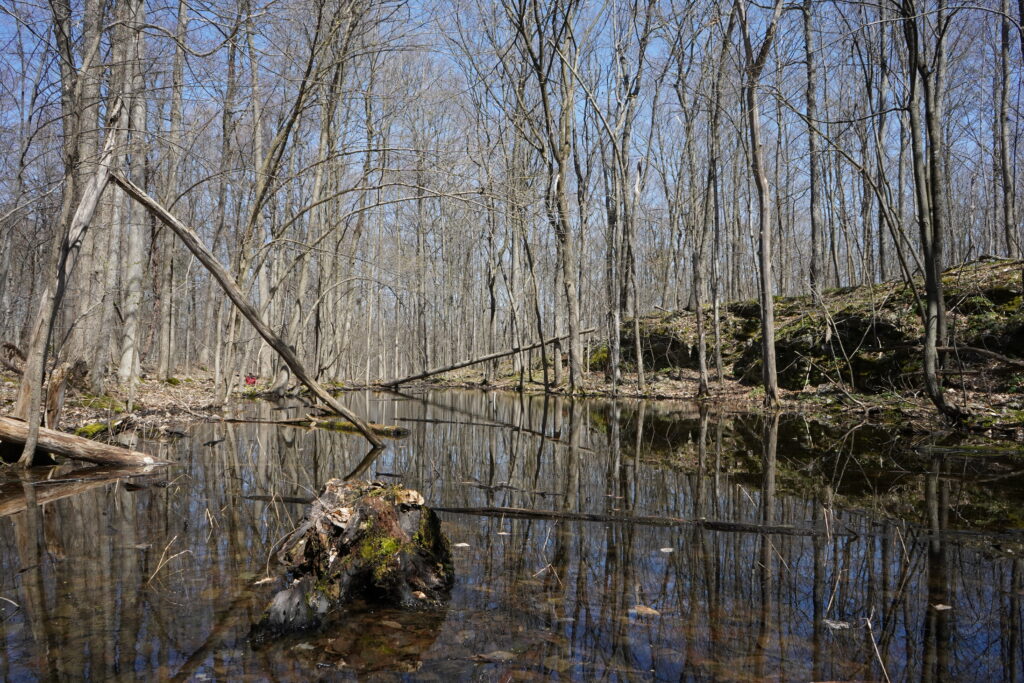
Vernal pool in Addison, VT. Photo by Emily Anderson
Kevin is leading vernal pool walks on April 11 in Norwich, April 12 in Hartford, April 22 in Salisbury, April 25 in Brattleboro, April 26th in Hinesburg, May 2 in Strafford, May 3 in Rupert, May 4 in Hartford, and May 17 in Burke. See details and sign up to join here.
Many people who have spent time wandering through the woods in spring and early summer have encountered small bodies of water in the forest. Perhaps it’s a low-lying depression between tree hummocks, or an old farm pond that has long since been reclaimed by Vermont’s expanding forest.
It’s very likely that you have encountered a vernal pool.
These unique ecosystems are hydrologically isolated, meaning they’re unconnected to permanent streams or other water bodies and generally don’t bisect the water table. Instead, they rely on surface runoff from snow melt and spring rains to fill, and bedrock or hardpan to retain water. This differentiates them from larger wetland complexes like marshes and fens that have a consistent inflow of water. It also leaves vernal pools highly susceptible to drying out, particularly toward the end of July as the weather warms and rain slows. Importantly, this wet-dry cycle prevents fish and large, predaceous invertebrates from becoming established.
Perhaps you view these water bodies as nothing but mosquito hatcheries, but to the salamanders and frogs who rely on them, they’re everything. And I mean that literally—certain species can’t survive without them. The conservation of one single vernal pool might not seem like much, but at the landscape-scale, their collective impact compounds.
Vernal pools provide crucial services such as flood control. They are commonly used as hunting grounds for Barred Owls and Broad-winged Hawk, and by megafauna like moose and bears for drinking water and as a respite from heat; a Scandinavian study found that moose, deer, and hares used vernal pools disproportionately more than permanent wetlands. They also funnel nutrients back into the forest, which may improve the quality of future timber harvests from the surrounding land.
That’s why, if you (or your neighbor) are the proud owner of forested land, you’ll want to know if there’s a vernal pool before making any big construction, farming, or timber harvesting decisions that could obliterate this cold-weather coral reef from the land.
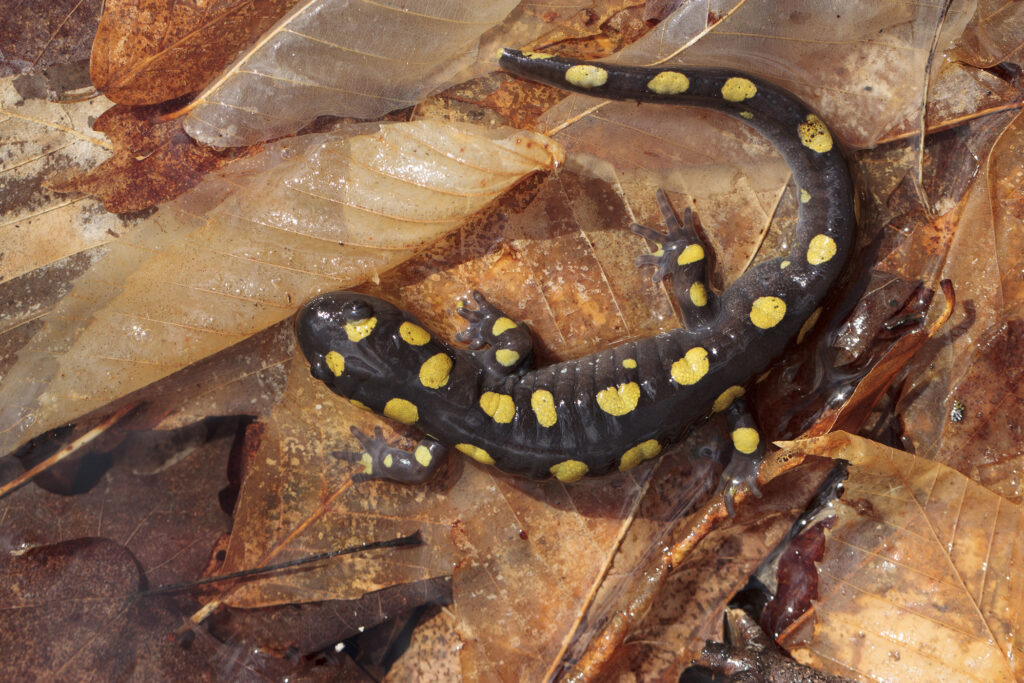
Vernal pools are defined by the specialist animals that rely on them, like this Spotted Salamander. Photo by Kent McFarland
A Microsized Safari
Towns like Dummerston and Norwich, where formal inventories have been performed, have around 150 potential and confirmed vernal pools in the Vernal Pool Atlas, with more likely unreported. However, until they’re officially confirmed, they can’t be documented in the state’s Wetland Inventory. As a result, they have historically been developed over, both accidentally and intentionally.
Since vernal pools are small and temporary, finding them requires you being in the right place at the right time, which tends to be April through June. They frequently go unseen during field surveys that occur later in the summer. They may also be mistaken for seeps, wet areas of forest where ground water breaches the surface on sloped land.
While natural communities are generally classified by their vegetation, vernal pools are somewhat defined by their lack of it. Most vernal pools, small and under a dense forest canopy, have few plants growing within the basin. Instead, vernal pools are defined by the specialist animals that inhabit them, the most widely known being Spotted Salamanders and Wood Frogs. Some more uncommon inhabitants include the Jefferson and Blue-spotted Salamanders, fairy shrimp, fingernail clams, and the state-Endangered Spotted Turtle.
How to Find and Confirm a Vernal Pool
Reporting vernal pools to the Vermont Vernal Pool Atlas ensures that they’re afforded regulatory protection.
So let’s say you want to figure out if you have one of these special natural communities nearby or on your land. First, visit and explore the VPAtlas and filter by your town to see if there are any confirmed, probable (visited but not officially on the record), or potential (satellite imagery suggests) vernal pools nearby.
Then, immerse yourself in their ecology and identifying traits by watching an online workshop I cohosted with the Association of Vermont Conservation Commissions.
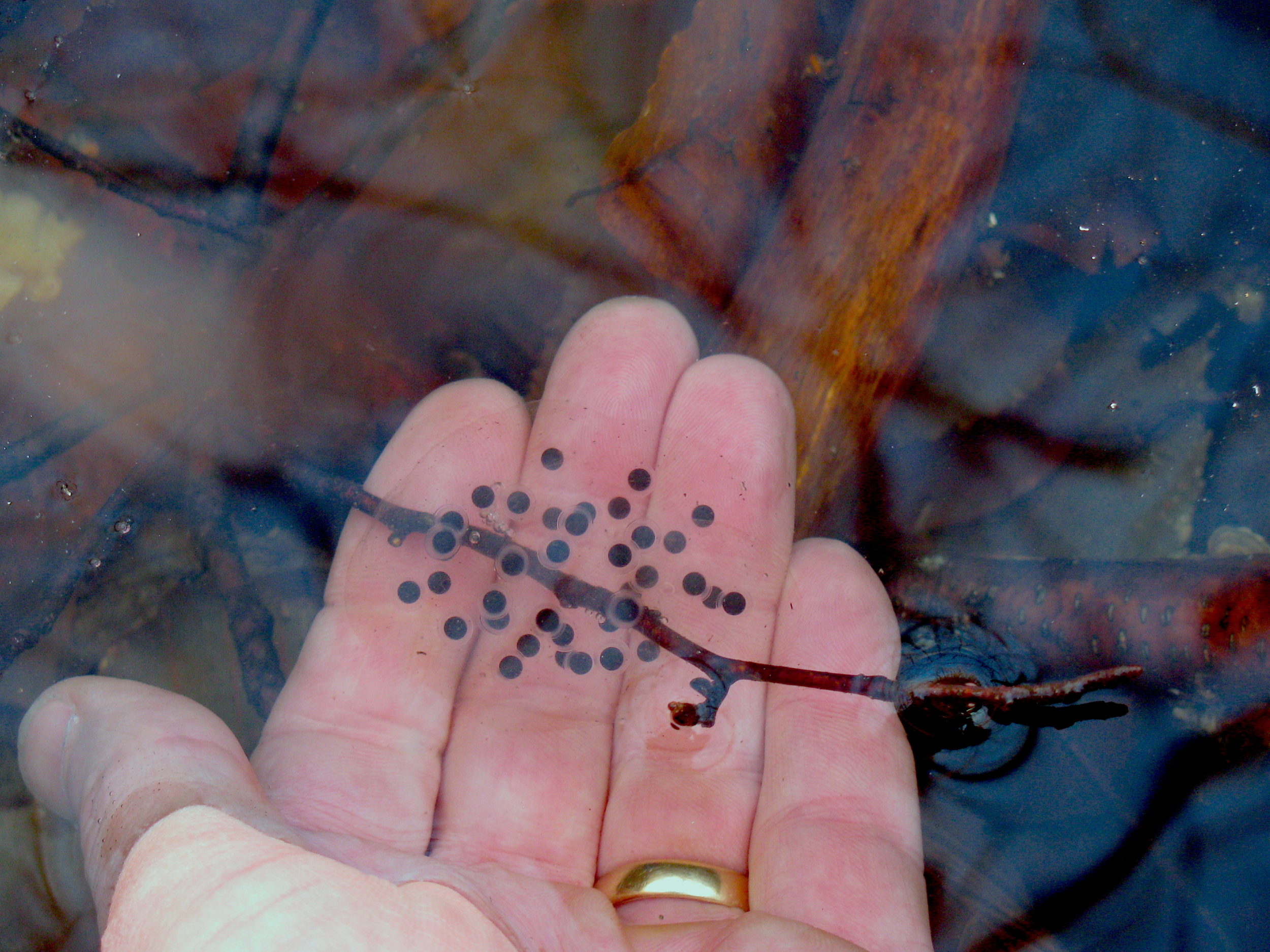
Jefferson Salamanders are one of the salamander species that lay their eggs in vernal pools. Photo from VCE archive
Once you’ve identified a suspected vernal pool, try to visit it during the amphibian breeding season to confirm that it’s actively being utilized by indicator species. This is best done in the weeks following the first warm rainy nights of spring, after amphibians have migrated and laid eggs. While vernal pool-breeding salamanders are highly fossorial (living and digging underground) and are only above ground for a few nights each year, their large, gelatinous eggs are very visible, making them ideal to survey to determine the population size. Since only four species’ eggs are commonly encountered during vernal pool surveys, you’re more than capable of learning how to identify which species are using this pool to breed.
Fill out this brief survey form with some information about the vernal pool and the species present. If it’s not on your land or publicly-owned land, try to get the landowner’s explicit permission as well. We’ll take that information and put it into VPAtlas and make it official!
For more details and instructions, check out our guide at the Vermont Atlas of Life.
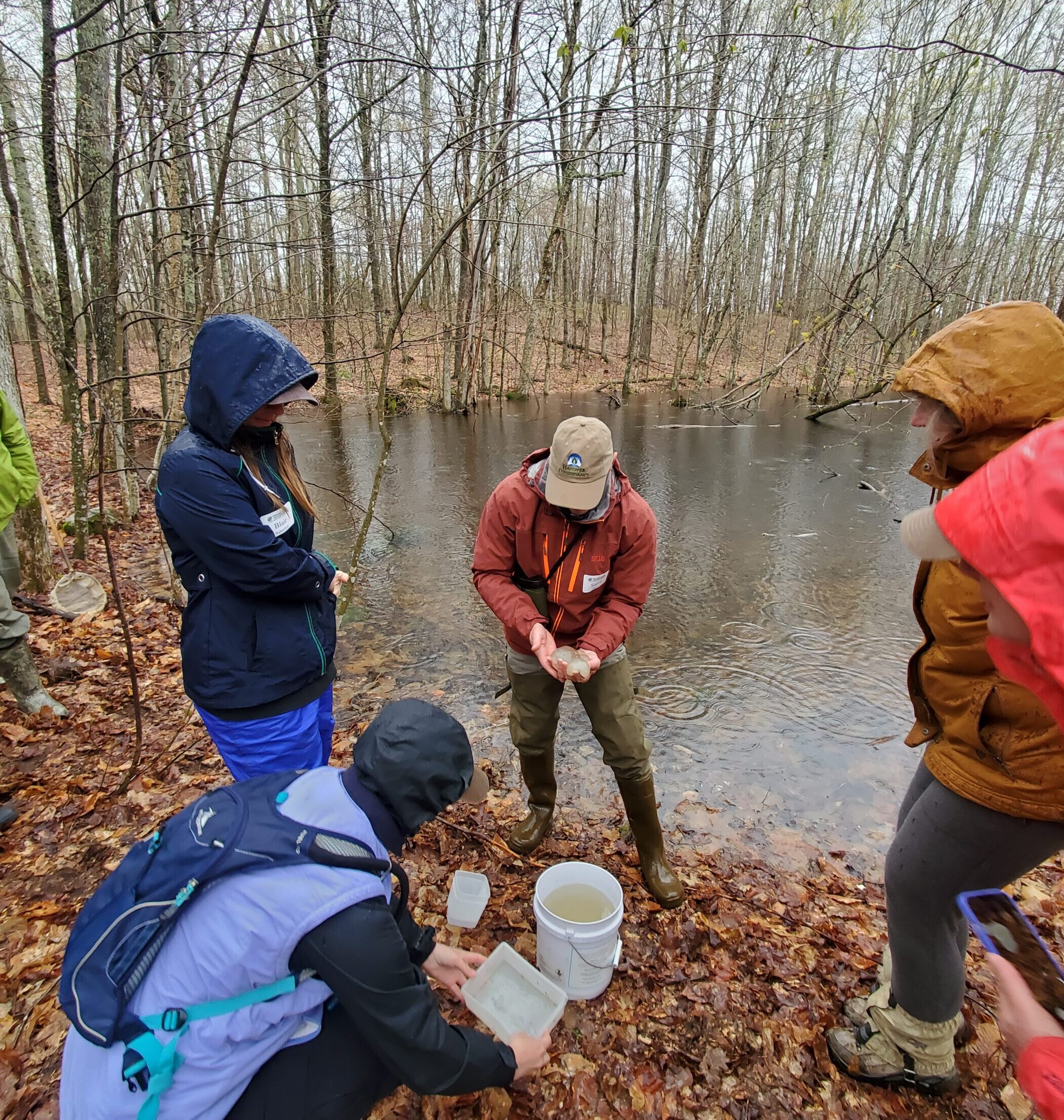
VCE Emeritus Conservation Biologist Steve Faccio shows amphibian eggs to a group of field trip participants. Photo by Alyssa Fishman
What to Do If You Have a Vernal Pool on Your Land
To effectively conserve a vernal pool, you should consider the full lifecycle of its amphibians. Though preserving the basin is of utmost importance, it’s also important to conserve the surrounding “life zone”—the area surrounding a vernal pool that amphibians disperse to after breeding, and where they spend 95% or more of their life.
While the legal buffer distance for development is only 50 feet for class 2 wetlands, which include vernal pools, the recommended minimum life zone is 400 feet surrounding the basin. Research done in Woodstock’s Marsh-Billings-Rockefeller National Historical Park by Conservation Biologist Emeritus Steve Faccio estimated that a life zone of 575 feet would encompass 95% of a pool’s salamander breeding population; however, more recent studies have estimated the protected area should be even larger.
The good news is that—if there are enough of them—you should still be able to hear the Wood Frogs in the pool from a porch located 600 feet away.