It’s Time to Remove Some Loon Nesting Rafts
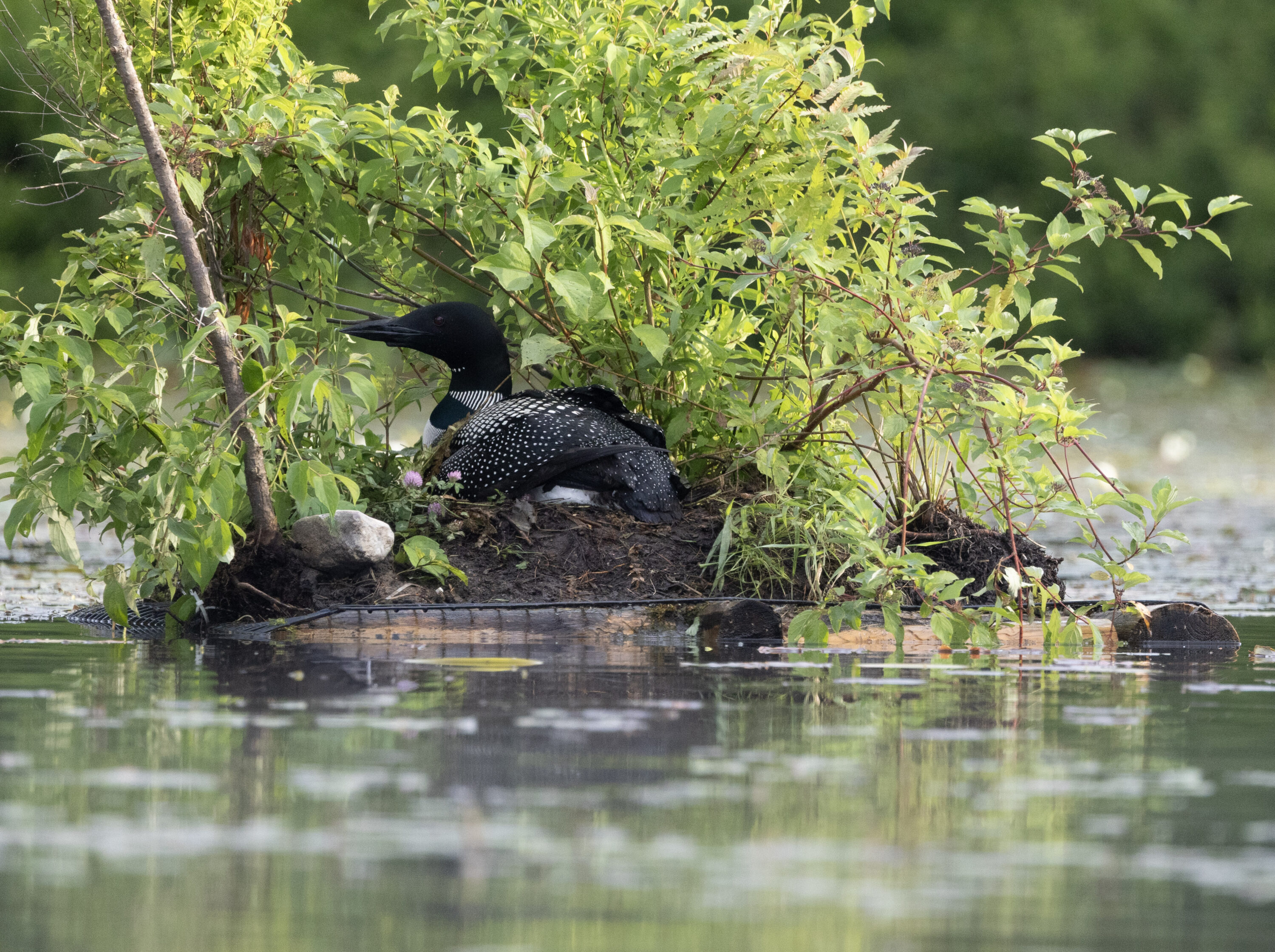
A renesting loon on Lake Iroquois in July 2025 by Lisa Angstman
This story ran in the 2026 Loon Caller, the Vermont Center for Ecostudies’ annual loon publication. Support Vermont loons today—select Vermont Loon Conservation Project for your online gift, or make your check out to The Vermont Center for Ecostudies with VLCP in the memo.
Two years ago, VCE Loon Biologist Eloise Girard and our intern Ava Purdy set out to remove the old waterlogged raft on Kettle Pond. They filled their canoe with a truly incredible number of foam blocks, milk jugs, and other flotation devices that had been added to the raft over the years. The raft sank to the bottom of the pond.
The Kettle Pond raft was one of Vermont’s earliest loon-nesting rafts, placed in 1992 after a decade of no nesting and three years of shoreline nest failure. At the time, Vermont’s loon population was less than 30 pairs. Loons prefer natural nesting locations, but the raft created an islandlike nest site on a pond without marshes or islands. It worked really well, with a pair using the raft for 27 of the past 33 years and a nest success rate of 74%.
Now loons in Vermont are doing great. In 2025 VCE volunteers and biologists documented several record highs: more adults, more successful nests, more chicks hatched, and more chicks surviving than any year before. Most lakes and ponds in Vermont larger than 50 acres now have loon activity, if not territorial pairs.
Girard and Purdy recovered most of those cedar logs from the bottom of the pond. But instead of rebuilding the raft on Kettle Pond, we decided to see what the loons would do on their own. Lo and behold, in 2025 the pair found a little shelf near a steep shoreline to tuck in a nest—and it was successful.
This success will not be universal. Rafts have an 86% success rate, whereas natural nests have a success rate ranging from 75% on islands to 69% in marshy vegetation to as low as 50% on the shoreline. When we removed some nesting rafts in the mid-2000s on Bald Hill, Jobs, and Little Hosmer ponds, success rates declined quite a bit. The Bald Hill pair found a successful location after a few years of failed nests. The Jobs pair has nested much less frequently. The Little Hosmer pair just hasn’t figured it out, despite having access to good island and marsh sites.
That is okay. From both regional population and long-term sustainability standpoints, it’s better to have chick numbers stabilize or even decline slightly to reduce the incidence of adult territorial conflicts that are sometimes fatal—to adults but especially to chicks. We are entering a period when we can reduce some of our active management activities and promote natural nesting.
When to Place a Nesting Raft
There are still some situations in which installing a floating nesting platform can benefit loons.
Flooding: Because loons build nests mere inches from the shoreline, their nests are especially susceptible to flooding. Occasional flooding that causes nest failures is a normal and natural event. Rafts do help to mitigate major flooding events, which seem to be happening more often (like the ones in 2023 and 2024). On the reservoirs where operating dams can cause the water level to change quickly, we consider rafts a necessary tool to mitigate human-caused flooding.
Human activity: Loons sometimes try to nest near people and lots of shoreline activity. We’ve placed rafts in quieter locations to reduce this human-animal conflict. Even in these cases, we try to give pairs several years to attempt natural nesting, in case they find a better spot on their own.
Where We Avoid Placing Rafts
Lakes and territories without nesting loons: On lakes or territories where loons are present but not nesting, there may be valid ecological reasons. For example, large lakes like Lake Willoughby support plenty of loons but have little nesting habitat, such as marshes or islands. These lakes provide important nonbreeding loon habitat where loons can rest and feed without defending a territory. Many smaller lakes also provide this habitat for nonbreeders. If we do see new nesting pairs on these lakes, we try to promote natural nesting as much as possible.
Small ponds: We now only deploy rafts on lakes of 80 acres or more to ensure there is a good stock of fish for nesting loons and their chicks.
Lakes with pairs already showing some success: Some pairs are naturally more productive than others, and variability in nesting success is expected.
In short, it is often good to let the loons figure it out themselves. When possible, we first allow a loon pair to attempt nesting naturally for up to three consecutive years before deciding to deploy a raft. This approach helps us identify where the pair is most likely to nest and where the platform should be placed. We’ve found that rafts positioned close to previous nesting attempts are more likely to be used.
We plan on removing a few nesting rafts each year over the next decade to promote natural nesting. Some of these pairs will find natural sites, and others may not. But rest assured, with your help we’re keeping a close eye on Vermont’s loons, and we can use more rafts again if we start to see worrying declines in the population.


Yes! Let natural population regulation proceed.