Know Your 5: Wild Bees That Pollinate Blueberries
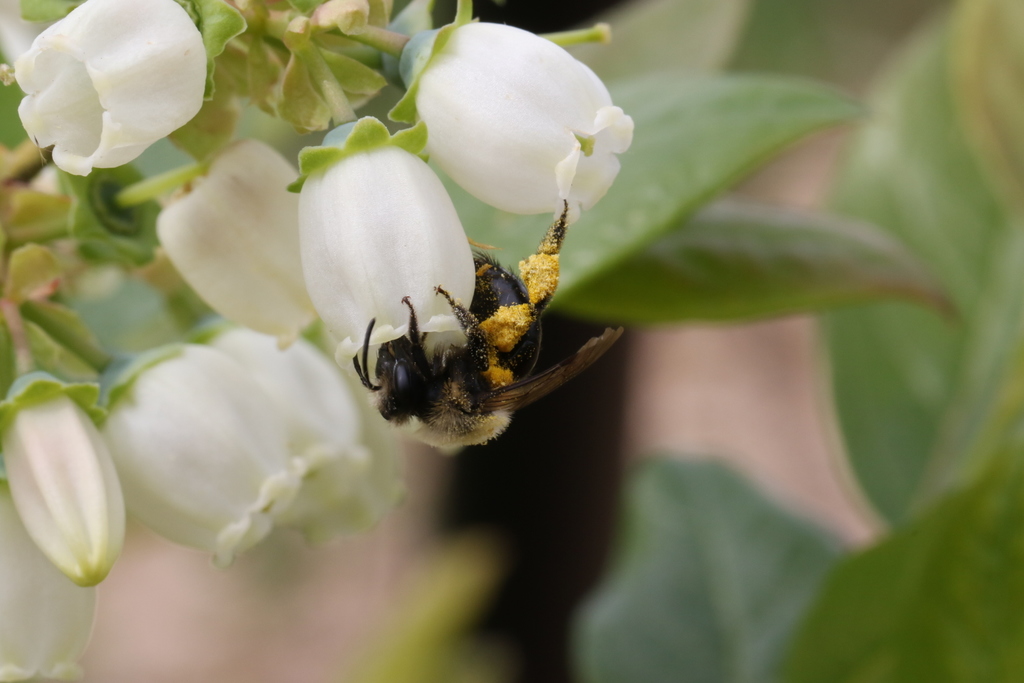
Mining Bee (Malendrena) © Spencer Hardy
Support Spencer Hardy’s research and other projects like this by making a donation to Vermont Center for Ecostudies! Learn about other ways to support VCE here.
The domesticated Western Honey Bee (Apis melifera) gets credit for most of the agricultural pollination in North America, but in many cases, it’s the wild bee species that are more effective pollinators. And unlike the Honey Bees in the northeast, wild bees do not need human assistance to survive—just a safe place to nest and plenty of flowers to eat from.
By identifying and understanding the natural history of these bees, you can provide the specific habitat that will help to ensure resilient and abundant pollination services and the tasty treats that result. With more than 350 species of bees in Vermont, it’s daunting to understand them all. So let’s start with some important bees for, and supported by, blueberry flowers.
Blueberry Pollination Overview
Northern Highbush Blueberry (Vaccinium corymbosum) is an economically important crop in Vermont. Both Northern Highbush and Lowbush Blueberries are widespread in the northeast and an important food for many wild bees.
Blueberry flowers hang downward, have a tubular corolla, and contain anthers and a small opening from where the stigma extends.
Blueberry pollen is relatively heavy and does not move well by wind, making insect mediated pollination essential. Bushes can produce berries when there is limited or no pollen transfer by bees, however, those berries will be small, ripening will be delayed, early fruit drop may result, and most berries would not meet market standard quality.
Blueberry pollination should be within three days of opening, and fruit set is unlikely after five to six days. Pollen receptivity changes with high temperatures. When in the 70s and 80s Fareinheit, successful pollination may be reduced to one to two days, and at temperatures above 95°F, pollination is further restricted. Cues of successful pollination are flower drop, leading to a white carpet under bushes. Dull, brown flowers on the bush can be an indicator of poor pollination.
Managed Honey Bees are a primary pollinator on large blueberry farms around the world, but are relatively poor pollinators on a per-visit basis. Blueberry pollination studies in Vermont have shown wild bees are primary blueberry pollinators in the state and pollination visits by wild bees increased seed set and fruit mass with an estimated production increase of 1-6% (Nicholson and Ricketts, 2019).
Supporting Pollinators and Limiting Insect Pests
Be careful and conservative with pesticide applications. Insecticides, fungicides, and herbicides can all pose risk to crop pollinators in different ways. When pest pressure exceeds an economic threshold, or consumer tolerance level, and the benefit of pest control outweighs the financial cost, avoid spraying during bloom when possible. Always follow an integrated pest and pollinator management plan.
Understanding the dichotomy of plants in the landscape that support pollinator habitat while also supporting potential insect pests of blueberries can be helpful when considering crop pest pressure. For particularly economically damaging fruit flies, like Spotted Wing Drosophila, avoid near-by plantings of other soft-fruiting plants that may host this pest (e.g. elderberry, raspberry) and consider removing select plants in the landscape, such as wild brambles, buckthorn, and any of the four invasive shrub honeysuckle cultivars in Vermont.
Other pests of concern, Cranberry Fruitworm (moth) and Blueberry Maggot (fruit fly), may be hosted in surrounding landscapes by other native, soft-fruiting plants, such as deerberry, huckleberry species, and wild and cultivated cranberry. Cherry Fruitworm (moth) hosts can include a number of other fruit tree species, such as wild and cultivated cherry, pear, peach, apple, and other trees and shrubs, like hawthorn and rose.
Support pollinators and limit insect pest pressure by enhancing landscape habitat with pollinator nesting space and season long flower blooms, but non soft-fruit bearing plants.
Options for trees include Maple, Black Locust, Chestnut, and American Linden. Useful shrubs to consider include, Willows, Staghorn Sumac, and Meadowsweet (genus Spiraea). Herbaceous annual and perennial flowering plants, such as clovers, self-heal, goldenrod, joe-pye weed are helpful. Early blooming plants attract wild bees to the landscape, while late blooming ones are valuable for increasing the populations of bumble bees and other long-season bees.
Nesting and overwintering habitat can be provided by areas of exposed light textured soils, downed snags or logs in field margins, leaf litter, and dead stems that are hollow or contain soft pith for insects to make tunnel nests.
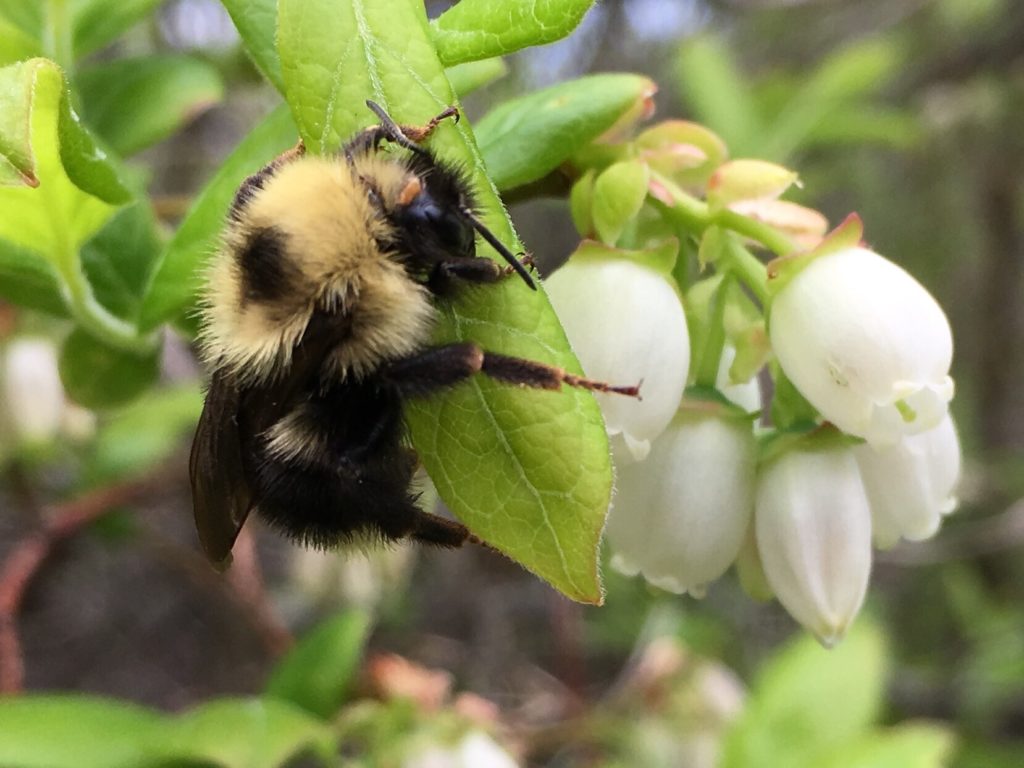
Female Yellowish Cuckoo Bumble Bee on highbush blueberry. © leif_richardson on iNaturalist
Bumble Bees (genus Bombus)
These large, charismatic bees are great pollinators of most crops. Queens emerge in early spring and do most of the blueberry pollination, with the smaller workers born in early June. Bumble bees are capable of “buzz” pollination, a particularly effective characteristic for blueberry pollination. Plant early-blooming flowers (willows, maples, etc) and nesting habitat (hedgerows and woodlots) to maximize local populations. Having multiple species on a farm adds resilience and increases pollination in inclement weather.
Mining Bee (Malendrena) © Spencer Hardy
Mining Bees (subgenus Melandrena)
This fairly distinctive subgenus of Mining Bees are among the most abundant pollinators on many blueberry farms around Vermont. They resemble small bumble bees, but are more slender and carry the pollen on the body, femur, and tibia (unlike bumble bees, which only carry pollen on their tibia). They are ground-nesting generalists that are most abundant in May and June.
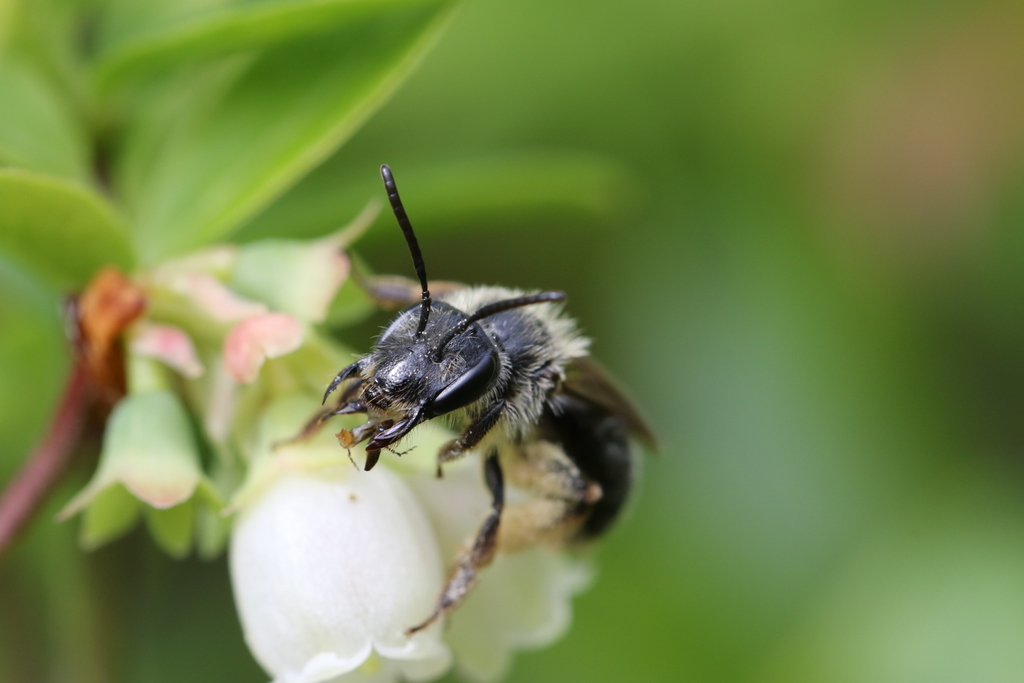
Carolina Miner Bee (Andrena Carolina) © Spencer Hardy
Carolina Miner (Andrena carolina)
Two mining bees in VT are specialists on blueberries (and related plants). The Carolina Miner is the more widespread of the two and frequently encountered on blueberry farms. Related shrubs (azaleas, leatherleaf, sheep laurel, etc.) blooming nearby may help to attract and retain the Carolina Miner and other blueberry-loving bees.
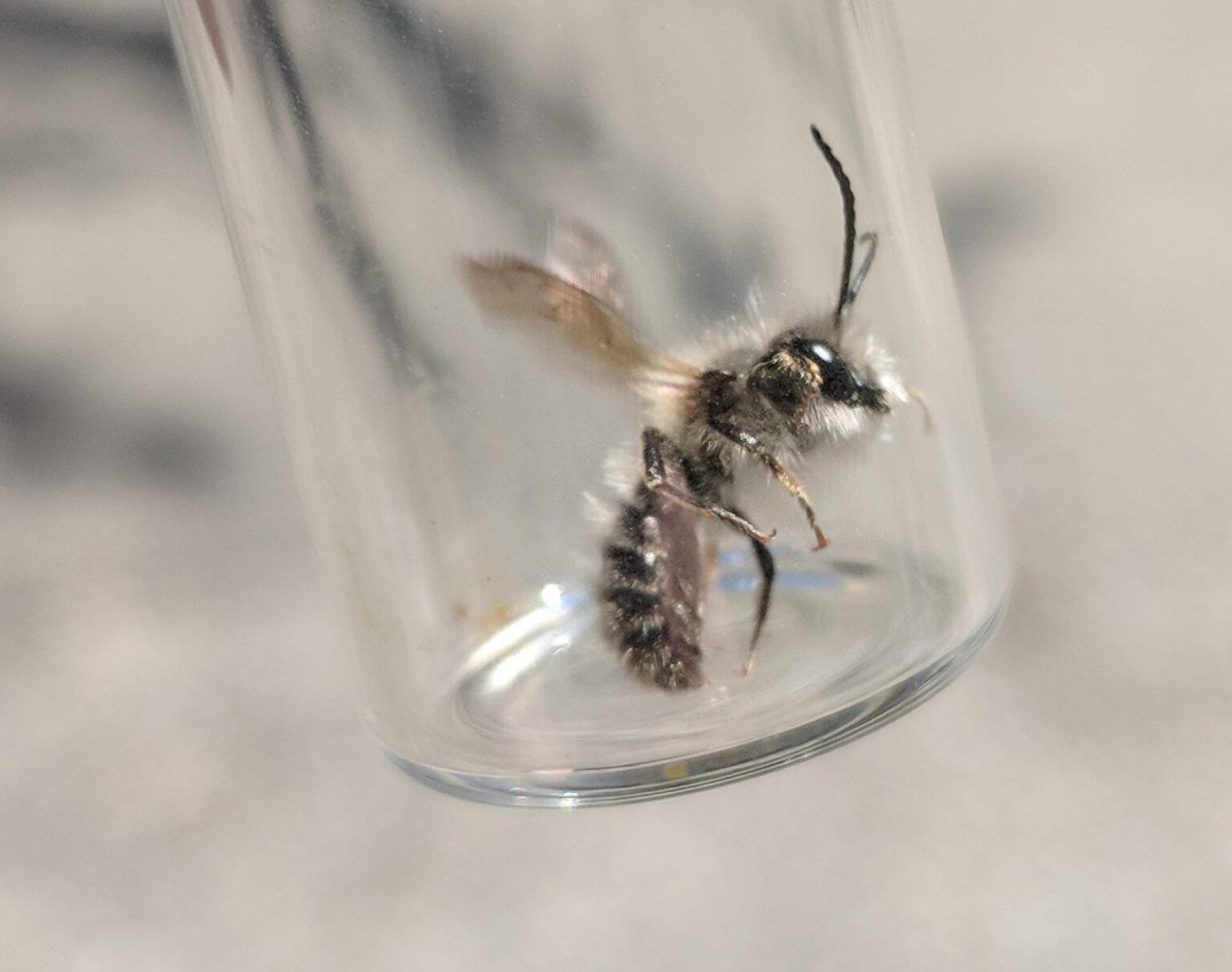
Horn-faced Mason Bee © Nathanial Sharp on iNaturalist
Mason Bees (genus Osmia)
These shiny blue bees are well known as efficient pollinators of many spring blooming fruits, including blueberries. Females can be identified by the pollen (or pollen collecting hairs) underneath the abdomen. Many species nest above ground in preexisting cavities (including bee hotels). One species, the Blueberry Mason (Osmia virga) is an uncommon blueberry specialist, known primarily from sandy locations in VT.
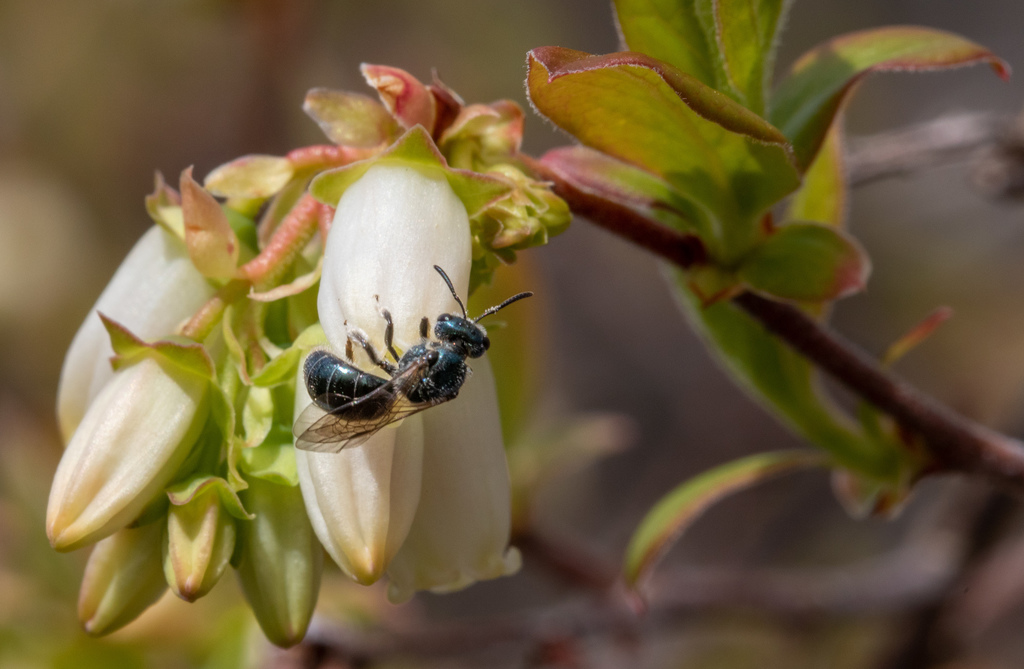
Deep-blue Sweat Bee (Lasioglossum coeruleum) © Spencer Hardy
Metallic Sweat Bees (genus Lasioglossum)
These small, slightly metallic bees are abundant and diverse. They are also capable of “buzz” pollination. Most are generalists that are active through the summer, with at least 27 species recorded from blueberries. Most nest in the ground, but several common species nest in rotting logs and stumps, which can be an important habitat feature, especially on wet or heavy soils where ground nesting is limited.
A project of the Vermont Pollinator Working Group, with funding from the Gund Institute’s Apis Fund. For more information about bees, email shardy@vtecosudies.org. For questions about pollinator support practices on farms, email Laura.O.Johnson@uvm.edu. All photos courtesy of Spencer Hardy unless otherwise noted.


Thanks, Spencer. Love all of this bee and pollinator information, keep it coming! And this inspires me to get to the local blueberry field for more bee photos.