Subadult Loons: Why We See So Few In Vermont Today
By Eloise Girard and Eric Hanson
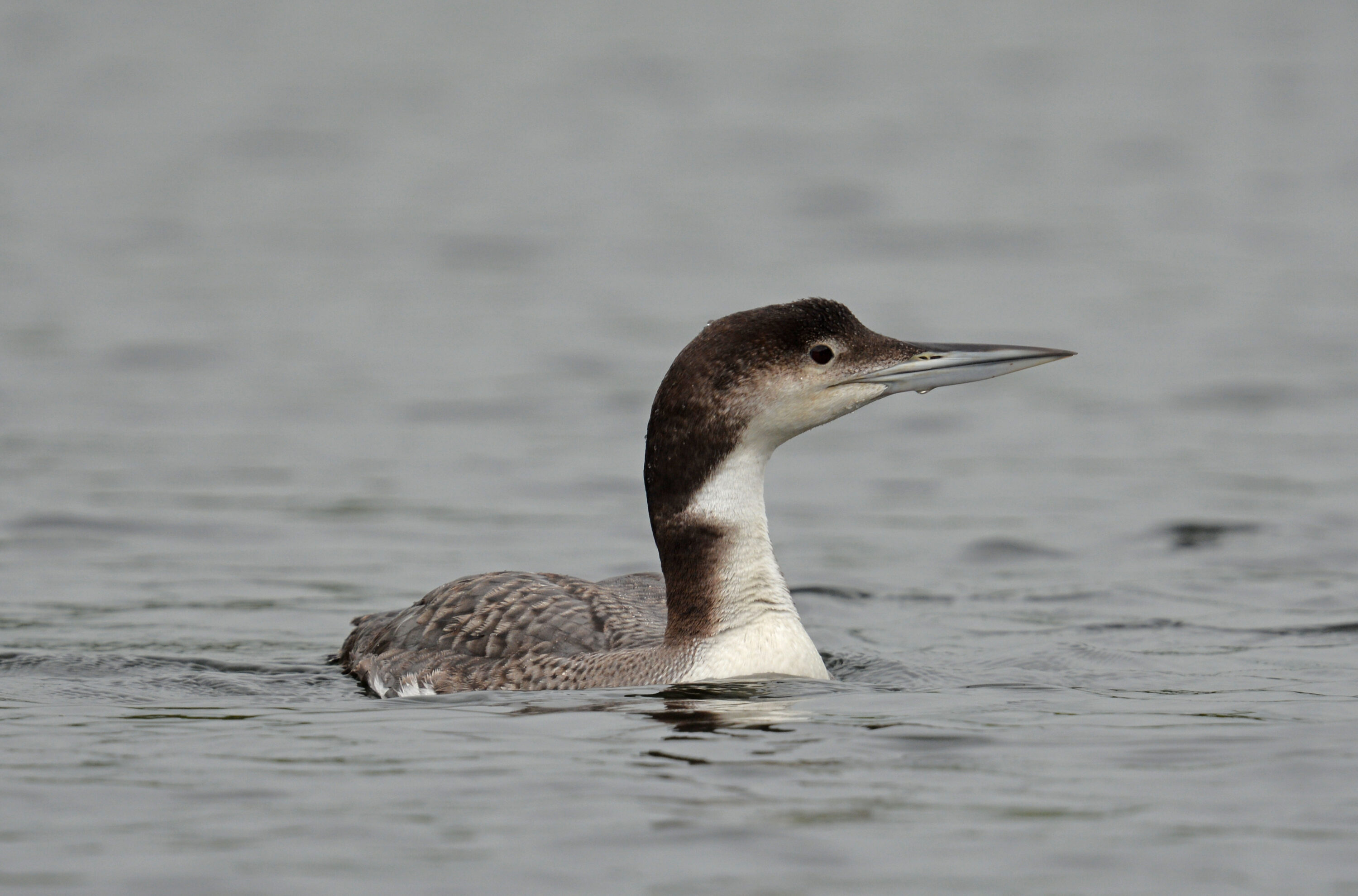
A subadult Common Loon (Gavia immer) © Anastasia Zinkerman
This story ran in the 2026 Loon Caller, the Vermont Center for Ecostudies’ annual loon publication. Support Vermont loons today—select Vermont Loon Conservation Project for your online gift, or make your check out to The Vermont Center for Ecostudies with VLCP in the memo.
During Vermont’s annual LoonCount (formerly Loonwatch Day), volunteers occasionally report seeing young loons of only one to two years in age (aka subadults).
In the 1990s, when Vermont was home to fewer than 100 adult loons, volunteers often observed 10 to 20 subadults during the survey. Over the past decade, however, volunteers have rarely reported more than four. So, where are the young ones?
Most loons spend their first three to four years on the ocean after leaving their natal lake. These birds look similar to wintering adult loons of breeding age, with grayish-brown feathers on their backs and heads, but can be distinguished by having some whitish-gray or more-worn feather tips. They can also sometimes be mistaken for 14-weekold chicks—but those have feathers with a distinct whitish fringe at the tip, giving them a scalloped appearance.
Although they reach breeding maturity at around three years of age, returning too early to breeding waters can be risky. Loons are highly territorial, and younger birds are rarely strong enough to challenge an established pair. Also, unlike many bird species, a healthy loon can live 20 to 40 years and may continue breeding throughout much of its life. Because of this longevity, there is no urgent rush to reproduce, and they may wait to nest until they are six or seven years old.
Conditions in Vermont have also changed dramatically over the past few decades. Thirty to forty years ago, many lakes suitable for loons were still unoccupied. At that time, more subadult loons ventured north during the summer because they could explore lakes without constantly being chased by aggressive, territorial adults. Today, however, most lakes larger than about 50 acres host regular loon activity.

When subadults do return to Vermont during the summer, they are most often found on very large lakes, like Lake Champlain, where there is more room to avoid territorial pairs. Although nesting loons have not been documented there, surveys regularly detect young birds using the lake. In 2002, a detailed assessment estimated that at least 20 to 30 subadult loons were present on Lake Champlain.
Eventually, young loons begin returning to the region where they were born, typically within 20 to 40 miles of their natal lake. At first, they tend to behave submissively around established adults. Research by Walter Piper, PhD, in Wisconsin shows that most loons that begin nesting between four and six years of age do so by establishing a new territory on previously unoccupied waters, which reduces the chance of conflict.
As loons grow older and stronger, they may begin to challenge birds already occupying territories. When observers notice a third or even fourth adult loon visiting a territorial pair, it is often a sign that these “floaters” are assessing the situation: evaluating the strength of the resident pair, learning the boundaries of the territory, and becoming familiar with the neighbors. Within about three years, they may find a new territory, replace a lost mate in an existing pair, or win a challenge for an established territory and finally secure their first breeding opportunity.