Saving the Song of the Bobolink
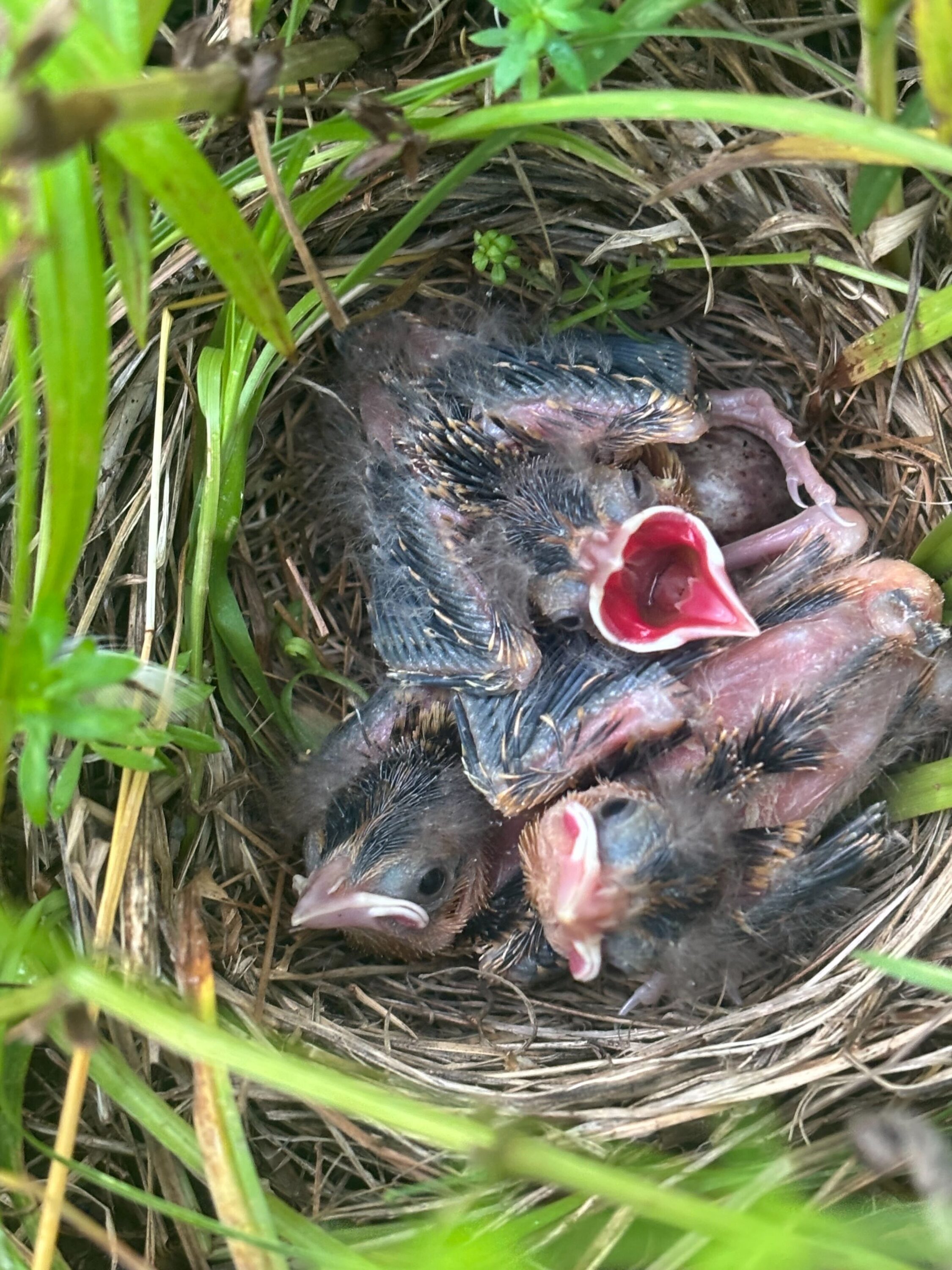
Bobolink nestlings found by Tolan last summer in a hayfield in Charlotte, Vermont, that is managed for grassland birds
This story ran in Field Notes, the Vermont Center for Ecostudies’ twice-yearly print magazine. Subscribe to receive the next issue in your mailbox.
“There’s a bright, golden haze on the meadow . . . all the sounds of the earth are like music.”
When I’m out doing grassland bird surveys, I think of the opening song to Rodgers and Hammerstein’s Oklahoma!, which captures to perfection the magical mood of sunrise over rolling hayfields. As the predawn coolness is replaced by a warm morning sunshine, the robotic song of a Bobolink rings out while it flutters above the field, and an Eastern Meadowlark echoes from the distance. It seems idyllic, but look closely at the vegetation. Menacing threats are creeping in from the edges—Spotted Knapweed, Smooth Bedstraw, Yellow Rattle, and Poison Parsnip are invading and taking over the diverse grassland and, with it, bird habitat.
The primary threat to grassland birds is habitat loss, according to a 2014 paper by VCE biologist Jason Hill and A Full Life Cycle Conservation Plan for Bobolink by VCE cofounder Roz Renfrew. This has certainly been the case in Vermont. Reforestation of hayfields, parcelization, and increased agricultural intensity have greatly reduced the available breeding habitat for these ground-nesting birds. The steep declines of species such as Upland Sandpiper and, more recently, Eastern Meadowlark have been particularly noticeable.
Now even grassland habitat that’s protected from fragmentation is imperiled by invasive plants.
Grassland birds aren’t picky about the species of plants that form their nesting fields, but rather the shape and growth structure of those plants, only choosing to breed in grass-dominated fields. Although most of the common grasses planted in hayfields were introduced to North America by settlers, these nonnative grasses form a similar vegetative structure to native grass species and provide suitable habitat for grassland birds. Grasslands that appear to provide the highest-quality nesting habitat for Bobolink tend to have a mixture of grasses and sedges of various heights that act as nest cover.
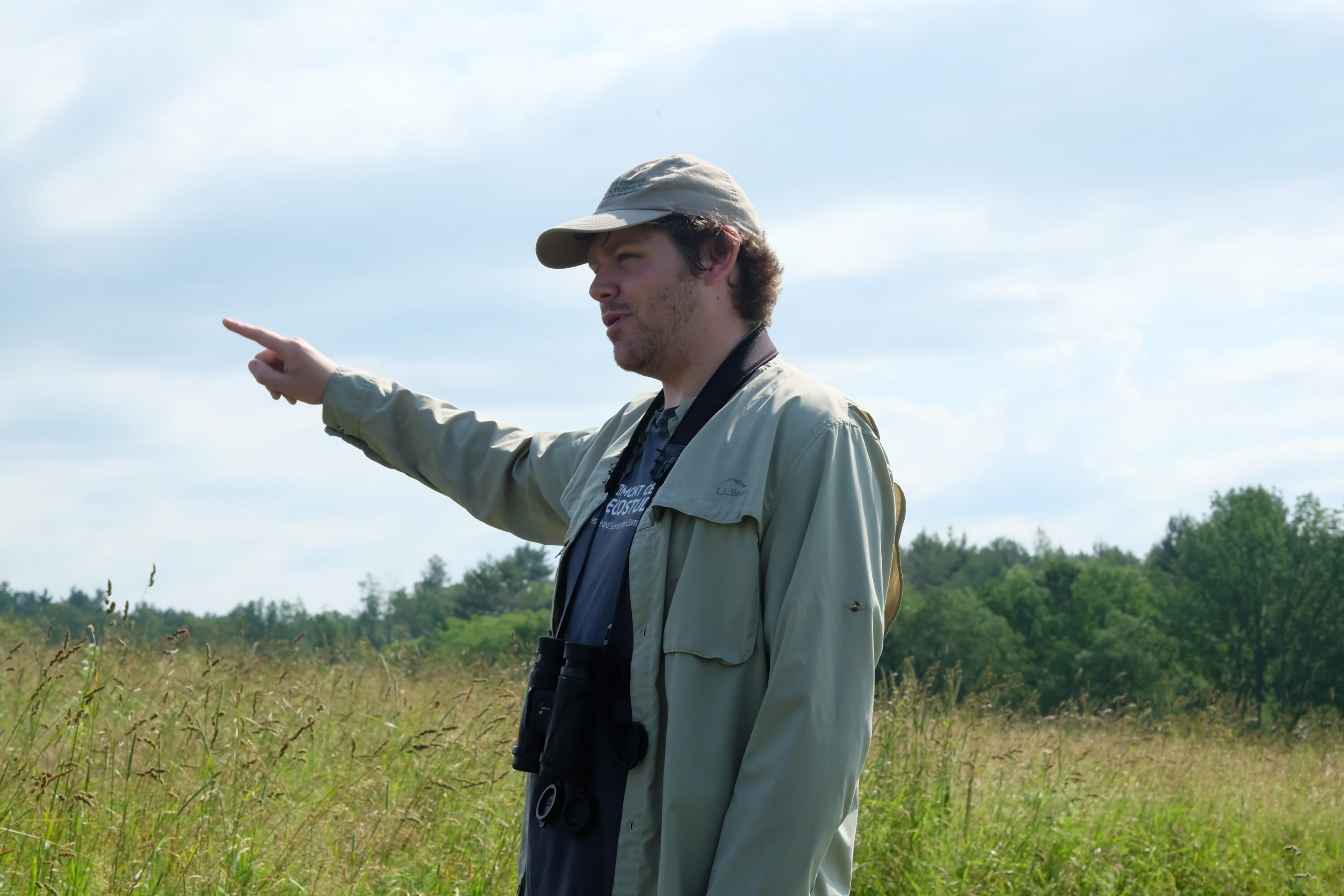
Kevin Tolan spends his days in mid-spring and summer wading through Vermont’s hayfields, looking for signs of grassland birds. © Alden Wicker
The most commonly employed management strategy to facilitate grassland bird breeding is delayed management—not mowing during the nesting season, which runs from late May until about July 15—to give birds time to successfully fledge their young. However, this extended period of uninterrupted growth allows invasive plants to seed and flourish. They rapidly form dense monocultures that outcompete the grasses relied on by grassland birds for nesting.
Managing a hayfield to reduce the presence of invasive plants through frequent cutting and reseeding may help provide long-term habitat but can have negative short-term consequences for grassland birds. Cutting the field several times per summer can reduce the vigor of undesirable species, but breeding adults won’t have enough time to successfully fledge young. Tilling and reseeding are even more effective to eradicate invasive plants, but these practices reduce the habitat quality for the several years it takes for the vegetation to regrow to suitable breeding habitat. Hayfield reinvigoration is further complicated by its financial cost, particularly for a field that’s unlikely to produce a monetary return on this investment.
To maximize the nesting quality of fields, land managers should aim to prevent the spread of invasive plants into the interior of fields where grassland birds prefer to nest. The most effective and cost-efficient way to control invasive plants is to stay vigilant for their arrival and act quickly upon finding them to prevent their spread. This targeted management can be done mechanically, chemically, or via animals, all of which have pros and cons that I won’t get into here. Additionally, maintaining a “moat”—a frequently mowed two-meter-wide path along the forest edge—can reduce the incursion of invasive and woody vegetation.
Hayfields are frequently overlooked in the forested Northeast, but with much of Vermont’s landscape predicted to have a high long-term potential for Bobolink conservation, our hayfields may play an increasingly important role in sustaining the global population of Bobolink and other grassland birds. While research into this rapidly emerging issue is still in the early stages, VCE is taking steps to address it in partnership with landowners throughout the state.
Incorporating invasive plant management into hayfields that provide habitat for grassland birds could make a major difference to your local Bobolinks and Eastern Meadowlarks in the uncertain decades to come.
This story ran in Field Notes, the Vermont Center for Ecostudies’ twice-yearly print magazine. Subscribe to receive the next issue in your mailbox.