See an Evening Grosbeak? Here’s How You Can Help Them…and Researchers!
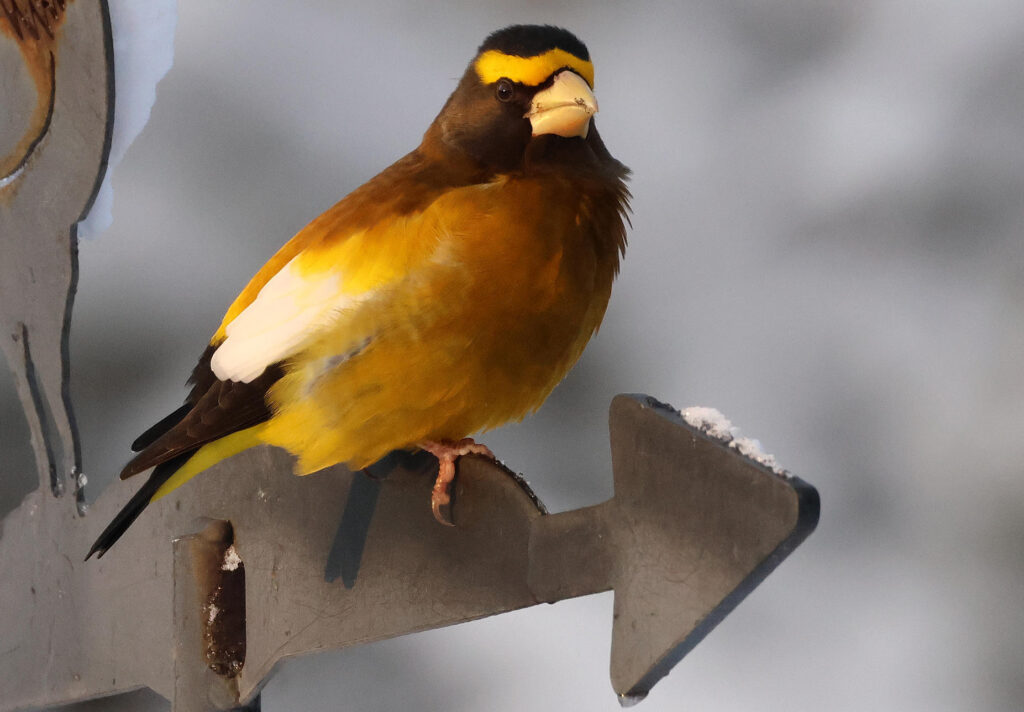
Evening Grosbeak © Mark Dennis (via iNaturalist, licensed under CC-BY-NC)
Support Desirée Narango’s research and other projects like this by making a donation to Vermont Center for Ecostudies! Learn about other ways to support VCE here.
Every holiday season, my family and I spend a weekend day cutting down our Christmas tree. We like to go to a local place about 45 minutes away in New Hampshire. The owner used to be a wetlands scientist, and you can tell that he cares for his farm with ecosystem health in mind. There are gobs of really nice trees all over, and it never takes us more than 10 minutes to find the perfect one.
Christmas tree farms can be examples of a ‘ natural climate solution ’—they cultivate a sustainable crop, store lots of carbon, and can be nice wildlife habitat too (especially if they have native Christmas trees, like Balsam Fir and White Spruce).
As we pulled into the lot, we heard the chirrp chirrrrp of grosbeaks visiting the farm’s feeder. I counted no less than 25 individual birds up in the trees waiting their turn. Sadly, I didn’t have my binoculars to check for any color bands, but we took a moment to chat with the owners about the birds. They were tickled to know we are helping to study Evening Grosbeak, to help save one of the fastest-declining songbirds in North America. They love watching the birds at the feeder, and seemed keen to look out for any of our tagged birds from last year.
After loading up our tree, we headed home ready to decorate. But a few hundred yards away we saw something hopping along the road. As we slowed down to do some impromptu bird watching, we realized it was a female grosbeak, and she did not seem to be doing well. Without hesitation, I jumped out of the car, scooped her up in my hands, and carefully brought her into the car. Her bill was covered in gravel, likely from desperately seeking food on the side of the road, and she was holding her wing weakly to one side. It was apparent she had been hit by a car, and was unable to fly.
Since I’ve moved to rural Vermont, I’ve noticed that road kill isn’t just a mammal problem—car strikes happen quite frequently here. Birds that are feeding or graveling (foraging for rocks and grit to grind up hard-to-digest foods) along a country road may not be able to escape quickly enough for a large vehicle barreling down it. In just the last year alone, my family and I have found one Hairy Woodpecker, one Black-capped Chickadee, one Indigo Bunting, two young Ruffed Grouse, one Wild Turkey, one Hermit Thrush, and now, one Evening Grosbeak. While the other birds were found deceased (and donated to our colleagues at the New York State Museum to contribute to science), this Evening Grosbeak had a fighting chance to survive.
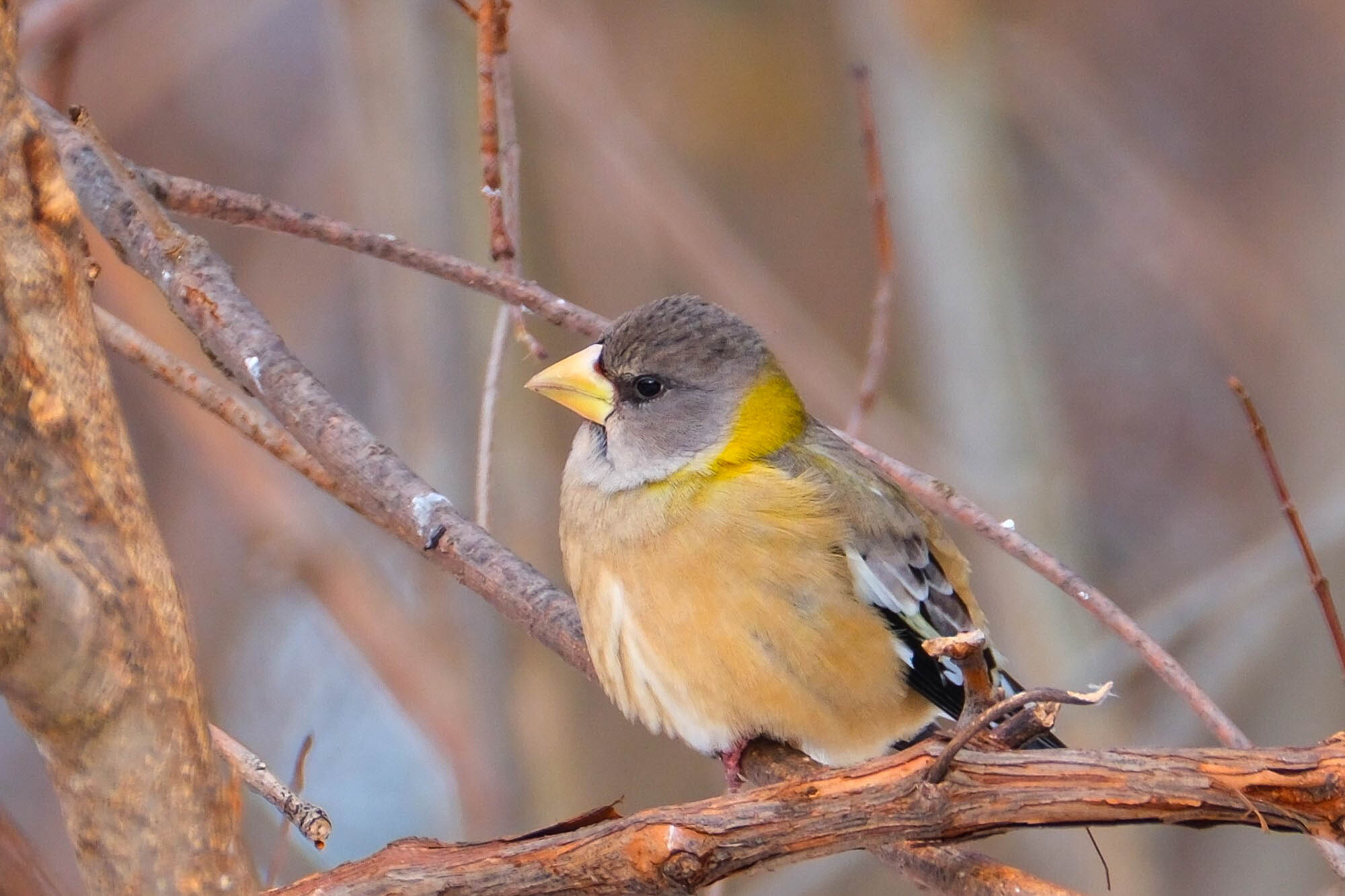
Evening Grosbeak @ Andrew Dressel (via iNaturalist)
Here in eastern Vermont, we are fortunate to have the Vermont Institute of Natural Science nearby, which can take in and rehabilitate injured songbirds. When you find an injured songbird, VINS suggests that you never give food or water to an injured bird, but immediately put it in a dark, quiet place, and call for advice and transport. We found an old box in the car, lined it with a t-shirt and immediately closed the lid. Stress can kill a small songbird, so we aimed to keep the drive as quiet as possible—we had the heat on low to keep the car warm, and the radio off. An hour later, we arrived at VINS, filled out the intake paperwork, and wished our sweet female grosbeak the best of luck in healing.
How Can You Help Evening Grosbeaks?
Not only are Evening Grosbeaks one of the fastest declining birds, but they are also one of top species for window strikes in the United States. In fact, well over one billion birds die each year from collisions with windows in the United States alone. During the non-breeding months, Evening Grosbeaks can spend large amounts of time near buildings with feeders—and glass windows.
To better understand the Evening Grosbeak’s window collision vulnerability and the impact this threat has on populations, our colleagues in the Evening Grosbeak Working Group have recently set up an iNaturalist project seeking observations of Evening Grosbeak window collisions.
If you find an Evening Grosbeak that struck a window, all you need to do is submit your observation to the iNaturalist project Evening Grosbeak Window Collisions and fill out the following required fields:
- Location
- Date
- Species – Evening Grosbeak (Hesperiphona vespertine)
- Was the bird Alive or Dead?
- Was this bird banded?
- Are you using feeders?
Optional information can be shared:
- Photo
- What is the distance of feeders from the nearest window?
- Does window or glass have bird collision deterrents?
- What side of the building was the collision (N,S,E,W)?
- Have you observed other bird collisions on your windows/glass? If so, what species?
Your contributions to this project will ensure that any deaths are not in vain. If you’d like to learn more about retrofitting your house with safer, bird-friendly glass, check out this ABC article on preventing glass collisions .
Help Us With Research: Look Out for Banded Grosbeaks
If you have Evening Grosbeaks visiting your feeder, you can also keep a look out for color-banded birds. Please report banded or tagged Evening Grosbeaks to the USGS Bird Banding Lab at www.reportband.gov and email David Yeany at dyeany@paconserve.org .
Please note and record:
- Location (Latitude/Longitude coordinates or address) and date
- Sex of bird:male or female (all birds have adult-looking plumage after Oct)
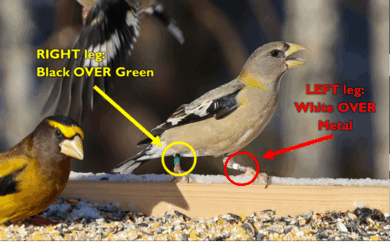
- Upper and lower bands on each of the bird’s right and left legs. All banded birds will have a metal band plus up to three colored bands. Example: RIGHT LEG: WHITE over METAL, LEFT LEG: BLACK over GREEN.
- Note if the bird has a transmitter.
Support Desirée Narango’s research and other projects like this by making a donation to Vermont Center for Ecostudies! Learn about other ways to support VCE here.


We have had about 25 Evening Grosbeaks here at our house on Peacham Pond Road in Marshfield. Usually they are here in as many as 60 and a bit earlier. This year there were fewer crab apples due to the drought and the robins cleaned most out early on, then 5 grouse were here for a week and now the grosbeaks are here. There are so many Blue Jays this year –as many as 50 at a time–that the grosbeaks are intimidated. Yesterday I saw 9 Pine Grosbeaks, my favorite, a mile down the road by the cemetery.
Thank you for all this support for one of my favorite birds. Flocks of various sizes have been coming every spring (February or so) and stay the summer to breed for the past 40+ years here! We have not had window strikes, but we twined ribbons on a hard-to-see fence, because a few Evenings have run into them . Two went to VINS for rehab, and one was returned to us. Will keep an eye out for bands. This winter we have had 2 visitors- quite unusual here. Be sure to support https://finchnetwork.org/ too, as well as all your great work!
Saw an Evening Grosbeak in my yard last couple days. I am in Newfane Vt.
Incredibly handsome bird
Thank you for your good efforts
I had about ten evening Grosbeaks at our black oil sunflower seed tray feeder yesterday January 19, 2026 in WOLCOTT, Vermont.
We have a flock of about 30 here in Grafton. They eat me out of house and home and argue with each other over
Every seed. They are so beautiful. The small flo k of bluebirds flies with them. Interesting.
I saw a male evening grosbeak at our feeder with a pink band on its right leg. Is this one you may have tagged? Reported it to USGS bird band site. Couldn’t see or tell if it had any others as it’s so cold up here in Newark that all the birds are puffed up.
It definitely could be! Evening Grosbeaks were captured not far from there and they do travel far. If you have any pictures and would like to send them along, you can email them to dyeany@paconserve.org. Thanks for your observations!
We had a flock of 15 Evening Grosbeaks at our feeder in Belmont Vermont in January. They are beautiful and happily shared the bird feeder with chickadees, titmouse and others.
I do not think they were banded.
I’m in Saranac Lake, NY (Adirondacks) and have quite a large flock of Evening Grosbeaks feeding on sunflower seeds in our backyard this morning (7 am). I’ve never seen them here before—I assume they’re migrating somewhere else? I can’t tell if any are banded—they move fast!
I live in Hanwell New Brunswick Canada.
We have at least two flocks that come to my two large feeders each day….and yes they polish off my feeders and the rock i leave food on in less than a day lol. We get probably each day 100-130 birds between the two flocks (approx 60-70 birds each) they feed in a flurry. The finches, Redpoles, chipper sparrows, junco, oh and cant leave out the black capped chickadees, all appreciate them as they throw seed on the ground that they go after.
Just one question why are the grosbeaks on such a decline.
Car strikes happen so frequently in Vermont because Vermonters drive way too fast. I know because I live on a road in western Mass on the border of southern Vermont that is heavily traveled by out of staters, especially from Vermont. They consistently ignore the speed limit signs and it’s really disrespectful and inconsiderate. I have taken my life in my hands several times by stopping the car in the middle of the road to get out and move nestlings, turtles and one time a newly born fawn.
I live in Southern Oregon, and have a pair of Evening Grosbeaks on my property. This is the first time I’ve had the honor of having them around.