The Federal Government Is Funding Conservation Work…for Now
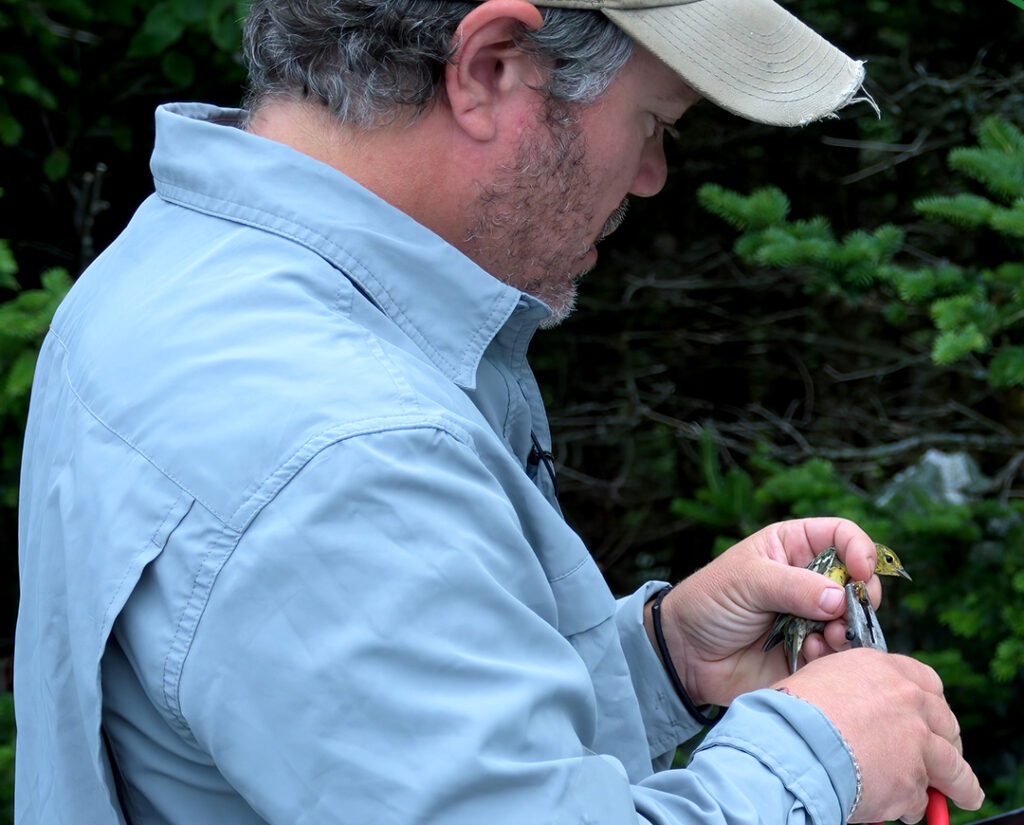
VCE biologist Mike Hallworth carefully attaches bands to a Blackpoll Warbler. This bird was banded and tagged under VCE’s USGS Bird Banding Lab permit. The Bird Banding Lab administers all U.S. bird banding and was one of the many programs that avoided deep federal funding cuts. Photo credit: Mike Sargent
When it comes to nail-biting spectacles, federal budgeting rarely makes most folks’ top 10 list. However, the 2026 budgeting process caused a fair bit of drama and anxiety, especially for the conservation-minded among us.
In early 2025, many people were worried after the president’s budget recommended dramatic cuts to all but a few science and environmental programs, including the National Science Foundation, Environmental Protection Agency, and Fish & Wildlife Service.
Many ecologists, including members of VCE’s staff, were particularly concerned about the proposal to “zero out” (read: end) the U.S. Geological Survey’s Ecosystem Mission Area. Had this gone through, the U.S. likely would have shuttered several research facilities across the country that tackle invasive species, provide data on climate change effects, and support U.S. Fish & Wildlife Service professionals.
The Ecosystem Mission Area also houses the Bird Banding Lab, which administers all bird banding in North America. In the months it took for the final budget to pass, VCE scientists were worried about the fate of their research and, more broadly, U.S. bird banding work if the program were to lose funding. Without the Banding Lab, scientists would be left in limbo without a clear path for obtaining bands or accessing data on bird migration and population health.
Fortunately, after nearly a year of speculation, debate, and false starts, budgeting for U.S. science programs is done, and many programs avoided the deep cuts that were threatened—for now.
The Making of a Federal Budget
To understand why developing the federal budget is such a messy process each year, we need to dig into how it actually gets made.
The executive departments (e.g., Department of Energy, Department of Agriculture, etc.) and independent agencies, like the Environmental Protection Agency, kick off the process by developing and submitting their own budget requests to the White House Office of Management and Budget (OMB). OMB references these requests as they draft the president’s budget and then sends that to Congress.
Once Congress receives the president’s budget, legislators begin formulating their own budget bills in 12 appropriations subcommittees, each responsible for drafting budgets for a subset of agencies. (For example, the Commerce, Justice, Science, and Related Agencies Subcommittee drafts budgets for the Department of Commerce, the Department of Justice, and science agencies, like NASA.)
Once the subcommittees have finished drafting the budgets for their agencies, they pass their bills along to the rest of Congress. From there, the House and Senate must each finalize their own versions of the subcommittee budgets and merge them into a single document for each set of agencies. These finalized bills are then sent to the president, who can decide whether to sign them into law or veto them. If the bills are vetoed, Congress must negotiate a version the president will sign.
In an extremely polarized and combative government, it’s easy for the budget process to get stuck at any of these stages.
What’s in the Budget
Ultimately, the budgets that direct federal funds to science and environmental programs were passed in late January and largely avoided the threatened cuts.
Here’s a breakdown of the funding, provided by the American Institute of Biological Sciences. The president’s original request is in the middle column, and the funding that is actually being allotted is in the right-hand column.
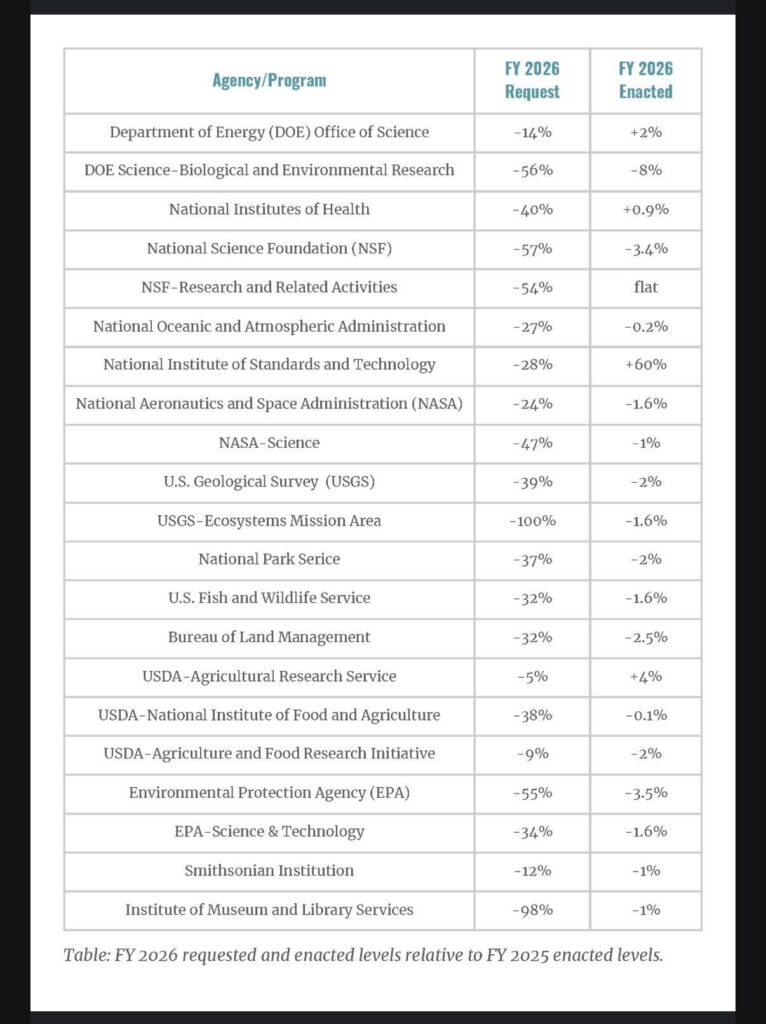
Proponents of science—and science-based decision-making—might prefer to see funding for these programs increase alongside increases in federal tax revenue and the complexity of environmental problems; however, given the president’s original requests, minor decreases are worth celebrating.
For now, the federal programs and partners VCE works with are securely funded for fiscal year 2026 with enough money to operate as close to normal as possible, given the significant reductions in force that occurred throughout 2025. Across the country, state, academic, and non-profit institutions continue to gather data, publish results, and offer insights for creating a more secure future for biodiversity despite federal funding cuts. However, many unknowns remain.
Last year, the administration made several attempts to prevent the distribution of congressionally mandated funds, like in the ongoing battles over the disbursement of climate funds. In the weeks since the 2026 budget was passed, the White House has already begun directing agencies to withhold funding for programs that the president’s budget had proposed to cut.
Even if funding is restored, it wouldn’t undo the damage already caused by loosened regulations and reductions in the federal workforce. The knowledge and capacity lost will be difficult—if not impossible—to completely recover. Additional employee layoffs also remain a possibility, especially as the administration continues to explore new avenues to make layoffs easier.
This whole saga underscores the need for conservation organizations, like VCE, to continue collaborating with federal partners to mitigate any research or management gaps that may arise. So far, our scientists have met with partners at the National Park Service and U.S. Fish & Wildlife Service to identify how our work may align with their needs should funding cuts or staffing changes disrupt their programs.
For now, here at VCE, our work continues, thanks to our donors, volunteers, and continuing grants from federal and state agencies. Our spirits are consistently lifted by the passion of our community and the tenacity of our partners.