The Unique Impact of Solar Farms on Grassland Birds
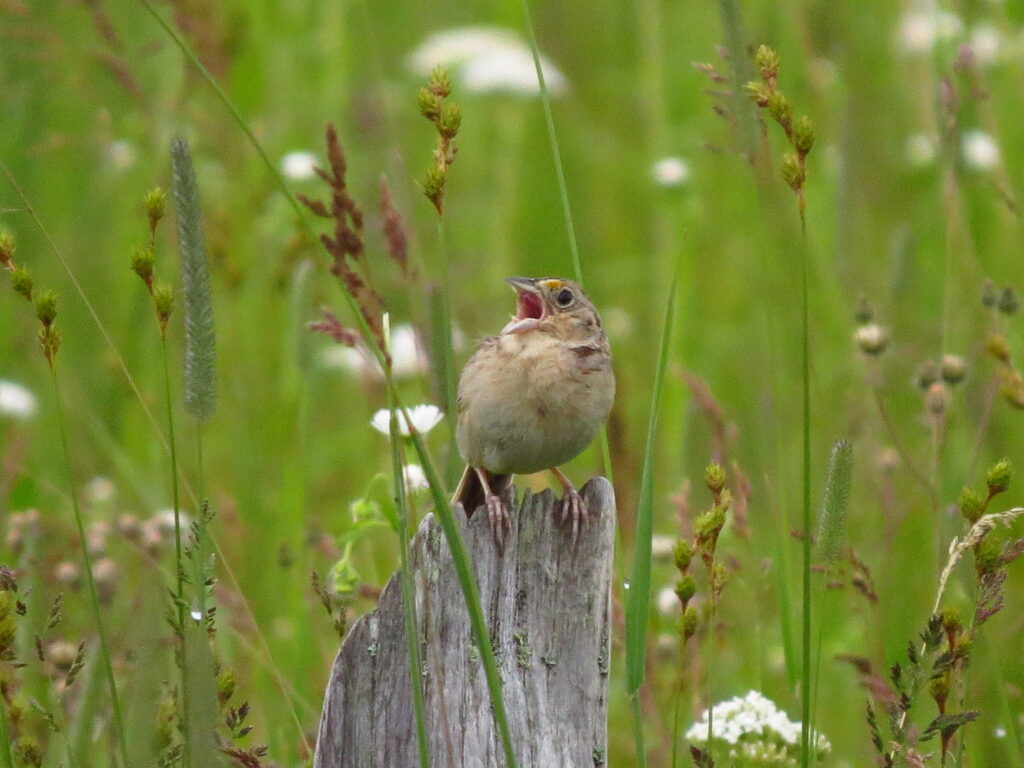
Grasshopper Sparrows lose habitat when solar panels are situated in a large grassland. © Ginny Moore on iNaturalist.
Grassland bird habitat is disappearing, and we need your help to ensure these tenacious birds have a fighting chance. As long as there are people like you who care about the sustainability of our ecosystems, there is hope. Please consider making a gift to the Vermont Center for Ecostudies before the end of this year to support grassland bird research and other projects like this. Every contribution, no matter the size, makes an impact.
Tanks and helicopters—grassland birds can tolerate a lot of disturbance.
I’ve captured and tagged Eastern Meadowlarks and Grasshopper Sparrows on the military training grounds at Fort Riley, Kansas, while tanks rumbled past our mist nets and helicopters buzzed us. At the time, with tracer bullets flying and artillery passing overhead, it felt more like a sci-fi movie, and absurdist.
But those lands are highly productive habitats for grassland bird species. Grasslands, after all, only exist because of disturbance. Without fire or grazing suppressing woody vegetation, grasslands quickly disappear into shrubs and then forest. Sometimes I’ve wondered whether grassland birds perceive tanks the way their ancestors once perceived herds of American Bison—large, disruptive forces that altered the landscape but left open habitat behind long after they moved on.
What grassland birds don’t tolerate well, however, is habitat loss. They are area-sensitive species—their densities increase as grasslands get larger, and they decline as fields are subdivided or interwoven with non-grassland habitat. Just as importantly, they respond to the perceived size of a field. A narrow row of trees, for example, can function like an uninviting wall, shrinking usable habitat far beyond the footprint of the trees themselves.
I saw this firsthand during my PhD work on Grasshopper and Henslow’s Sparrows, where we documented their population responses after experimentally manipulating tree densities in savanna-like grasslands.
Those same grasslands are increasingly intersecting with another force shaping Vermont’s landscape: photovoltaic (PV) solar farms. Under Vermont’s 2020 Global Warming Solutions Act, our state is legally required to reduce greenhouse gas emissions by 80% compared to 1990 levels by mid-century, and a substantial body of research supports expanding renewable energy—particularly solar—as a key part of those broader efforts. Reducing emissions remains one of the most important ways to safeguard ecosystems over the long term.
In recent years, thankfully, there has been a growing effort to make large-scale solar development less impactful on wildlife. Solar facilities can be designed to better accommodate wildlife—for example, by modifying (or eliminating) perimeter fencing to allow mammal movement and planting native vegetation instead of lawn grass to support pollinators. Taken together, these approaches reflect a genuine and welcomed attempt to reduce the ecological footprint of solar development.
But climate solutions unfold in real landscapes. In Vermont, utility-scale solar developments are often sited (i.e., placed) on low-intensity agricultural lands—hayfields and pastures—the very landscapes that support many of our remaining, dwindling grassland bird populations of Eastern Meadowlarks, Grasshopper Sparrows, and other species. As a result, conversations about “wildlife-friendly solar” can feel relatively straightforward for pollinators, but grind to a halt when someone brings up grassland birds.
The View from the Grass
From a Grasshopper Sparrow’s perspective, a solar installation within a former hayfield fundamentally changes how that space is perceived and used. Closely-spaced rows of panels, support structures, fencing, and access roads likely reduce the real and perceived openness of a field. Indeed, recent research found solar farms in the Midwest to be strongly, negatively associated with Grasshopper Sparrows, while the species that show positive relationships to solar fields tend to be less area-sensitive or not grassland obligate species, such as Chipping Sparrow and Eastern Bluebird.
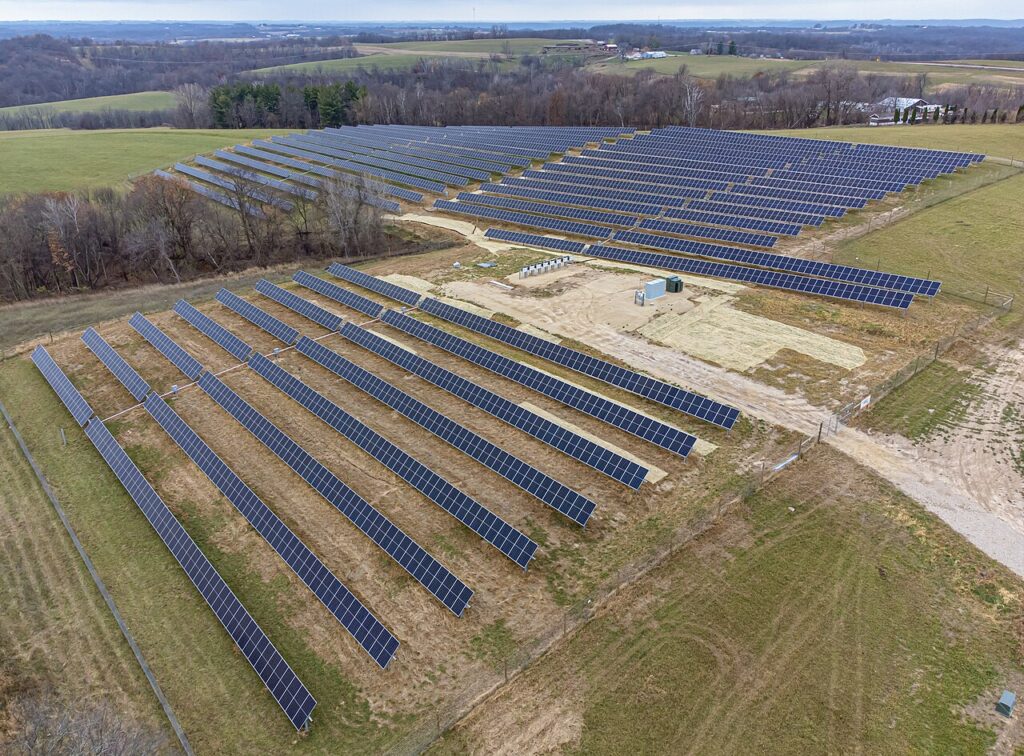
Solar arrays are frequently built on open agricultural fields—the same landscapes that support many of our remaining grassland bird populations. Wikimedia Creative Commons, all rights waived.
This helps explain why design elements that are often highlighted as “bird-friendly”—such as wider panel spacing—don’t necessarily translate into usable habitat for grassland birds. For area-sensitive species, the issue is the loss of large, uninterrupted open space and the introduction of vertical structures that visually and physically fragment what was once continuous habitat.
Small Mitigation for a Large Problem
In an attempt to partially offset this grassland loss, Vermont requires developers to address impacts to grassland birds through a mitigation process. Developers are required to survey for these species during the breeding season on fields greater than 20 acres. If grassland bird species are detected, developers must mitigate for both direct (the project footprint) and indirect (the area beyond the footprint up to 50 meters) impacts. From my experience serving on Vermont’s Bird Scientific Advisory Group, which reports to the Endangered Species Committee and reviews these permit applications, developers almost always choose the mitigation option of making a direct payment to Massachusetts Audubon, for their management of the Bobolink Project within New England. The payments occur annually for the life of the solar project, and are currently $50/acre.
Developers must conduct construction work outside of the breeding season to avoid destroying nests and young, as required under the Migratory Bird Treaty Act. So, in essence, the birds themselves are protected, but not their habitat. 
Criticism of the mitigation process towards grassland birds has largely fallen on three aspects. First, the practice assumes that displaced birds can be absorbed by a shrinking number of suitable fields elsewhere. As grassland bird populations decline and grasslands themselves become rarer in Vermont, that assumption becomes increasingly unlikely. Second, solar development can replace habitat occupied by the rare Grasshopper Sparrow, for example, but there is no requirement that mitigation funds be directed toward supporting the same species elsewhere in the state. Indeed, with fewer than two dozen Grasshopper Sparrows left in Vermont, largely concentrated on two land parcels (Camp Johnson and Franklin County Airport), this would be difficult to accomplish even if required.
Third, this mitigation framework does not distinguish between impacts to relatively common grassland birds, such as Bobolinks, and impacts to species that are already rare or state-listed, such as Upland Sandpiper and Eastern Meadowlark. As a result, habitat loss affecting Threatened and Endangered species is treated similarly to habitat loss affecting more abundant species, despite the very different conservation risks involved.
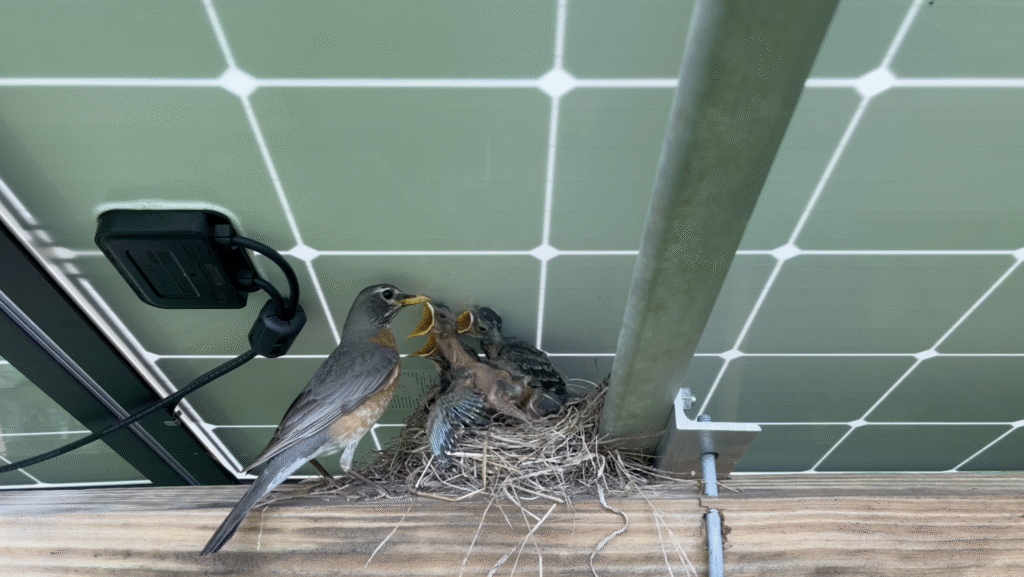
Some adaptable bird species, such as American Robin (pictured here), may nest or forage within solar installations. Area-sensitive grassland birds, however, require larger, more open habitats than conventional solar fields typically provide. © Jill DeVito on iNaturalist
Finally, while mitigation funds support grassland bird management, the per-acre payments are not sufficient to purchase, permanently protect, or manage grassland parcels in perpetuity. In response, the mitigation process is better viewed as a partial and ephemeral offset, rather than a long-term mechanism for replacing lost grassland habitat.
Siting Solar to Protect Grassland Birds
As Vermont works to meet its climate goals, solar energy will continue to play an important role in reducing greenhouse gas emissions, but we still have much progress to make to design solar farms that are at least neutral toward grassland birds. This may mean placing greater emphasis on siting decisions and creating stronger incentives to avoid high-value grasslands and fields that support Threatened and Endangered Species. It may also involve exploring whether design elements—such as panel height, spacing, layout, or resting angle in tracking systems, plus vegetation management—can meaningfully reduce the fragmentation of grassland bird habitat.
These challenges represent real opportunities for policymakers, landowners and developers, and conservation practitioners to co-develop and test innovative solutions, to meet both our energy needs and wildlife responsibilities. Grassland birds remind us that climate solutions involve tradeoffs that are not always easy to resolve. Clear-eyed conversations about where solar development occurs, how impacts are mitigated, and what success looks like for wildlife are essential if we hope to meet our energy goals without losing species that are already in decline.
If you are interested in collaborating to explore or test novel approaches that could help solar development better coexist with grassland birds, please get in touch. I would welcome the conversation.
Support grassland bird research and other projects like this by making a donation to Vermont Center for Ecostudies! Learn about other ways to support VCE here.


Do you have any quantitative data on upland sandpiper, grasshopper sparrow, eastern meadowlark that evaluates change in occupied habitat use after construction that also takes into consideration vegetation structure, maintenance schedules and array design?
How did VT develop mitigation fee?
Hi Brian,
Great to hear from you and thanks for the questions. I get very few questions and comments on my posts, so I’m always excited to discover that at least one person has read them. To my knowledge, we don’t yet have quantitative, before–after datasets in New England or elsewhere that track changes in occupancy or habitat use for area-sensitive species like Upland Sandpiper, Grasshopper Sparrow, or Eastern Meadowlark following solar construction while also accounting for vegetation structure, maintenance schedules, and array design. Those kinds of studies are very challenging to implement here for a few reasons. Solar projects on private land often move from proposal to construction relatively quickly, which limits opportunities to collect baseline data. We on the Scientific Advisory Group, for example, typically find out about a proposed solar development only a few months before construction begins (often in late winter when those migratory species are not present). Because most sites are privately owned, longer-term access for multi-year monitoring also depends on landowner and developer permission well in advance of construction and into the operational phase.
That being said, I think there’s growing interest in understanding these questions more rigorously. Some developers are genuinely interested in making projects more compatible with wildlife, and we jointly submitted a large grant proposal ~4 years ago with a local solar developer to get at exactly the kind of data you asked about, plus data regarding invertebrate and bat communities. We proposed to conduct different management practices at each site, trying to get at understanding the mechanisms potentially driving changes in wildlife communities at solar farms. Unfortunately, that proposal was not funded, and we are waiting on another suitable funding opportunity to hopefully resubmit one day.
On your second question about how the mitigation fee was developed: I don’t know the full historical context of the origins of the mitigation rules and rationale. I know there are some structural barriers that present challenges to changing these rules. For example, I asked last year if Vermont Fish and Wildlife could hold onto mitigation monies until they had sufficient money to (for example) purchase a parcel of open land to permanently manage as grassland habitat (ideally, adjacent to an existing WMA). I was told that the applicable state laws would not permit that, and the mitigation money must be spent immediately. I’ll tell you what—I will ask about the early origins of the mitigation rules at our next Scientific Advisory Group meeting this spring and report back here once I learn more. Maybe somebody reading this blog post and our conversation, might have some insight that they can share by submitting their own comment.
I’d certainly welcome the chance to talk more if you or others are interested in collaborating on ways to gather the kinds of data you’re describing. If before-after data is off the table (because the development has already happened), then we still might gain some insight from manipulating vegetation around the perimeter of solar farms. The current situation is an opportunity for creative thinkers to put their minds together for the benefit of solar AND grassland birds.
Thanks again for the questions.
I love your explanation of the macro perspective re: grassland species’ needs for disturbance management to maintain their desired habitat and the comparison of modern tank activity to bison herd disturbance! And great explanations of habitat needs by species and the need to prioritize by specific threatened species vs. the over broad filter of “grassland birds”.
Many thanks Kate–I really appreciate that.
I have a dumb question that’s probably already been thought of and most likely cost prohibitive, but in very large field locations could the panels be put around the periphery of the surrounding woods instead of in the middle of the field? it would resemble the natural edge of forest-field transition. This would leave the field wide open.
Hi Linda!
That is NOT a dumb question at all. I really like how you’re thinking–concentrating panels near the field edges to preserve as much open space as possible for area-sensitive birds to nest in the middle. I have never seen a large solar farm oriented like that, and I presume that cost and solar efficiency are the main deterrents for developers. Tightly clustering the panels means a smaller project footprint and hence cheaper mitigation fees and a less-costly lease with the landowner. The tight spatial arrangement of panels also makes the installation and maintenance easier, with fewer meters of power cables, access roads, and fencing to build/maintain. If the edge of the fields are forested, then panels near the edges would be subjected to shading and a reduced solar efficiency.
However, I know of several very small solar farms (e.g., at Brookmead Conservation Area in Norwich, VT) where the panels are clustered near the edges of the fields. At Brookmead, for example, the panels sit on a south-facing hill on the edge of the field. However, this solar field is very small, maybe 0.3 hectares and might produce only something like 0.2 MW. So that’s much smaller that the large-scale solar projects in Vermont (~20 MW) and even smaller than most community solar fields (+1 MW) fields to my knowledge. But regardless, I’d cite that farm as an example, and the rest of the big field does host some grassland birds.
Moving up I-89 from me, there’s some solar farms on both sides of the road in Royalton/Sharon area and I think these are good examples worth pointing out. This ~2 MW facility is right next to the interstate, spread across multiple small former ag fields that are too small to support grassland birds. For me, that’s a win-win: solar-energy + no impacts to grassland birds.
Going back to the birds and your original bird-friendly idea. There’s a property out there, somewhere (West Side Story reference, anyone?) where your suggested panel arrangement would be a great fit. The risk that you’d need to guard against, is filling in the edges of the field so much on all sides that you’re left with a middle, panel-less section that’s too small in absolute area and too surrounded by edges to harbor grassland birds. But I think this is exactly the kind of situation that might be a good compromise for birds and energy production. I think the biggest hurdle might be finding the right landowner and developer who would entertain such a project, and then finding an ornithologist (ahem) who’d monitor the birds before, during and after to see how well it worked.
If folks know of some other bird-friendly solar arrangements in the Northeast, 1 MW and up, please feel free to point them out in the comments below. And thank you again, Linda, for this excellent question.