We Are ALL IN for Biodiversity
At the Vermont Center for Ecostudies, we believe in the power of community science to inspire and guide biodiversity conservation. There’s something about sharing in the joy of discovery, and working together to protect what we love, that lightens the weight of environmental challenges. Time and again, our conservation scientists have harnessed your curiosity and support to produce practical conservation tools. And the tools keep getting better!
Since the 1970s, these tools have evolved:
- from management recommendations for declining species to statewide recovery plans;
- from wildlife distribution models to permanently protected conservation areas;
- from narrowly targeted technical reports to science coaching for teachers and legislators;
- from local and short-term collaborations to decades-long international partnerships; and
- from hardbound bird atlases to a free online portal to maps, photographs, checklists, and real-time biodiversity data spanning all living taxa.
 These are just a few examples of the tools sought out by public and private land stewards and backed by peer-reviewed science.
Buoyed by the success of our cooperative, evidence-based approach, we set out in 2018 to dramatically increase VCE’s capacity and conservation impact. Our guide on this path has been a strategic plan that motivates us to:
- invest in pioneering science;
- collaborate for conservation outcomes; and
- broaden our vision for community science.
This is ambitious and never-ending work, and we’re grateful to be carrying it out with you.
Thank you for contributing your ideas, observations, and hard-earned dollars. Thank you for your questions, advice, and stories from the field. And thank you for joining us in the hopeful inquiry and eye-opening discovery that make it possible to sustain that which sustains us.
When it comes to conserving biodiversity, it’s great to know that we’re all in.
Investing in Pioneering Science
VCE has increased the scope and impact of our science by expanding the Vermont Atlas of Life, enhancing long-term monitoring with cutting-edge research, and adding new fields of expertise to our team of conservation scientists. Together with dozens of collaborators, we are building knowledge to generate conservation solutions here and across the hemisphere.
Explore the Vermont Atlas of Life (VAL) to access occurrence maps, species accounts, and open data for more than 14,000 plant, animal, and other species! And discover how findings from VAL’s 10th Anniversary Report can guide conservation activities statewide and inspire biodiversity assessments elsewhere.
Read about breakthroughs in understanding threats to Bicknell’s Thrush survival, the nesting ecology of Hispaniolan birds, and the migratory patterns of Upland Sandpipers, Eastern Meadowlarks, and Grasshopper Sparrows.
Learn how international science collaborations have enabled us to link the rapid northward expansion of Eastern Giant Swallowtails to climate change and to deploy an intercontinental network of AI-powered moth monitoring stations.
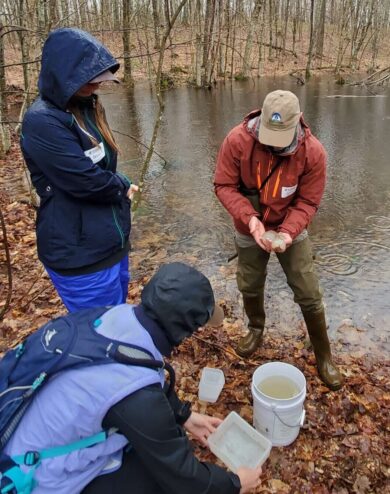
Take a look at other ways we’re using innovative technologies to study the response of vernal pool amphibians to climate change, to evaluate the efficacy of prescribed burns in dry oak forests, and to track Bicknell’s Thrush across the hemisphere and verify the accuracy of our predictive spatial model of prime winter habitat.
Find out how we now know that vernal pools are hotspots of mercury bioaccumulation and that mercury concentrations in the blood of mountain-breeding thrushes are below levels known to impair reproduction in other invertebrate-consuming songbirds.
Visit the frontier of invertebrate science as you read about ongoing VCE efforts to rank plant species by their value to pollinators, find out if organic lawn sprays control ticks, and understand the relationship between high-elevation invertebrate and bird populations.
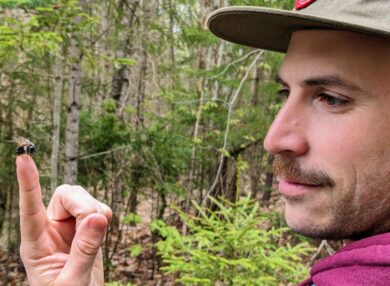 Check out our Vermont Wild Bees Report, and our atlases for vernal pools, bumble bees, lady beetles, moths, and butterflies to see how we’re expanding the frontiers of atlasing, regularly recording new species for the state, and showing our peers in other states how atlas results can be applied to conservation.
Participate in one or more long-term monitoring projects, which inform the design of pioneering research, illuminate emerging threats, and help prioritize conservation actions.
Honors and Awards
Over the years, VCE staff and collaborators have received numerous awards and honors recognizing their outstanding contributions to conservation and ecological science in Vermont and beyond.
You can read about some of their achievements below.
Chris Rimmer Receives Partners in Flight Lifetime Achievement Award
VCE Biologist Eric Hanson Wins GMP-Zetterstrom Environmental Award
VCE’s Jason Hill Receives High Honor as AOS Elective Member
VCE Biologist Kent McFarland Receives Sally Laughlin Award from the State of Vermont.
VCE Biologists and Colleagues Earn U.S. Forest Service International Research Award
VAL Gets a Boost with SciStarter’s Inaugural Award for Outstanding Work in Community Science
Haitian Colleague Anderson Jean Receives Prestigious Conservation Award
Dominican Colleague Yolanda León Receives Prestigious Conservation Award
Collaborating for Conservation Outcomes
VCE is leading action-oriented partnerships and creating practical tools to protect biodiversity. By introducing evidence-based stewardship strategies to landowners, legislators, and other key decision makers, we are putting our science to work for conservation.
Explore the useful conservation products of the Vermont Wild Bee Survey, compiled in the landmark State of Vermont’s Wild Bees report, including conservation ranks for 335 species, a watchlist of imperiled species, and maps of Important Bee Areas, unique bee communities, and priority regions for future surveys.
Find well-informed management guidance for conserving wild bees in gardens, yards, powerlines, and forests. And get to know the species that serve as important pollinators for agricultural crops like apples, strawberries, blueberries, and squash.
Learn how the Vermont Loon Conservation Project’s exemplary blend of monitoring, management, and outreach have enabled recovery of this iconic species, from a low of eight nesting pairs in the 1980s to well over 100 in recent years.
Zoom in to a critical wetland near you with the Vermont Vernal Pool Atlas. This interactive map is a go-to resource for landowners, foresters, and land trusts aiming to safeguard vulnerable amphibian populations.
Page through the Vermont Atlas of Life 10th Anniversary Report to find biodiversity hotspots and an assessment of how well today’s conserved lands protect the state’s natural heritage—now and in future climate scenarios.
Step into the field with a seasonal biologist studying the efficacy of sugarbush management standards intended to benefit migratory birds and maple syrup producers. And learn how our collaboration with Audubon Vermont and the University of Vermont is linked to complementary research into sugaring’s effects on ecosystem services and socio-economic outcomes.
Read about the launch of a Science to Policy Working Group that provides a forum for scientists to share findings with lawmakers and lawmakers to communicate their information needs.
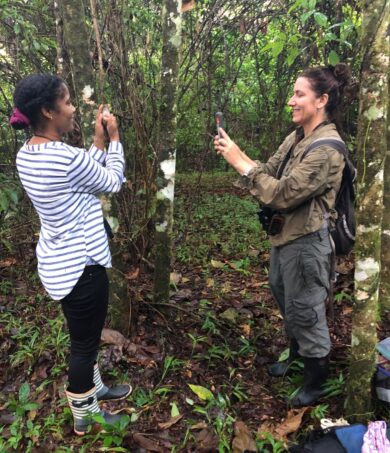 Find out how we’ve worked with partners in the Greater Antilles to identify and protect a 1,000-acre reserve in the Dominican Republic, curb illegal deforestation in globally important habitat, and narrow down the whereabouts of Bicknell’s Thrush in Cuba.
Travel to the DR’s Sierra de Bahoruco National Park with Executive Director Susan Hindinger, Director Emeritus Chris Rimmer, and Caribbean Conservation Coordinator Jim Goetz on a mission to map Bicknell’s Thrush migration routes. Watch Chris nanotag a bird for this effort to locate stopover sites needing protection.
Discover how VCE’s Grassland Ambassadors are helping farmers improve essential nesting habitat, and you’ll understand why the State of Vermont asked us to write a recovery plan for the endangered Eastern Meadowlark.
Learn about a highly collaborative research project that could help forest managers curb impacts of mountain bushwhacking.
Broadening Our Vision for Community Science
As a national leader in people-powered science, VCE is fulfilling its obligation to broaden the community that participates in field studies and benefits from them. Our outreach activities and internship program reflect our commitment to cultivating diversity not just in our corps of volunteers but in the field of community science itself.
Look at results from our 2019 survey of community scientists, which provide a baseline understanding of volunteer demographics and motivations.
Read VCE’s Commitment to Diversity, Equity, and Inclusion, which guides our efforts to improve access to naturalist pursuits and professional opportunities in science.
Learn why we switched to more inclusive language in describing what we do.
Enjoy the reflections of two VCE interns, whose experience at VCE has helped prepare them to be a part of diversifying the field of ecology.
See how the Vermont Atlas of Life makes millions of biodiversity records available to any internet user in a variety of useful formats (scalable maps, tables, charts, and photographs).
Meet Desirée Narango, who brought urban and suburban ecology expertise to VCE when she joined the science team in 2022.
Find out how eButterfly, a VCE collaboration with Canadian partners, has made it possible for anyone with a smartphone, anywhere in the world, to collect useful data and identify unfamiliar butterfly species. And learn how the second Vermont Butterfly Atlas is using this tool to lower barriers to participation and verify field identifications.
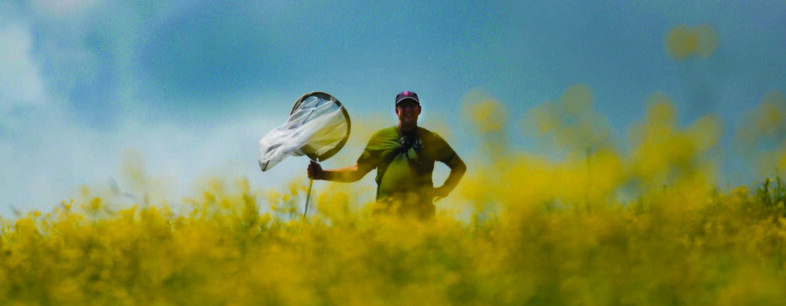
Meet Levi Smith, a talented naturalist and recipient of our inaugural Youth Community Scientist of the Year Award. And learn how our Community Science Teacher Workshops are empowering educators to stoke their students’ scientific curiosity and motivate more youth to explore and care for the natural world.
Listen to a hopeful message from Doug Tallamy, one of North America’s most influential ecologists, given at the 2023 Biodiversity Jamboree, a free event attended by hundreds from several generations. This partnership with the North Branch Nature Center is the seed of a statewide community science network that we’ll cultivate with the addition of a community science coordinator to our staff.
Conservation Coffee Hour
Want to learn more about some of the work supported by the ALL IN for Biodiversity campaign? VCE Executive Director Susan Hindinger hosted a series of 45-minute Zoom chats with our scientists about their campaign-supported projects, with opportunities for attendees to ask questions.
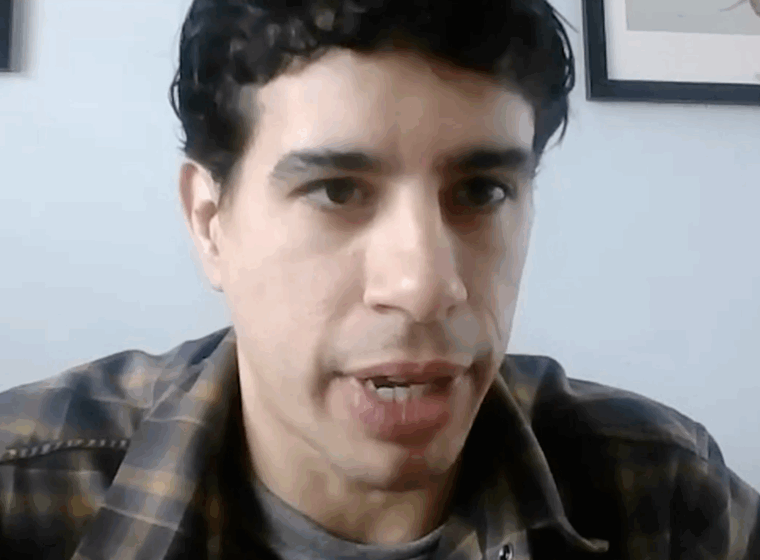
Future Ecologists Internship with Ryan Rebozo »
Hear VCE Director of Conservation Science Ryan Rebozo share highlights from the first couple years of our Future Ecologists internship. VCE launched our Future Ecologists internship for aspiring ecologists underrepresented in the field of ecology, providing an opportunity for two aspiring ecologists to join VCE each summer.
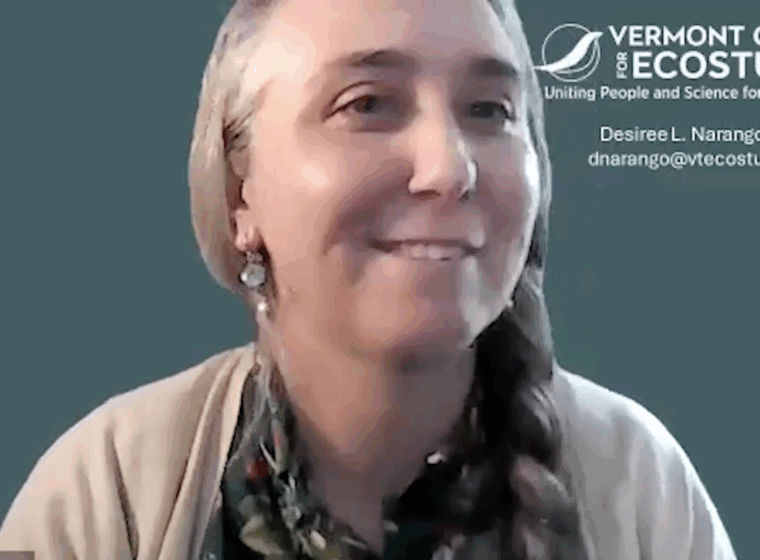
Native Plants and Pollinators with Desirée Narango »
Now that spring has sprung, spend an hour getting excited about native plants and their pollinators. VCE Conservation Biologist Desirée Narango shares her extensive knowledge and dives into her research projects that center plant-pollinator interactions.
Vermont's Wild Bees with Spencer Hardy »
Join Susan and VCE bee biologist Spencer Hardy for insights into Vermont's bee diversity. Together, they will discuss key takeaways from the 2022 State of Vermont's Wild Bees report and explore its conservation impacts in Vermont and beyond.
Backyard Tick Project with Jason Hill »
VCE Conservation Biologist Jason Hill launched the Upper Valley Backyard Tick Project in 2023 to explore whether tick spraying has unintentional impacts on beneficial insect communities. Hear takeaways from the first year of data collection and Hill's plans for the next summer.
Changes in Wildlife Atlasing with Kent McFarland »
For decades, wildlife atlasing has been a cornerstone of long-term biodiversity monitoring. Hear VCE Conservation Biologist and Vermont Atlas of Life director Kent McFarland share his reflections on how atlasing has evolved over the years, discuss the second Vermont Butterfly Atlas, and offer thoughts on the upcoming third Vermont Breeding Bird Atlas.
VCE faces an exhilarating period of growth and transition as we celebrate our first 12 years and look ahead to our next chapter. In the next five years, we will focus on three strategic goals in addition to the ongoing, innovative conservation science programs that are our hallmark.