Got Caterpillars? New Research Finds They’re Essential for Eastern Bluebirds
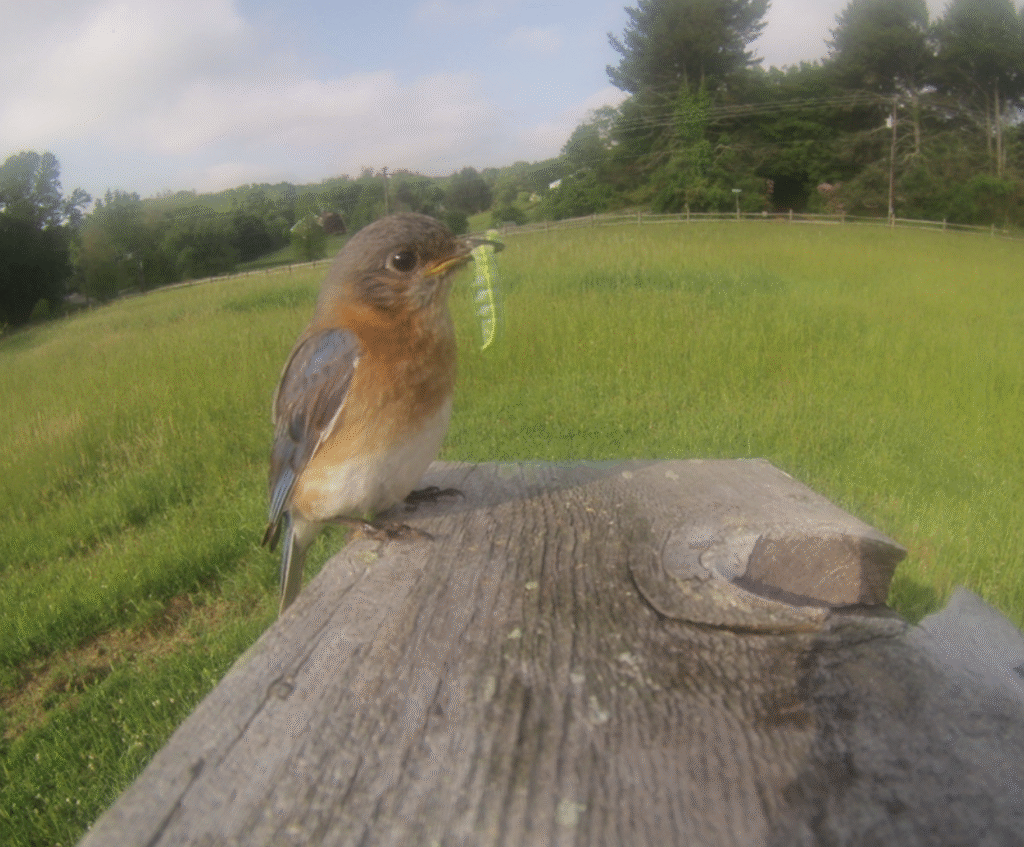
A female Eastern Bluebird on the roof of a nest box, before provisioning nestlings with prey (Amphipyra pyramidea caterpillar) at Mt. Cuba Center, New Castle County, Delaware, June 2016. Photo taken with a GoPro® HERO 3+. Photo by Ashley Kennedy.
How important are insects to bird diets? Are some insects more important than others?
These are questions I’m asked regularly—and for good reason. Much of my research focuses on studying food web relationships among plants, insects, and birds, to help us better manage human-dominated (read: urban, suburban, and residential) landscapes to support wildlife conservation. I’ve spent a lot of time thinking about what birds eat, and why it matters.
In my own studies examining global patterns of bird diets, I’ve found that more than 95% of songbird species (Order Passeriformes) eat insects or other invertebrates at some point during the year. That’s over 6,000 species worldwide! Even when we narrow the focus to songbirds whose diets are mostly invertebrates (meaning more than 50% of their food), that still includes about three-quarters of all songbird species. That is a lot of birds relying on insects.
Even though birds have been studied for centuries, we are only recently beginning to uncover the finer details of the diets of even our most familiar and well-studied species. Now, thanks to advances in molecular techniques (like DNA metabarcoding and stable isotopes) and new autonomous tools (such as camera traps), we’re now getting more detailed and accurate diet information than ever before.
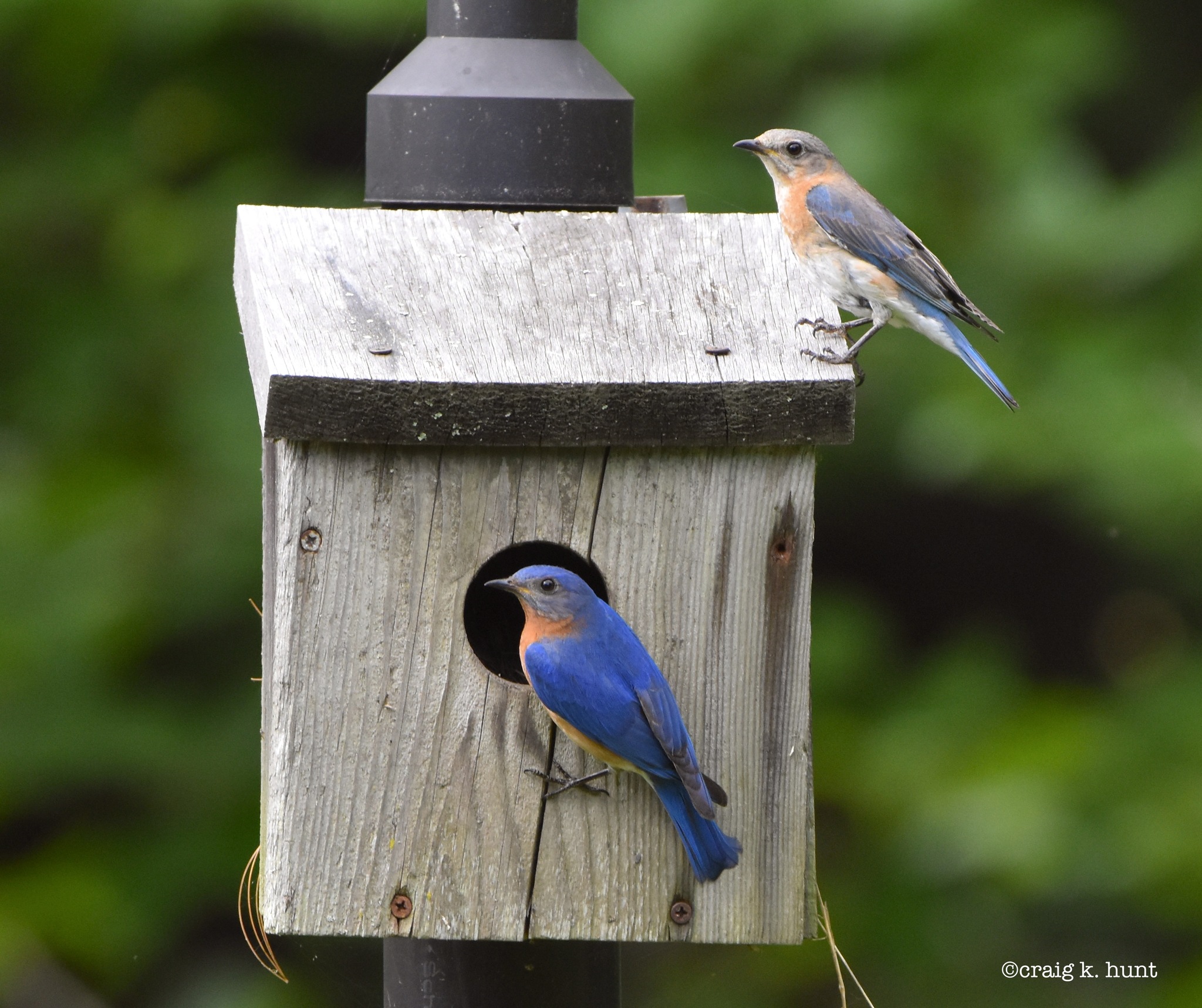
Eastern Bluebirds © Craig K. Hunt (via iNaturalist, licensed under CC-BY-NC)
Recently, we published a new paper examining the nestling diet of one particularly well-studied (and well-loved), species: the Eastern Bluebird (Sialia sialis). My colleague Ashley Kennedy used time-lapse GoPro cameras installed at nest boxes, taking photos once per second to capture the food items adult bluebirds brought back to their chicks. Fortunately for us, bluebirds were very cooperative and often paused on top of the nest box before entering, giving the cameras a clear view of each food item.
By the end of the study, Ashley had amassed more than 8 million (!) photos, of which 8,128 captured identifiable food items, giving us fine-scale detail about exactly what Eastern Bluebirds were bringing back to their nestlings.
One of our most striking findings was the importance of caterpillars (the larvae of butterflies, moths, and sawflies). Early in the breeding season, caterpillars made up about 35% of all food items brought to nests. Later in the season, that number rose to nearly 45%.
This result was especially interesting because Eastern Bluebirds typically forage in open, grassy areas. Yet many of the caterpillars they brought back are species that are specialized on trees and shrubs. After feeding, these caterpillars drop to the ground to pupate, where bluebirds likely encountered them, either on the ground or while foraging in nearby vegetation.
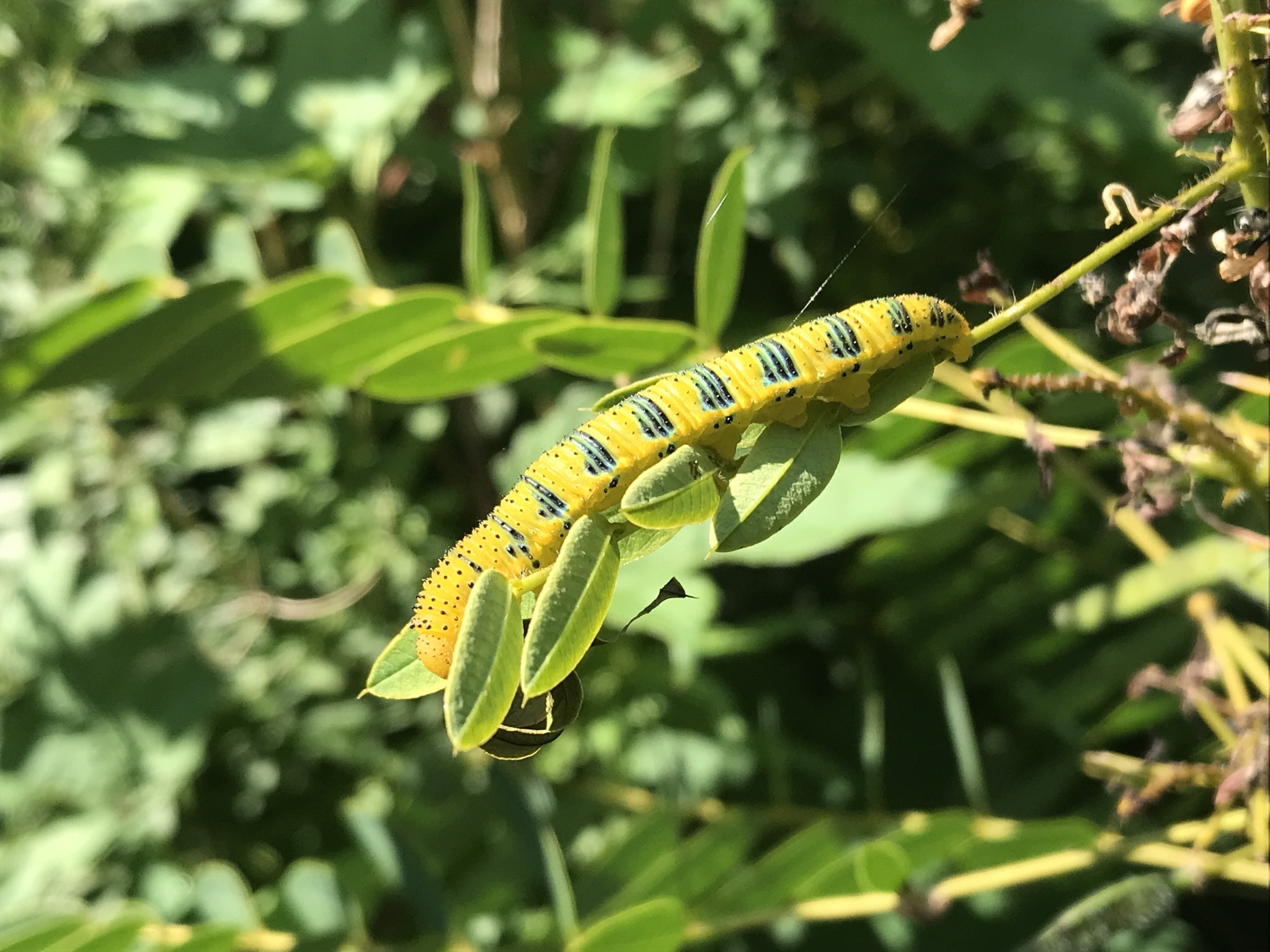
Cloudless Sulphur Caterpillar © Desirée Narango
Other frequently delivered prey included grasshoppers and spiders. Grasshoppers are abundant in the open habitats bluebirds prefer, making them an easy and reliable food source. Spiders, meanwhile, consistently show up as an important component of bird diets. They are especially rich in protein and taurine, which is an amino acid critical for growth and development. Previous research suggests taurine may be particularly important for nestlings as they rapidly grow bones and feathers.
Just as interesting as what bluebirds did bring was what they didn’t. Fruit was almost never fed to nestlings, despite being available in the late summer, which makes sense, nutritionally. While fruit can be high in sugars or fats, it is low in protein and provides relatively little value for growing chicks that need protein-rich food.
Other invertebrates, such as earthworms, flies, mantids, snails, centipedes, and millipedes, were also rarely provisioned. These prey items may be less abundant, harder to capture, or simply not nutritious enough to justify the effort required to collect and deliver them to the nest.
Together, caterpillars, grasshoppers, and spiders accounted for roughly 80% of all food items delivered to bluebird nests. And there were surprisingly few differences according to brood size, nestling age, adult sex, or time of year. Caterpillars—and to a lesser extent, grasshoppers and spiders—were consistently important regardless of who was feeding, when they were feeding, or how many chicks they were feeding.
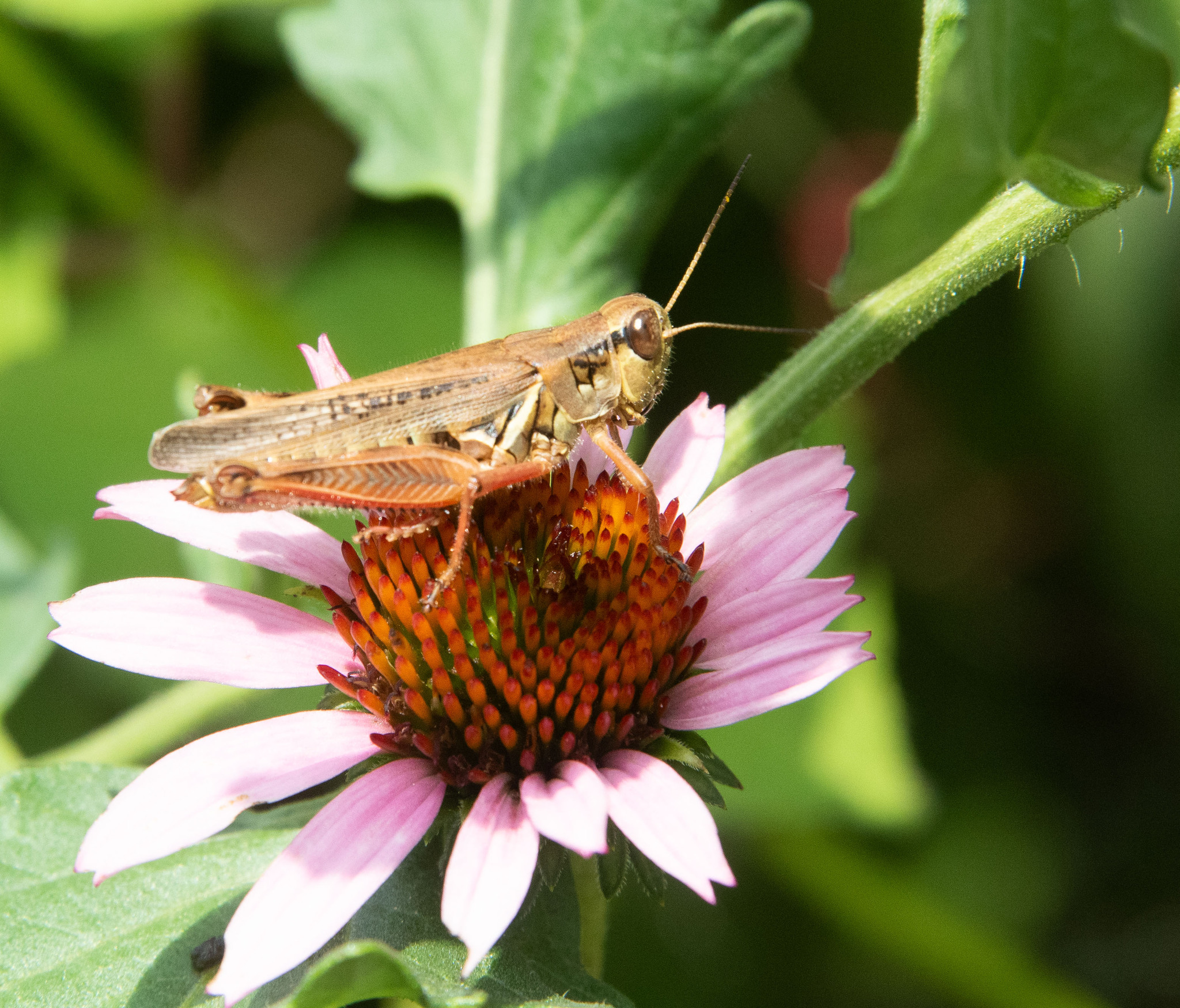
Red-legged Grasshopper (Melanoplus femurrubrum) © Erika Mitchell (via iNaturalist, licensed under CC-BY-NC)
The good news is that if you want to support bluebirds, you can grow their food at home. Most caterpillars are specialists that rely on specific host plants, and native plants support far more caterpillar species and individuals than non-native plants. By choosing native trees, shrubs, and perennials—and by making your yard safe for nesting birds—you can meaningfully contribute to the conservation of bluebirds, plus many other insect-eating species.
Interested in learning more about what birds eat? We’re currently conducting similar studies on Bicknell’s Thrush throughout the year. Your support helps fund basic natural history research that is increasingly difficult to support through traditional funding sources.
Interested in hosting bluebirds and other nest box species? We’ll be recruiting backyard monitors in the very near future. Sign up for our newsletter to find out when that happens!
Read the rest of the paper here.
Kennedy, A.C., Narango, D.L., Tallamy, D.W., Miles, K., Bartlett, C.R. and Stewart, I., 2026. Camera traps at nest boxes reveal consistent importance of Lepidoptera in Eastern Bluebird (Sialia sialis) nestling diets. The Wilson Journal of Ornithology, pp.1-18.