Identifying the Wild Bees That Pollinate Vermont’s Crops
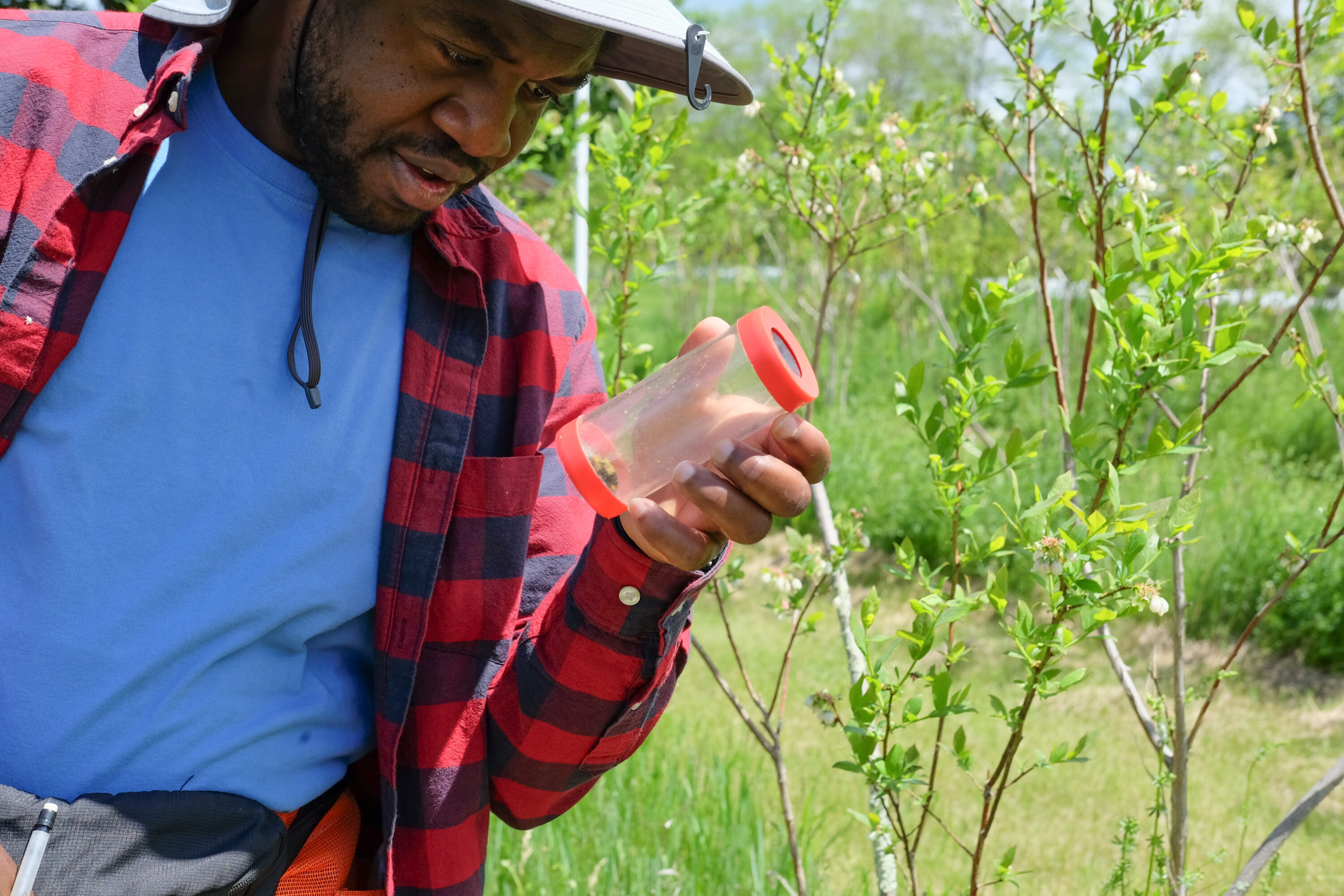
Edy Cheremond examines a bumble bee (genus Bombus) for identification © Alden Wicker
By Edy Cheremond, Wild Bees on Farms Technician
I enter the farm location into my GPS. It’s 34 miles away, but with the mountains in between, it will take me nearly an hour to get there. I shake my head.
When I arrive, I step out of my car and take in the scene. The sun is out, the wind speed is low and the temperature is around 70 F. I smile, it’s a perfect day to look for bees. I strap on my orange tool bag, grab my net and bee vacuum and head down the slope towards the blueberry bushes.
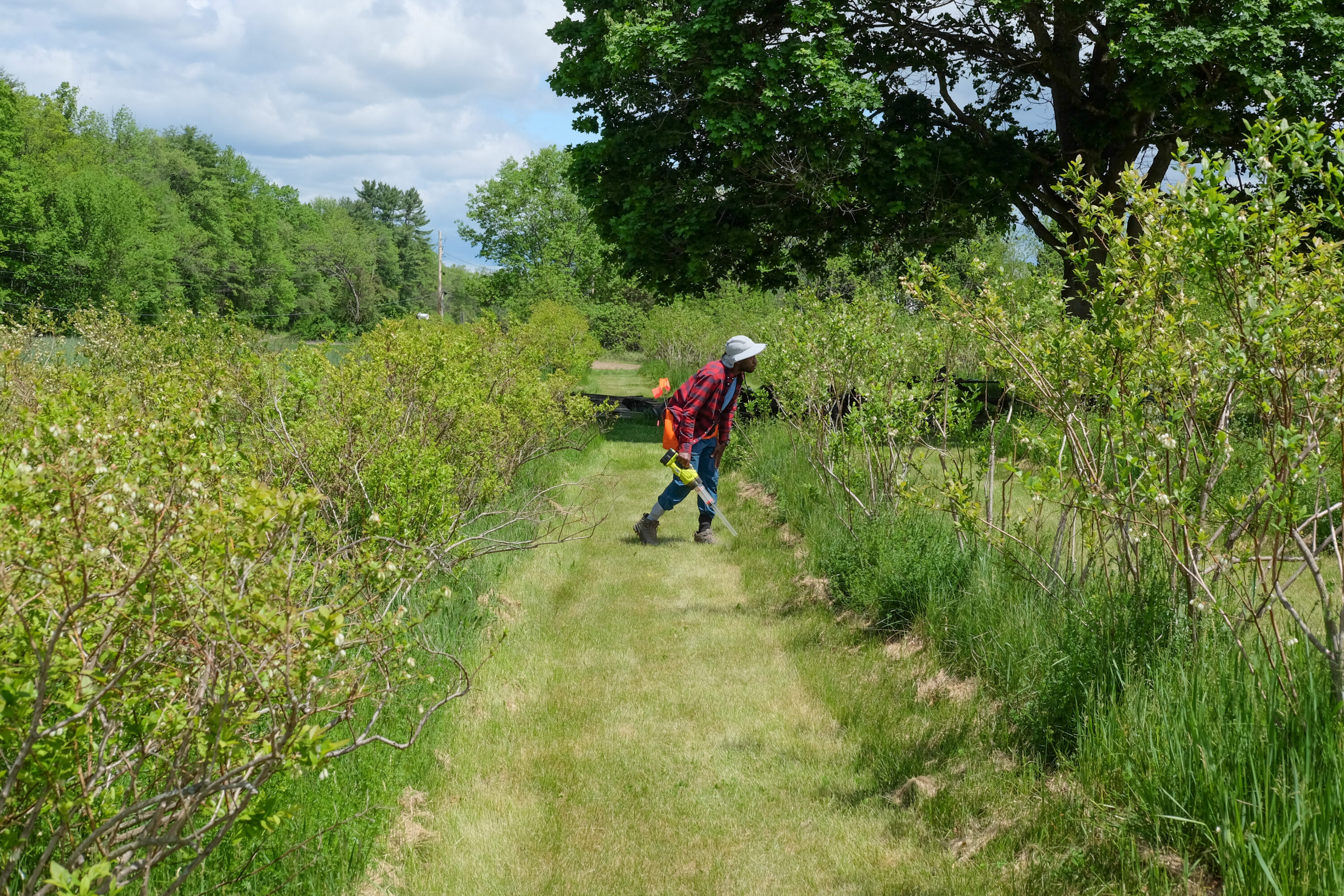
Edy Cheremond surveys blueberry bushes at Cedar Circle Farm © Alden Wicker
Of course this farm is on an angle. I shouldn’t be surprised—four out of the seven farms I visited in the last two weeks have been on slopes. And yet, I always forget to adjust my expectations. This will take twice as long as I’m used to, since for the last eight years I’ve been performing pollinator surveys in flat places like Kansas. No matter. I may not be in Kansas anymore, but this is the fun part and no degree of incline will change that. At peak blueberry bloom, at 20 feet away, you can both hear and see hundreds if not thousands of bees zipping from flower to flower. It truly is an amazing sight to witness.
I’m the seasonal technician for VCE’s Wild Bees on Farms project. There are 17 farms in the project, which is in collaboration with the Vermont Agency of Agriculture, Food and Markets, and we are focusing on four crops: blueberry, apple, winter squash, soybeans, plus pasture grazed by sheep. My role is to determine which bee species are nutritionally supported by these specific crops. The hope is that the information we gather from this project will help us in the future when we try to support a bee whose population is declining.
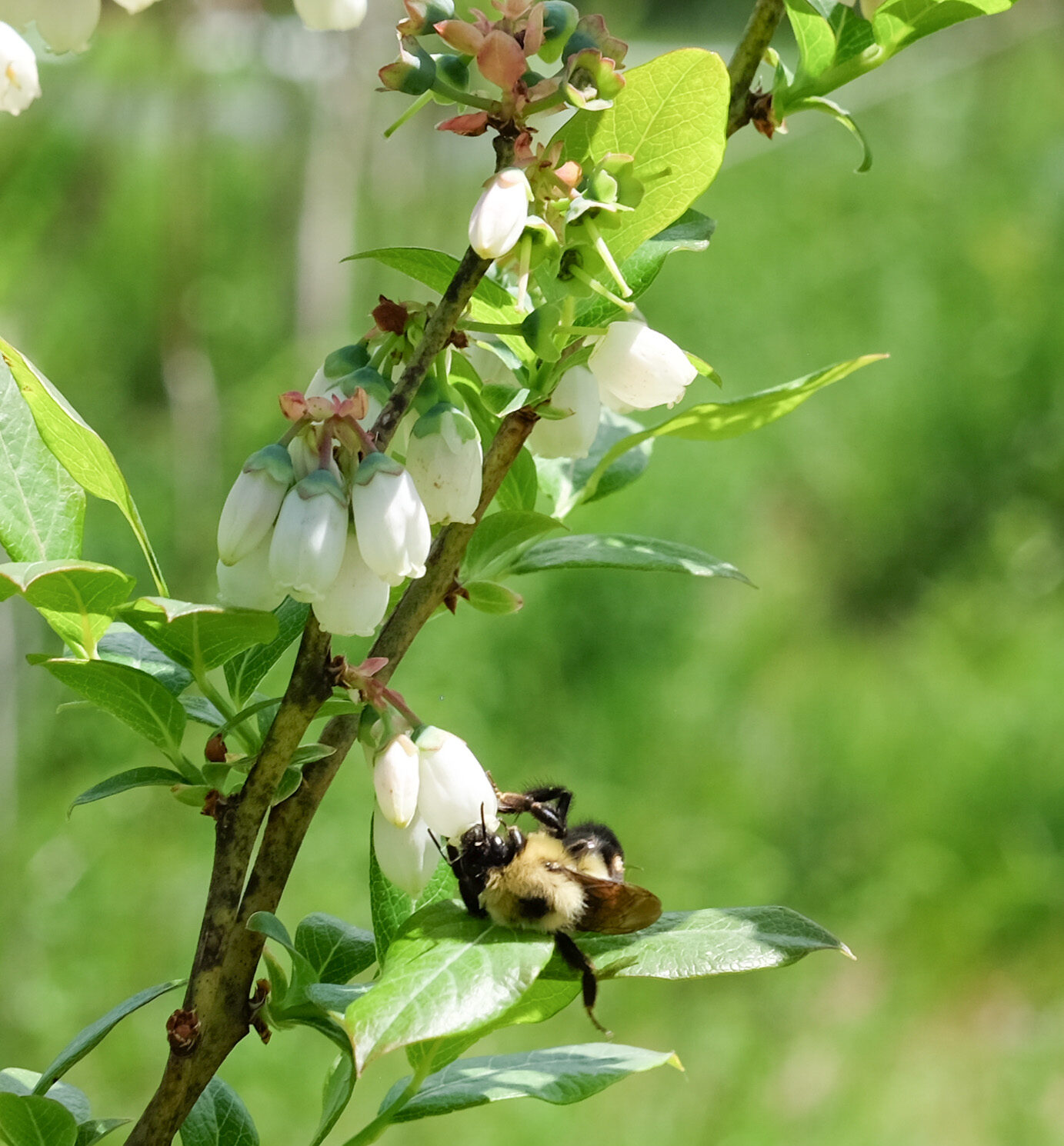
A bumble bee pollinates a blueberry flower © Alden Wicker
When I get to a farm, the first order of business is to walk around and outline three 100-meter transects lines that run along the crop of interest. Then I perform a pollinator survey by slowly walking along the transect for a minimum of 10 minutes, attempting to visually identify any bees visiting the flowering crop and any other flowering plants at the site.
Large bees such as bumble bees are relatively easy to identify to species in the field, but for smaller bees like mason bees, mining bees, sweat bees, cuckoo bees, scissor bees or cellophane bees, most of my field identifications are at the genus level. Occasionally I catch a few individuals that look visually similar with my bee vacuum, put them in a glass vial, and take my field magnifying glass out of my tool belt for a closer look. If that works, I release them. If I still can’t identify them to species, I keep them for identification in the lab under a microscope.
The keen reader will notice that the survey is not focused solely on the flowering crop of interest. It also includes all the other flowering plants within the transect, so we can learn which management practices (mowing versus not mowing for example) is correlated with bee diversity and abundance.
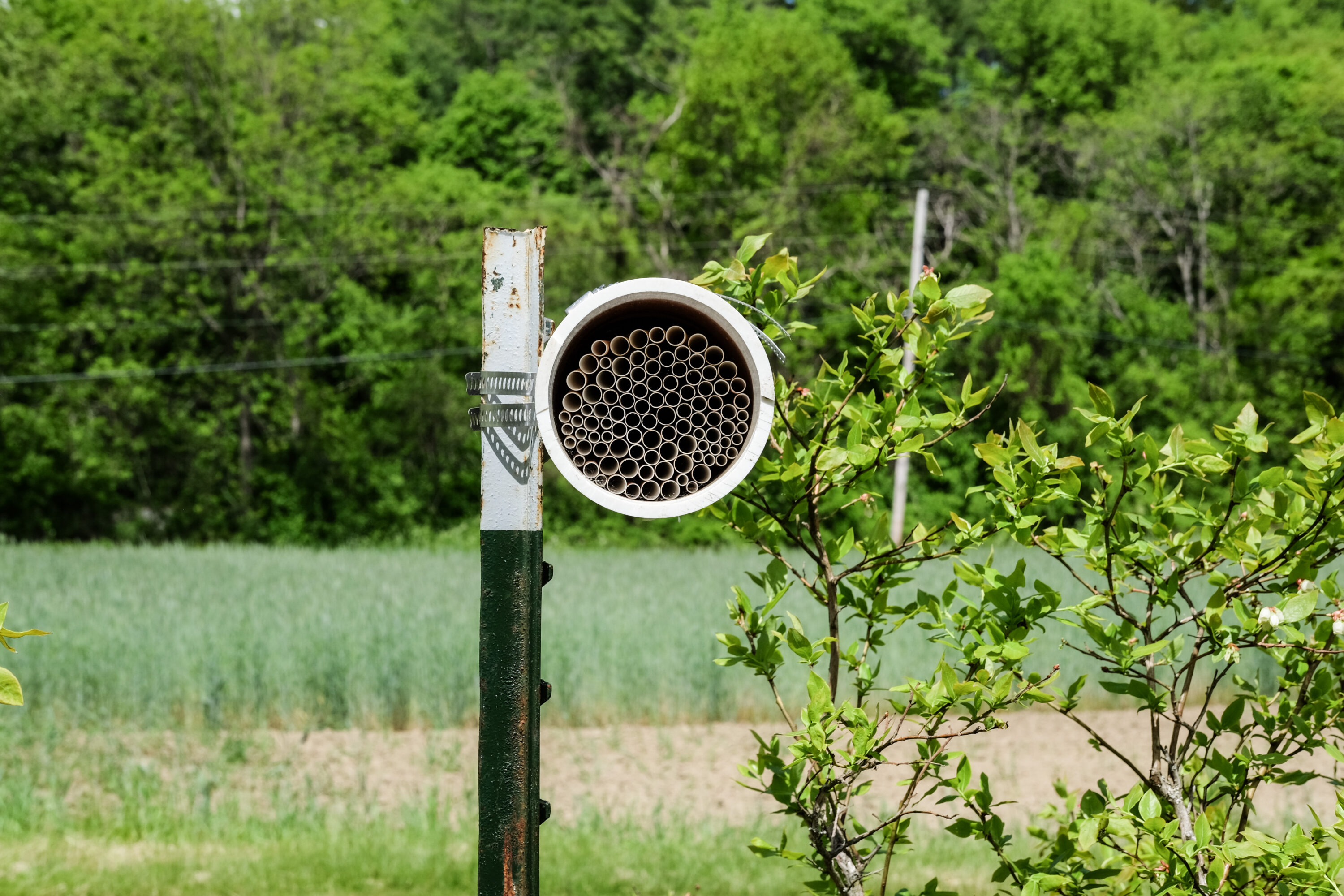
Cavity bee trap nest © Alden Wicker
To supplement the surveys, we’ve placed three trap nests at each farm. They consist of a PVC cylinder mounted on a T-Post, with tape at one end and a bundle of 100 straws of various diameters inside. Hopefully the traps will teach us more about cavity nesting bees such as mason or cellophane bees. Once a cavity nesting bee has chosen a nest site, it will seal the back end of the cavity with mud or plant matter, carry pollen inside, lay an egg on that pollen, and add another seal, creating a small capsule or chamber, then create several more chambers throughout the length of the cavity. Throughout the season we hope to collect six bee-occupied straws per farm and perform DNA analysis on the pollen we find inside to get additional information about which plant species these cavity nesters are visiting. This can be surprisingly difficult, because wasps also use these cavities. If the cap at the front end is made of mud, it’s impossible to tell the difference. Before winter we will collect all the nest traps and place them in storage so that we can identify the bees that emerge next year.
The more immediate next step as the field season ends is to identify the bees collected in the field, then analyze and synthesize more than 3,000 bee observations into initial findings that can be shared with our farmers, colleagues and collaborators. There are at least two more years to this project (our shared goal with our partners is to run this project for a decade) and the hope is to be able to increase our capacity to survey more farms, increase our confidence in our results, and strengthen our recommendations to farmers and others interested in helping our wild bees.
Support VCE’s work on wild bees and other projects like this by making a donation to Vermont Center for Ecostudies! Learn about other ways to support VCE here.


Great essay and topic. Thanks for sharing your day in the life. And can’t wait to hear about what you find with samples and collected bees and so on.