Loon Versus Eagle: A Conservation Success Story
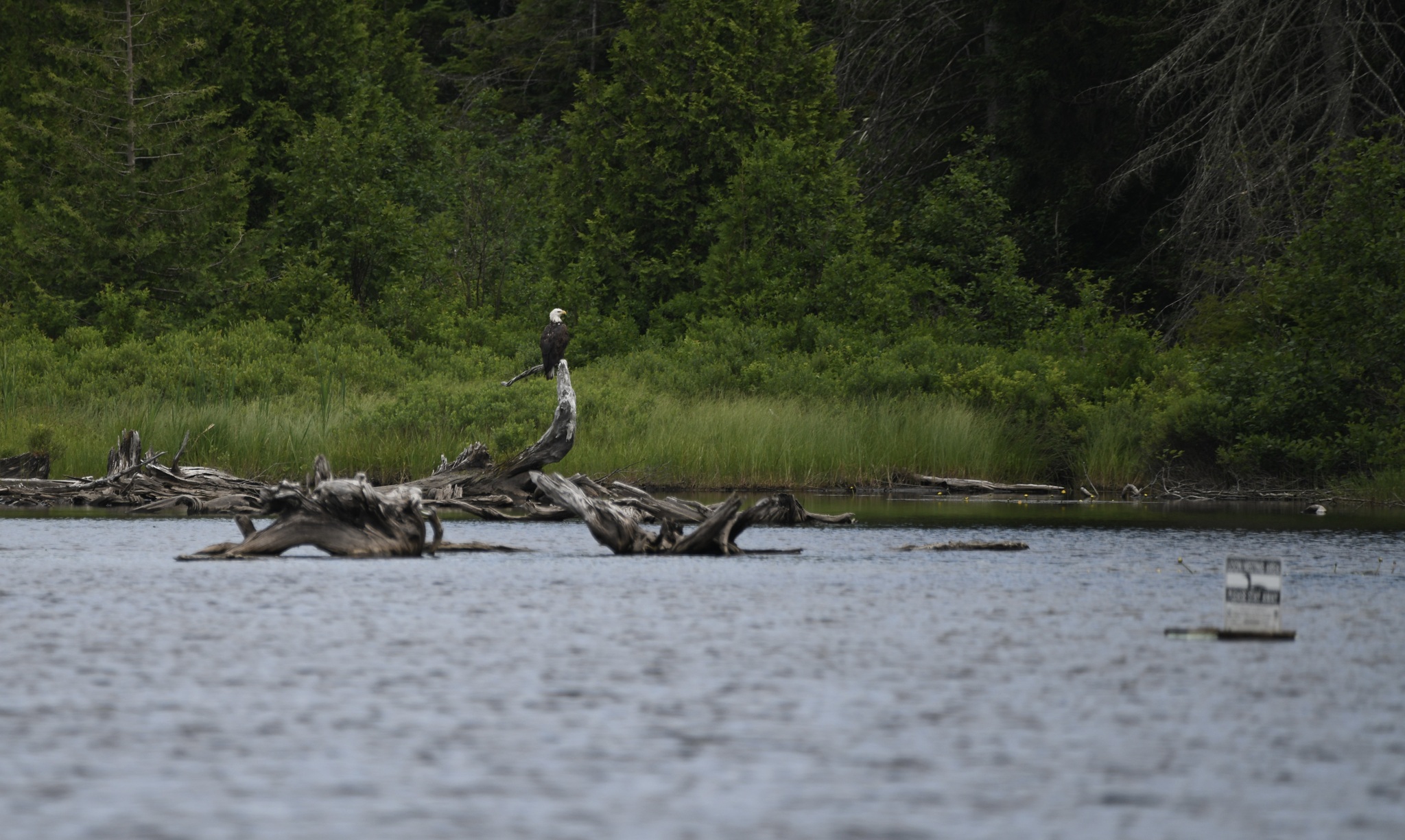
A Bald Eagle (Haliaeetus leucocephalus) perches near a Common Loon (Gavia immer) nest as indicated by the signs at Great Averill Pond. © Rebecca Scott, some rights reserved CC-BY-NC
By Catherine Weatherby, 2026 Interdisciplinary Intern. Support loon conservation and other projects like this by making a donation to Vermont Center for Ecostudies! Learn about other ways to support VCE here.
It was the morning of July 20th, and as one of VCE’s interdisciplinary summer interns I was tasked with completing some independent loon surveys that had been missed on the big annual Vermont LoonCount day two days earlier. I arrived at the parking lot for the Chittenden Reservoir around 8:30 am and embarked in my kayak on my survey at the boat launch by the dam.
Chittenden Reservoir is approximately 721 acres, with plenty of room for multiple loon territories. Previous surveys found two families and some ‘floater’ loons: adult birds that are not part of a mating pair and do not yet have a territory. These lone birds usually hang out in the open water in the middle of lakes, ponds, and reservoirs.
As I paddled along the perimeter of the reservoir, I scanned the glimmering open water to my left in search of bobbing black dots and the lush shoreline to my right for nests, as well as any potential predators. Two American Minks scampered along the shore, chittering to each other and occasionally dipping in and out of the water, inquisitively looking at me.
Eventually I paddled out of earshot of the minks and from a distance spotted one adult loon and then two loonlets, which looked to be around two weeks old by their body size (around that of a mallard) and medium brown downy plumage. The adult loon kept diving and resurfacing further from the loonlets, then going back to them. As I slowly drifted closer I realized the adult loon was not just checking in on the young birds, but feeding them small fish it had caught! I excitedly recorded what I saw in my field notebook and grabbed a few quick photos before continuing my paddle.
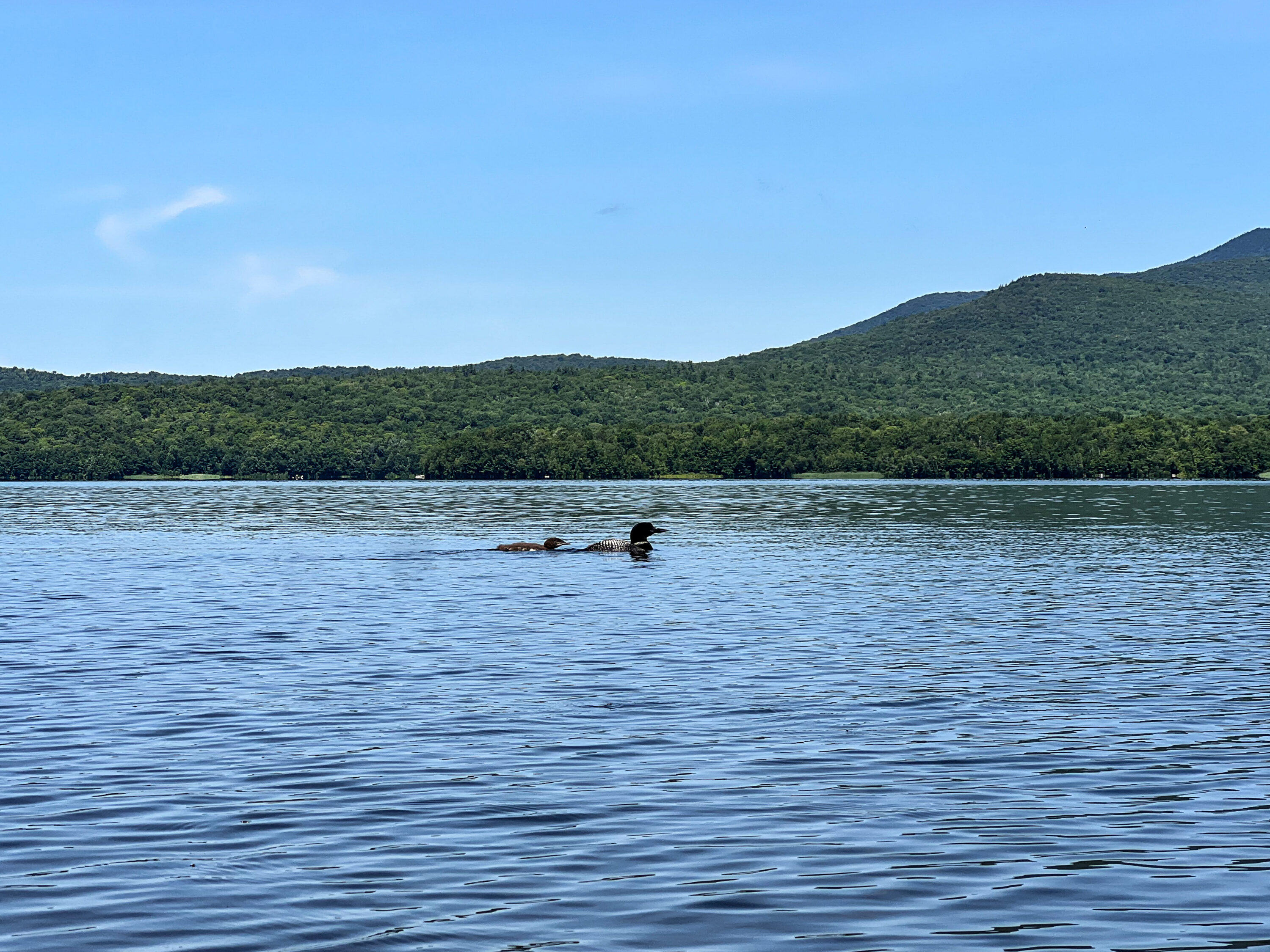
A parent loon and chick. Courtesy of Catherine Weatherby
As I continued making my way around the perimeter, I noticed one floater out in the open water, so I quickly jotted that down with an approximate location. It was then I noticed a massive bird in the sky. It was not just any bird, but a known competitor and predator of loons: the Bald Eagle. It soared to the top of a large hemlock tree on the shore overlooking the open water and the floater loon let out a warning yodel. After I scribbled down that there was an eagle present, I kept on paddling and came upon a second loon family. After a moment watching them, I heard a loon yodeling with increasing intensity and frequency and turned to see what all the commotion was about. The Bald Eagle was circling right above the floater loon. It hovered over the lone adult for a moment, before tucking in its broad wings and diving towards it, talons extended. I held my breath in shock, fear, and awe.
After what felt like an eternity of frantic loon calls and splashing from both parties, the eagle took off. To my relief, the loon seemed unharmed. The eagle, with something grasped in its feet, flew overhead and landed on the tip of a large boulder sticking out of the water. Fearing it might have a loon chick, I gingerly paddled in its direction. I was relieved when the eagle began tearing into its meal and I saw fins and scales glisten in the sun. The floater loon was not so relieved and continued yodelling feverishly for several minutes. After a few moments, the eagle sprang from the rock with its leftovers and returned to its lofty coniferous throne.
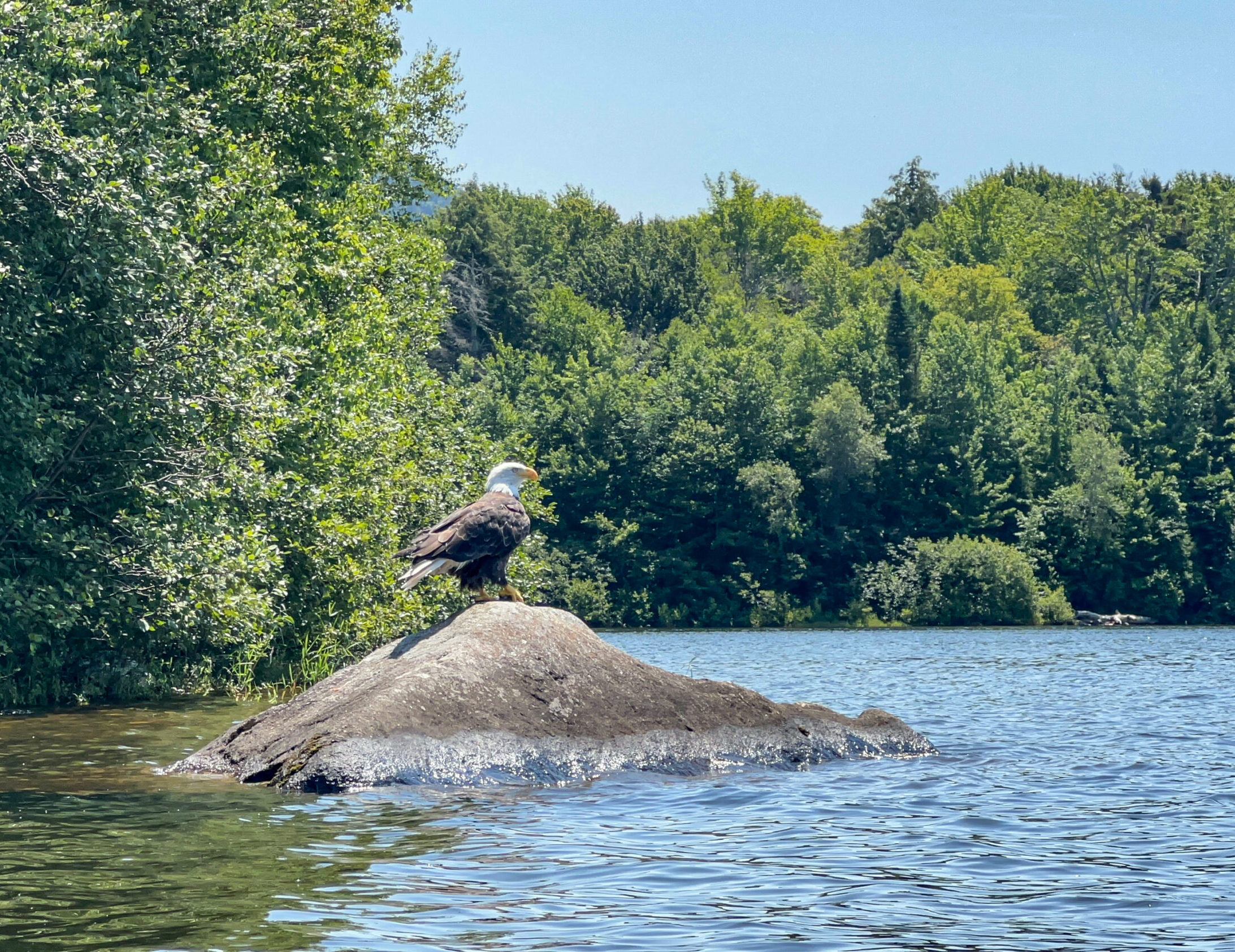
A Bald Eagle feasts on a fish it took from a loon. Courtesy of Catherine Weatherby
My interpretation of what I just witnessed based on my knowledge of these animals was that the Bald Eagle had noticed the floater loon hunting for fish in the middle of the lake, waited for the loon to catch something good, and at the perfect moment swooped in and stole a (relatively) easy meal.
I felt so many conflicting emotions. My first reaction was to be scared, then disappointed and sad for the loon, because it likely worked to get that fish and was stressed by the interaction, but I was simultaneously impressed by the eagle. After a few minutes of digesting what I had seen, I settled on being happy for the raptor in the end.
It was especially intense to witness this interaction between two avian species that were both once on the brink of extinction, what a privilege to witness this at all! If I were out doing this survey just a few decades earlier, I probably would not have even seen an eagle and a loon on the same day, let alone the same body of water. Common Loons and Bald Eagles were reclassified in Vermont as no longer endangered in 2005 and 2022 respectively, their comeback due to tireless conservation efforts and community wide changes in behavior, like switching to non-lead fishing gear, donating to conservation efforts, banning the use of DDT, and participating in citizen science programs. 
For me, keeping a relatively neutral perspective around wildlife interactions can be one of the most challenging parts of being a wildlife biologist. It can be difficult to not anthropomorphize animals, or assign them human emotions and qualities such as disappointment, satisfaction, cruelty, or generosity.
This summer has helped me broaden my perspective of wildlife by acquainting me with species that I had yet to feel connected to, like herbaceous plants, bees, wasps, butterflies, loons, and songbirds. After working with less traditionally charismatic species this summer, my biased perspective has shifted to a more well rounded one, especially pertaining to wildlife interactions. For example, I didn’t even consider the perspective of the fish torn to shreds by the eagle until days later. Now when I venture outdoors I find myself paying much more attention to insects whizzing by that I once overlooked, and the birds singing that I once tuned out.
All this is not to say anybody should stop loving their favorite species. Rather, I want to encourage others to observe the nature around them closely, and with an open mind. All living things, from the most charismatic to the most overlooked, interact in a complex, sometimes intense, and always mesmerizing web of life that deserves our attention and respect.
Support loon conservation and other projects like this by making a donation to Vermont Center for Ecostudies! Learn about other ways to support VCE here.


This was so well documented. I wanted read more…
Awesome article!
This drama–loon versus eagle, with humans always rooting for the underdog (the loons)–plays out on a regular basis at South Pond in Marlboro, Vermont. I’m with you, Catherine, in rooting for Mother Nature to win…whatever her master plan might be. The fact that both Common Loons and Bald Eagles are once again present in Vermont so we can have this conversation is the ultimate victory for us all–humans and birds!
At Shadow Lake in Glover, I monitor loons for VCE and bald eagles for VT Audubon. This season, both species thrived: our loon pair successfully raised two chicks, while a new shoreline bald eagle nest in a tall Eastern pine produced two fledglings in early July.
Despite initial fears of a “Clash of the Titans” summer, the birds adapted to share the lake, though not without some thrilling drama. An adult eagle frequently pirated Rainbow trout directly from the yodeling loons. Measuring up to 21 inches and weighing 2 to 3 pounds, some trout were simply too heavy for the eagle to lift into flight. The opportunistic eagle had to swim its stolen feast to shore, rowing across the lake surface using its wings like oars. Getting a front-row seat to witness these kind of high-stakes wildlife interactions and watching two apex species figure out how to coexist right in front of you is exactly what makes lake monitoring so rewarding! Thank you to VCE & DFW and VT Audubon, and all volunteer monitors for sharing vivid field observations as we strive to conserve these magnificent birds!
Wonderful article Catherine – you captured the interactions so descriptively! I’ve observed these two species coexist and thrive on Lake Iroquois over the past several years. I don’t think my anxiety will ever quiet when the loons (frequently) alert to the adult or juvenile eagle. We’ve been lucky thus far, that the loons and eagles have not actually injured each other this far.