The Hidden Conservation Value of Powerline Corridors
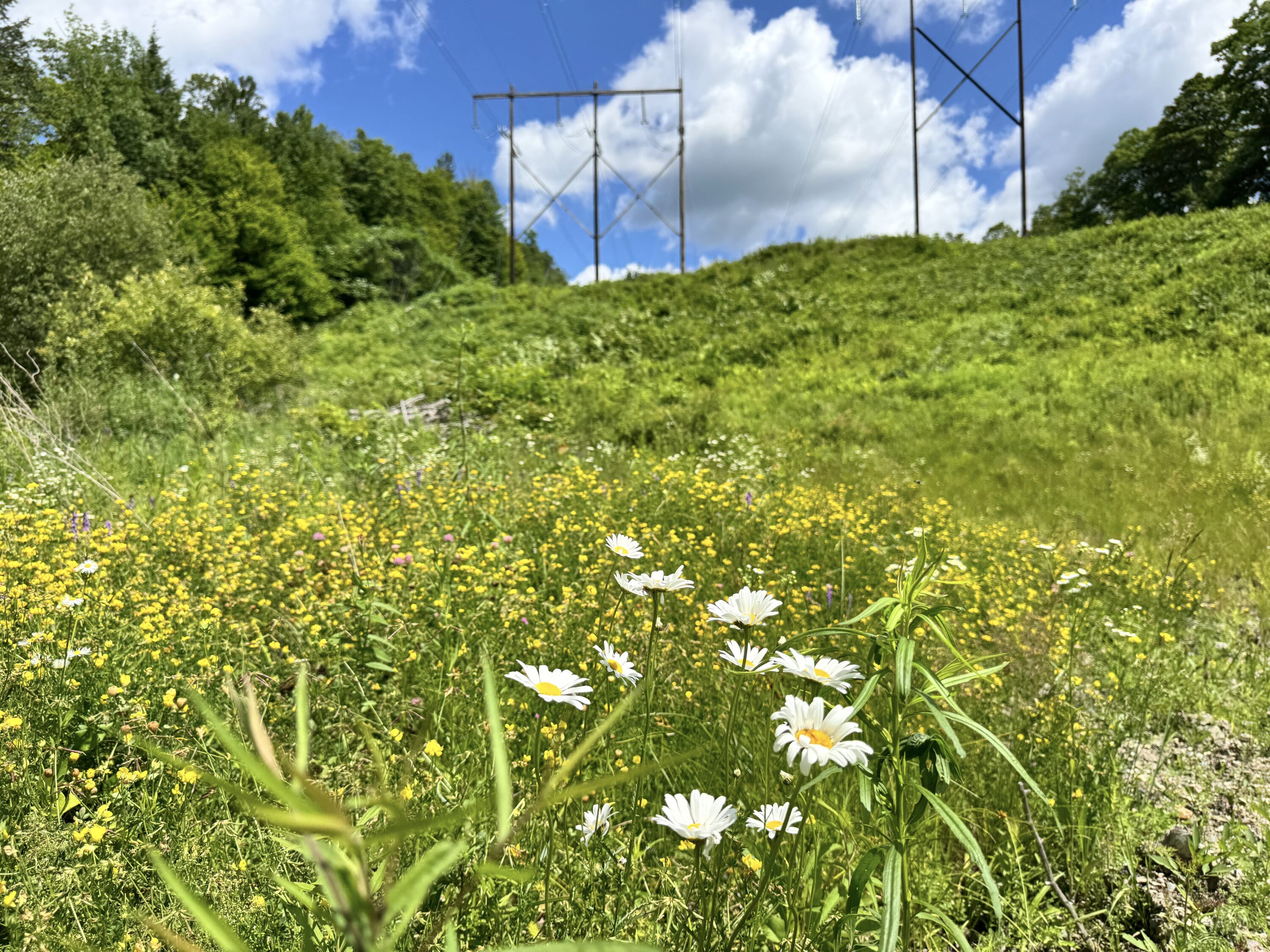
A powerline cut in Vermont © Jill DeVito
“Wasted space”, “junk lands” and the “DMZ” are all ways that folks have categorized powerline cuts when I’ve sought their permission to survey for butterflies and bumble bees.
But powerlines and other utility rights-of-way (ROW) in New England provide more conservation value than most of us realize. What often appears to be an undesirable strip of brush is actually one of the few permanently maintained early-successional habitats left in New England.
Left alone, much of our interior New England landscape would revert to closed-canopy forests following disturbance events from beavers, insect-outbreaks or indigenous land stewardship practices. Following these disturbances, early-successional plant communities rapidly colonize and temporarily dominate these areas. These plant communities are typically dominated by grasses and non-woody flowering plants at first, before transitioning into woody shrubs and eventually forest.
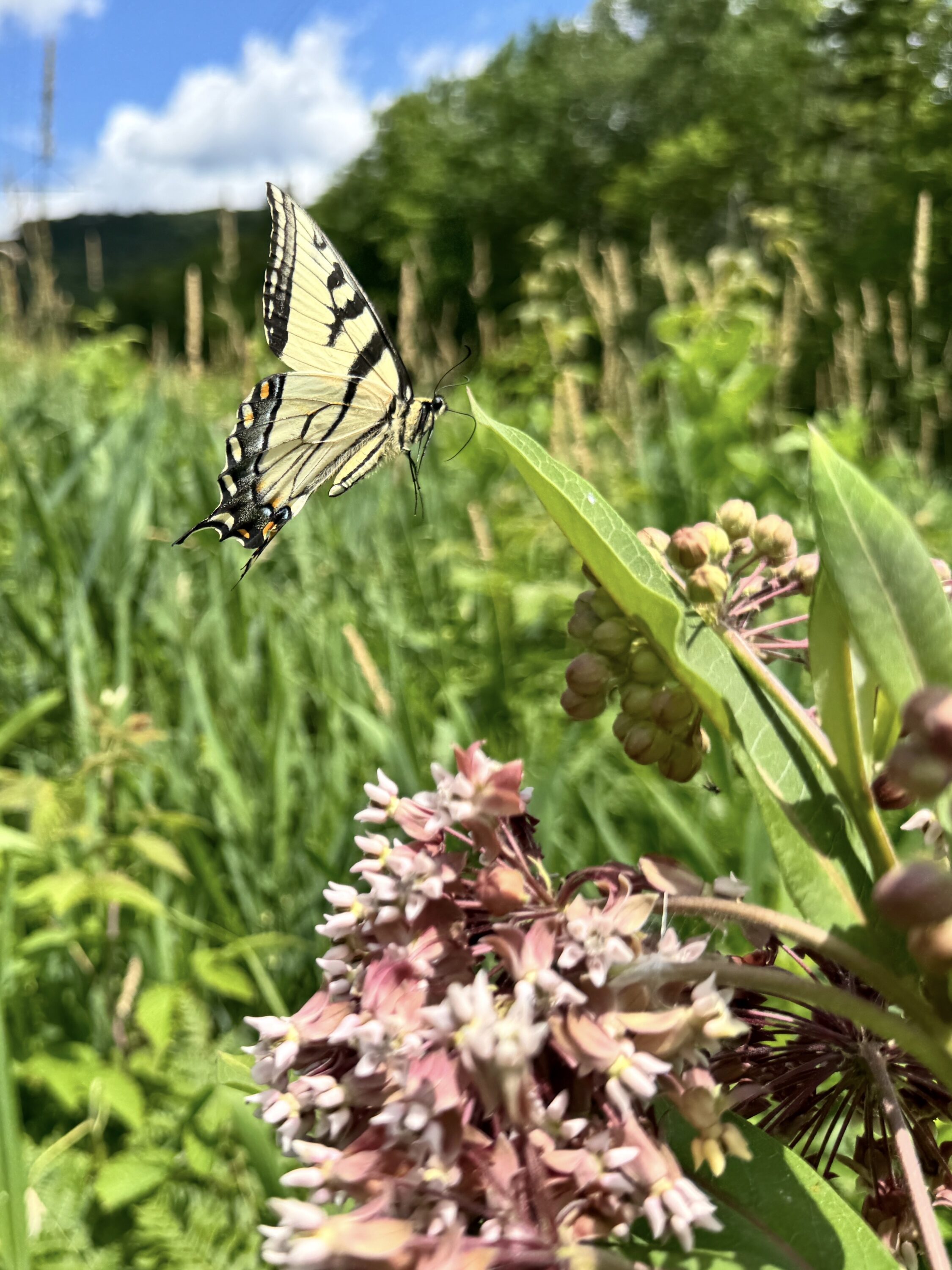
Tiger swallowtail on milkweed © Jill DeVito
While today’s ROW are not natural, they nonetheless partially fulfill the role of early successional habitats and can provide substantial ecological benefits. ROW stretch across landscapes and serve as predictable foraging habitat and as movement and dispersal corridors for plants and wildlife. A New England study by UCONN ecologist David Wager and others, found that ROW plots contained twice as many wild bee species as nearby forest plots and had more than ten times as many individual bees, including rare species such as Epeoloides pilosulus and Macropis ciliata. The Wagner study concluded that perhaps half of New England’s bee species are found in ROW habitats.
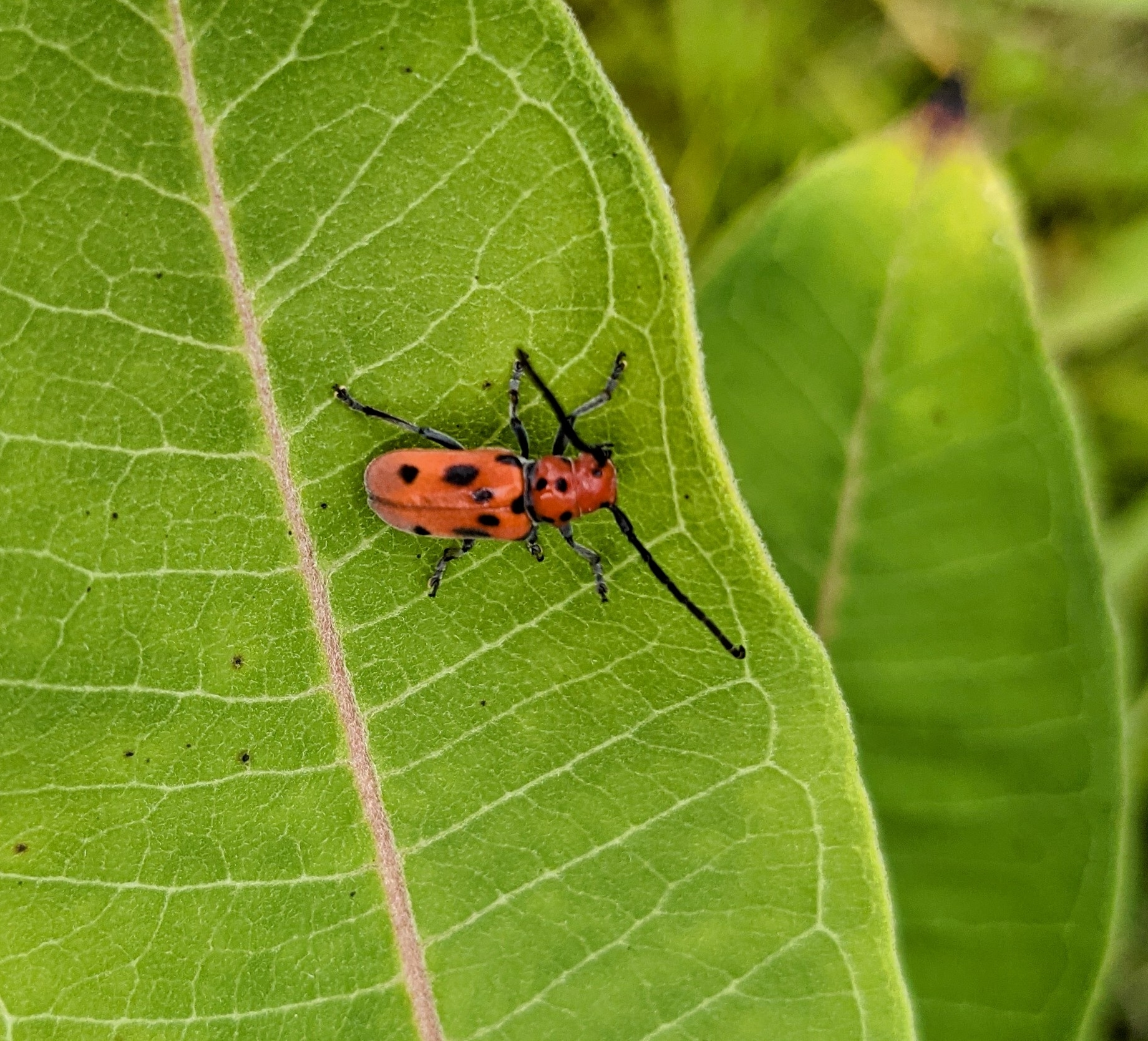
Red Milkweed Beetle (Tetraopes tetrophthalmus) on Common Milkweed (Asclepias syriaca) in a powerline corridor in Strafford, Vermont © Jason Hill
These habitats also frequently harbor substantial amounts of milkweed and their associated specialists, as well as sun-loving native plants and shrub-nesting bird species such as Prairie Warbler, Chestnut-sided Warbler, and Eastern Towhee.
What Private Landowners Can Do in Powerline Corridors
A common misperception is that utility companies own and control the land under powerlines, but Vermont and New Hampshire landowners actually own most of our states’ land within ROW. The utility companies have a legal right to access these areas to perform vegetation management to ensure the integrity and safety of the overhead lines and associated infrastructure. These companies and their subcontractors typically perform woody vegetation management every four to five years through a combination of mechanical clearing (e.g., brush hogs and chainsaws) and herbicides.
Landowners, however, can and should conduct their own annual vegetation management on their ROW because these linear corridors can also facilitate the spread of invasive plant species such as Glossy Buckthorn and Purple Loosestrife. Landowners can remove these invasive plant species, but be careful when performing these actions during birds’ nesting season: roughly May through August for the shrub-nesting species likely present on ROW. As you remove invasives, simultaneously plant and encourage native wildflowers and low-growing native shrubs, and embrace the structural diversity and messiness of ROW. Let the soil and existing plant community serve as indicators as to which native plants can thrive in your particular ROW. Tools such as iNaturalist can help you identify the native plants already successful growing there, while the Native Plant Trust plant finder tool can match additional native species to your ROW’s sunlight and soil moisture conditions.
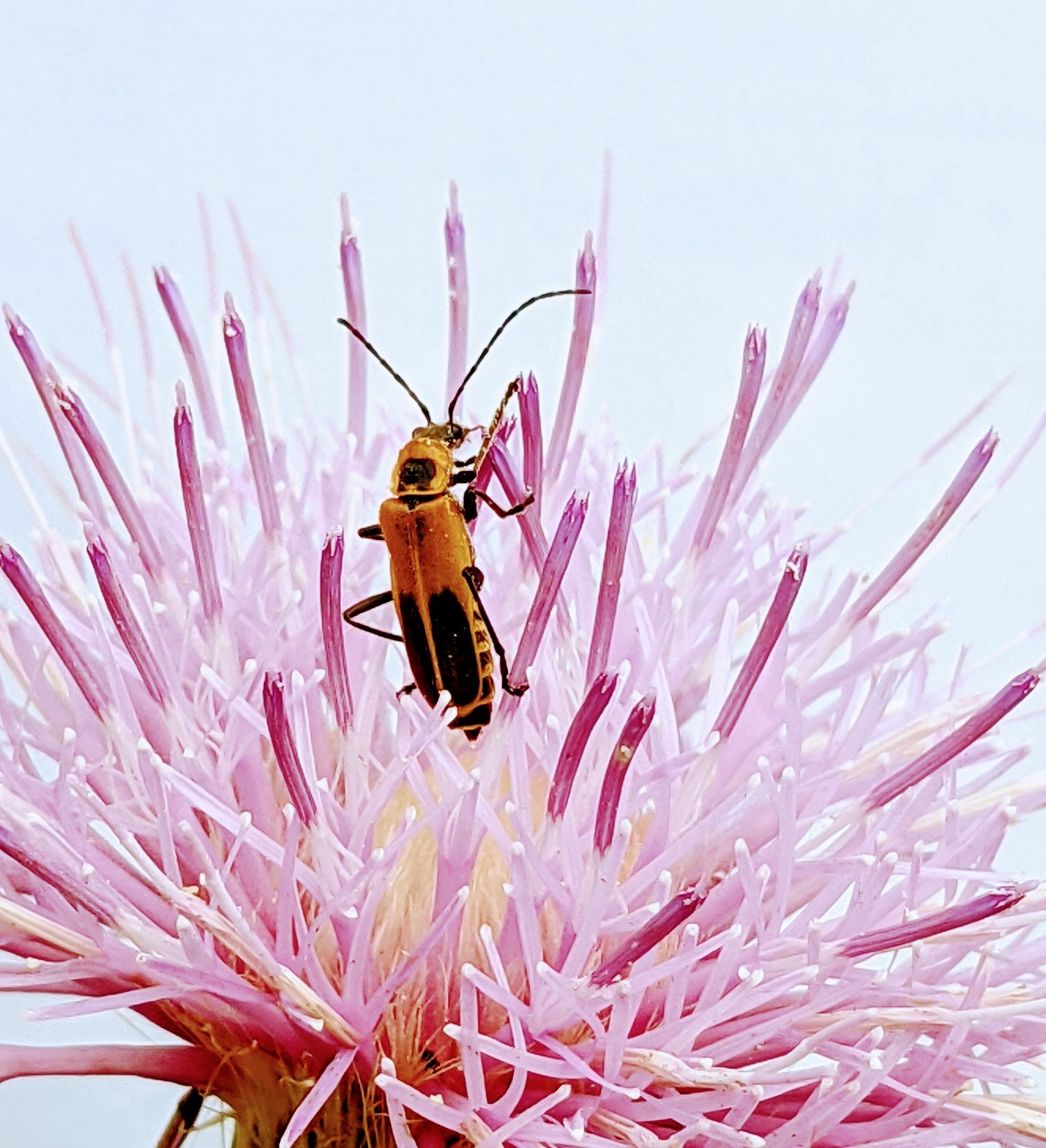
Goldenrod Soldier Beetle (Chauliognathus pensylvanicus) on Creeping Thistle (Cirsium arvense) in a powerline corridor in Norwich, Vermont © Jason Hill
It’s important to work cooperatively with the utility company that manages your ROW—they have important roles in ensuring the safety of the energy infrastructure that runs across your land. If you have questions and concerns about their practices, reach out to learn more and to clearly communicate your management preferences in writing. You can opt out of herbicide use on your property, and with good reason: previous research has documented negative effects of herbicides on wild bee diversity within ROW.
Vegetation management is often performed by subcontractors working long days across miles of non-descript ROW, and mistakes do happen. So consider clearly denoting your property boundaries on the ROW with your name and phone number, and clearly marking sensitive plantings and small wetlands such as vernal pools, which—as small ephemeral wetlands—can be easy to miss by someone applying herbicide along miles of ROW each day. If possible, avoid improving access roads within ROW with crushed stone or gravel, which reduces the amount of space available for native plants and wildlife.
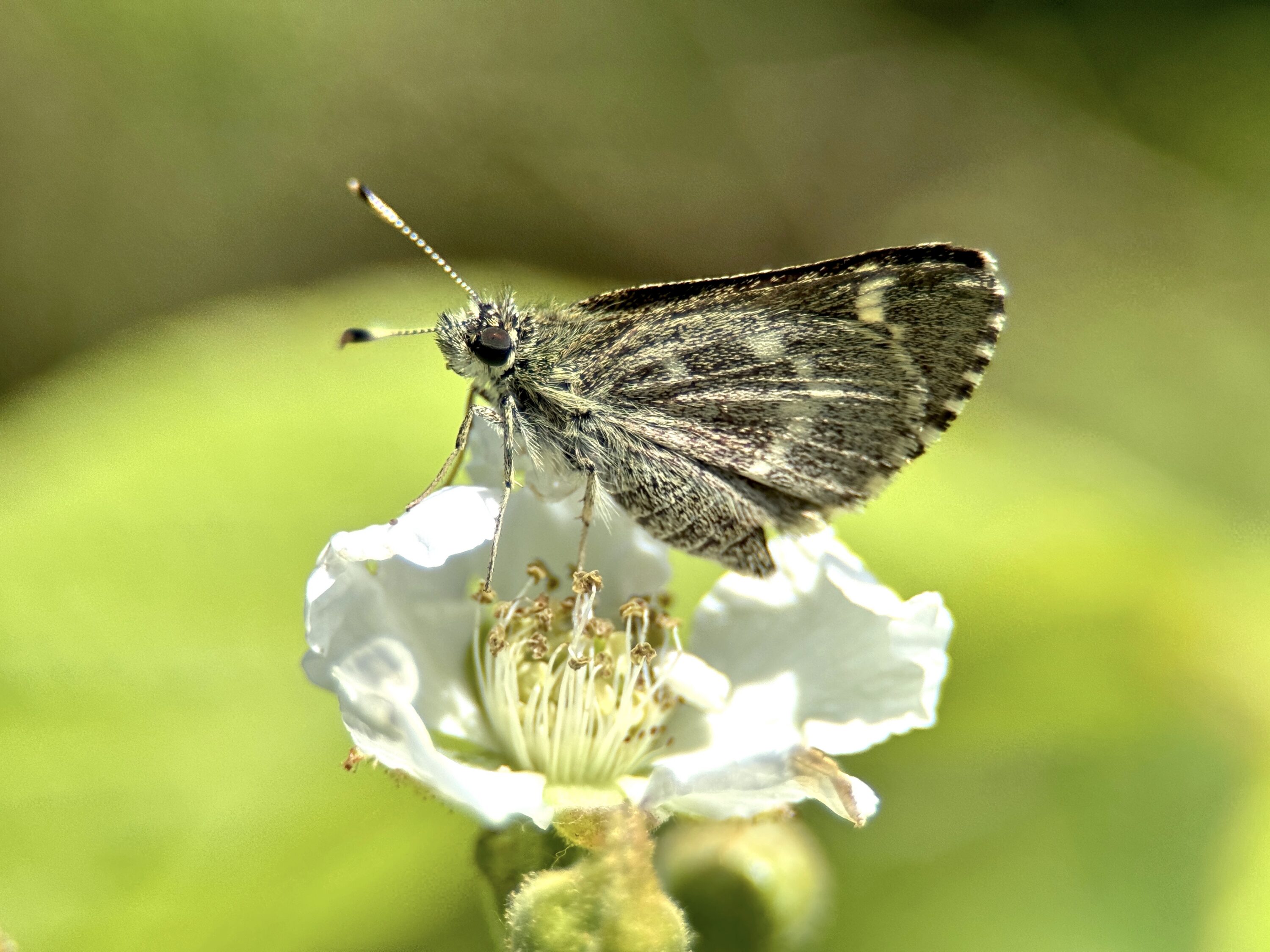
Pepper and Salt Skipper (Amblyscirtes hegon) © Jill DeVito
The next time you pass through a powerline corridor, look beyond the wires and through the messiness—ecologically healthy landscapes are rarely neat or tidy. Not all ROW provide the same ecological value, but what may seem like an abandoned strip of land is more likely to be buzzing with native bees, hosting nesting birds, and providing some of the most important early-successional habitat in your immediate landscape.


Great article, Jason. I’d be curious if there is research about bird populations within the mostly invasive plant species in these power lines. My personal experience is that the birds gravitate to the dense cover of invasive tangles. Not sure if the nesting success is equally good in majority native or non-native plant settings. I am working on a small section to release the native plants but the cover is much diminished in these areas while native species fill in the spaces left by the removed non-native plants. Thanks
Thanks for that question Lewis. If there’s one thing that the 1000s of nesting-habitat papers have taught me, including my own research, is that birds care about structure…not plant species’ identity. I can think of a few possible exceptions. For example, I used to work with Red-cockaded Woodpeckers who almost-exclusively nest in Longleaf Pines, because the trees bleed copious amounts of sap around the nest cavities which offers some protection from climbing predators. However, even there, one could argue that if an invasive tree extruded the same sap (structure) then the woodpeckers might just as frequently excavate cavities in the invasive tree. I think that’s what’s happening in cases like this article from Schlossberg and King (2009; https://www.fs.usda.gov/nrs/pubs/jrnl/2010/nrs_schlossberg_2010_001.pdf), where catbirds seemingly preferred to nest in invasive shrubs, which are often more vegetated (and seem to provide more cover and protection from predators) than their native counterparts. The invasives (think honeysuckles) also tend to leaf out earlier in the season and perhaps look like a safer place to nest in the early breeding season.
However, the body of literature on the relationship between native and invasive plants and nesting success and preferences, suggests that there’s a lot of exceptions and nuance that makes it unwise to make any definitive statements. Many studies (e.g., https://www.jstor.org/stable/4493689) have reported lower nesting success when birds nest in invasive shrubs. If you have a dense monoculture of invasive shrubs (think buckhthorn on a powerline), it could be the birds have almost no ‘choice’ about which species of shrub they nest in, and they’re stuck with nesting in the invasive shrubs and in a vegetation community that might support fewer insects (nestling food) than the pre-invaded native plant community. The monoculture of invasives might also increase predator search efficiency (https://www.jstor.org/stable/2641974), as some studies have suggested, by reducing variation in possible nest placement and vegetation structure (effectively training predators to get really good at searching for food in that one invasive species).
However, however….check out this nice summary (https://phys.org/news/2024-04-bad-invasive-birds-large-scale.html) of the infamous (and terrific) Clark et al. (2024) paper from Connecticut. In that study, some (e.g., Lonicera morrowii) invasive shrubs supported higher arthropod biomass and protein than native shrubs, and birds foraged as much in the invasives as the natives. That wasn’t true for Barberry though. Here is a memorable quote from one of the authors (Seewagen): “Our results indicate that it should first be demonstrated, not assumed, that invasive plants are inferior resources for birds compared to the dominant native plants in the community before land managers undertake costly removal efforts.” And from the paper, “We recommend a regionally tailored and species-specific approach to invasive plant management that targets species that provide low-quality foraging opportunities relative to the quality of the local native plant community.”
So the charge for all of us researchers: figure out which invasive shrubs on powerlines are the worst (for insects, birds and other wildlife) and prioritize/target them for removal. I nominate you, Lewis, to figure it all out for the rest of us. Good luck on your Mountain Birdwatch routes.