They’re Alive! Banded Birds Flock to Mount Mansfield for Our 34th Season
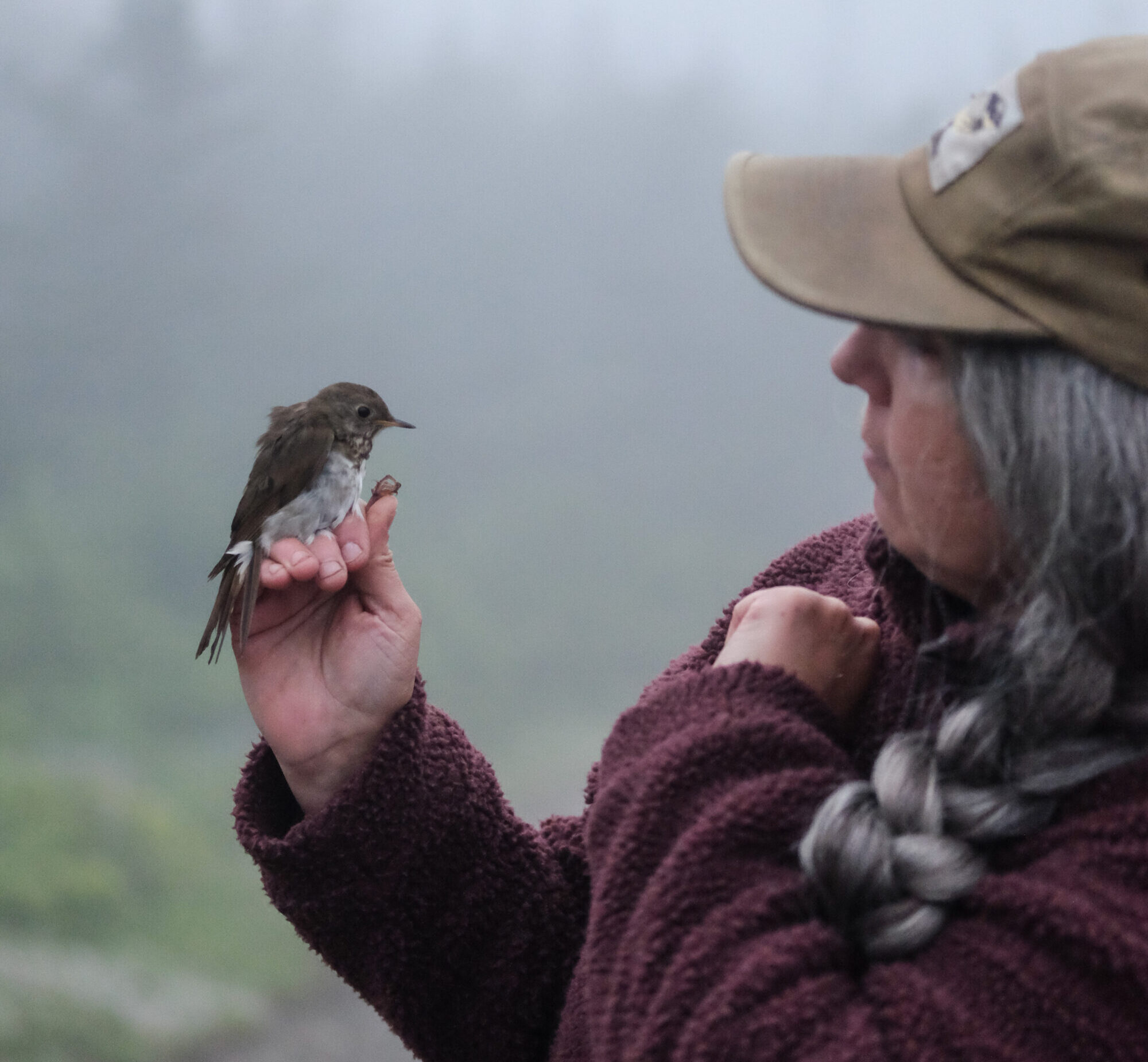
VCE Conservation Biologist and project lead Desirée Narango looks at a banded Bicknell’s Thrush, whose feathers ruffle in the wind, before releasing it. © Alden Wicker
Support Desirée Narango’s research and other projects like this by making a donation to Vermont Center for Ecostudies! Learn about other ways to support VCE here.
I walk out onto the Amherst trail, carefully watching my step over the rocky path, and make my way to one of my favorite views. This spot overlooks the eastern slope of Mount Mansfield, with stunning views of the peak and the valley below. There, with the sun setting behind me, I hear the “Veer!” call from an old friend.
For the last three years, this moment has defined the beginning of my summer. It’s our first evening on Mansfield, and the Bicknell’s Thrush are singing their evening chorus before settling in for the night as the sun sets on Lake Champlain.
We launched this 34th season of songbird research on Mt. Mansfield on June 1st this year. VCE’s summer ‘26 Mansfield team includes Lead Bander Anna Peel, Seasonal Technician Jackie Quinones, Data Scientist Mike Hallworth, and me (the project’s principal investigator).
While we continue our long-term monitoring of returning and newly arrived high-elevation birds, we have a second goal this summer. We must recapture the Blackpoll Warblers and Bicknell’s Thrushes we fitted with “backpack” tags last year. Having traveled with the birds throughout their life cycle, these tags hold a year’s worth of precious data on their migratory journeys.
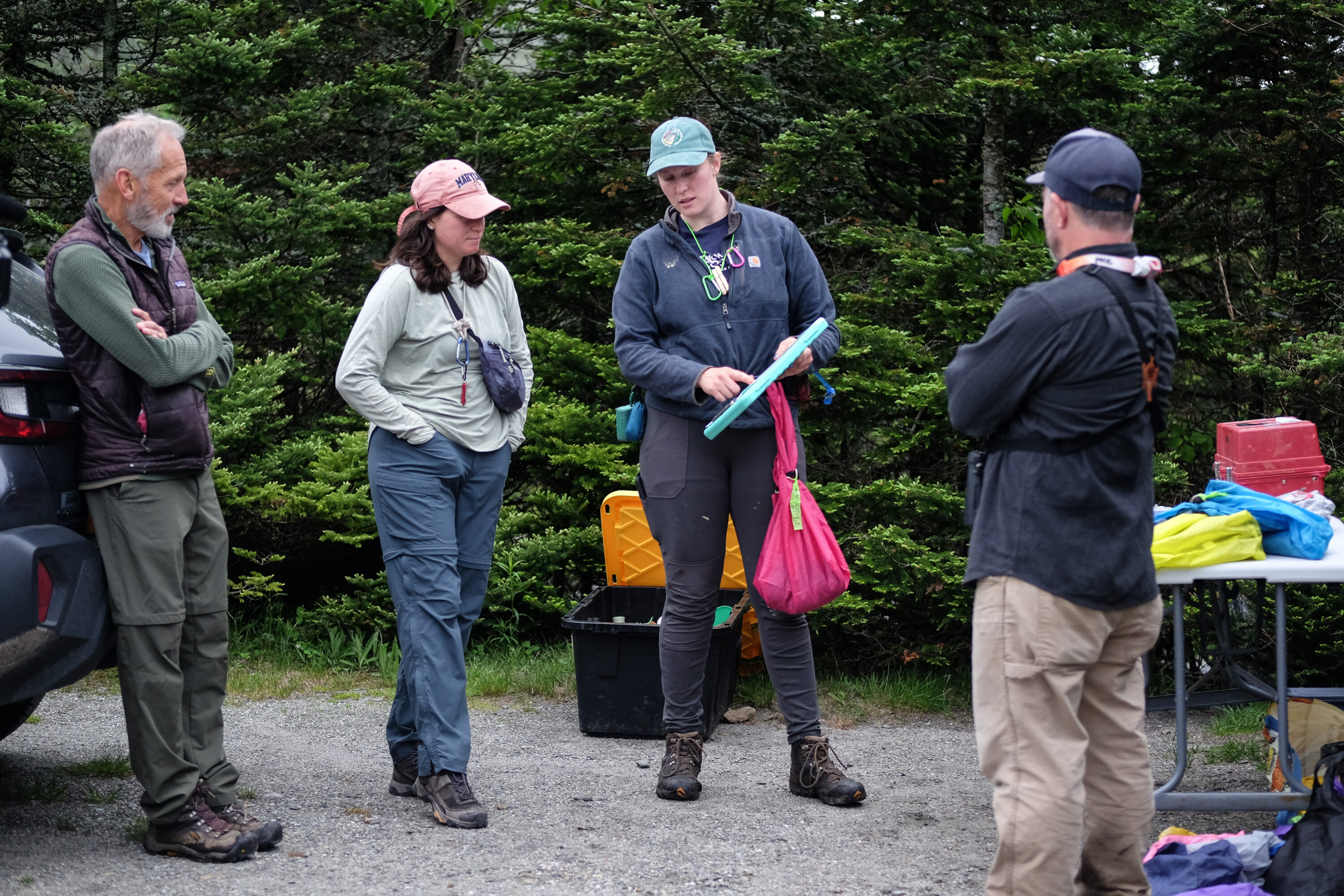
Lead Bander Anna Peel (center right) shares the plan for which mist nets each person will check, while VCE cofounder and Director Emeritus Chris Rimmer (left), Seasonal Bander Jackie Quinones, and Data Scientist Mike Hallworth (right) listen. © Alden Wicker
In 2025, we deployed 40 backpack tags on Blackpoll Warblers and Bicknell’s Thrush to collect data on their migratory behavior—where they went, how long it took them to get there, and how fast they flew. These tags are archival, meaning they store data within the unit, and we must recapture the birds to download it. We also applied unique color bands to the tagged birds, so if we see them this year, we’ll know they are individuals to target for recapture.
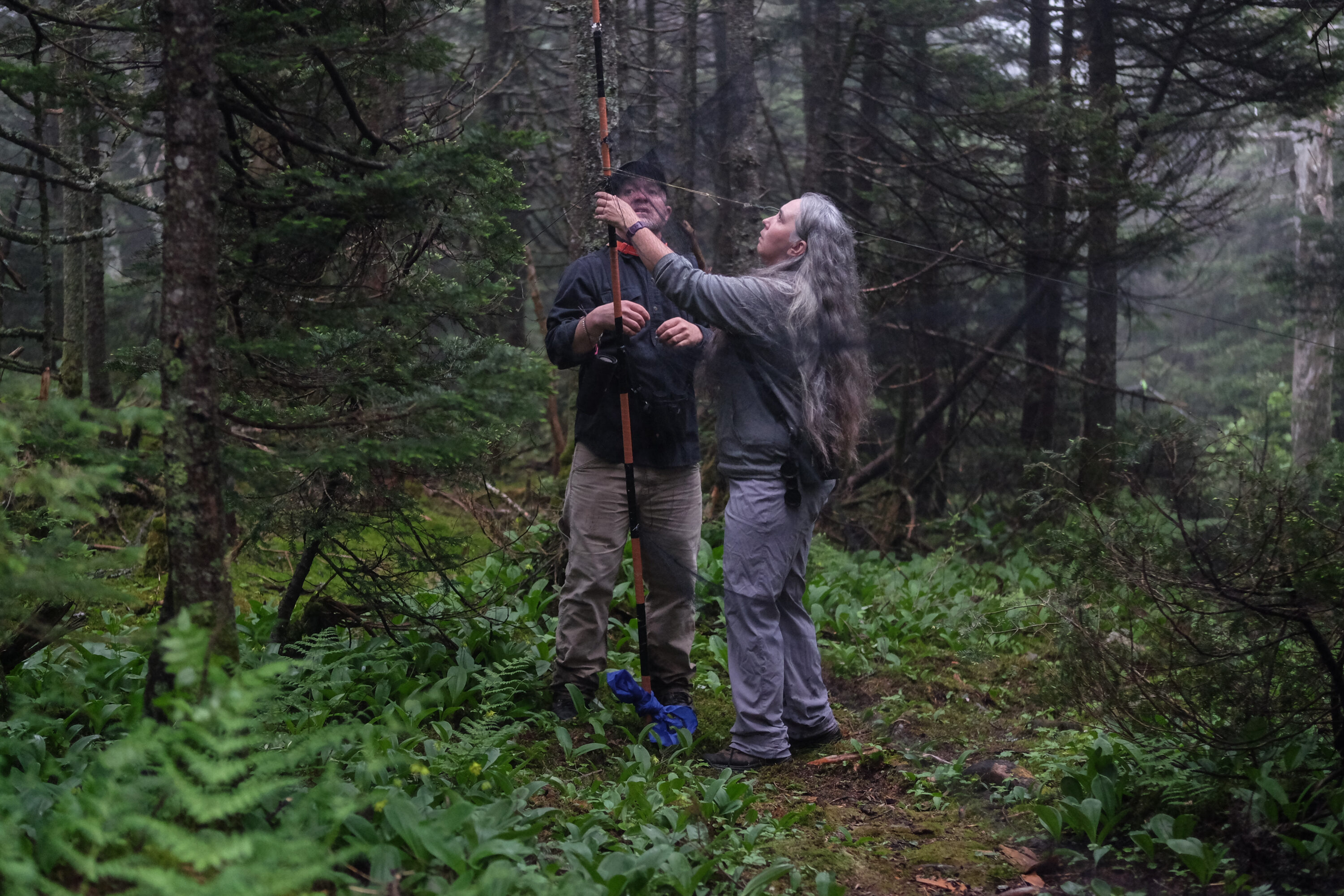
Desirée Narango and Mike Hallworth open up mist nets on a muddy trail. © Alden Wicker
Day 1: Looking for Color Bands
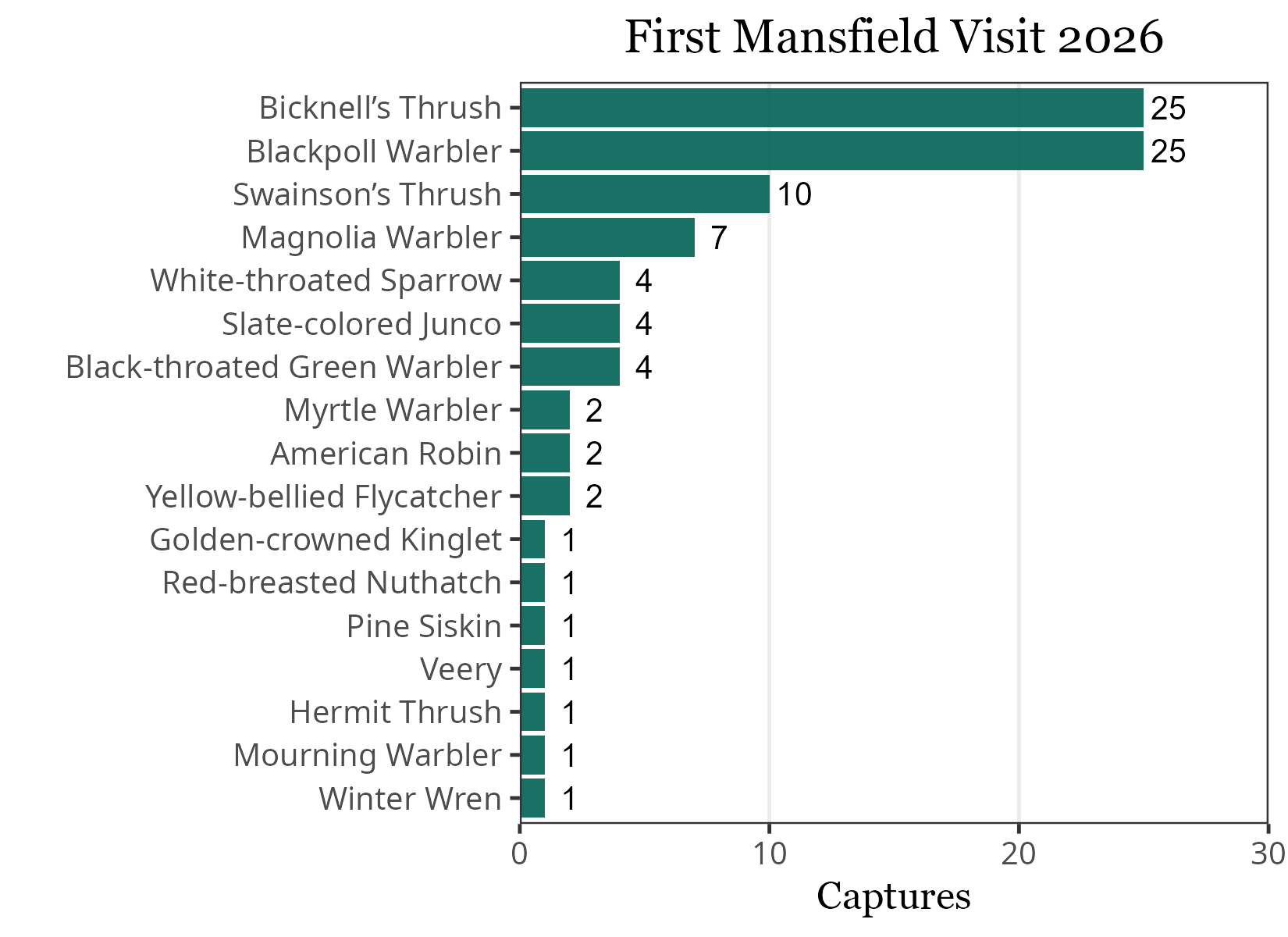
We couldn’t have asked for better conditions for our initial three-day trip: clear skies, a lovely 50 degrees, with few black flies. Anna, Jackie, and Mike crisscrossed the mountainside looking for color-banded birds. They resighted a few but recaptured none, so the team regrouped to plan for day two, when we’d open about 25 nets across the ridgeline for our long-term banding program.
On our first evening, we captured a decent number of birds, but the activity was relatively low and even-paced. It was a good one for teaching Jackie our data collection protocols and teaching her how to set up nets on the rocky slopes—which isn’t easy!
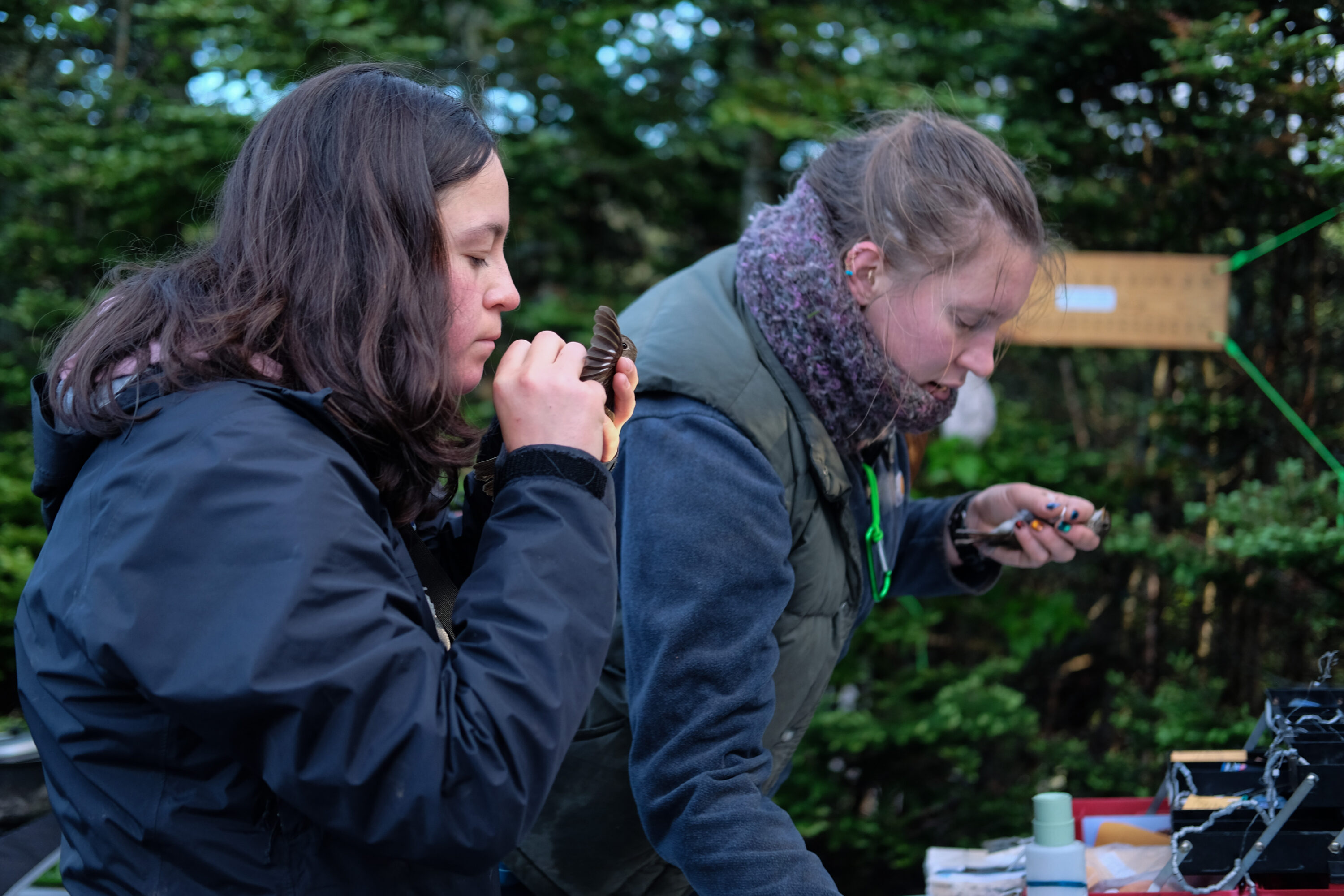
Jackie Quinones and Anna Peel measure and check for parasites on two Bicknell’s Thrushes. © Alden Wicker
Day 2: A Bird-Banding Assembly Line
Our second morning was a different story. I set out to try to capture a Blackpoll Warbler we affectionately call ‘the WCAX bird’, a male with purple color bands who has staked out a territory near the building owned by the local TV station. However, the birds had a different plan! Activity in the nets picked up very quickly, and soon Anna, Jackie, and I were busy processing bird after bird, and I had to postpone looking for WCAX. Reassuringly, many of these birds were recaptures—birds that we have banded in previous years—suggesting that survival over migration and winter could be high this year.
We ended the morning with 55 new captures—a high-volume day for us. Each week tends to hold a surprise or two, and this time, it was netting a large number of species that we seldom encounter. We found many more Black-throated Green and Magnolia Warblers than I’ve seen in previous years—these two species are much more common at mid-elevations on the mountain. Ruby-crowned Kinglets also made a big showing; this species only occasionally breeds on Mansfield. I have a particular soft spot for these six-gram birds, so I hope they stick around. (Six grams is about the weight of a nickel!)
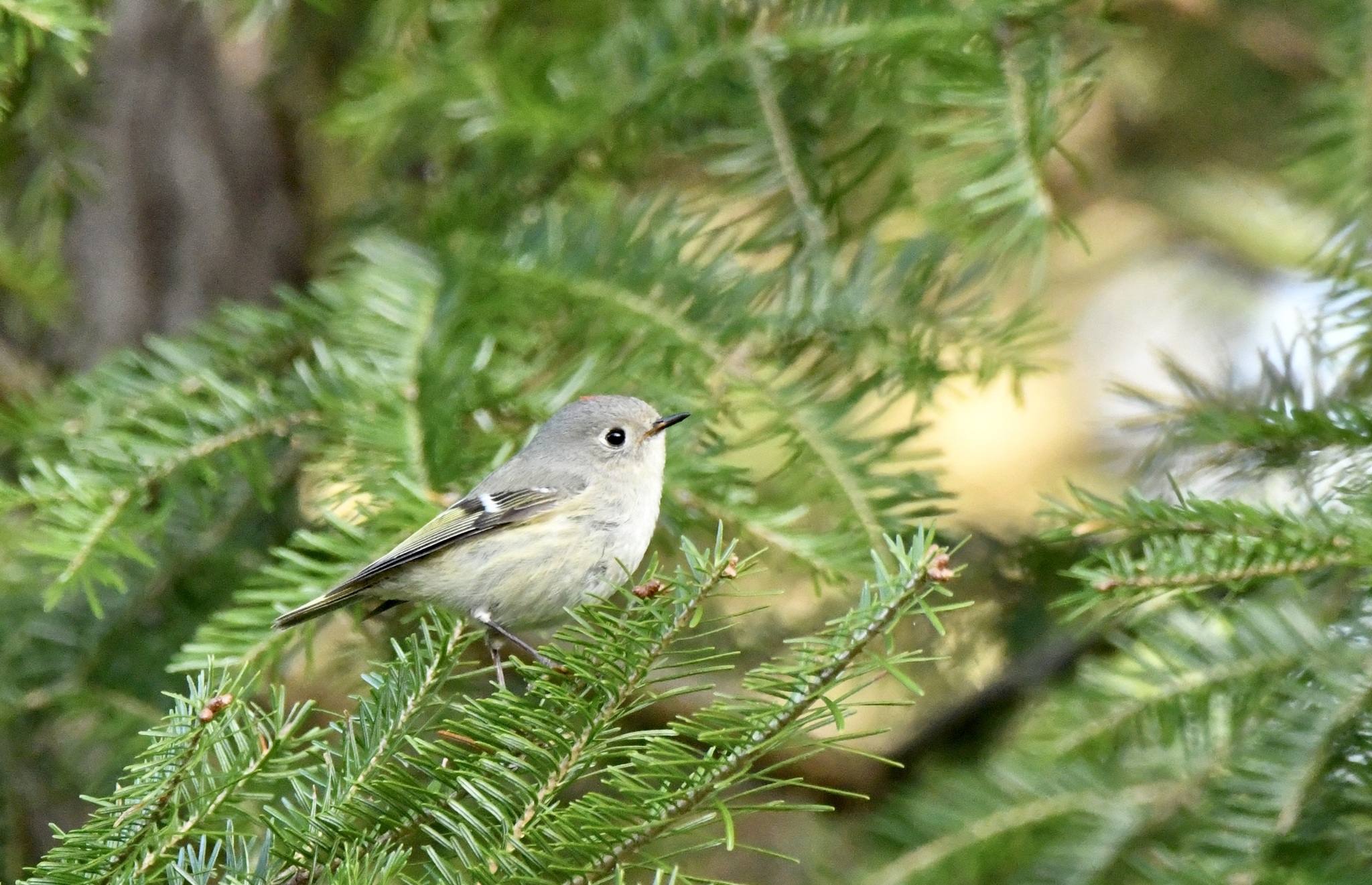
Male Ruby-crowned Kinglet by Rebecca Scott on iNaturalist, some rights reserved CC-BY-NC
After a morning of passive netting, we had captured many birds, but not WCAX. Anna and I made a plan to spend another morning on the mountain, specifically targeting him. After watching the WCAX bird all morning, I had a pretty good idea of his territory, including the dense Balsam Fir on a large boulder he seemed to spend a lot of time singing near. That evening, we decided to blanket his territory with more nets, hoping to catch him during his first foraging foray of the morning. I traveled down the mountain for a good rest to prepare for day three, stopping only to say hello to an adorable porcupine along the way.
Day 3: Recapturing WCAX
On the third morning, I was back up the mountain by 3:45 am with one goal in mind: capturing the WCAX bird. I opened eight of the nets we had placed across his territory. Catching previously banded birds is not easy work. They can recognize a net, and some birds are wary of responding to the songs and calls we broadcast. We like to say that target netting is kind of like fishing. You need to pay attention to the conditions, the wind, the sunlight, the bird’s behavior, and use your stealth and cunning to trick a very smart individual into your net–and still have a little bit of good luck.
One of our nets was right in the middle of WCAX’s territory. I decided to start my playback here with a male song:
Sure enough, WCAX came in, singing quietly and curious about who the intruder was near his favorite singing perch. He came in, but not low enough to be caught, so I switched to some Blackpoll Warbler call notes. I hoped he would think this was a visiting female and come closer to investigate:
He slowly moved further down into the understory, and I optimistically held my breath. Then, suddenly, he just took off! I muttered a few frustrations under my breath. Our playback can also bring in neighboring birds, and it was possible he left to chase off his neighbor to the east. I moved on to check my nets and devise a new plan.
But as I approached a cluster of mist nets nearby, I glimpsed something black and white caught in one. Could it be? Yes! Holy cow! It was him! When WCAX took off, he inadvertently flew into one of our nets! 
Our strategy of watching him, learning his territory, and putting up more nets had paid off. We finally had our target bird. It was hard to contain my excitement as I removed the tag that this amazing bird had carried over the last year. This small tag contains a wealth of information about the location, timing, and speed of his migration that we will analyze for the first time for this species. I wished the WCAX bird well and thanked him for being so cooperative.
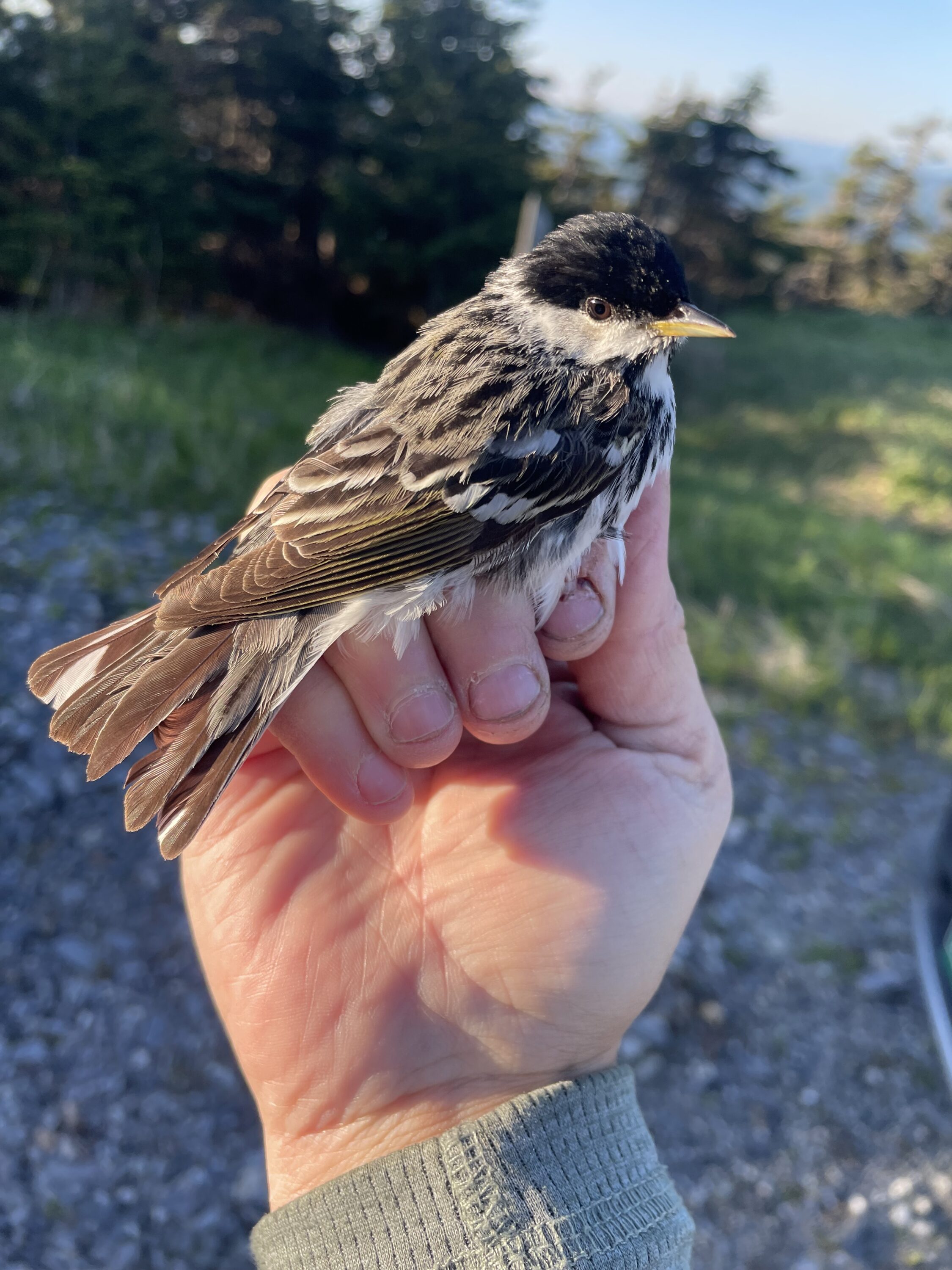
Male Blackpoll Warbler we call “WCAX” © Desirée Narango
While I was relishing my success, it turns out our neighbors at the WCAX building were also watching the fun (remotely). Apparently, I was a surprise guest on the live weather show as Meteorologist Alex Wasilenko spotted me releasing one of our birds in the WCAX parking lot. Next time, I hope they come out and say hi! (You can watch the charming segment here.)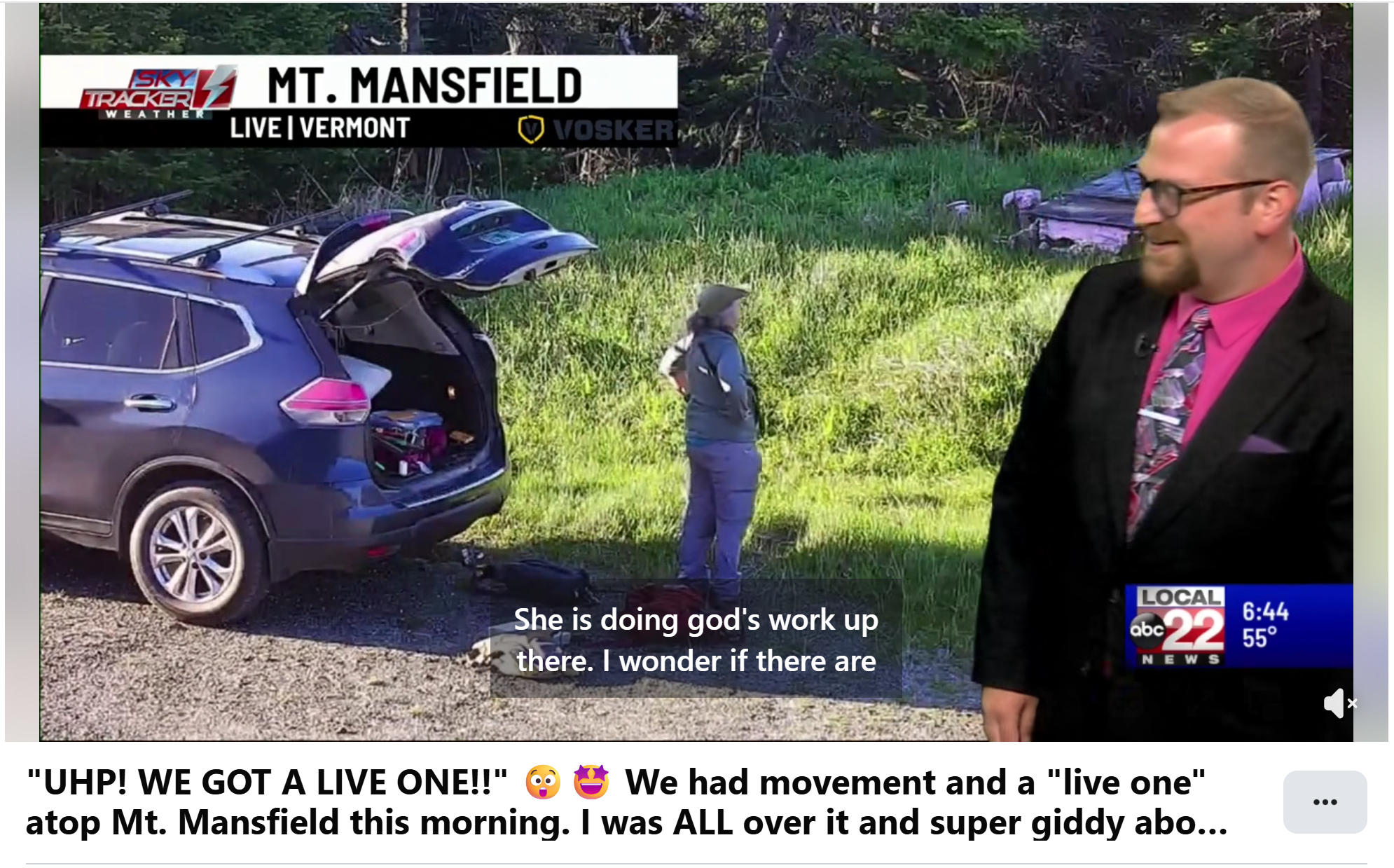
Last summer, we also tagged 19 Bicknell’s Thrushes with the same tags as our Blackpoll Warblers, as well as Motus tags that remotely ping from receivers across the US, Canada, and the Caribbean. This suite of birds was featured in our “Bicknell’s Thrush Race to the Atlantic”—a fun contest where people could vote on which bird they thought would reach the Atlantic coast first based on our data. We were very curious to see which of our named thrushes would successfully make it back to the mountain.
It turns out I wasn’t the only one experiencing an exciting morning. Anna was also successful, capturing ‘Nightingale Nate’ on the Amherst Trail! Overall, over the three days on the mountain, we captured four of our Motus-tagged Bicknell’s thrushes, including Cap’n Krummholz, Big Ol’ Balsam, and Freddy Wet-foot. (In fact, 14 of our 19 Motus-tagged Bicknell’s Thrushes from the Race to the Atlantic are back in the US. Amazing returns this year!)
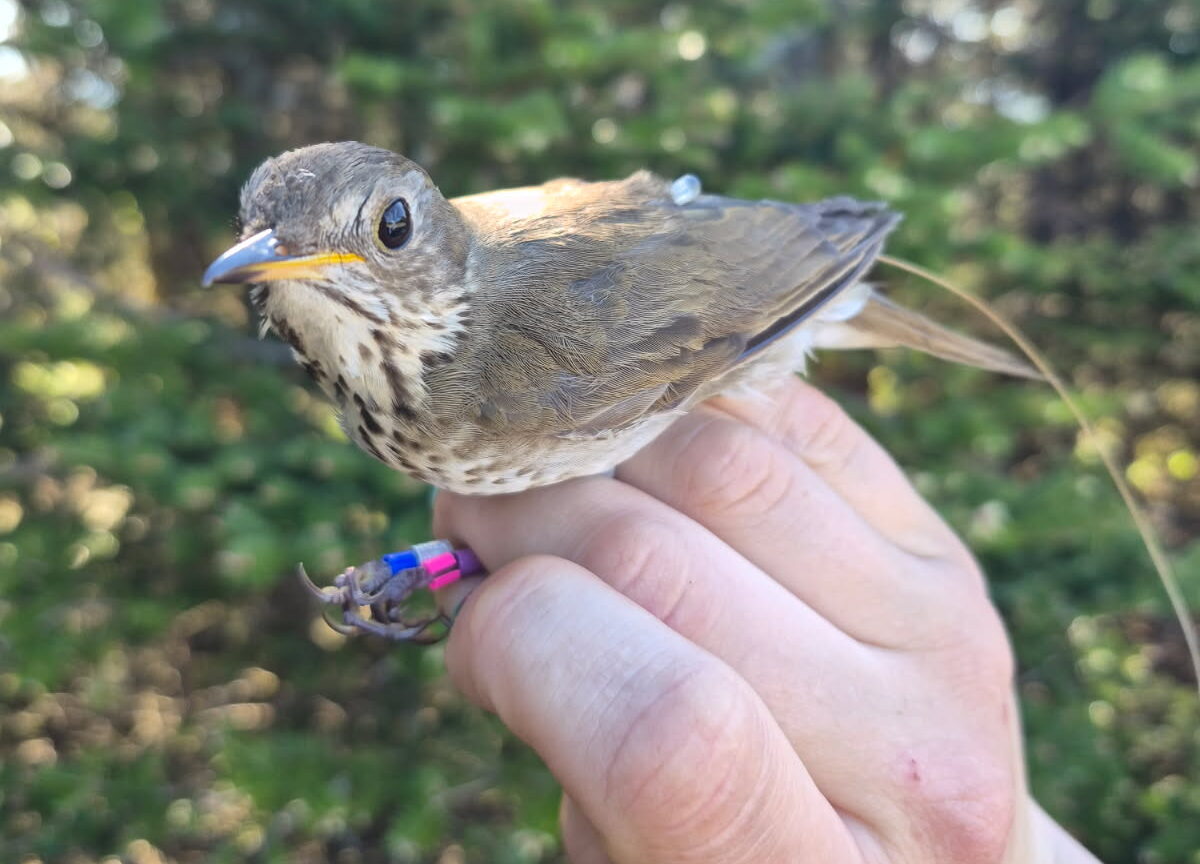
Handsome Nightingale Nate has made it back from his wintering grounds in the Caribbean! © Anna Peel
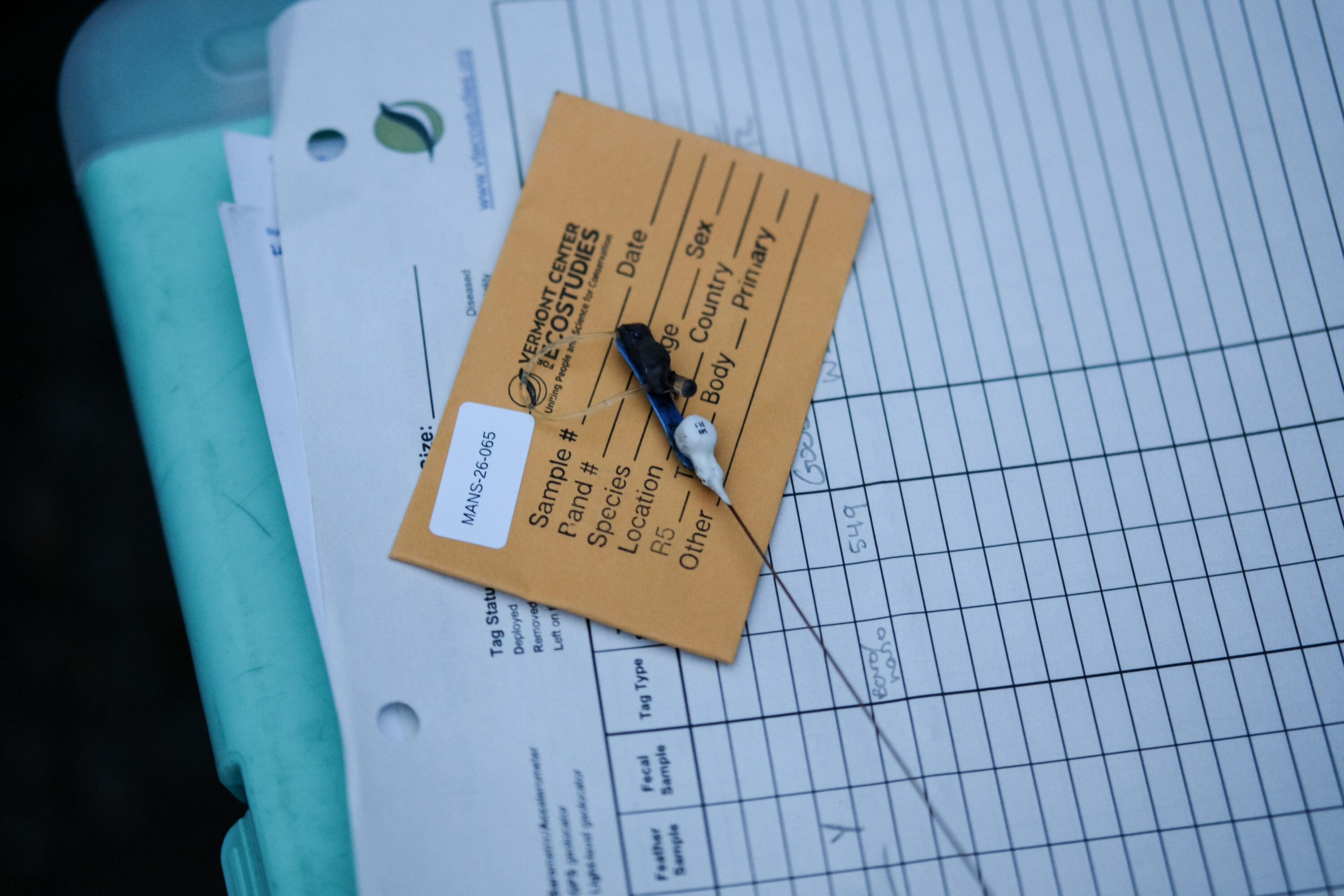
A recovered tag © Alden Wicker
Our summer will be busy running the long-term banding program and trying to recapture the remaining tagged birds. We’re excited to see what Mansfield has in store for us this year, and we’ll keep you updated on our progress and how many more birds from the Race to the Atlantic lineup we can recapture.
Support Desirée Narango’s research and other projects like this by making a donation to Vermont Center for Ecostudies! Learn about other ways to support VCE here.