Where Did My Hayfield Birdsong Go?
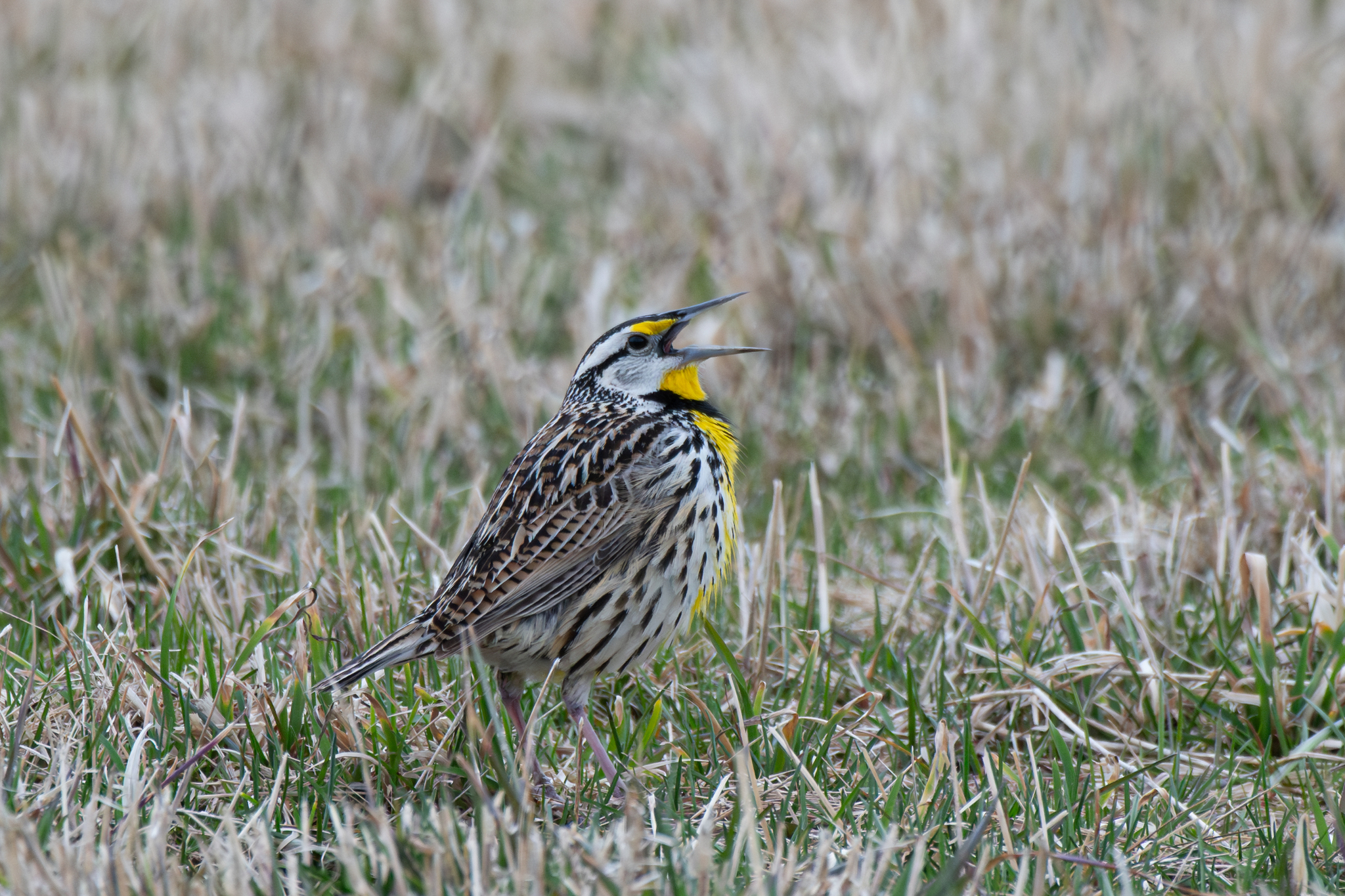
Eastern Meadowlarks have less than 50 breeding pairs left in Vermont. © Chris Roberts on iNaturalist, some rights reserved CC-BY-NC
Support Kevin Tolan’s research and other projects like this by making a donation to Vermont Center for Ecostudies! Learn about other ways to support VCE here.
For people that grew up in Vermont’s farm country, hearing the sounds of grassland birds has become a shot of nostalgia.
Vermont is a forest-dominated state today, but 150 years ago the landscape was a much different place. Much of the woodlands had been cut for timber and the land was planted with introduced European forage grasses for sheep and, more recently, dairy cattle.
As animal agriculture has waned and forests have regrown and reclaimed the landscape, the birds that inhabit large agricultural fields have disappeared from many regions of the state. The songs of Eastern Meadowlarks, Bobolinks, and even Eastern Whip-poor-will have been replaced by Hermit Thrush and Black-throated Blue Warblers.
While birds everywhere are facing unprecedented threats, this loss has been particularly pronounced in grassland birds that nest on the ground in prairies and hayfields. Eastern Meadowlark have undergone a population-wide decline of 75% and now have a Vermont population of less than 50 breeding pairs.
Though there are several reasons for these population declines, one of the major drivers is a decrease in recruitment: the process of young surviving and maturing to breeding age. Many adults survive their full annual cycle, but their young die before having the opportunity to reproduce.
This is a massive problem for grassland birds, since one of their primary threats is nest destruction, particularly by intensive grassland management. Bobolinks need roughly 32 days to finish their nesting cycle, plus an additional two weeks if the grass is cut prior to breeding season, for the grass to regrow to a height that provides enough nest cover.
Meanwhile, it takes 28 to 35 days for forage vegetation to peak in nutrition content, depending on hay species composition. Protein quality increases with haying frequency, and grass loses nutritional value every day left unharvested; as a general rule of thumb, high-quality forage gets cut prior to flowering. So for farmers that are cutting hay between three and five times per season for the purpose of feeding animals, any delay in harvest results in an unacceptable decrease in hay quality. 
The resulting frequent cuttings can create a “population sink”: otherwise attractive habitat draws individual birds to try breeding, but they can’t successfully fledge young. For Bobolinks, frequent cutting causes 100% nest failure. As the average number of young per adult decreases towards zero, the sink drains the local population, resulting in a low reproductive output and a declining population in the surrounding area.
Invasive plants may also result in reduced grassland bird populations, though we’re not entirely sure how this happens. One possibility is that nesting densities decrease as grass is replaced by invasive forbs flowers because there are fewer locations to build a nest. Additionally, Bobolinks appear to be more polygynous in higher-quality habitat, particularly where more food is available. While a male might have three females nesting in his territory in high-quality habitat, individuals in fields with lots of invasive species might be more likely to be monogamous (or bachelors), leading to fewer nests and offspring. We are currently researching how to integrate the management of invasive species into existing grassland bird management recommendations.
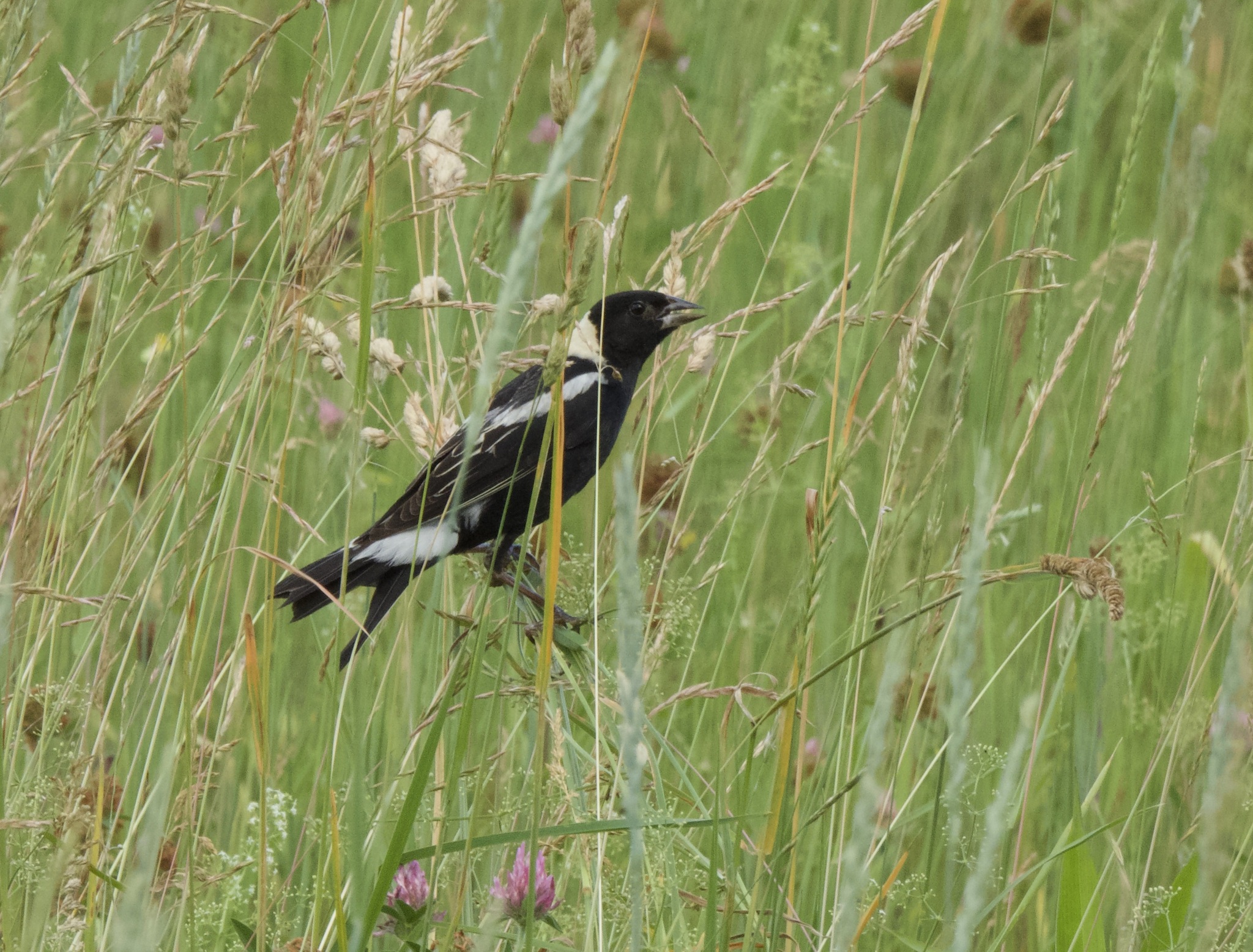
A male Bobolink in a Massachusetts hayfield © p1tch_p1ne on iNaturalist, some rights reserved CC-BY-NC
How to Bring Grassland Birds Back to Your Hayfield
If you hope to provide breeding habitat for Bobolink then there’s good news. In some ways, if you maintain it, they will come. Large hayfields are likely to entice grassland birds for breeding, so all you have to do is conserve them as unfragmented, grass-dominated habitat. The first step is to mow your fields at least once per year in the late-summer to prevent forbs (non-grass flowering plants) and woody shrubs from getting established.
Since Bobolinks exhibit a high level of natal philopatry and have a tendency to return to breed close to where they were born, it might take some time for Bobolinks to colonize a field, particularly if the field is isolated from other hayfields with Bobolink populations. Some studies have explored the use of conspecific playback (recordings of a song of that bird species) and decoys to attract grassland birds to a field. In Bobolink, playback and decoys during the post-breeding period have been shown to impact the territory plots of individuals during the following breeding season. However, this has not been a widely trialed method in Vermont and is an interesting potential research question for us.
With the rapid continent-wide decline in grassland birds, Vermont has the potential to play an invaluable role in grassland bird conservation into the next 100 years. As large swathes of the Midwest are expected to become uninhabitable for Bobolink, Vermont has the climate and rainfall necessary to provide suitable prairie-like midgrass habitat. With new agricultural fields seldom being established anymore, we must ensure that today’s existing grasslands—and their birds—are still around tomorrow.
Support Kevin Tolan’s research and other projects like this by making a donation to Vermont Center for Ecostudies! Learn about other ways to support VCE here.


R2-D2 Bobolinks. A favorite. In the “Quiet Corner” of NE CT we’ve had decent luck through the CT Audubon Society and local land trusts (Wyndham) paying hay farmers to delay their mowings and compensating them in the peak harvest season.
Hi Charles,
Some groups in VT (such as The Bobolink Project and a few of the Natural Resource Conservation Districts) have had good results doing that too, but after several years of delayed management those fields are now falling victim to invasive plants. I’m hoping that we can develop integrated management practices that provide farmers funding (or an economically viable harvest) that reduces invasive plants, while still permitting birds time to fledge; I’m in the midst of trying to secure funding for a project to do just that.
Here’s a recent article that I was quoted in regarding the emerging invasive plant issue: https://northernwoodlands.org/knots_and_bolts/delayed-mowing
Best,
Kevin
Kevin – you made an early morning Bobolink survey 3-4 years ago. we are happy to report a healthy annual population, but find the invasive are creeping in.
We mow/hay the periphery/treelines leaving the middle for the nesting.
We will get the first cut on the late side – mid July. Usually we can see the fledging young testing their wings.
Are you finding the nesting window has moved earlier in the year with the warming climate?
Hey Steve,
Nice to hear from you! I’ve been meaning to reach out, I’d love to visit again and establish a monitoring plot to track that invasive encroachment. I’ll shoot you an email next week to see about planning a morning!
Interesting, their nesting window doesn’t appear to have meaningfully shifted. They rely on the photoperiod to determine migratory movements, and that doesn’t change with the climate. But, agriculture is definitely changing. Here’s a paper out of Shelburne on the subject: https://onlinelibrary.wiley.com/doi/full/10.1002/ece3.7548
Best,
Kevin
Hi, I’m glad to see strong interest in bobolinks. When the VCE was founded, I was immediately in touch, particularly because we had a long history of bobolinks in our hayfields. I expect that our farm, Broadbrook Mountain Farm in Royalton, will appear in your records because of this; however, no one from VCE has ever visited the farm. We still raise purebred Romney sheep and make our own hay, just as we did then and many years before that. The bobolinks still come. We used to have 5 males, this year we have 3. I hope they will long continue!
Hi Holly,
Thanks for the comment, I’d love to arrange a visit. Can you shoot me an email? grasslands@vtecostudies.org
Best,
Kevin