Fourteen years of monitoring by many hundreds of community scientists has revealed that our mountain birds face challenging times in the northeastern United States. Our research continues to shed light on the underlying forces behind these declines, but anthropogenic climate change in our mountains is likely a root source of this problem. More details are available in our State of the Mountain Birds report.
In 2007, VCE scientists predicted that rising mean summer temperatures—as little as 1°C (or 1.8°F)— would cause major declines in some of the Northeast’s most iconic bird species, and eventually reduce by more than half the critical mountain habitat for many nesting bird species. (Read the full peer-reviewed paper.)
Our annual monitoring of approximately 800 montane locations is sadly bearing that prediction out. Most of the species that we monitor (Yellow-bellied Flycatcher, Winter Wren, Bicknell’s Thrush, Swainson’s Thrush, Hermit Thrush, Blackpoll Warbler, and White-throated Sparrow) have declined by an average of 42% since 2010.
The most persistent declines continue to occur in the Catskills (at the southern periphery of the northeastern spruce-fir zone), where seven of the eight monitored bird species declined by an average of 55% since 2010. (Fox Sparrow and Boreal Chickadee do not breed in the Catskills so are not included.) Only Black-capped Chickadees increased there.
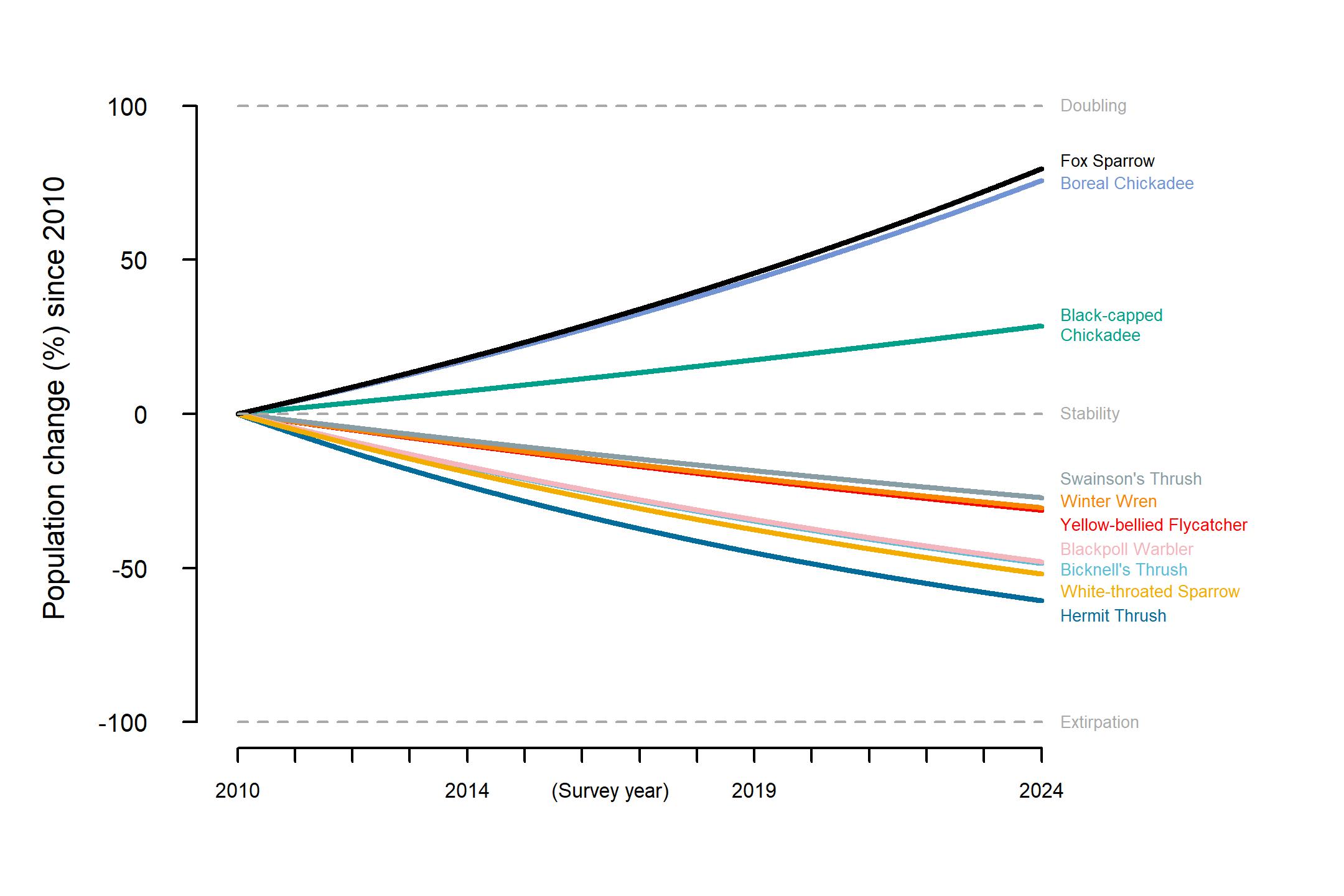
The estimated percent population change between 2010 and 2024 for all 10 focal bird species monitored via Mountain Birdwatch throughout the Northeast. Click to enlarge.