For the past 25 years, Mountain Birdwatch’s incredible community scientists have combined their passions for birds with their love of mountains, hiking more than 100 routes across eastern New York and Northern New England in June. The data they collect provides powerful insight into the health of bird populations that reside in our montane spruce-fir forests.
Learning new bird species has...caused me to be attuned to the available habitat, movements of species smaller than me, and the myriad sounds that surround me in some spaces. Practicing this intentional, slow attention-giving whether at home or further afield, has enriched my understanding of these places, and made my mental maps more complex.
— Mara Scallon, "Listening Differently", Spire: The Maine Journal of Conservation and Sustainability
2026 Survey Progress Dashboard
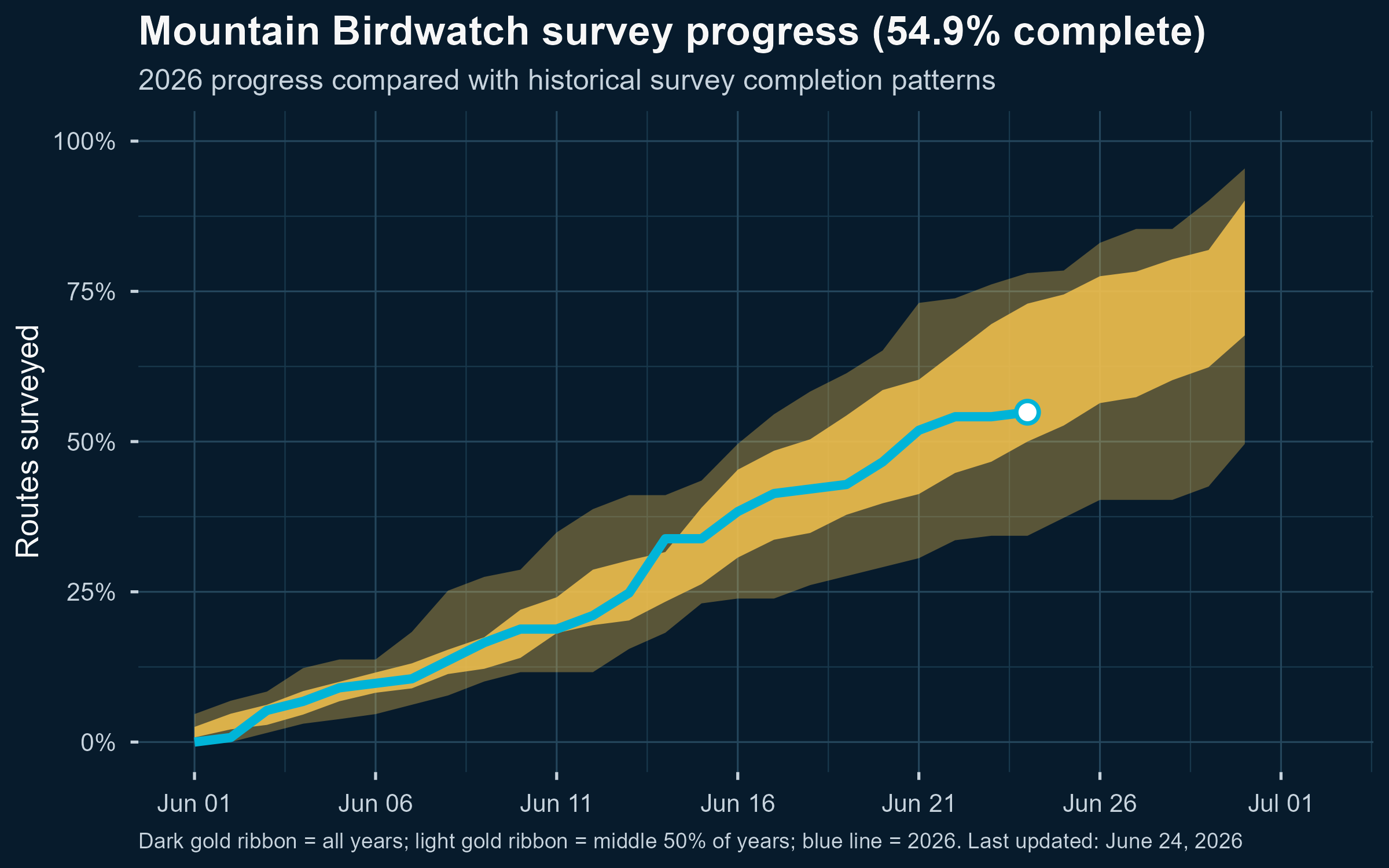
What a strong finish to the Mountain Birdwatch June survey season! It takes more than a few weekends of rain to keep us down, and 85% of the routes were surveyed. A huge shout-out to the mountain ambassadors who surveyed (or attempted to survey) their routes. Thank you Team ~ Jason
How did we do in 2026 compared to our other most-successful years? I’m glad you asked–check out the figure below to find out.
Mountain Birdwatch relies on approximately 100 volunteers to annually listen for ten bird species at approximately 800 locations in the spruce-fir zone atop mountains in the Northeastern United States.
The species they listen for represent the breadth of birds that might live at high altitudes in the Northeast in the summer—a mix of montane specialists (e.g., Blackpoll Warbler), intermediaries that occur in the lower hardwoods and spruce-fir (e.g., Swainson’s Thrush), and lower elevation species (e.g., Black-capped Chickadee) that are likely to colonize higher elevation areas as the climate warms and as humans further modify the landscape.
Together, the data points collected by volunteers paint a picture of how bird populations in the Northeastern U.S. mountains are changing.