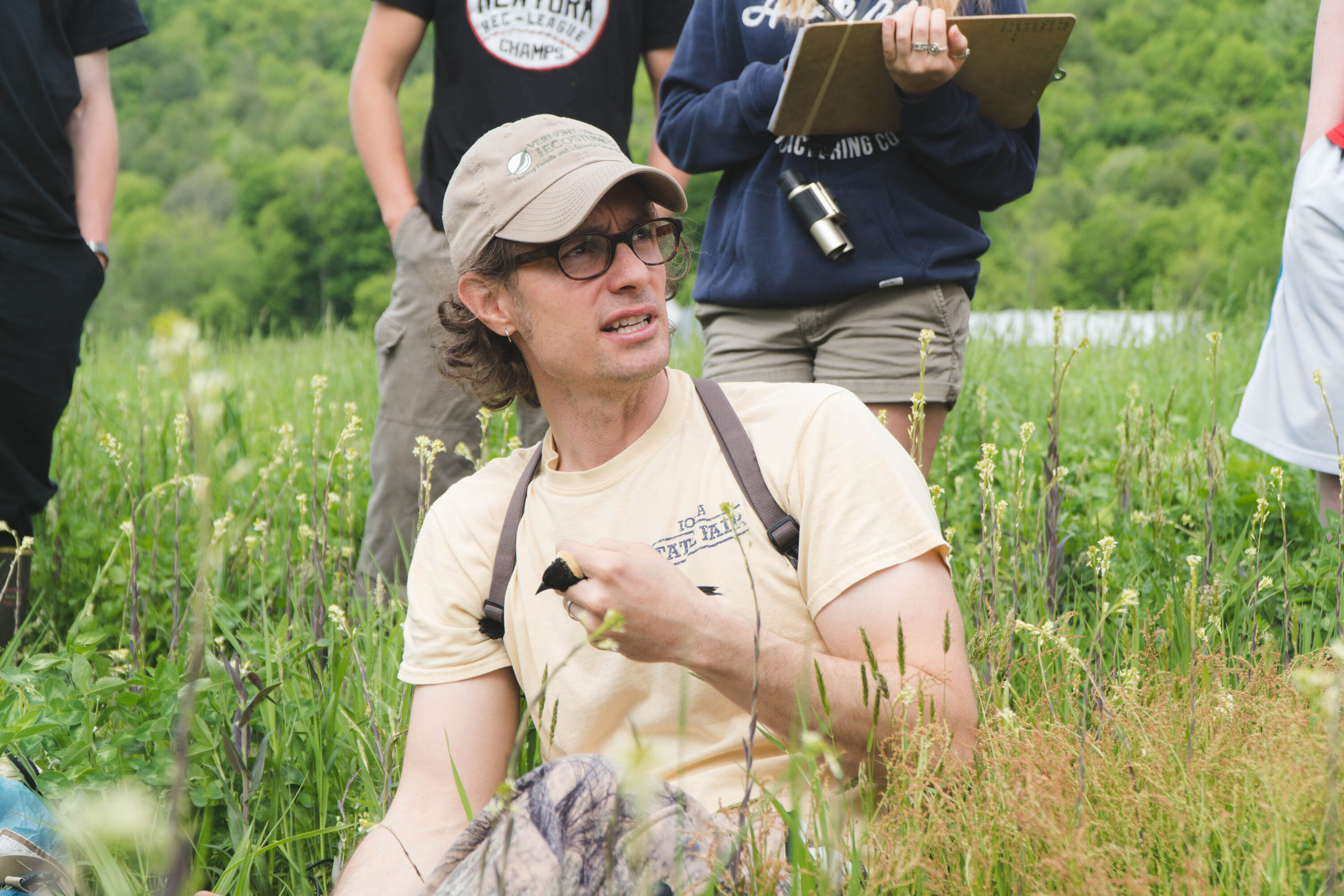
Jason is a quantitative ecologist and conservation biologist at the Vermont Center for Ecostudies whose work focuses on understanding how human-modified landscapes shape wildlife populations—and how changes in human behavior can improve conservation outcomes. His increasingly diverse research pairs rigorous quantitative science with deep, participatory community engagement. Jason coordinates and directs Mountain Birdwatch, a long-running community science program monitoring montane bird communities across the northeastern United States that is widely recognized as a model for collaborative, scientist–community partnerships. Mountain Birdwatch community scientists actively shape the program by discussing and voting on protocol changes and engaging directly with the modeling products generated from the data, reflecting Jason’s commitment to treating participants as colleagues and to shared ownership of both data and results.
Originally from Iowa, Jason grew up exploring the margins of a heavily agricultural landscape, where early exposure to both biodiversity and its loss shaped his interest in conservation. He earned his MS in Ecology from the University of Connecticut studying post-fledgling ecology of Saltmarsh Sparrows, and completed his PhD in Ecology with the Pennsylvania Cooperative Fish and Wildlife Research Unit at Penn State University, where he studied grassland sparrow population responses to experimental landscape
manipulation.
Jason’s work is grounded in quantitative modeling, with particular emphasis on hierarchical Bayesian approaches, open and reproducible science, and long-term datasets. He is a strong advocate for Open Science and freely shares data, expertise, and analytical code, and he regularly works with communities, conservation commissions, state agencies, and policymakers to address conservation challenges of local concern. He serves on Vermont’s Birds Scientific Advisory Group and participates in numerous regional and professional working groups, and he frequently makes himself available for in-person discussions with community groups and decision-makers.
Earlier in his career, Jason conducted field research across a wide range of ecosystems—from monitoring sea otters in California and Red-Cockaded Woodpeckers in Florida, to studying House Wrens in Costa Rica. One formative experience included assisting in failed efforts to capture the last known Po‘ouli on Maui; witnessing a species go extinct remains a powerful motivator for his focus on timely, action-oriented
conservation science.
Outside of work, Jason enjoys chasing insects with his kids, paddling, hiking, and moonlit ski treks with his family.
Projects
Jason Hill is an expert on:
- Northeast and New England mountain ecosystems
- Climate change and mountain birds
- Community/citizen science (i.e. volunteering for wildlife research)
- Large-scale wildlife monitoring
- Grassland bird ecology, conservation & management
- Tick spraying and pesticides
- Pesticides and pollinators
- Quantitative ecology & wildlife population modeling
Selected Publications
Harrison, A-.J., C. Stenzel, A. Anderson, … J. M. Hill … & M.B. Wunder. (2026). The collective application of shorebird tracking data to conservation. Conservation Biology e70194.
Linscott, J.A., E. Basso, R. Bathrick, … J.M. Hill … & N.R. Senner. (2024). The Amazon Basin’s rivers and lakes support Nearctic-breeding shorebirds during southward migration. Ornithological Applications 126: duae034. https://doi.org/10.1093/ornithapp/duae034
Hallworth, M. T., A. P. K. Sirén, W. V. DeLuca, T. R. Duclos, K. P. McFarland, J. M. Hill, C. C. Rimmer, and T. L. Morelli. 2024. Boom and bust: the effects of masting on seed predator range dynamics and trophic cascades. Diversity and Distributions 30:8 e13861.
Faccio, S.D., L. Morse, S. Hagenbuch, J.M. Hill, S.P. Hardy, A.W. D’Amato, B. Fisher. 2023. Sugarbush management impacts on forest structure and bird communities in Vermont.. Figshare. Preprint. https://doi.org/10.6084/m9.figshare.24168042.v1
Meehan, T.D., et al. (incl. M.T. Hallworth, J.M. Hill, K.P. McFarland, C.C. Rimmer). 2022. Integrating data types to estimate spatial patterns of avian migration across the Western Hemisphere. Ecological Applications 32(7):e2679.DOI:10.1002/eap.2679
Migratory patterns and connectivity of two North American grassland bird species. 2019. Hill, JM and RB Renfrew. Ecology and Evolution 9(1):680-692.
A fine-scale U.S. population estimate of a montane spruce–fir bird species of conservation concern. 2017. Hill, JM and JD Lloyd. Ecosphere 8(8): 14 pages.
Winter diet of Bobolink, a long-distance migratory grassland bird, inferred from feather isotopes. 2017. RB Renfrew, JH Hill, DH Kim, C. Romanek, N. Perlut. The Condor 119(3):439-448.
High-resolution tide projections reveal extinction threshold in response to sea-level rise. 2017. CR Field, T Bayard, C Gjerdrum, JM Hill, S Meiman, CS Elphick. Global Change Biology 23:2058–2070.
Mark-resight abundance estimation under incomplete identification of marked individuals. 2014. McClintock, BT, JM Hill, L Fritz, K Chumbley, K Luxa, and DR Diefenbach. 2014. Methods in Ecology and Evolution 5:1294-1304.
Occupancy Patterns of Regionally Declining Grassland Sparrow Populations in a Forested Pennsylvania Landscape. 2014. Hill, JM and DR Diefenbach. Conservation biology 28:735-744.
Habitat Availability Is a More Plausible Explanation than Insecticide Acute Toxicity for US Grassland Bird Species Declines. 2014. Hill, JM, JF Egan, GE Stauffer, and DR Diefenbach. PLOS ONE 9(5): e98064.
On the persistence of Cenococcum geophilum mycorrhizas and its implications for forest carbon and nutrient cycles. 2013. Fernandez, CW, ML McCormack, JM Hill, SG Pritchard, and RT Koide. Soil Biology and Biochemistry 65:141-143.
Experimental Removal of Woody Vegetation Does not Increase Nesting Success or Fledgling Production in Two Grassland Sparrows (Ammodramus) in Pennsylvania. 2013. Hill, JM, and DR Diefenbach. The Auk 130:764-773.
Male-Skewed Sex Ratio in Saltmarsh Sparrow Nestlings. Hill, JM, J Walsh, A. Kovach, and CS Elphick. 2013. The Condor 115:411-420.
Are Grassland Passerines Especially Susceptible to Negative Transmitter Impacts? 2011. JM Hill and CS Elphick. Wildlife Society Bulletin 35:362-367