Field Report: New Birds Are Showing Up on Mount Mansfield’s Peak
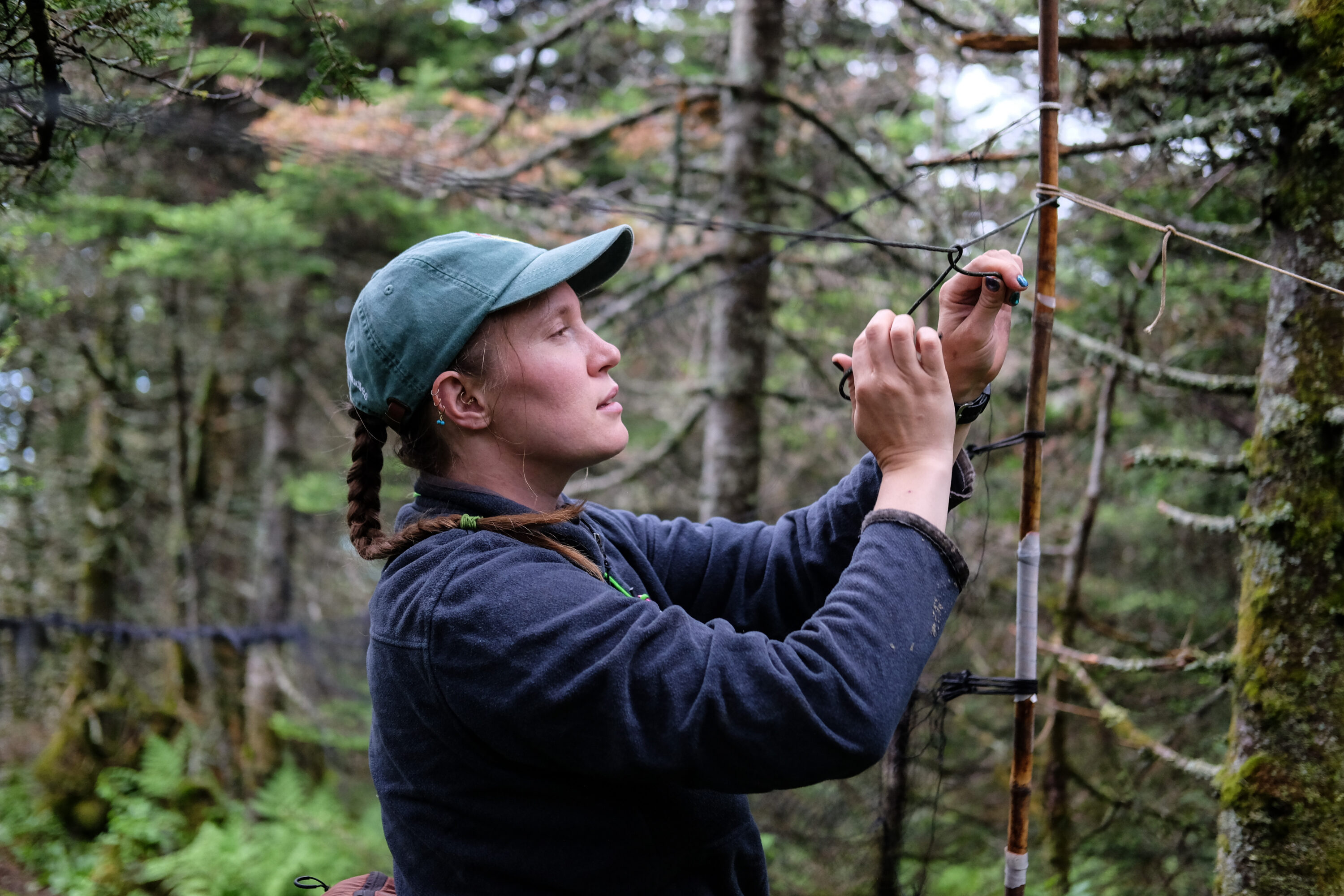
Anna Peel opens a mist net on Mount Mansfield © Alden Wicker
Support Anna Peel’s work and other projects like this by making a donation to Vermont Center for Ecostudies! Learn about other ways to support VCE here.
I’ve heard it said that you cannot step twice in the same river; I’d argue the same is true for Mount Mansfield. The ever-shifting face of Vermont’s tallest mountain is impossible to pin down. Even over the course of a single morning, change is everywhere you look.
On my first pre-dawn run to open our nets, night wraps around the bobbing beam of my headlamp; all is silent except for the sound of my footsteps and the low mechanical throbbing of the WCAX radio tower atop the Nose. By the time I’ve opened our last net, birds are beginning to wake up all around me.
Often, a White-Throated Sparrow is the first to break the silence with only a single note of their song, as if they need a moment to remember how the rest of it goes. After a few false starts and long pauses, the phrase finally unfurls in its entirety. Next, perhaps, a Winter Wren might respond with a glittering musical cascade; these little maestros never need a warmup before their center-stage moment. Finally a Bicknell’s Thrush joins in, and the mountain comes alive with birdsong before the sun is even up.
When I next check the nets, the forest around me has gone from velvet-black to shades of gray, shot through with beams of orange light. This first light is intensely vivid, almost jeweled; the undulating clouds over the valley below are striped with coral, and glinting beads of dew on the balsams throw needles of rubied light in every direction, like tiny disco balls. Blackpoll Warblers have begun to sing by now, late but welcome arrivals to the morning’s party.
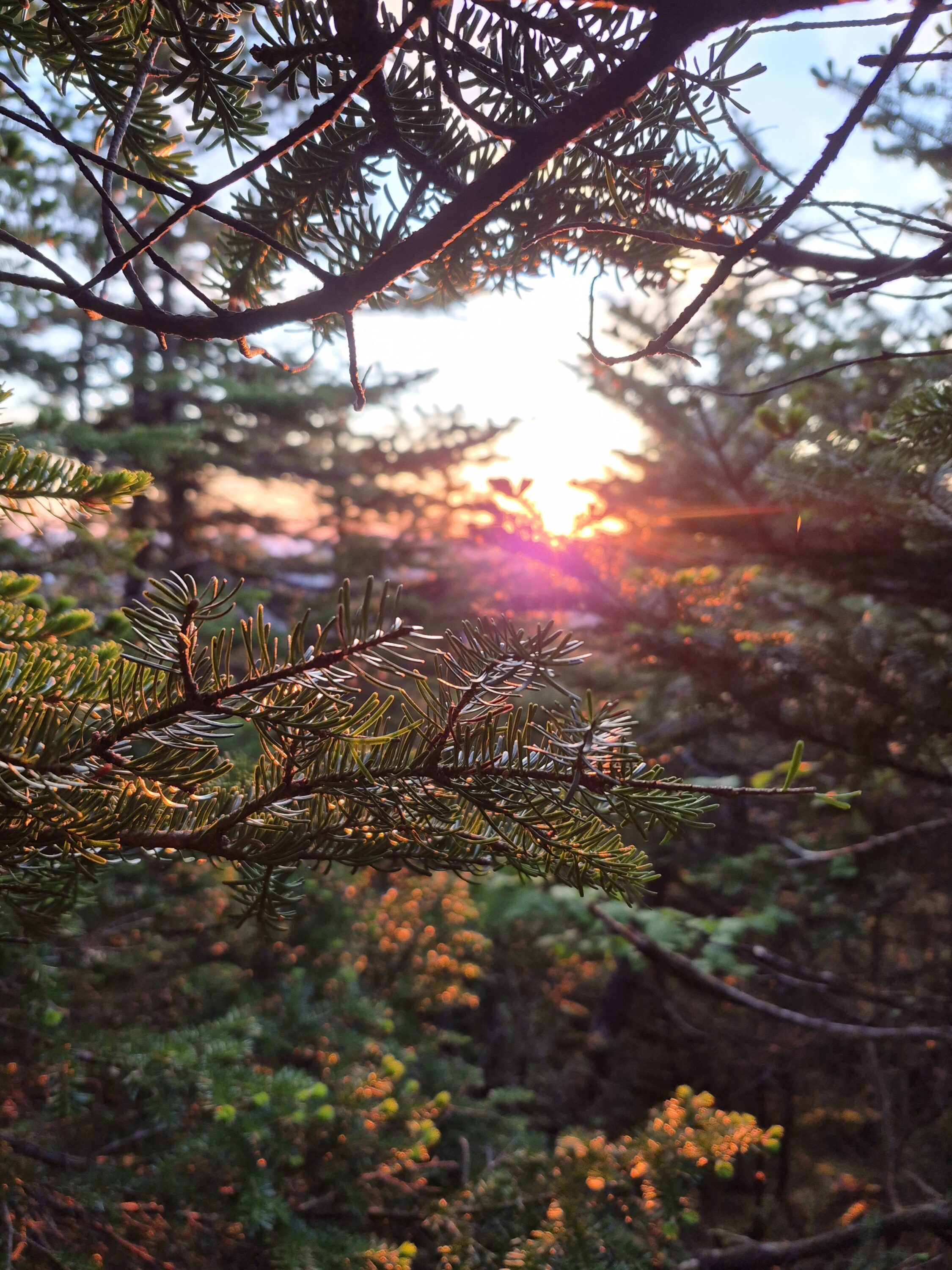
First sunlight through Balsam Fir needles © Anna Peel
Within an hour, the sun finally climbs high enough that I no longer need a headlamp to see the net against a bird’s feathers, and the richly colored dawn light has eased into a softer palette. The Adirondacks and the White Mountains flank us on either side, their pale silhouettes like washes of blue watercolor against the sky. From this moment onwards, brightness and heat spread quickly over the mountain. It seems like hardly any time at all passes before we are all sweating in the noon sun, packing up our nets and heading down the mountain, bidding Mansfield farewell until the next week.
New Birds on the Block
Change is afoot on Mansfield on a larger scale than the day-to-day. This summer, birds that usually breed at lower elevations like Black-throated Green Warblers and Magnolia Warblers have firmly staked their place at the peak itself. In 2025, we caught our first Black-throated Green Warbler on the 24th of June. According to the Vermont Atlas of Life, Black-throated Green Warblers begin arriving in Vermont in the last week of April, and raise only one family of chicks per season. Therefore, our first 2025 Black-throated Green almost certainly did not breed on the peak, and only visited our station after he had concluded his business further downslope. Over the next weeks of July 2025, we caught only three more Black-throated Greens visiting the peak.
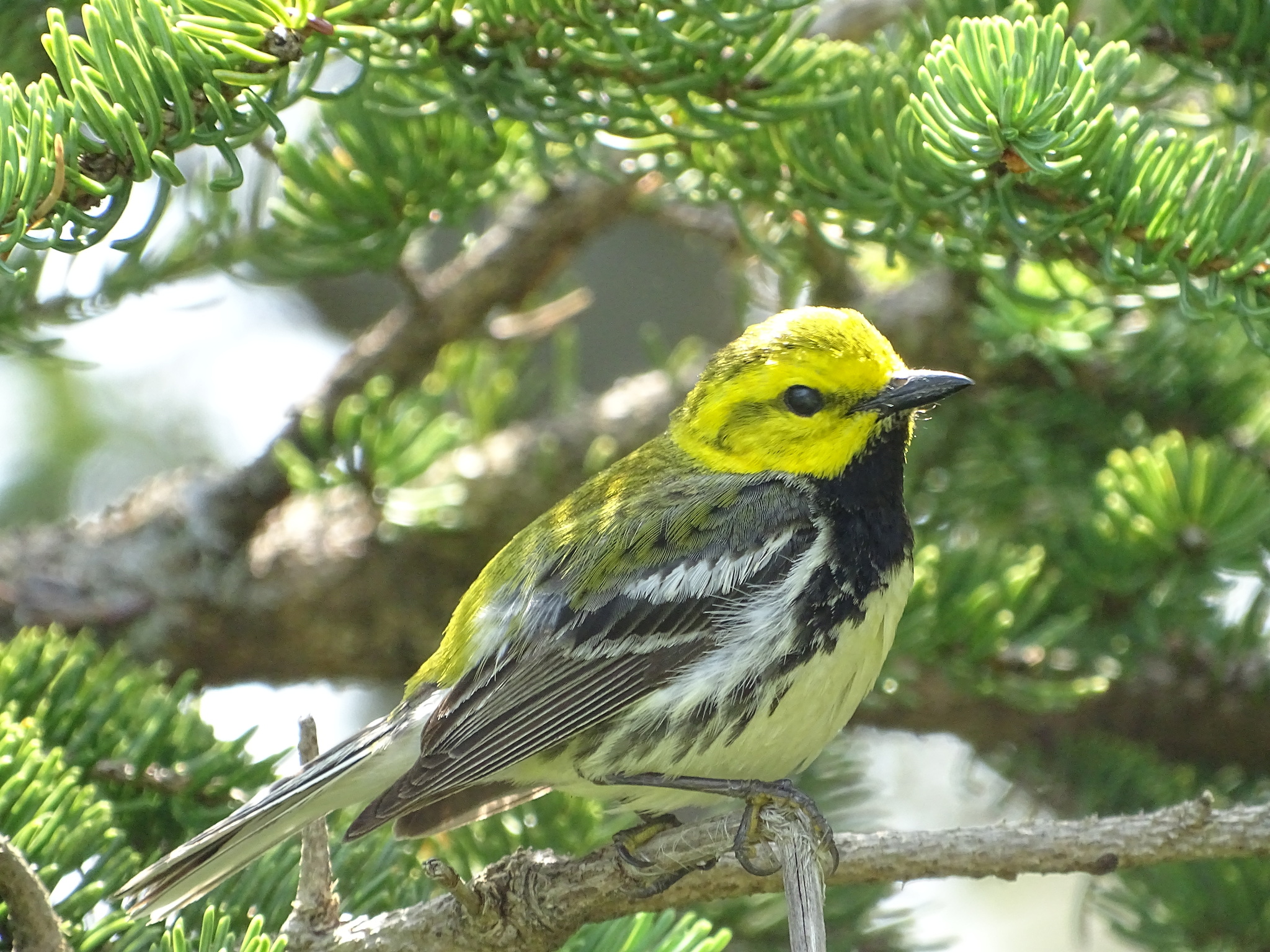
Black-throated Green Warbler (Setophaga virens) observed in late June in Maine. They usually breed at lower elevations but have been moving to Mount Mansfield’s ridge and peak. by @Seabrook48 on iNaturalist. Some rights reserved CC-BY-NC
2026 has been a different story. We caught four Black-throated Green Warblers in the first week of June, and four more in the following three weeks. All but two of these birds were in peak breeding condition, with either the cloacal protuberance males develop to mate with females, or the brood patch females use to incubate eggs and keep chicks warm. Even if we hadn’t caught these birds and seen the physical breeding evidence up close, it would have been difficult to miss the auditory evidence. There seems to be a male Black-throated Green Warbler singing his three-toned song of buzzy whistles everywhere we go this year, and we have even seen them scuffling with each other among the trees, perhaps to impress watching females!
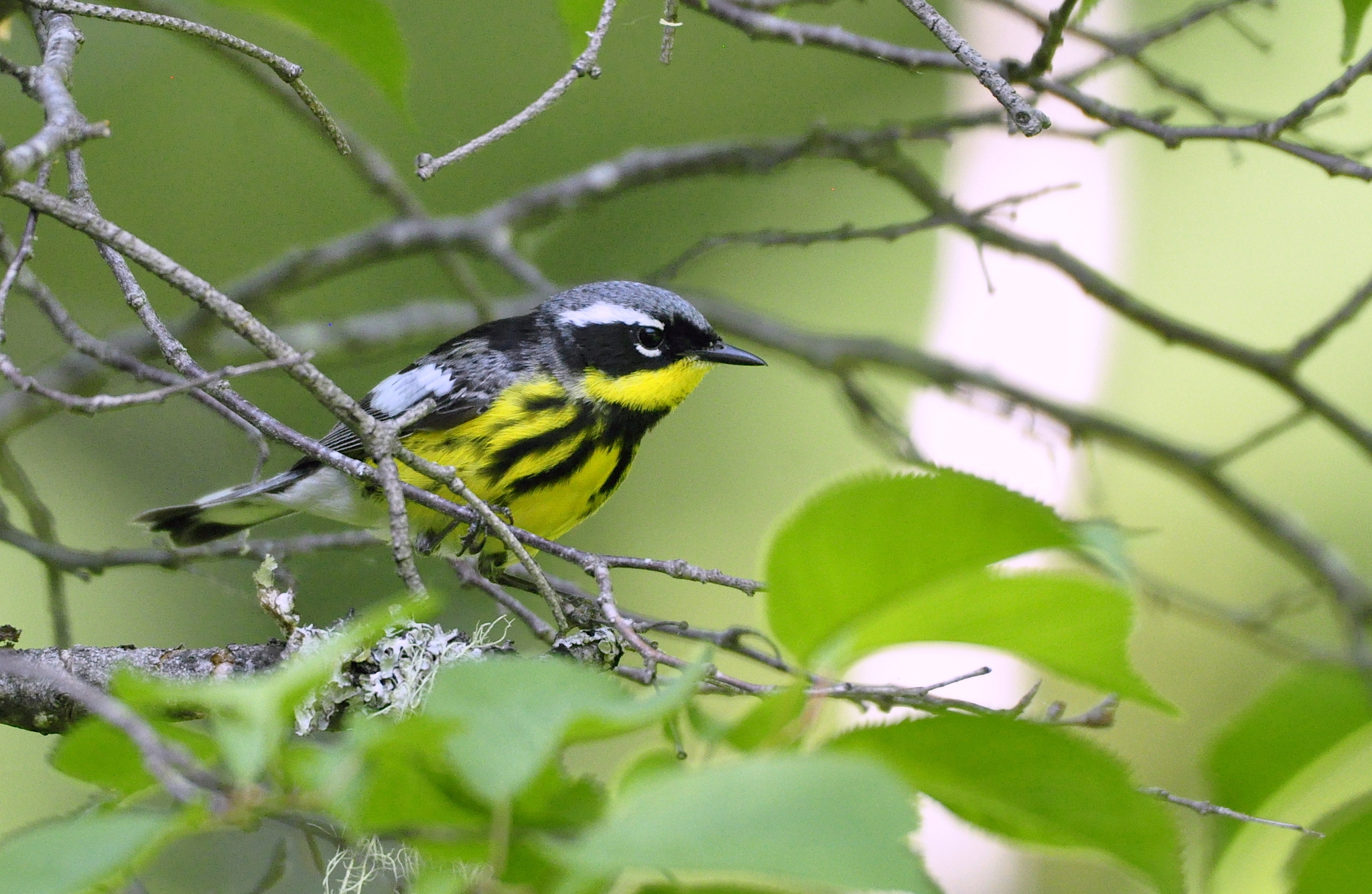
Magnolia Warbler (Setophaga magnolia) observed in Maine in mid-June. They also usually breed at lower elevations, but we’ve caught ten on Mount Mansfield that showed breeding evidence. © Oliver W Patrick on iNaturalist. Some rights reserved CC-BY-NC
Just as the Black-throated Green Warbler has burst onto the scene with little preamble, so too has the Magnolia Warbler. In 2025, we captured three male Magnolia Warblers in our nets, only one of whom had any evidence of breeding activity. This summer, we have already banded twelve new Magnolia Warblers. Ten out of these twelve birds showed breeding evidence, and six have been recaptured multiple times since their first visit to our station.
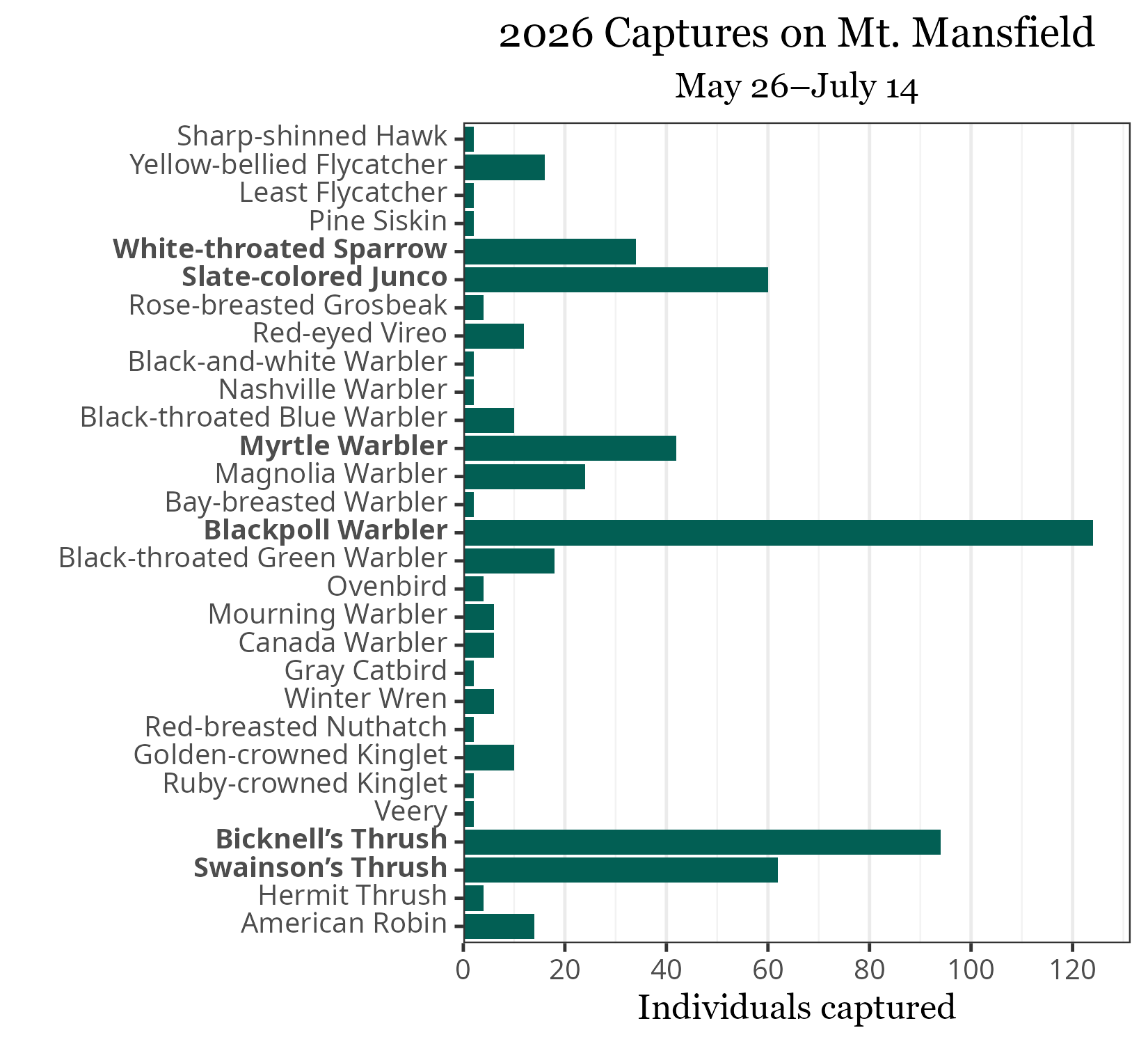
Bolded names are focal bird species for VCE’s Mount Mansfield songbird research
To put those numbers into context, our Magnolia Warbler captures this summer are now vying to equal those of our Myrtle Warblers. Myrtle Warblers, a regional subspecies of the Yellow-Rumped Warbler, have historically been one of VCE’s six focal breeding species on Mount Mansfield. Those six focal species are usually the species with the highest capture numbers at the Mansfield banding station. You can see in the graph below, however, that there are now seven distinctly longer bars, rather than six. The Magnolia Warbler is catching up—and quickly!
Although this shift only reflects one summer’s worth of data, VCE’s scientists have collected over fifteen years of information about Mansfield’s avian community which they will analyze to test our hypothesis. We suspect that these birds are here to stay, and that more will follow as Mansfield’s peak gets warmer in the coming years.
Re-Catching Tagged Birds
Many of VCE’s supporters followed the story of last summer’s radio-tagged Bicknell’s Thrush with great excitement during their “Race to the Atlantic”. This spring, more than two-thirds (fourteen out of nineteen!) of our original squadron of intrepid Bicknell’s Thrush returned to Mansfield. You can read my colleague Dr. Mike Hallworth’s detailed account of their journey here. We’ve been lucky enough to recapture eight of those fourteen birds so far this summer, and all but one of those eight were captured passively in our long-term net arrays—what obliging birds Bicknell’s Thrush can be!
Our tagged Blackpoll Warblers, however, are a very different story. Last June, we fitted twenty male Blackpoll Warblers with harnesses capable of recording barometric pressure, acceleration and geolocation, as well as three colored legbands each. Blackpoll Warblers are a species with high territory fidelity, which means that from year to year they return to roughly the same fifty-meter area to breed. We had seen our colorbanded Blackpolls regularly throughout last summer, and hoped to recapture them in those territories this summer.
During our first week on the mountain, Mike Hallworth and myself found four of the twenty color-banded and harnessed Blackpoll Warblers back in their territories from the previous summer, and quickly set up target nets to capture our old friends. In the weeks that followed, we ranged further, looking for birds that might have moved to territories adjacent to their plots from last summer, then searching the areas beyond even neighboring territories. After four weeks of ever-widening search areas, we recovered two more Blackpoll Warbler harnesses, bringing our total number up to six. Desiree Narango’s stirring tale of her capture of our fifth harnessed Blackpoll Warbler near the WCAX buildings can be read here.
The recovery of our sixth and (so far!) final Blackpoll Warbler depended on a confluence of good luck and the skill and determination of our Seasonal Technician Jackie Quinones. This Blackpoll was first captured in 2025 at the junction of the Cliff and Amherst trails. For those who don’t know Mansfield’s trails, the Cliff trail is one of the most notoriously steep and treacherous ways to access the peak. Jackie set off from our bird’s 2025 capture location, following the tantalising whisper of a Blackpoll song into the thick Krummholz. Finally, about twenty meters from the trail, she managed to catch a clear glimpse of the singing bird – disappointingly lacking the colored legbands that tell us that a bird is carrying a precious harness. But Jackie didn’t turn back; she had begun to hear another Blackpoll singing even further away. Just as the mountain terrain became impassably steep, she saw a small bird perched atop a dead snag – with one dark blue and two orange legbands.
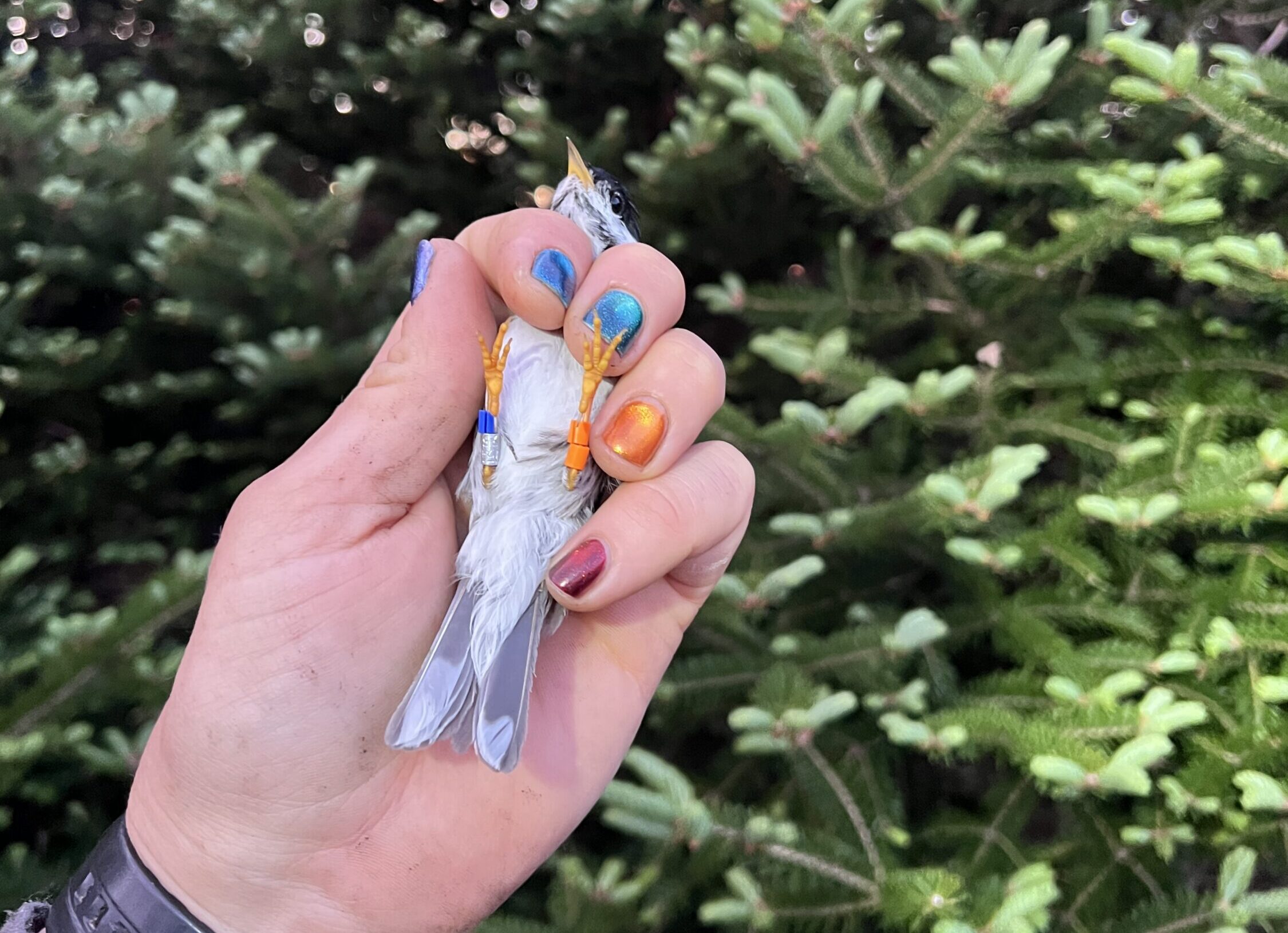
Our sixth recaptured Blackpoll Warbler shows off his brightly-colored leg bands. © Jackie Quinones
Within an hour, Jackie and I had set up two closed six-meter nets, one near the spot she had seen the colorbanded Blackpoll singing, and one a little further away, as close to the steep drop-off as we could manage. We hightailed it out of there in the gathering dusk, and I returned before dawn the next morning to open the nets and lie in wait for our long-absent friend, stashing my speaker below the net closest to his perch from the day before. Fifteen tense minutes later, I heard him sing for the first time, and my heart sank – he was singing from below the drop-off. I scrambled to move my speaker to the second net, and quickly crawled to a new hiding spot where I hoped he wouldn’t see me. He sang again, and I pressed play on my recording of a male Blackpoll song. I heard a flutter of wings—and the next time my recorded song rang out, I heard the real Blackpoll sing a response from directly next to the net.
The next five minutes were a heart-thumping game between myself and the bird. Every time I heard him sing, I triggered the playback, so it would seem as if a rival male was challenging him in a display of what we call “countersinging”. I could hear the real bird flying back and forth over my net, and began to fear that he might be too clever to be captured a second time. I upped the ante of my recorded song, mixing in a series of “alarm call” chip notes. The real Blackpoll Warbler abruptly went silent. I waited thirty seconds to make sure, then jumped up from my hiding spot and ran to the net. There he was, tangled in the net directly above my speaker. In the end, he was caught only forty-nine meters from where he had been initially captured in 2025 —but what a dense thicket those forty-nine meters were!
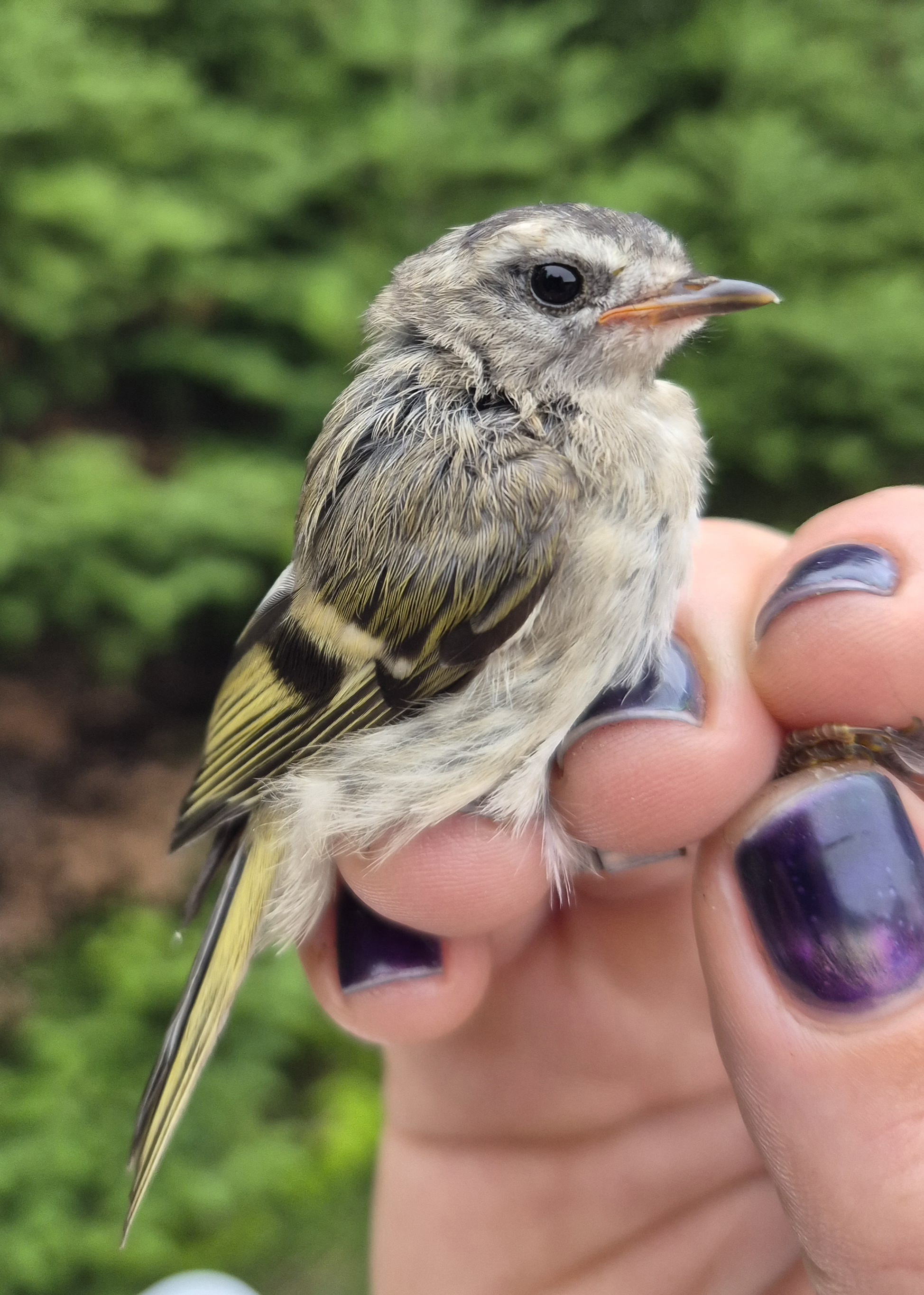
A juvenile Golden-Crowned Kinglet, orange-colored gape still visible at the corner of its bill © Anna Peel
In the few weeks remaining of VCE’s 2026 summer season, there is always a chance that one more of our tagged Blackpolls or Bicknell’s Thrush might choose to visit our passive nets of their own accord. We will be crossing our fingers that they do. In the meantime, we are cherishing the influx of juvenile birds from across the mountain as fledglings leave the nest for the first time and explore their brand new world.
That world is changing day by day. We can only hope these new fledglings will rise to meet the challenge.
Support Anna Peel’s work and other projects like this by making a donation to Vermont Center for Ecostudies! Learn about other ways to support VCE here.


EXCELLENT writing and report! Thanks for the Mansfield update, Anna.
Thanks for this exciting report.
The new technology adds so much information about the lives of these birds.
Well done!
I echo the wonderful writing comments, and really appreciate the stories of Mansfield. Hard work, such passion and creativity.