Ever since the day in 1803, when John James Audubon tied thin silver cords to a brood of Eastern Phoebes near Philadelphia, and later confirmed that two returned to the neighborhood the following year, ornithologists have been devising ways to track songbird migration.
Life would be so much easier for VCE biologists if only birds could talk. Where did this Bicknell’s Thrush come from? Where is it going? In what kind of habitat did this Blackpoll Warbler spend last winter? Where are declining species facing the largest threats?
Answers to questions like these don’t come easily. For nearly two centuries, the only way to trace connections across an individual’s annual cycle was banding them and hoping that someone else captured the same bird at a different time of year. For some species, like migratory waterfowl, we gained valuable insights from band recoveries. For others, like warblers and other songbirds, recapturing a previously banded bird is like searching for the proverbial needle in a haystack. Possible, but few and far between.
What Is Migratory Connectivity?
Migratory connectivity is the geographic link between populations in two or more seasons of the annual cycle.
The strength of migratory connectivity is a continuum ranging from strong to weak. Understanding the strength of migratory connectivity is critical for evaluating how species respond to environmental stressors across the annual cycle—and where best to focus conservation efforts—because it describes the extent to which populations co-occur between seasons, and therefore whether they are exposed to the same environmental conditions and selective pressures.
In order to quantify the strength of migratory connectivity, we need to know where individuals from across a species distribution are throughout the different phases of their annual cycle. For small-bodied animals, like songbirds that can traverse thousands of miles and span continents, it’s especially challenging. Until relatively recently, it wasn’t even possible.
Although understanding space-use strategies and habitat preferences of Nearctic-Neotropical migratory songbirds has grown substantially in recent decades, despite banding millions of individual birds, the strength of migratory connectivity remains poorly understood for many species because of extremely low recapture rates.
Technological advances in recent decades have allowed VCE researchers to use innovative techniques and technology—from analyzing the chemical composition of bird feathers to directly tracking movements via miniaturized data loggers—that offer greater insights into songbird ecology and conservation.
Stable Isotopes
A bird’s diet, and the resulting chemical signatures incorporated into a bird’s feathers can help tell us the approximate latitude of where their feathers were grown.
Some basic chemistry explains how. A hydrogen nucleus has a single proton. Yet there are trace amounts of another form called “heavy hydrogen,” or deuterium, with one proton and one neutron. It is a stable (non-radioactive) version of hydrogen with similar properties. We call these and other naturally occurring elements stable isotopes. They are relatively easy to measure in the environment—in rainwater, oceans, soil, plants, humans, and, by extension, birds and other wildlife. This ratio generally varies with latitude— precipitation in Vermont, for example, will contain different hydrogen stable-isotope ratios than rainwater falling in Virginia.
As rainwater passes up the food chain from plant to insect and eventually birds, the hydrogen stable-isotope signature in rainfall is retained. As a result, a bird’s feathers carry stable-isotope ratios that correspond to the precipitation in the latitude where those feathers were grown. In other words, you are what you eat.
The latitudinal estimates leave a lot to be desired since the locational precision is low, but for many small bodied species, stable isotopes provide a way to uncover where individuals originated from. Studies that use stable isotopes generally have larger sample sizes and are less expensive than large-scale tracking projects, because stable isotope analyses are relatively inexpensive, and individuals need to be captured only once.
VCE has used stable isotopes to advance our understanding of migratory species from teasing apart how Bicknell’s Thrush disperse between disjunct breeding populations to describing the annual cycle of migratory dragonflies.
Feathers aren’t the only tissues that speak volumes on a bird’s behalf. So do toenails. Unlike feathers which are molted on the breeding grounds, toenails are constantly growing, just like humans, and so can provide information about non-breeding habitat use.
VCE, using isotopic evidence from toenails obtained shortly after arriving to Vermont, suggests that Bicknell’s Thrushes may segregate by habitat—in cloud forests, where they can find ample insects for feeding, or lower-quality second-growth habitat, where fruit may comprise a larger part of the winter diet. The isotopic signatures suggest that males occupy the preferred montane winter habitat while females tend to use the less desirable regenerating forest. These findings may explain the skewed 3:1 male-to-female sex ratio observed on the breeding grounds.
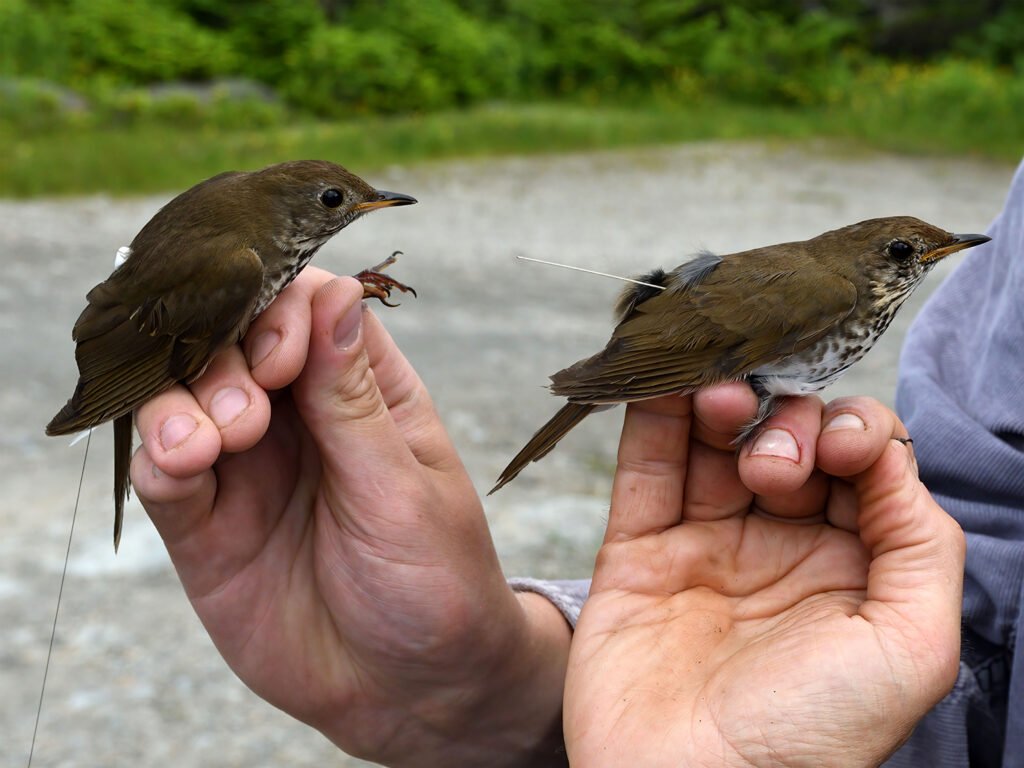
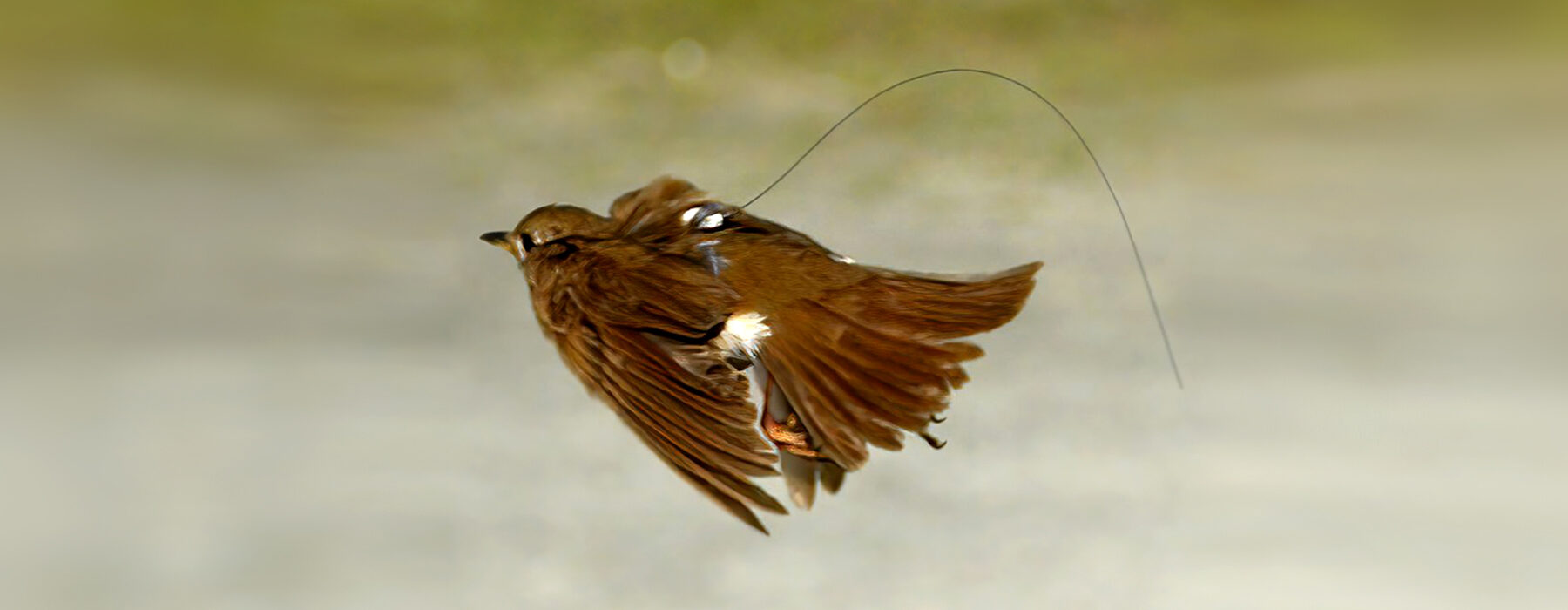
2 Bicknell’s Thrushes with tracking backpacks. © Michael Sargent
Tracking Technology
When it comes to tracking animals, size matters. Generally, the larger the tracking device, the more precise the location estimates. Large tracking devices, such as GPS or Argos Satellite tags, have been around for decades and have been used to track everything from large mammals to raptors, seabirds, and shorebirds. The larger devices communicate directly with satellites and provide real-time data on individual movements. VCE has used these tags to track the long-distance movements of Andean Flamingos as they move between high-elevation salt flats in the Andes, to better understand the threats that lithium mining poses to that fragile system.
Unfortunately, small-bodied species like warblers can’t carry the relatively heavy GPS and Argos tags. However, the technological advancements and miniaturization of tracking technology over the past two decades are staggering. The first study to directly track individual songbirds across the annual cycle was published in 2009. The availability of lightweight light-level geolocators was a significant advancement in tracking technology and led to a much better understanding of migratory connectivity and the full-annual cycle for a variety of small-bodied songbird species.
VCE scientists are constantly developing new ways to analyze, interpret, and integrate movement data to address pressing conservation issues and stem ongoing population declines of migratory populations. So keep checking back to find out what we’re working on next.