Vermont Center for Ecostudies, along with our collaborators and international partners, have been trying to uncover the migration mysteries of the Bicknell’s Thrush for over 30 years.
Migratory bird populations are declining rapidly all across North America. The most vulnerable among them are species that have small population sizes that are geographically separated, with a limited distrubution and specialized habitats.
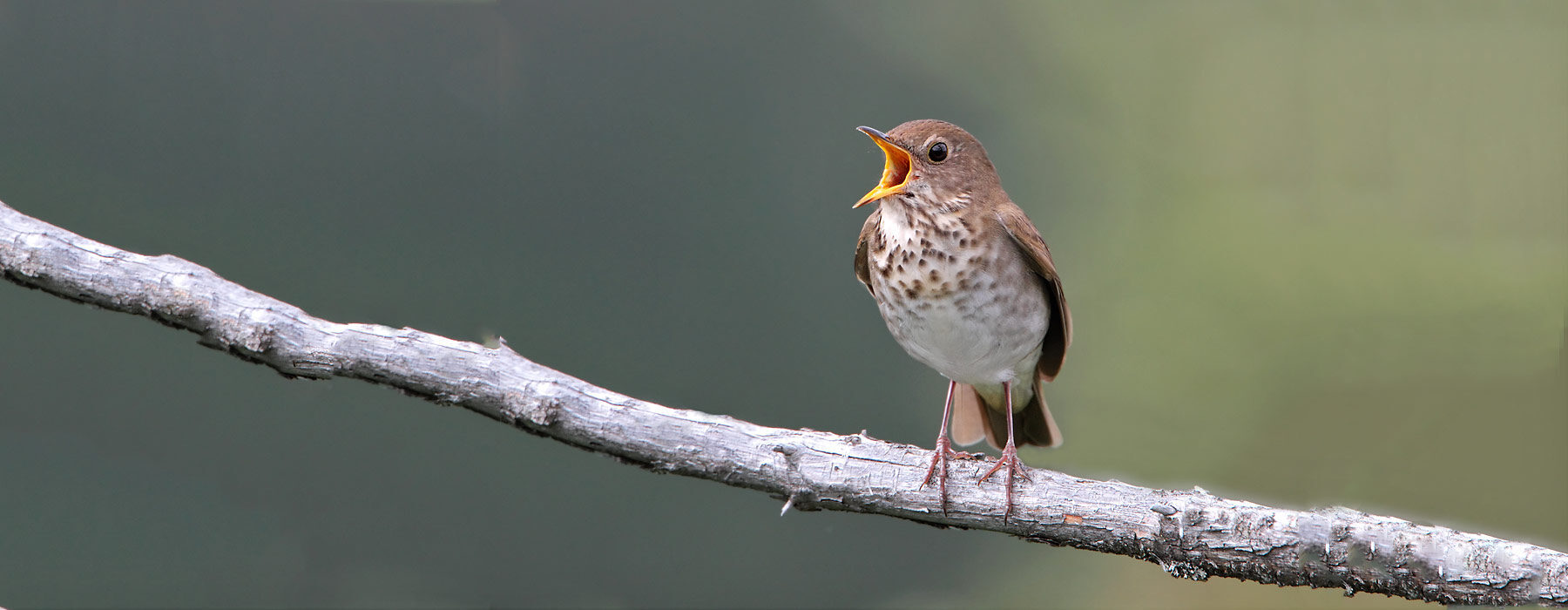
The Bicknell’s Thrush, a small, nondescript brown bird with an eerie song that floats from the mountain ridgetops, checks all of those boxes. We’re trying to learn more about Bicknell’s Thrush behavior, range, and habitat so we can take steps to save it. And along the way, protect its habitat and other species that live alongside it.
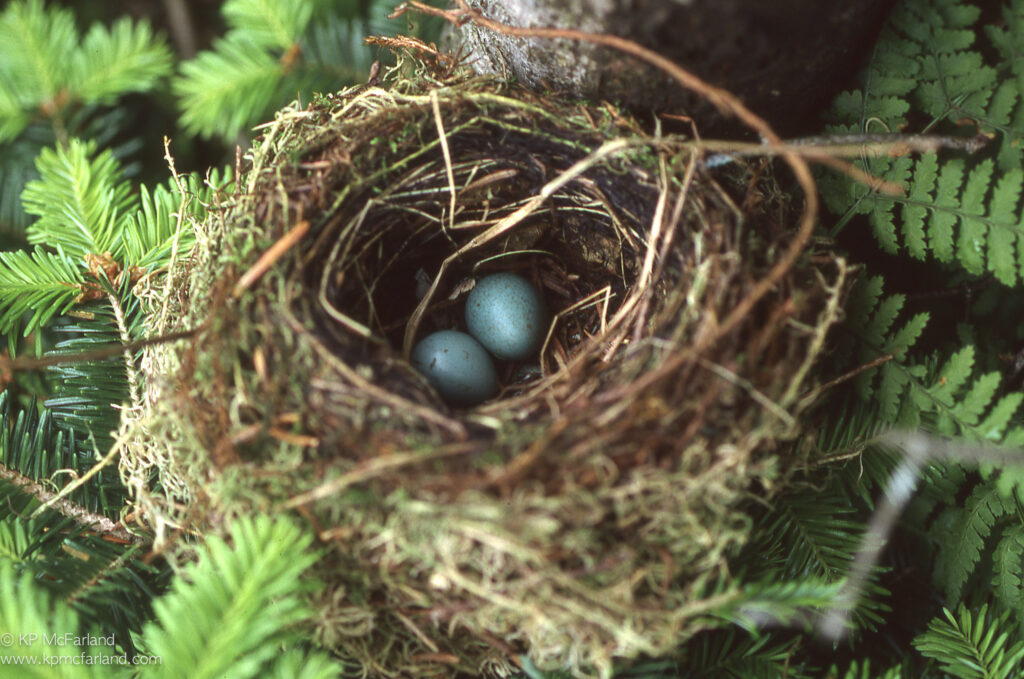
by Kent McFarland

Home in the Hilltops
During the summer, Bicknell’s breed on the summits of only the highest, wind-swept peaks of New York, New England, Quebec, and Nova Scotia. The breeding season is short in the montane spruce-fir forests across their range, and they arrive to breed only after the majority of their habitat has broken free from its icy winter encasement, in mid-May. Patches of snow can persist until mid-June in the shady granite crevices, and temperatures hover around freezing as the nights lengthen, starting in mid-September.
A Climate-Sensitive Bird
As the climate changes, animal and plant species are responding by either moving poleward or up in elevation. The Bicknell’s Thrush, breeding at the top of northern mountains, is already at the precipice and is being crowded from below by the Swainson’s Thrush, a larger, closely related species that poses stiff competition.
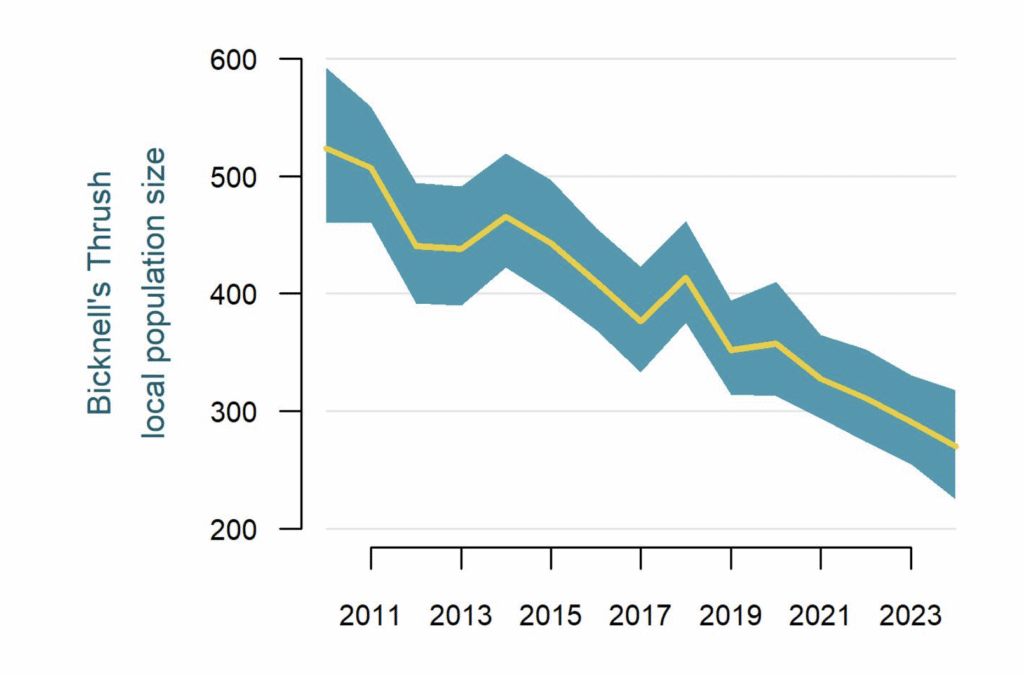
VCE’s Mountain Birdwatch monitoring program has shown a steep decline over the past 12 years across the Northeastern United States.
A Lopsided Sex Ratio
On the summit of Mt. Mansfield, there are two to four male Bicknell’s Thrush to every one female. Females are the limiting sex, and are key for the species survival, so we’re working hard to figure out when, where, and how this skewed sex ratio develops. To be more clear: where are the females dying after they leave the mountain?
From tracking females, to following them to the mid-Atlantic and the tropical forests of the Dominican Republic—we’re not leaving any stone un-turned.