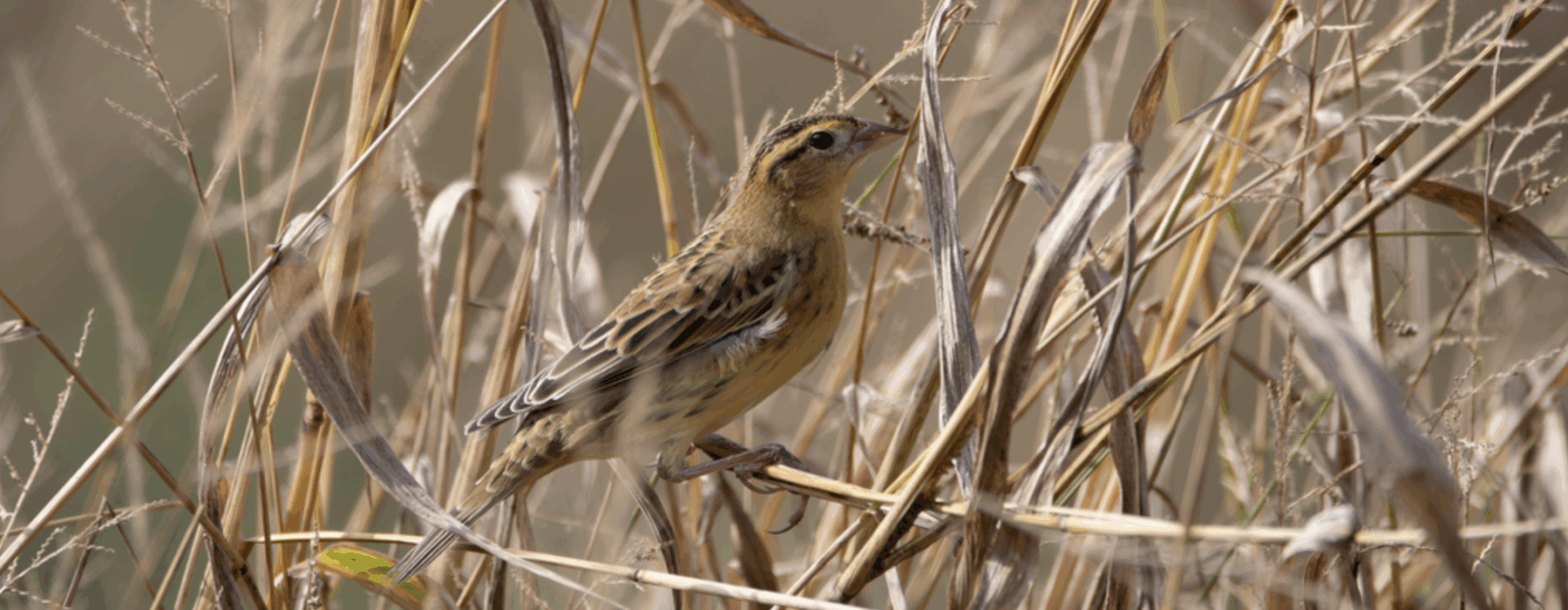
The Bobolink has been in steep decline for decades, which has led VCE to pursue full life-cycle research to better understand and conserve this charismatic songbird. From North American breeding grounds to South American wintering areas, VCE has tracked Bobolinks to study their post-fledging movements, the impact of threats such as toxic pesticides, locate critical migration stopovers, examine population structures, and assess how agriculture and climate change influence their survival and breeding success.
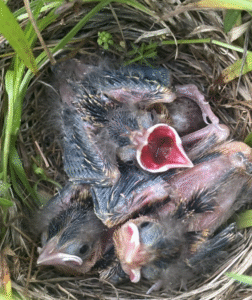
Picture of Bobolink nest taken by Kevin Tolan.
Conserving Bobolinks is uniquely complex, as Bobolinks spend twice as much time in South America than in their North America breeding grounds, and undergo an epic trans-hemispheric migration. In New England, our conservation options are limited, as habitat is primarily located on agricultural and other privately-owned land.
In response to these and other challenges, the US Fish and Wildlife Service designated Bobolink as a focal species and called for a conservation plan that would address the global threats to Bobolinks, as well as other grassland bird species
With input from North and South American partners, this Bobolink Conservation Plan considers the “full life-cycle” of Bobolinks: north, south, and in migration, and includes guidelines for carrying out cross-country coordinated conservation at multiple scales.
New England Grassland Bird Resurvey Project
Grassland birds in New England and the rest of North America have experienced substantial declines—likely due to habitat loss derived from reforestation (especially in New England) and the intensification of agricultural practices.
To better document the distribution of grassland birds across the six New England states and New York, Mass Audubon surveyed 1,145 grassland sites (e.g., hayfields, pastures, and municipal airports) in the late 1990s. Observers netted over 10,000 observations of grassland birds, including Northern Harriers, Bobolinks, and Savannah Sparrows—a monumental surveying effort. In 2014-2015 VCE, Mass Audubon, and the University of Delaware organized a resurveying effort at 495 of those grassland sites across New England. Our goals were twofold: to understand how grassland bird distributions have changed in our region since the 1990s and to connect with grassland landowners to discuss opportunities for grassland bird conservation on their properties.
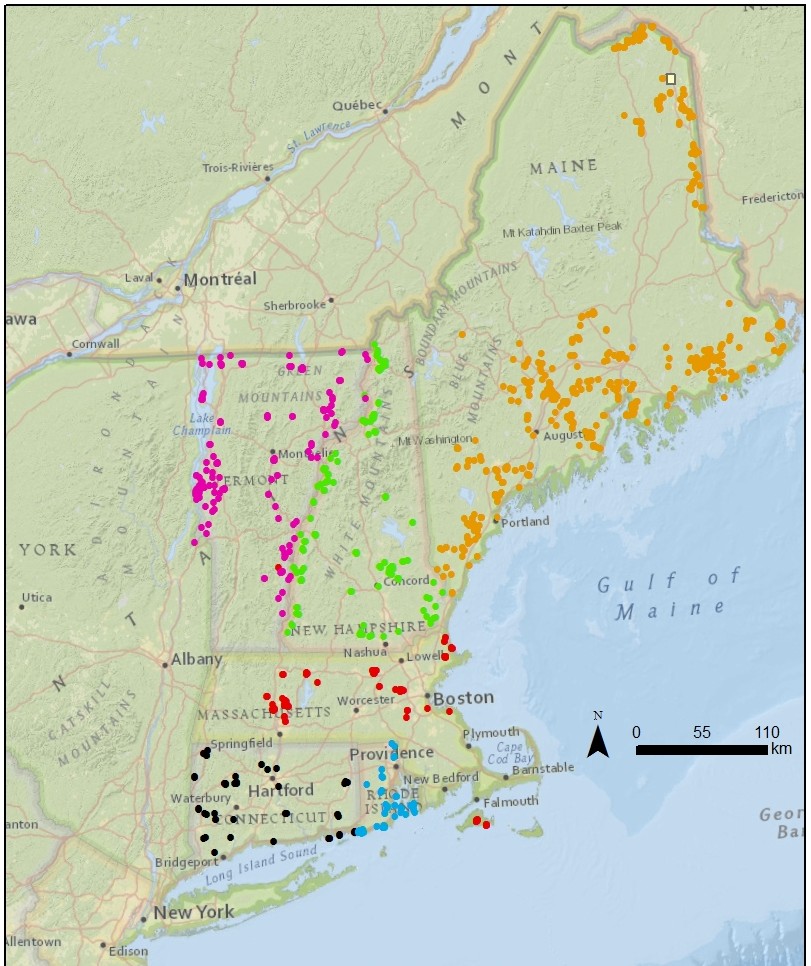
Point count locations from the 2015 New England Grassland Resurvey Project
In 2015, we conducted the most comprehensive survey of grassland birds across New England since the 1990s. Observers conducted 1,356 point counts at 700 sites.
We found that 8 of the 9 species we surveyed were detected at an average of 41% fewer sites in 2015 compared to the 1990s. The ninth species, Upland Sandpiper, was found in only 4% of the sites where they were previously found. Eastern Meadowlark site occupancy had declined by 76%. Losses of grassland birds from sites were most severe in Connecticut and Massachusetts. Our extensive surveys provide concrete evidence for declines in grassland bird populations in New England. Our data provide another benchmark for the changing grassland bird populations in New England, and elucidates changes in their spatial distribution in New England.
Grassland Bird Resurvey Partners: