Autumn
© Kent McFarland
Change is in the air this month. The loons are fluffing their feathers for their journey to the ocean, songbirds are molting their feathers and feasting in preparation for migration, and you might start to see a charming visitor to your home—charming, that is, until there are hundreds of them!
By Jason Hill
The most abundant and frequently-encountered lady beetle species in Vermont is…the non-native Asian Lady Beetle (Harmonia axyridis).
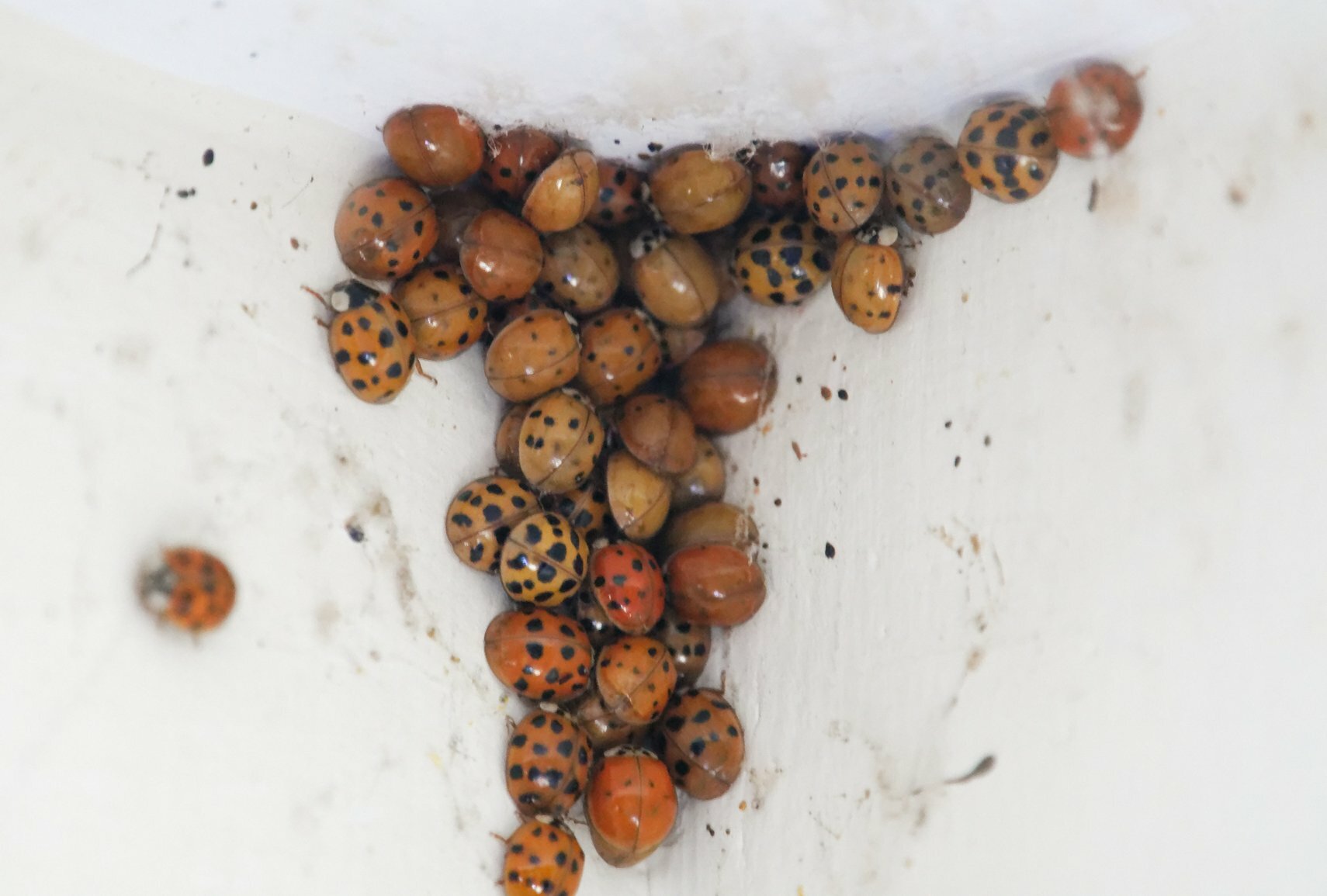
Given that there are many hundreds of species of lady beetles in Asia (mistakenly and frequently called lady bugs), this species is also known as the Harlequin Ladybird Beetle—a name referencing its bright, patterned color. As you read this, you’re likely near a few (or few thousand) of these beetles as they make their way indoors in October to spend the firewood seasons with us clumped in windows, attics, and other warm spaces.
Harlequin Ladybird Beetles frequently aggregate inside our homes in large numbers to spend the winter in a low metabolic state known as diapause. They are the only lady beetle species one is likely to encounter during the winter in New England, and the only species that congregates in sizable numbers inside—a strategy not without downsides.
The heating of our homes often interferes with diapause, causing Harlequin Ladybird Beetles to exhaust their stored fat reserves and die of dehydration before spring. While they’re still crawling around on your walls and ceilings, however, they can emit a yellowish fluid consisting of highly volatile methoxypyrazines. These nitrogen-based compounds are dispensed for both defense (called reflex bleeding in insects) and communication, but the fluid stains walls and smells rather unpleasant—enough so that those secretions have been known to taint vintages of wine when Harlequin Ladybird Beetles are accidentally incorporated into the wine-making process. Cheers.
Unlike our native lady beetles, which also tend to be physically smaller, the Harlequin Ladybird Beetle is remarkably variable in its appearance, ranging in color from drab beige to orange to red, with anywhere from 0 to 20 black spots on its elytra (hard outer wing covers). With so much phenotypic variation, you’d imagine this species would be difficult to identify. The adults, however, are readily recognizable by the presence of a black ‘W’ or ‘M’ on their pronotum (the shield-shaped region immediately behind the head). The spiky larvae are equally recognizable, with rows of dark and orange, diagnostic double-branched spines pointing upwards along their dorsal surface—a means of physical defense from would-be predators.
Harlequin Ladybird Beetles reproduce multiple times throughout the year and are predators of numerous aphid species (family Aphididae). They also consume other soft-bodied insects, pollen, fruit in fall, and…each other. Cannibalism, fascinatingly, is a heritable strategy in some Harlequin Ladybird Beetle lineages. As aphid density declines, the intensity of cannibalism increases, and in some cases can account for 50% of all Harlequin Ladybird Beetle eggs being consumed. Adult Harlequin Ladybird Beetles also consume the eggs, larvae, and pupae of other lady beetle species. These characteristics give Harlequin Ladybird Beetles the ability to suppress native lady beetle populations via direct predation and indirect competition for food. Rates of predation by Harlequin Ladybird Beetles on native lady beetle species also appears to be tied to aphid density.
Like most of our introduced species, the precise date of Harlequin Ladybird Beetles’ arrival into North America is unknown. They were purposefully introduced by the U.S. Dept of Agriculture’s Agricultural Research Service as early as 1916 on the West Coast for biological control, and as early as 1978 in New England for similar control of crop pests. Establishment in the wild is thought to have taken hold in the 1980s and 1990s in much of the East.
Our soon-to-be published research using historical observation records and hierarchical extinction modeling, however, suggests that Harlequin Ladybird Beetles likely arrived in Vermont considerably earlier—most likely in the 1960s. While not conclusive, their appearance overlaps with the decline and disappearance of several native lady beetles in Vermont, including the formerly widespread Thirteen-spotted (Hippodamia tredecimpunctata) and Transverse (Coccinella transversoguttata) Lady Beetles.
If you’re stuck inside during a snowstorm, but still looking to keep busy on iNaturalist, keep an eye on your Harlequin Ladybird Beetle housemates for their uninvited guests. The parasitic fungus Hesperomyces virescens (also known as green beetle hanger) feeds on their internal fluids, and is often visible as a growth on their exoskeleton. Coccipolipus hippodamiae is a sexually-transmitted mite that is visible on Harlequin Ladybird Beetles—look for an orange-red jelly-like attachment. Finally, pun-intended, fatal fungi in the genus Beauveria attack Harlequin Ladybird Beetles and other insects. These fungi grow inside until they come fatally bursting out, enveloping the Harlequin Ladybird Beetle in a fuzzy white blanket.
Invaders, squatters, or wallpaper stainers: they’re still worth a closer look and a photo for iNaturalist before you vacuum up their remains. When doing so, you can add observation notes (e.g., “winter congregation”) using the tag feature or add the observation to the Never Home Alone project. “Swarm” is often used to describe a group of insects, but perhaps we’re in need of a species-specific name for the Harlequin Ladybird Beetle groups in our homes this winter. Leave your suggestions in the comments!
By Michael Hallworth
Every autumn, people flock to Vermont and neighboring states to see the hillsides change from shades of green to hues of gold and scarlet. But most leaf peepers have unknowingly just missed an equally impressive color show. The vibrant yellows and oranges that set Vermont’s hillsides ablaze each October have been there all along. We just couldn’t see them.
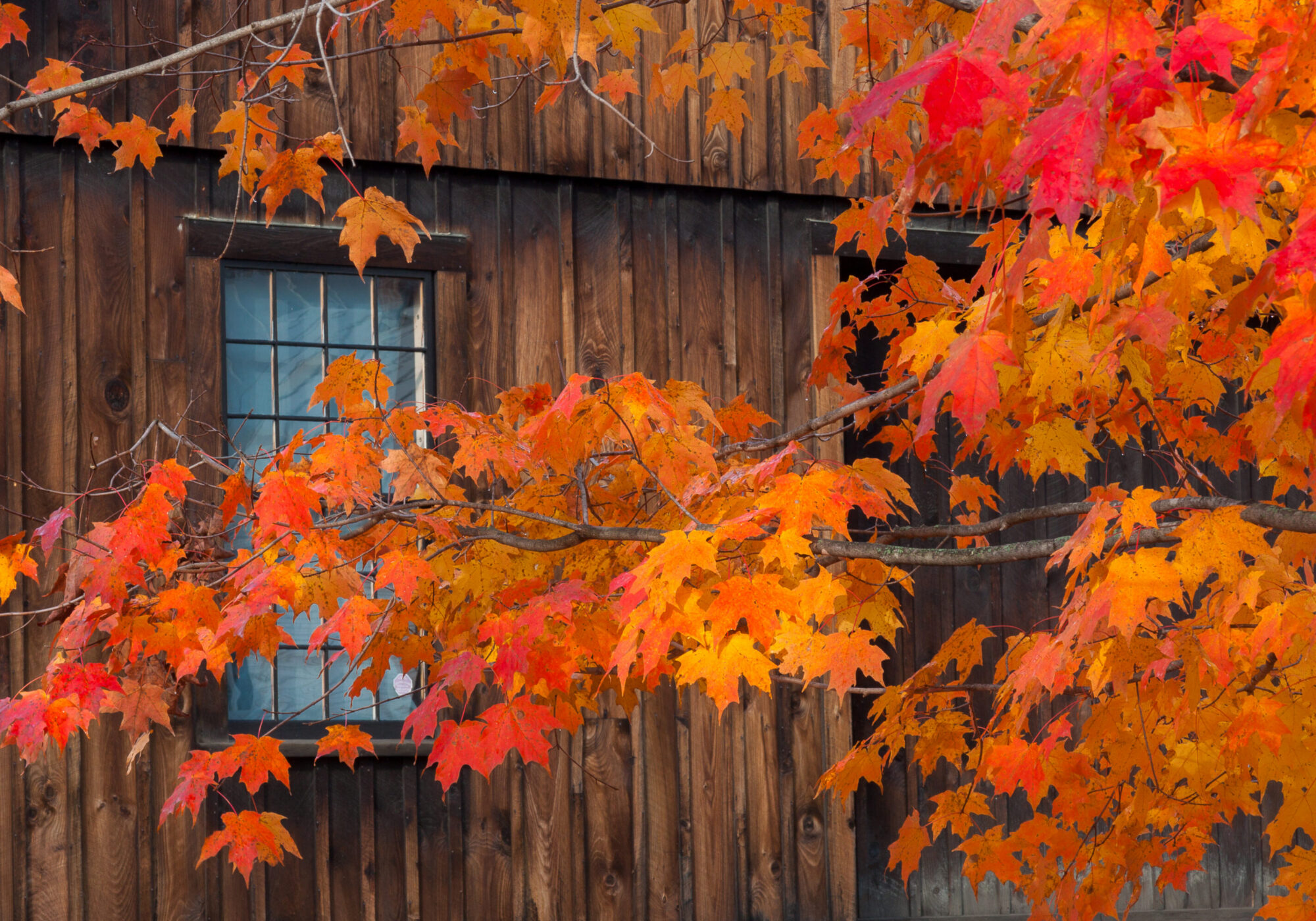
The leaves of maple, oak, birch, and other deciduous trees are packed with warm-colored pigments called carotenoids. These are the same molecules that make carrots orange and egg yolks yellow. In the spring and summer, they’re hidden in plain sight, drowned out by chlorophyll, the green pigment used by leaves to convert sunlight into nutrients. As the days shorten and temperatures drop, trees stop producing chlorophyll and the greens fade. The carotenoids are revealed, and the trees start to show their true colors.
The eye-catching yellow of the American Goldfinch, the stunning red of a Scarlet Tanager, and the Blackburnian Warbler’s flame-throated, showstopping brilliance were built from carotenoids.
However, birds can’t produce carotenoids. Only plants, algae, and certain fungi can. So birds and other organisms obtain carotenoids through their diet. Goldfinches get their yellow from seeds and other plant material. Tanagers get their red from fruit and from insects that themselves feed on plants. The carotenoids move up the food chain and are deposited into feathers when they molt or regrow.
That means that all summer long, Vermont’s forests have been shuttling carotenoids from leaves to caterpillars and eventually into the songbird feathers that are admired by millions of birdwatchers.
Carotenoids aren’t just about color. In both birds and trees, they’re doing critical biochemical work. In leaves, they help capture light and protect against damage to the machinery that converts sunlight into energy along the photosynthetic pathway. In birds, carotenoids serve as antioxidants and play a role in immune function. A male that grows especially vivid feathers isn’t just beautiful; he’s advertising to females that he found enough food, stayed healthy, and has spare pigment for display. It’s an honest signal of quality.
As the hillsides ignite with colors in October, most of the migratory songbirds that spend the summer in Vermont replace their vibrant breeding feathers with a duller set for the long migratory journey ahead and the winter beyond. The male Blackburnian Warbler’s blazing orange throat becomes pale and ordinary. The goldfinch dims from neon yellow to a soft olive.
Our attention, like the colors, passes from the dazzling feathers back to where they originated: the leaves.
What to Look for in Vermont This Fall
Migratory songbirds don’t replace their feathers (i.e., molt) all at once. The rate and timing of feather molt vary among species and individuals.
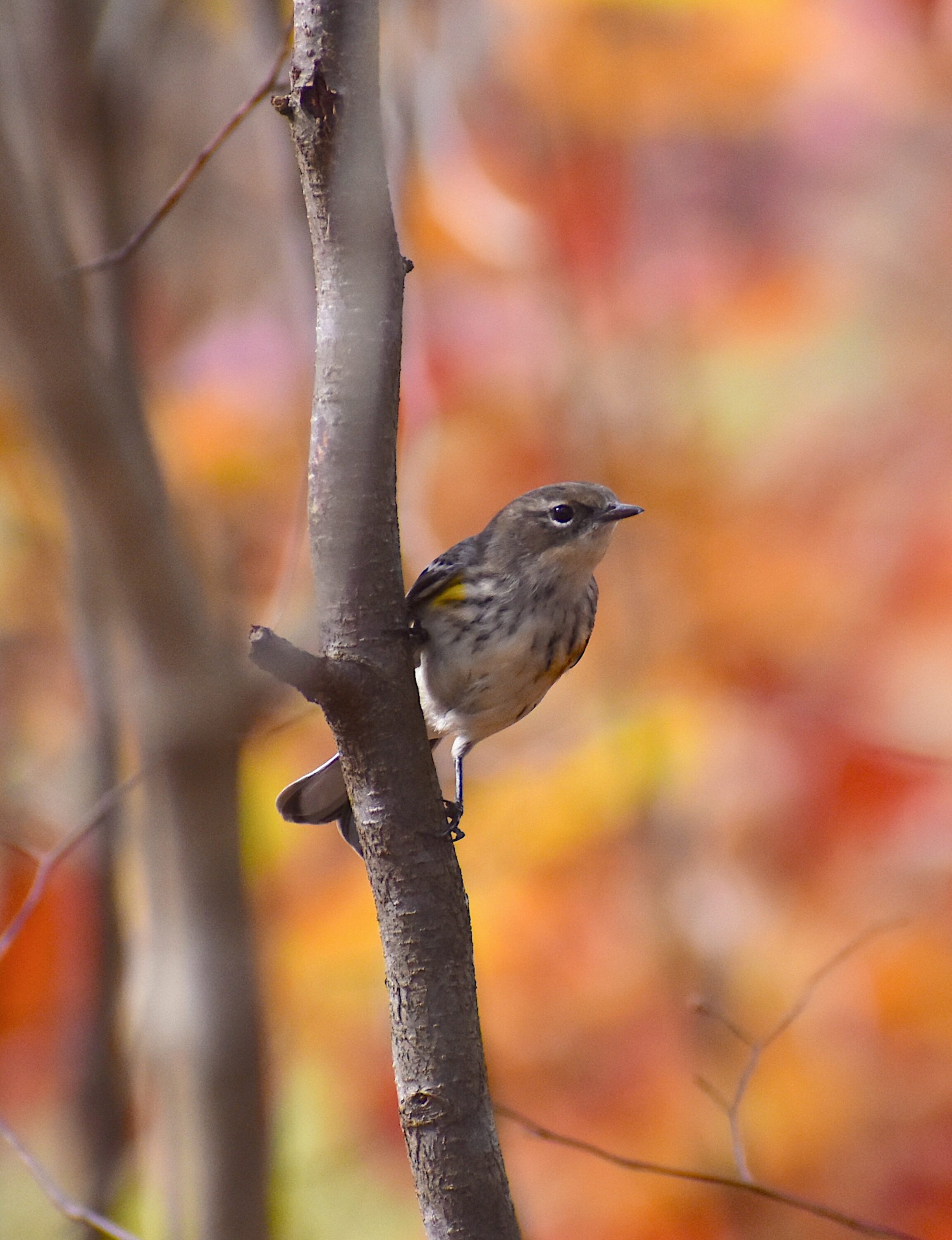
If you’re able to take your gaze away from the fall foliage, you might notice the Yellow-rumped Warbler, for example. It is one of the last warblers to leave Vermont and often the most numerous fall migrant in the state. By October, they’ve already traded in their sharp spring markings for a streakier, duller look. Their namesake feature, however, persists: a yellow rump patch. You’re likely to find them foraging on bayberries and wax myrtle (genus Morella) farther south to fuel their migration, but those fruits also help deepen and maintain their carotenoid-based yellow feathers.
The American Goldfinch undergoes a more dramatic wardrobe change. Through October, males move from their summer yellow to a patchy, half-molted state, then to their final winter plumage, which is mostly olive. If you’re lucky enough to see a large flock in a field or at a feeder, you may witness the whole gradient at once.
The Blackpoll Warbler, an abundant breeder atop Mount Mansfield (home to Stowe Mountain Resort) and other high peaks across New England, molts into a plain, streaky plumage resembling nothing like its crisp, black-capped summer self. You’ll likely find them frantically foraging, trying to gather enough resources to fly nonstop for more than 60 hours over the Atlantic en route to South America.
New England’s famous leaf-peeping season may be brief (and as of late, unpredictable) before the onset of what some of us call stick season; but as you’re admiring Vermont’s hillsides this October, remember that the tree’s true colors shine brightly every summer as warblers move through their branches, showcasing the carotenoids normally hidden from sight.
By Eric Hanson
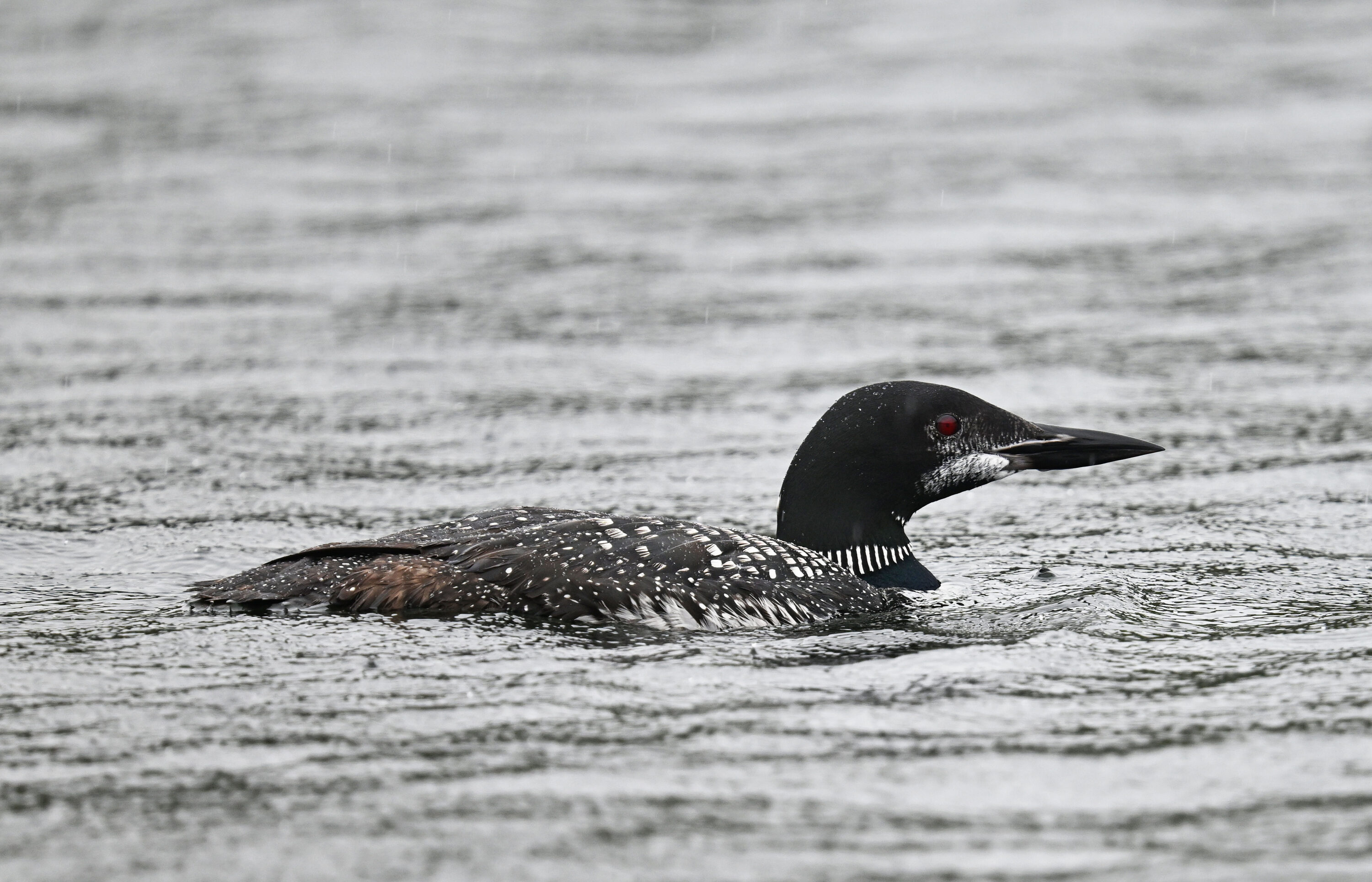
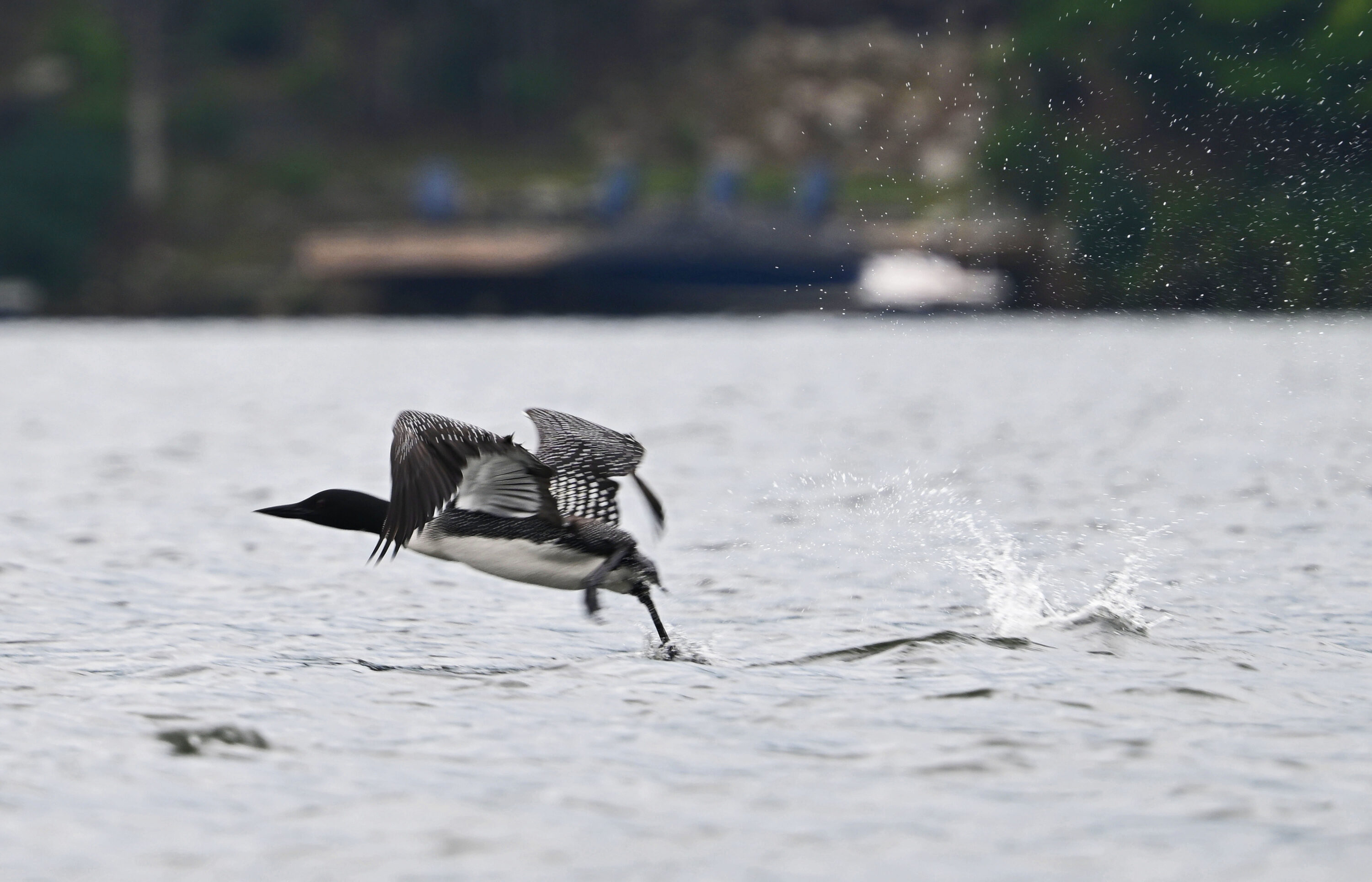
Those lucky enough to still be spending time on their favorite Vermont lakes—and submitting surveys, thank you—may have noticed the disappearance of their resident adult loons, even with chicks still around. Or you might observe congregations of up to 18 loons on larger lakes such as Caspian Lake or Norton Pond.
So, when do loons take to the skies? To help answer that question, I’ll refer to Lee Attix’s work from 2013 to 2017 on loon migration timing for the Biodiversity Research Institute, which he shared with me some years back. As reported in Northern Woodlands, starting in September, Lee checked in on 32 banded loon pairs in Maine and New Hampshire twice a week until late November. He found a lot of variability in the timing of loon departures, but also some general trends.
Some adults start to move or even leave in September, while others stick around until late November. Chicks tend to depart in late October and November, but like the adults, some will leave in late September. Others never seem to get that migration restlessness (referred to as zugunruhe in textbooks) and are still on the water when ice starts to form. Some of his findings include:
Most New England loons spend the winter off the Northeast coast, with a short migration period of only one to two days. Juveniles figure out how to reach the ocean on their own and likely take a much longer time getting there. A 2009 satellite telemetry study followed a lone New York juvenile as it left the Adirondacks in late November and took 56 days to puddle jump from lake to lake, eventually reaching Long Island Sound in January.
Juveniles that reach their second year are considered immature a.k.a. subadult birds, and they usually spend several years on the ocean before returning to their natal lake region as sexually mature individuals.
Loons from the central part of North America have a lot farther to fly than New England’s loons! They will overwinter along mid-Atlantic and southeastern coasts and the Gulf of Mexico. One study that followed two loons from Saskatchewan revealed that one individual migrated to Lake Michigan and straight down to the Gulf of Mexico, while the other loon flew to the same location in the Gulf via Lake Erie, the Chesapeake Bay, and across the Florida Panhandle. How did they choose which route to take? We don’t really know, but once a loon learns a route, they stick with it for years to come.
After spending the winter eating seafood on the ocean, loons will return to northern, forested, freshwater lakes and ponds in the spring, usually in April or early May. The magic of migration in all animals is fascinating: What initiates it, and how do species find their way back to the same lake or forest stand in spring? The sun, stars, Earth’s magnetic field, learned behavior, and genetics are several of the myriad factors that influence these amazing journeys.