Want to share your Vermont loon observations? Sign up and fill out a loon survey at vt.loonweb.org.
Click on the sections below to learn how to volunteer for the Vermont Loon Conservation Project.
Got more questions you don’t see answered here? Email Dana Williams at dwilliams@vtecostudies.org.
For Both LoonCount and LoonMonitor:
- Volunteers record information about the number of loons they see and the time and location of sightings and submit a survey using LoonWeb.
- Volunteers can enter data into the LoonWeb survey either while you are at the lake on your smartphone or afterwards at your computer.
LoonMonitor
- Our all-season-long monitoring of loons, their nests, and their chicks in Vermont.
- Volunteers choose a lake to visit every 1-4 weeks throughout the loon season from April to August.
- Multiple people can adopt a single lake for LoonMonitor.
- Volunteer submit regular surveys using LoonWeb on nesting and territorial loon pairs, chick survival, predators and more.
LoonCount
- Our one-day census of Loons in Vermont.
- It’s on the 3rd Saturday in July. LoonCount happened on July 18th in 2026 and is now complete.
- Only one person or group is allowed to adopt each lake through LoonWeb.
- On LoonCount day, volunteers spend at least one hour tracking and counting loon adults and chicks on the lake between 6 a.m. and 10 a.m.
Create an account on LoonWeb
Find a Lake on LoonWeb
Visit LoonWeb at vt.loonweb.org.
1. In the upper left, click the button for the project you want to join: LoonCount (LC) or LoonMonitor (LM). LoonCount is complete for 2026. Please select the LM button.
2. Use the search bar to find a specific lake (you will need to click the lake name from the drop-down list that comes up) or look for a lake on the map.
3. When you click on a lake, the right panel on the screen will provide more information including whether that lake has been adopted by other volunteers. Multiple volunteers can adopt a lake for LoonMonitor. At the bottom of this panel is a graph with information about how many loons have been seen on the lake over the past 10 years (bars) and when it was last surveyed (yellow circles). Note that lakes that don’t have any data on loons could still have newly arrived loons, and could still use monitoring!
Lakes must be adopted for LoonCount.
For LoonMonitor, you can submit surveys for any lake in Vermont without adopting one. However, adopting helps save our biologists time by showing them which lakes they need to visit and which ones are covered by volunteers.
Adopt your Lake
Whether you are participating in LoonCount or LoonMonitor, you will use the same survey and input the same data.
Not ready to use the mobile survey app? Download our data form to fill out while you are on the lake.
Required Observations
- How many individual loons did you see?
Only count each loon once, and do not count loons flying overhead.
Note down: The time and location you FIRST saw them, and their age (Adult, Chick, or Subadult).
- Did you see a loon nest?
Note down: The time you saw the nest, its location, the nest type (raft, island, shore, or marsh), and any nesting behavior.
- What time did you start and finish your survey? How many people were with you?
- Did you survey from a boat or the shore? Did you cover the whole lake, or just a part of it?
- How far did you travel during the survey? (An estimate is perfectly fine!)
Optional Observations
- Were there any Bald Eagles present during your survey?
- Did you see other animals (or people) interacting with or disturbing the loons?
- Did the resident loons interact with any intruding loons?
Be ready to note: The time, location, and behavior that occurred - What were the weather and wave conditions like?
If you see zero loons, that is still important for us to know! Loons may use these “empty” lakes as feeding areas, or new loons may move in in future years.
After you’ve paddled or walked around your lake and noted down your loon sightings (using our printable data sheet):
- Visit LoonWeb at vt.loonweb.org on your computer. Look in the upper right corner of the page to make sure that your profile icon is green, not white. (If it’s white, you need to sign in!)
- Click the Survey button.
- On the first page of the survey, enter your lake name, date of survey, time you started your survey and click Start.
What to record in your survey
Add Loon(s) – Record your first sighting of a single or a group of loons within 50 meters of one another. You will be asked the time you first saw them and how many adults, chicks or subadults there were and then be asked to move an icon on a map to where you saw them.
- Loons are considered On Nest if you can recording a sighting of a loon on a nest.
- Loons are considered In a Pair if they are swimming calmly together or if one loon is on a nest.
- If you see no loons during your survey, do not click Add Loons and skip to End Survey.
Add Nest(s) – Only add this if you see loons interacting with a nest. You will be asked to record the time you saw the loon on the nest, the nest type (raft, island, shore, or marsh) and the nesting code closest to what behavior you saw the loons doing on the nest.
• Hover your mouse over the nest code buttons to learn what each one means.
Predators (optional) – Record whether you saw a Bald Eagle during the survey or whether you saw any animals interacting with the loons. Click the button that matches what you saw. Provide details on the interaction in the comments.
Behaviors (optional) – Record any interesting interactions you see between loon pairs and intruding loons. Click + Behavior and record the time you saw the behavior occur, what type of behavior it was, and where you saw it occur on the map.
End Survey – Record final information about your survey including the time you ended your survey, the number of observers (including yourself) who were out watching, whether you were surveying by boat or by shore, and whether you covered all or part of the lake (you will be asked to estimate the % of lake covered).
Once you are done, scroll to the bottom of the End Survey page and click Draft (if you wish to return to edit the survey later) or Complete (if you are ready to send it to us). Once you click an option, you will be brought to your list of surveys.
Click Upload on Complete surveys to send them to us. If you do not click upload, they will not come to us.
“I put in too many loons or nests!”
If you accidentally add too many loons or nests, don’t worry! You can remove them with these steps.
1. On the LoonWeb survey, click History on the bottom center of the screen.
2. Find the survey you want to change and click Edit.
3. If you need to change the number of loons associated with an observation, click the loon or nest icon for that observation and click Edit.
4. Click the +/- buttons to change the number of loons associated with that observation.
5. If you want to delete the whole observation, click the Delete button at the bottom of the screen.
“My comments have disappeared!”
Your comments and other information from each observation is stored under the icons on your map.
1. On the LoonWeb survey, click History on the bottom center of the screen.
2. Find the survey you want to change and click Edit.
3. On the map, click the loon, nest or behavior icon where you wrote your comments. Click the Edit option to see and update your comments or other information.
“How do I know if you got my surveys?”
- Go to the LoonWeb survey, click History on the bottom center of the screen.
- Check the status of your surveys and the buttons underneath them. If you see an Upload button, this survey has not been uploaded. Uploaded surveys will have a dark green badge that says ‘Uploaded’.
If you don’t see your question answered here, email Dana Williams at dwilliams@vtecostudies.org.
It is important that you log your hours and mileage with Vermont Fish & Wildlife so we can match the grant that we receive from VFWD.
- EACH DAY OF OBSERVATION NEEDS TO BE LISTED SEPARATELY whether done online or on paper copy.
- Each person enters their own report.
Online volunteer hours: Our preferred method. Do so at the Vermont Fish & Wildlife website. Download instructions below. If adding multiple dates at one time, use the “+” button at the top of the volunteer details page before hitting the submit button. Project is “loons.”
Paper forms: Please print TWO copies or ask us to mail you two. You will need to submit one form through June 30 and a second form for hours after July 1. Please mail or scan or take a picture of the form and email the signed form back by July 15 and August 30 (even if you will still be monitoring chicks later). One form per person.
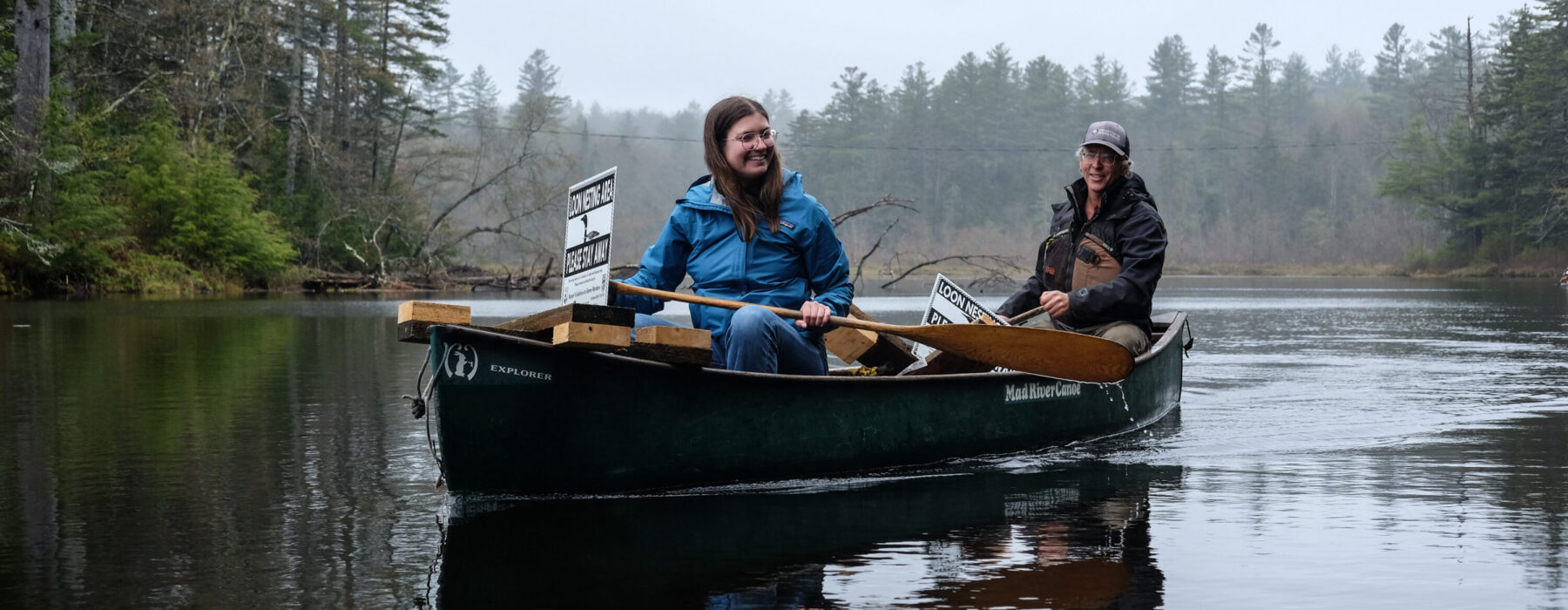
Yes! Loon Raft & Sign volunteers help Eric and Eloise put out rafts and signs to protect nests at certain lakes around Vermont.
We can use help with:
• Storing rafts and signs on shore overwinter
• Cleaning up rafts and signs during the spring.
• Putting out rafts and signs during the spring and taking them in during the fall.
To see if your lake is on the list and offer help, email loon@vtecostudies.org.