The Rare Bicknell’s Thrush in Popular Culture
 Here at VCE, we love Bicknell’s Thrush. This shy songbird has been core to our organization’s research program for over 30 years.
While sometimes it makes the news (usually because of our research findings), appears in a documentary, or draws crowds because of a rare sighting, Bicknell’s Thrush is not exactly a household name. The species is largely overlooked by the non-birding public because of its remote habitat, small geographic range, and nondescript appearance.
But that doesn’t mean it hasn’t gotten any spotlight! Here are a few recent appearances of BITH in popular media.
Mystery Advertisement (2026)
This idea for this article came when VCE Conservation Biologist and co-founder Kent McFarland posted to the VCE Slack, saying: “I was listening to a Twins versus Guardians ballgame on the MLB app, extra innings, when there was a commercial for some app for the outdoors. I was hardly listening, but then I heard it… Bicknell’s Thrush calls! I thought, wait, really!? I listened closer—yes, Bicknell’s Thrush, calling again and again. They used that for the background sound in the commercial. Crazy. You never hear that bird used in popular media. Must have been done by a birder!”
Birds of the World describes the call of the Bicknell’s Thrush as a “harsh, penetrating, downward slurred whistle […] variously rendered as beer, veer, peert, queep, or quee-a“. Kent would recognize these calls better than almost anyone because he’s spent so many years up on Mansfield working with them.
In fact, Kent’s impressive ear for BITH once led him to find and document the only known Bicknell’s Thrush x Veery hybrid, when he noticed a strange-sounding song with features of both species.
We haven’t been able to track down this ad yet. Kent is pretty sure he didn’t hallucinate it. Let us know if you’ve heard it too.
Julie Carrick Dalton, Waiting for the Night Song (2022 novel)
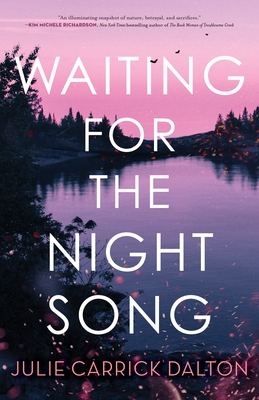 In the first chapter of this mystery-suspense novel about childhood friends reconnecting in a rapidly warming New Hampshire town, a forestry researcher studying the arrival of a wildfire-causing bark beetle receives an email about Bicknell’s Thrush:
‘Hey Cadence! I’m working on a project to re-create/protect habitat for Bicknell’s thrush and found what I think is a bark beetle infestation. […] Uptick in local temps are driving Bicknell’s north, plus ski resorts, turbines. Then hurricanes in the DR, Cuba + deforestation in Haiti are eliminating the winter habitat and they aren’t surviving to return to New England […] Same conditions attracting your beetles are driving out my thrush. Can we share data?’
The novel’s title refers to the song of Bicknell’s Thrush, which they may continue to sing all through the night during a full moon.
Some of this is in fact true—we continue to work with partners in the Caribbean to conserve habitat for overwintering birds and install more Motus towers to track where birds die during the course of their annual lifecycle and migration to Hispaniola and back to the Northeast’s mountains. .
However, while there are several species of bark beetles present in New England that can cause tree mortality, they are not currently implicated in the decline of Bicknell’s Thrush. Furthermore, in this story the beetles were a new arrival from the Rocky Mountains, so this is a bit of a creative fiction.
One thing we love about this book is that it also features scientists sticking together in the face of pressure from the federal government to stop their ecology and climate research.
The Marvelous Mrs. Maisel (2018 TV episode)
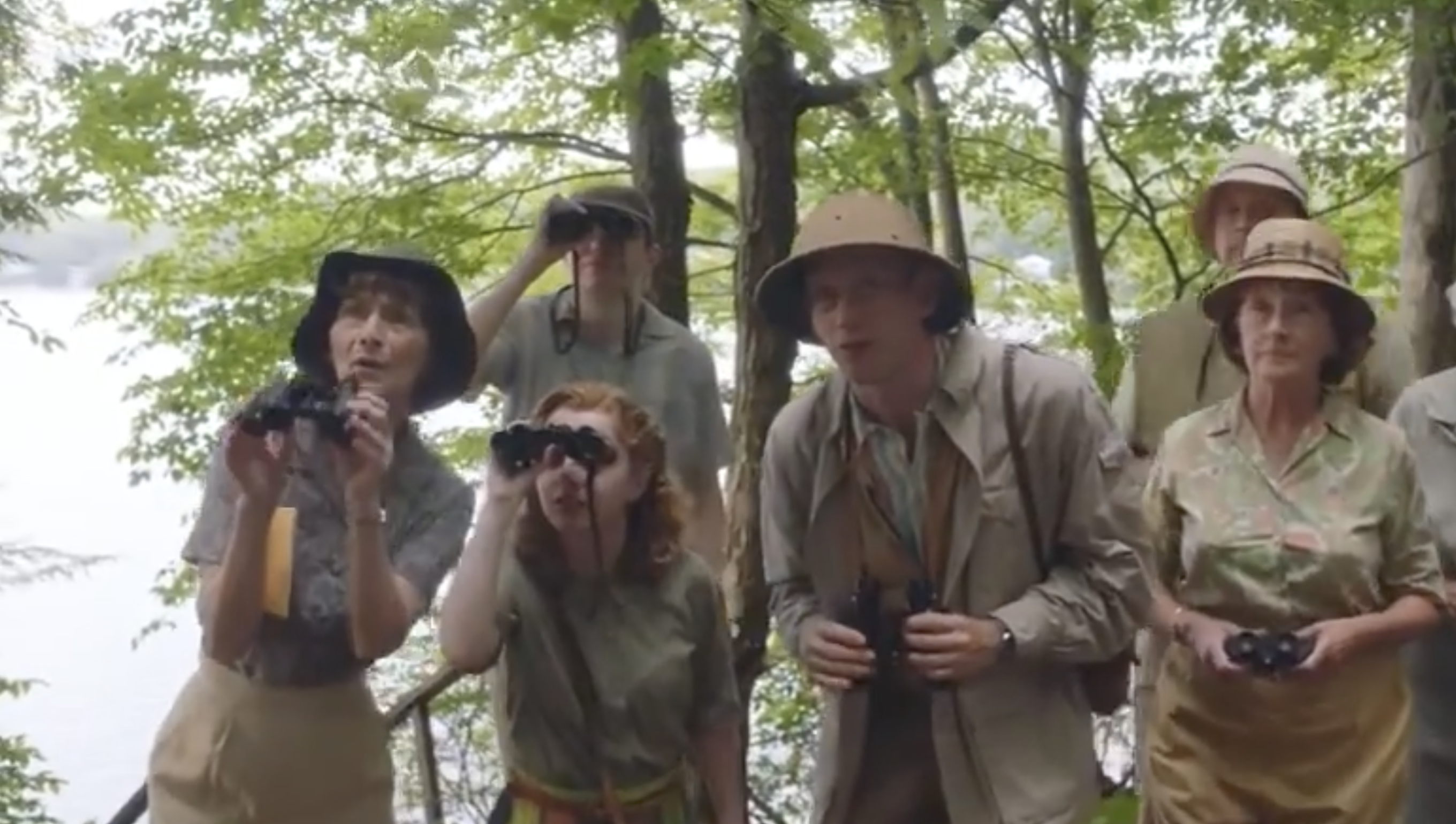
In Season 2, Episode 4 (“We’re Going to the Catskills!”) Midge and her mother go birding in the Catskills and observe what their guide calls a “Bicknell” Thrush (no “’s”), getting “a rare opportunity to hear its beautiful morning song.”
The song is correct—they also sing in the evening, and are vocal throughout the day. The region is also correct: Bicknell’s Thrush was first documented by Eugene Bicknell in 1881 on Slide Mountain in the Catskills, though in recent years, Bicknell’s Thrush has declined most rapidly in that same region. But the series takes place in the late 1950s, when the species was more abundant. Also, until 1995, it was considered a subspecies of the more common Gray-cheeked Thrush, so their guide was very ahead of the times (or very pedantic) to call it a “Bicknell”!
One more quibble: The habitat in the clip is not accurate to their breeding habitat where they would be singing (they rarely if ever sing during migration). Bicknell’s Thrush is restricted to high-elevation spruce-fir habitat, nearly impenetrable to the average person except for hiking trails. It would probably be hard to film in the right habitat though!
“I wrote to Rachel Brosnahan, the lead actress, and invited her to actually see one here,” says Kent. “But I never heard back!”
Brad Kessler, Birds in Fall (2006 novel)
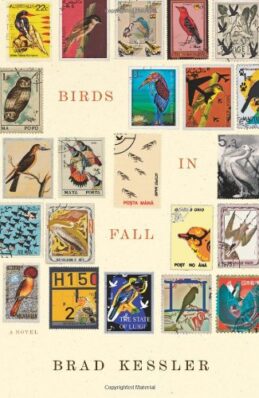
Kessler is a Vermont-based author who included BITH in the backstory of his characters. The main character and her husband were both ornithologists. After the husband dies in a plane crash (the aftermath of which is the main focus of the novel), she reminisces about his days banding Bicknell’s Thrush on Mount Katahdin in Maine:
“She removed from the fold the photograph of Russell she’d been carrying for days. It was taken on a mountain in Maine on a research trip. He held a Bicknell’s Thrush in hand, and was making a goofy face, mimicking the expression of the frightened bird.”
Photos of birds in the hand can be a sensitive topic. Nowadays, the North American Banding Council provides a set of ethical guidelines on when and how to respectfully photograph birds during research operations, and professional bird banders strive to keep birds calm and comfortable throughout the process.
In the face of climate change, high peaks like those on Mount Katahdin are most likely to maintain suitable habitat for Bicknell’s Thrush. VCE founders Chris Rimmer and Kent McFarland are thanked in the book’s acknowledgements.
The Big Year (2011 film)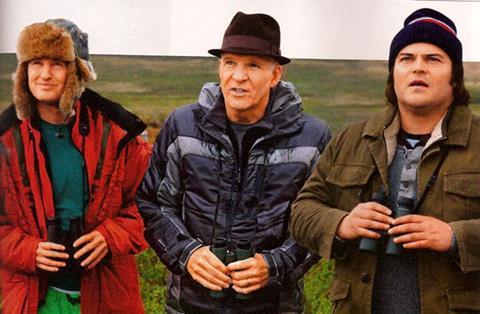
This one is a bit of a stretch, as it’s an entry defined by absence, not presence. Bicknell’s Thrush doesn’t even receive a mention in the film The Big Year (or the nonfiction book it’s based on). Yet the birder that Steve Martin’s character is based on, Al Levantin, famously missed Bicknell’s Thrush during the real-life 1998 big year that inspired the movie.
We’re always happy to hear about this little brown bird getting a starring role. If you notice one depicted in fiction, creative nonfiction, or even a random advertisement, let us know!
This September, our scientists tagged 17 Bicknell’s Thrushes near the top of Mount Mansfield, Vermont’s highest mountain. You can follow along on their migration journey! Participate in our Second Annual Bicknell’s Thrush Race to the Atlantic and predict which bird will reach the ocean first while supporting crucial songbird research at the same time!