Loons in Vermont are doing great. In 2025, volunteers and loon biologists for Vermont Center for Ecostudies’ Loon Conservation project documented several record highs: more adults, more successful nests, more chicks hatched, and more chicks surviving.
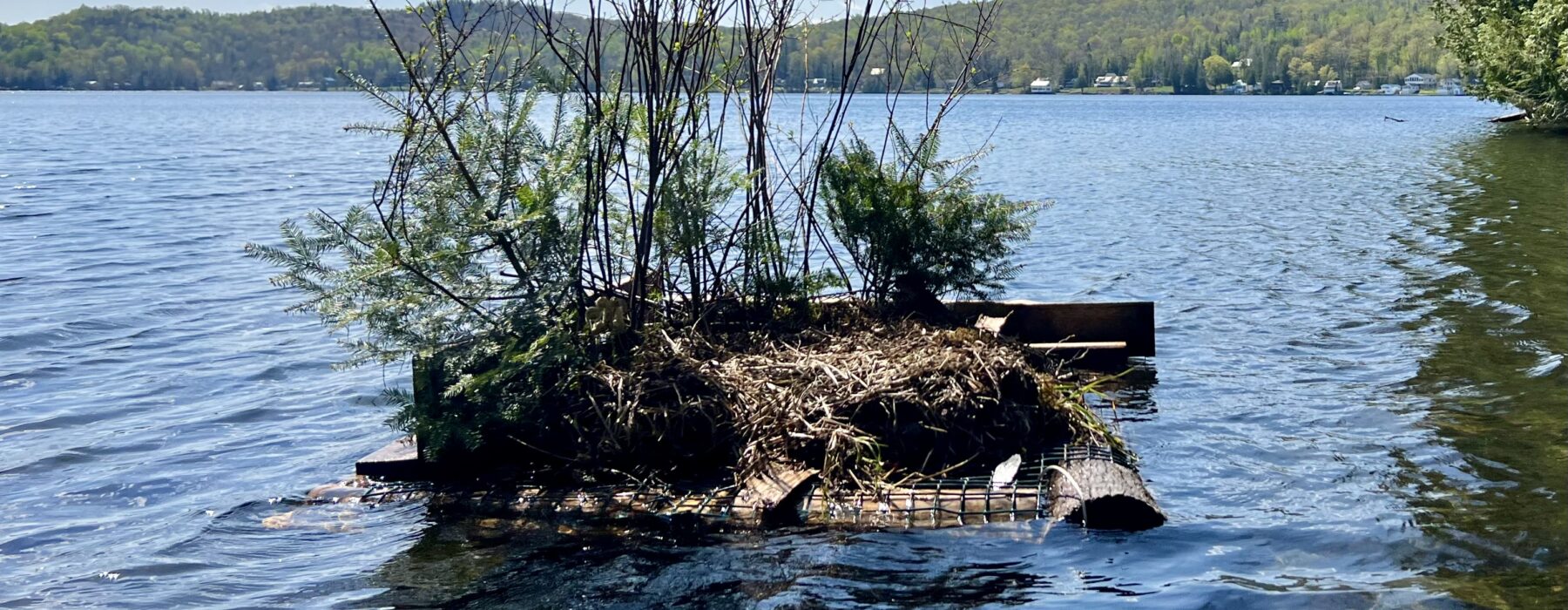
Rafts have played an important role in the recovery of the species. When loons nest on rafts, their nest success rates tend to be higher than when they build their nests on islands, marshes, and especially the shoreline. However, from a regional population standpoint and long-term sustainability, it’d be better to have chick numbers stabilize where they are or even go down slightly.
We are entering a period where we can reduce some of our active management activities and instead promote natural nesting.
When to Place a Nesting Raft
Flooding: Because loons build their nests mere inches from the shoreline, their nests are especially susceptible to flooding. Occasional flooding that causes nest failures is a normal and natural event, though rafts do help mitigate the major flooding events we observed in 2023 and 2024, which seem to be happening more often. However, on some manmade reservoirs where the water level can change quickly, we consider rafts a necessary tool to mitigate that human-caused flooding.
Human activity: The second reason for a raft is for loons that try to nest near people and lots of shoreline activity. We’ve placed rafts in quieter locations to reduce this human-animal conflict. Even in these cases, we will try to give the pair several years of trying naturally, in case they find a better spot on their own.
Where We Avoid Placing Rafts
Lakes and territories without nesting loons: On lakes or territories where loons are present but not nesting, we generally wait for them to make the first move. If they are not nesting, there may be valid ecological reasons. For example, large lakes like Lake Willoughby support plenty of loons but have little nesting habitat, such as marshes or islands. These lakes provide important non-breeding loon habitat where loons can rest and feed without defending a territory. Many smaller lakes also provide this habitat for non-breeders. If we do see new nesting pairs on these lakes, we’ll try to promote natural nesting as much as possible.
Small ponds: We only deploy rafts on lakes of 80 acres or more, to ensure there is a good stock of fish for nesting loons and their chicks.
Lakes with pairs already showing some success: Some pairs are naturally more productive than others, and variability in nesting success is expected.
Letting Nature Take Its Course
We totally understand that it is difficult to observe ‘your’ pair fail or lose their chicks. But it is normal to have years of no nesting, failed nests, and lost chicks.
We’ve gotten used to abnormally high chick productivity—over the 15 years from 1995 to 2009, both nesting success and chick survivorship was over 80% on average, and Vermont loon pairs were producing seven to eight chicks over a 10-year period. Starting 15 years ago, productivity lowered to five to six chicks over a 10-year period, on average. The recent loon baby bust in Vermont is normal, and due to several natural and ecologically-sound factors:
- Competition between loons: We are seeing more territorial interactions and occasionally fights, causing years of no nesting, failed nests, and lost chicks.
- Bald Eagles: Eagles take eggs and chicks and are having an increased impact on the loon population.
- Newer pairs nesting in marginal habitat: These loons will tend to be less successful.
In short, it is good to let the loons figure it out themselves.
Our Next Steps
We plan on removing some rafts from many lakes over the next decade to promote natural nesting. Some of these pairs will find natural sites, and others might not. But we can always use more rafts again if we start seeing major declines in the population. We do not plan on deploying new rafts for new pairs unless flooding due to a regulated dam causes nest failures repeatedly. For new pairs nesting near people and failing, we’ll give the pairs several years of trying before considering a raft.