Common Loons sometimes find themselves in uncommon situations. They might land on wet roads or small ponds lacking a suitable “water runway” for takeoff, get caught on frozen ponds, or ingest fishing lures and line.
As leader of the Vermont Loon Conservation Project, VCE get loons back on the water or in the air—often with help from citizens like you.
If You Find a Loon in Trouble
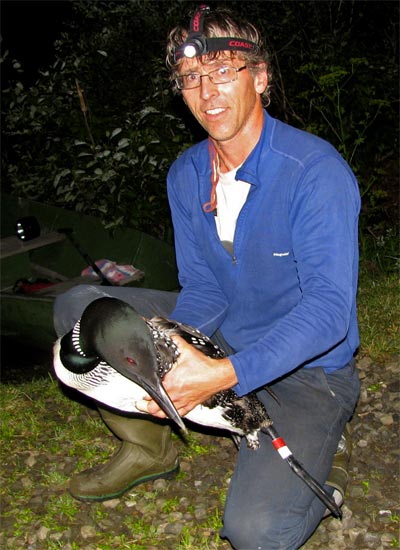
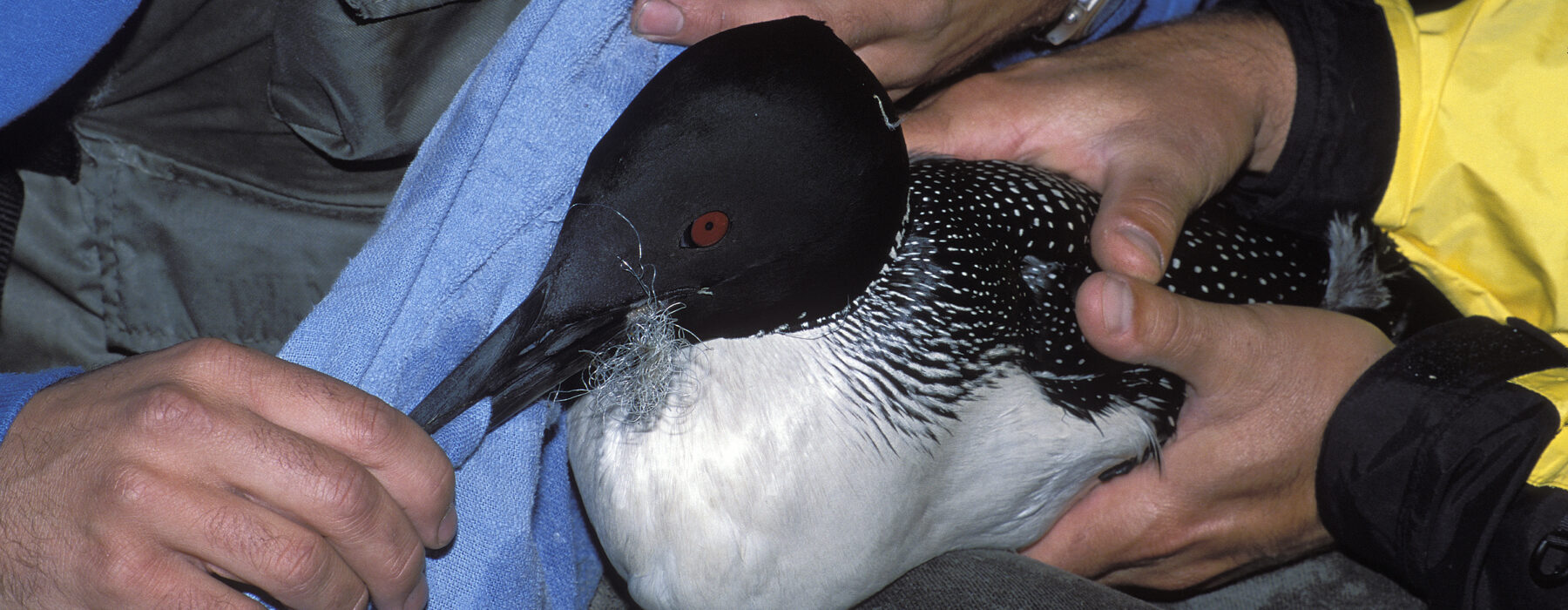
Loon biologist Eric Hanson handles a distressed Common Loon.
- Injured loons can be dangerous—do not try to rescue a Common Loon on your own.
- Be aware of ordinary loon bathing behavior that might be mistaken for distress, including a loon frantically flapping about on the surface of the water, wing-rowing followed by splashing, rolling over, sticking one wing out and flapping it, reaching repeatedly with its bill to one part of its body. These can be the behaviors of a loon taking a good, cleansing bath to remove parasites. At some point the loon will calm down and start re-oiling its feathers by reaching back to the oil gland at its hind end.
- Watch the loon and make notes of its behavior. Take pictures and videos. Is it swimming, diving, feeding, or preening? Does it swim in circles or float lopsided in the water? Does it beach itself? Can you see fishing line around the bill or body? Does the loon appear to be trying to remove something with its bill? Keep an eye on where the bird goes. This information will be valuable in deciding what to do next.
- If the distress continues and is affecting the loon’s ability to function, contact VCE’s loon biologists at loon@vtecostudies.org with your observations and phone number.
- If the bird is swimming calmly or is on shore in a safe area, wait for a return call. If it’s an emergency (the loon is at risk of drowning or is in traffic) call (802) 585-4861or (802) 730-9137. If you can’t reach us, contact the Vermont State Police to reach a state game warden.
- Be aware that watching may be in the best interest of the bird, whether to let nature take its course on a diseased or naturally injured loon, or to wait for a loon entangled in fishing gear to get weak enough for us to catch it. Loons are tough and can go without food for over a week. We often wait a few days to set up capture attempt with local volunteers.
The Importance of Loon Rescues
Rescues of loons in distress are a significant part of VCE’s recovery and conservation efforts. U.S. Environmental Protection Agency population modeling has shown that each adult loon contributes more to the long-term sustainability of the Common Loon population than nesting rafts, nest warning signs, or the survival of a loon chick. We rescue several loons a year, most of them adults.
Unfortunately, we can’t save every loon. Catching a free-swimming loon tangled in fishing line or stuck on a small pond from which it cannot fly is difficult. If a loon has ingested a hook, especially with a lead sinker, the chances of survival are low. But we will give it our best shot. In 2025, we rescued nine loons and released six of them safely.
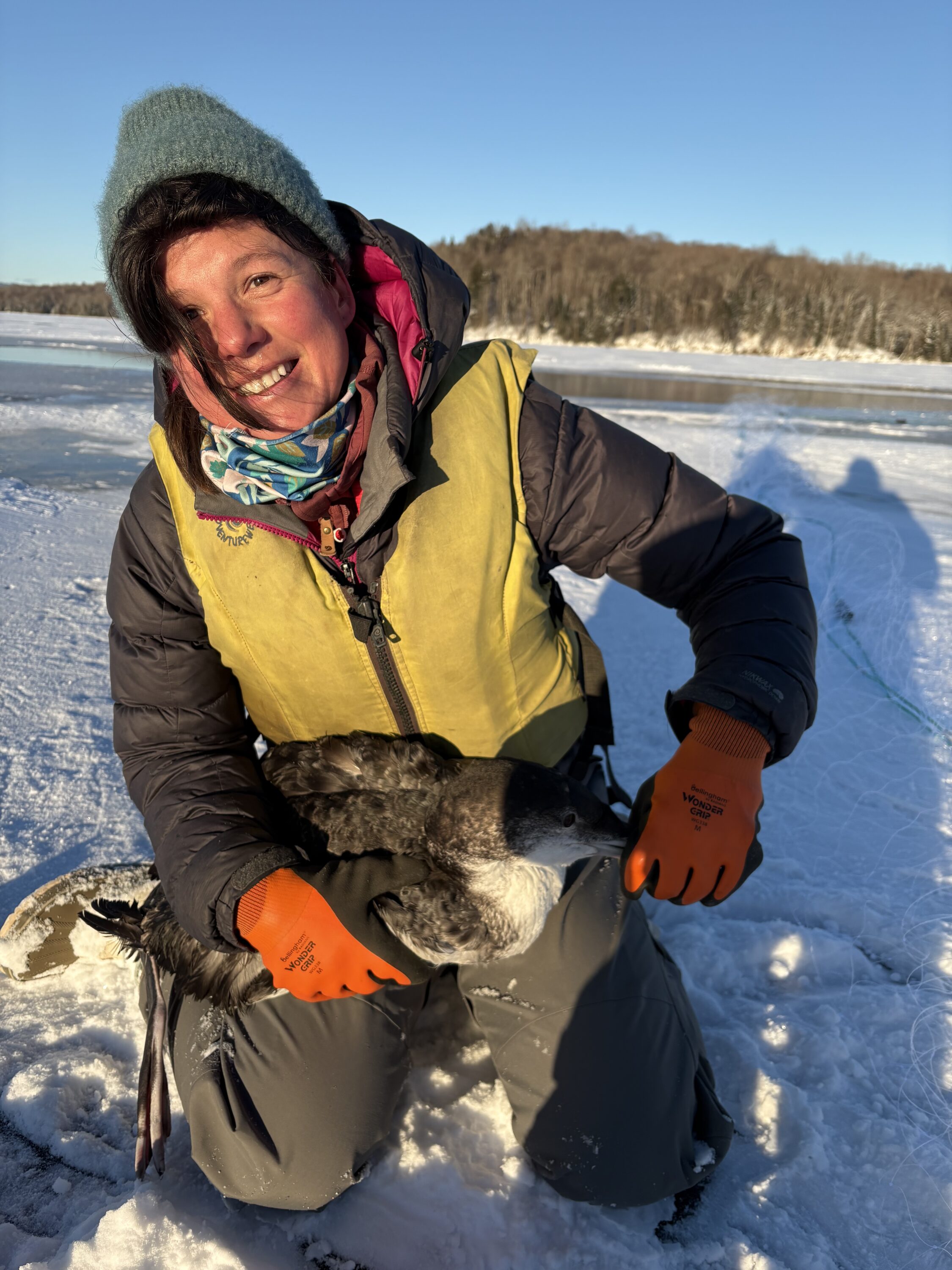
Iced-In Loons
For juvenile loons in their first year of migration, the temperature drop can catch them by surprise. Loons usually need 50 or more feet of open water to take off. So when a pond or lake starts icing over before they’ve taken off for the first time, they can be (at least temporarily) trapped.
The good news is that loons can live in these holes for a week or more, keeping them open with their movement, and can go without much food for a week or two. And you might be surprised! We’ve observed a loon take off from a 30-foot-long opening. We think many have taken off from 50-foot-or-less openings, as they are gone the next day, and we cannot find any sign of them around the shorelines or on the ice.
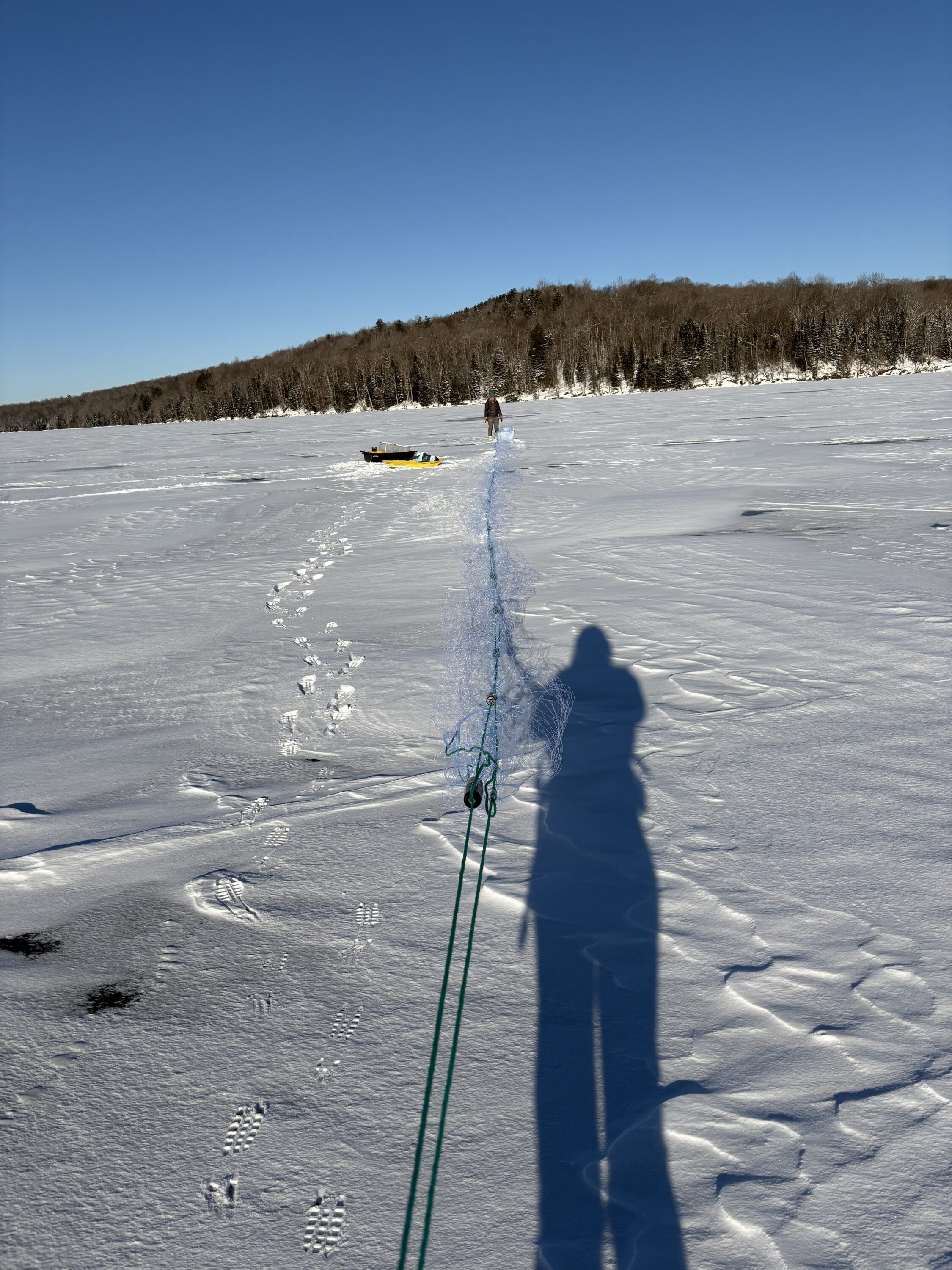
So for most ice-bound loons, we monitor and wait until the hole freezes over and the ice is at least three inches thick before considering venturing out with a large net and box. If the ice becomes safe and the loon is still swimming in an open hole, we have a gill net that might allow us to nab the loon.
Sometimes the entire lake will freeze over quickly on really cold nights, and loons are forced onto half-inch ice. There is not much we can do in this situation unless the ice gets to three inches quickly over several days. Bald eagles may take loons in this situation.
You can help by checking on the loon every few days, or asking a local game warden if they can, and keeping us updated.