After Bicknell’s Thrush young and old have built up their strength and energy stores, they take off from the Eastern Seaboard of the U.S. and fly over the Atlantic Ocean to islands in the Caribbean, where they spend the winter.
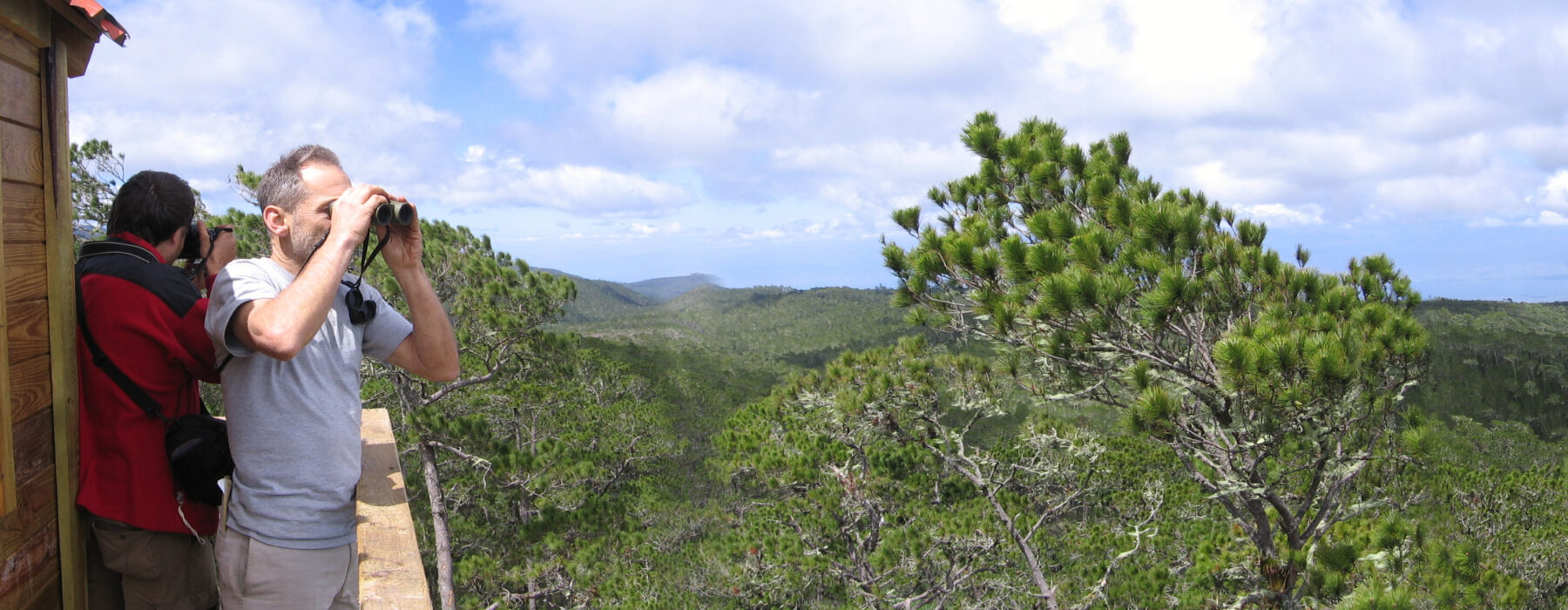
This is the non-breeding period of its annual cycle, and VCE’s long-term commitment to Bicknell’s Thrush conservation demands that we pay careful attention to issues on its winter range. Since 1994, VCE biologists have followed the birds there, committed to studying and conserving these important, high-elevation, tropical habitats.
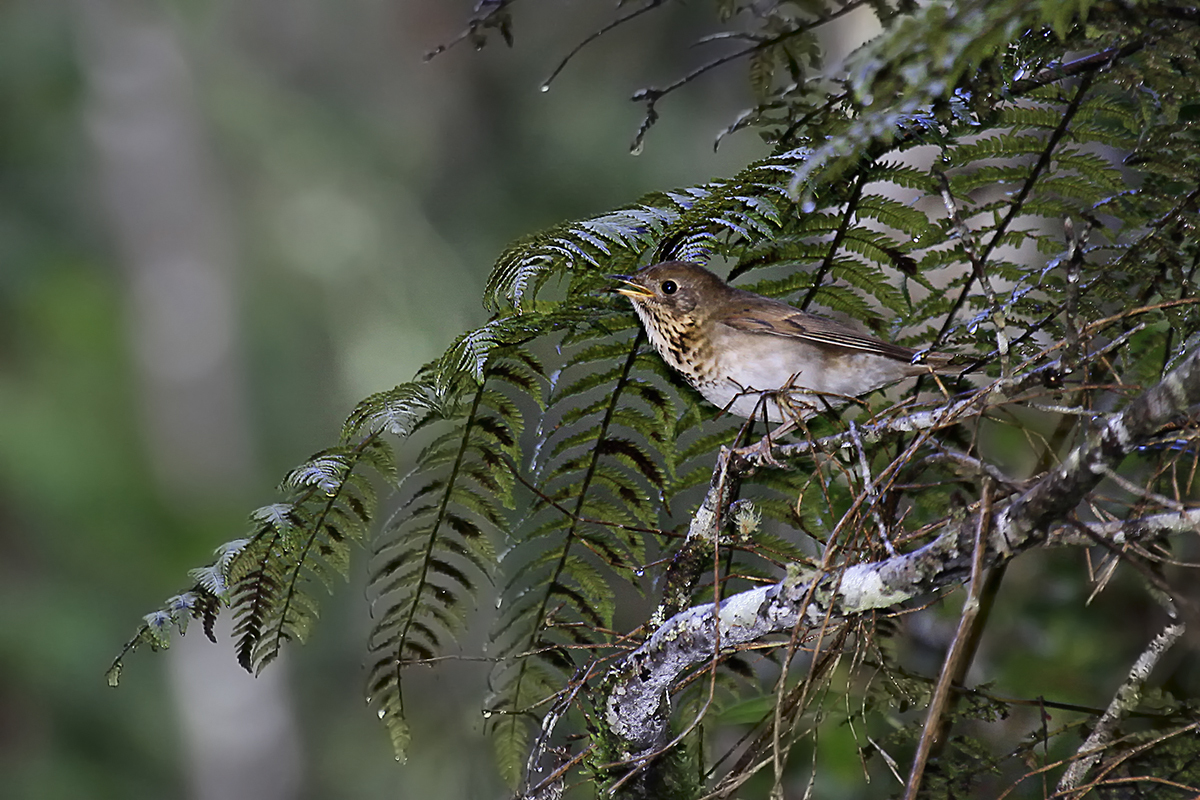
© Pedro Genaro Rodriguez on iNaturalist. Some rights reserved CC-BY-NC
A Mostly Caribbean Bird
In the 1990s, the Bicknell’s Thrush wintering habitat was largely unexplored. Historical records, while scant, suggested that the Bicknell’s Thrush winter range was restricted to the Caribbean Greater Antilles, and an exploratory trip to the Dominican Republic by Chris Rimmer in 1994 confirmed the presence of Bicknell’s Thrush in high- elevation, broadleaf forests of Sierra de Bahoruco.
This catalyzed a three-year study of the species’ distribution and habitat use. Although Bicknell’s Thrush have been found in the Blue Mountains of Jamaica, the Sierra Maestra of Cuba, and Puerto Rico’s Luquillo Mountains, VCE’s research has shown convincingly that at least 90% of the species’ global population overwinters on Hispaniola.
We’re currently trying to get more detail on when they arrive and leave. In January 2025, Vermont Center for Ecostudies deployed the first Motus station within the Bicknell’s Thrush wintering distribution, at Reserva Privada Zorzal. BITH that we have fitted with small radio receiver backpacks will ping this and other towers, giving us data on their whereabouts.
With help from generous private donors, we are setting up more towers along the coast so we can further track BITH’s arrival and departure to the island, and understand where in their migration they are running into obstacles and dying.
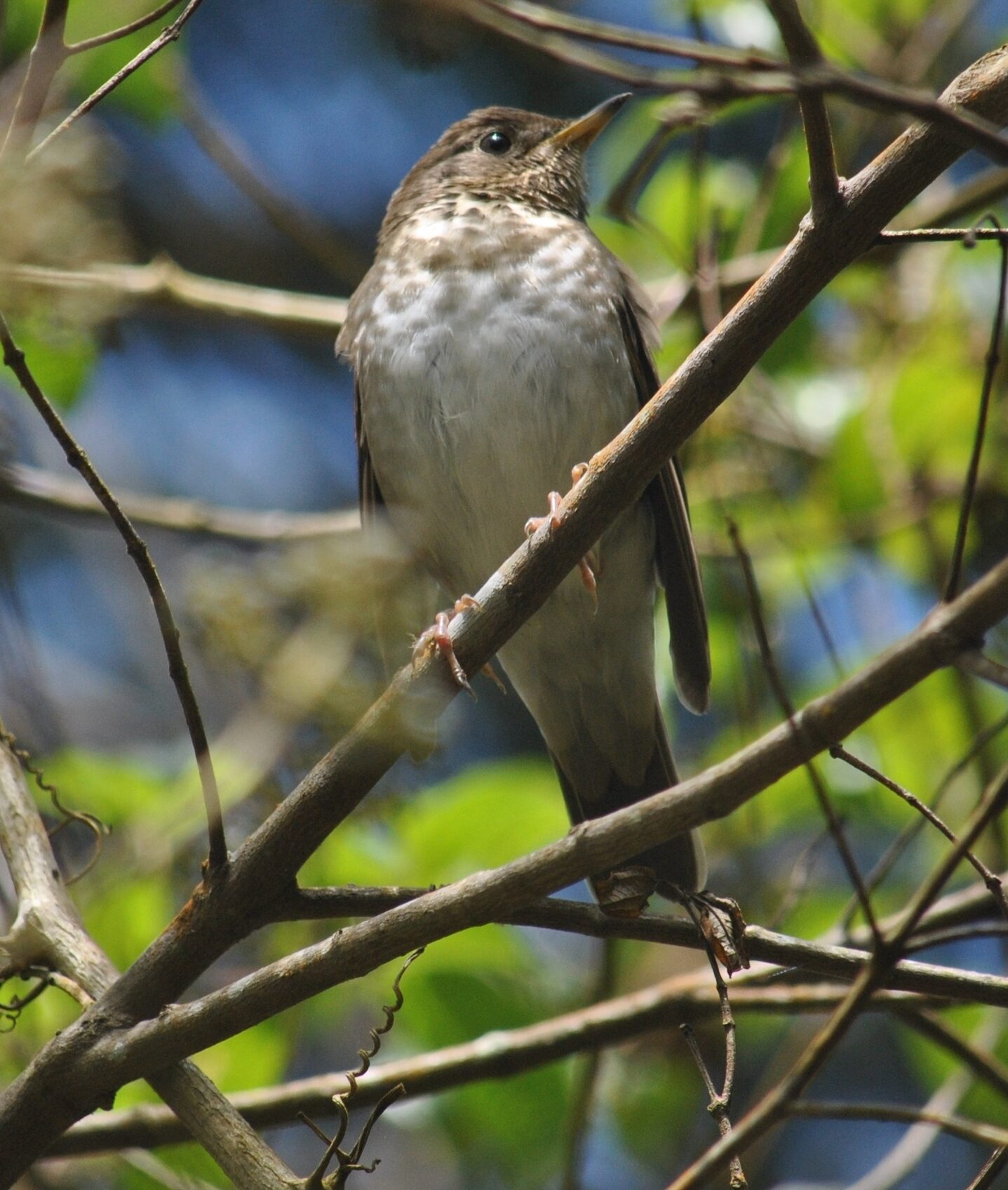
© Yolanda M. Leon on iNaturalist. Some rights reserved CC-BY-NC
Preferred Habitat and Human Disturbance
Montane forests in the Dominican Republic and Haiti constitute the primary winter refugia for Bicknell’s Thrush. They prefer wet, broadleaf forests with a dense understory. Although we have documented Bicknell’s Thrush in humid forests at sea level, extremely few of these habitats have escaped loss or alteration by humans. But even remote habitats on the island face unrelenting loss from intense human population pressures.
Remotely sensed data suggest that from 1996 to 2022, both Haiti and the Dominican Republic experienced rapid primary forest loss, inside and outside protected areas. Forest agriculture such as shade grown coffee or cacao production have increased rapidly. Cacao production, especially along the northern coast, has exploded in recent years as the price for cacao beans has nearly tripled.
Climate change is also expected to decrease rainfall, which doesn’t bode well for a species that prefers wet rainforests. Adding insult to injury is our discovery that introduced rats may cause significant mortality during winter, even in the relatively pristine forests of Sierra de Bahoruco.
Male and female Bicknell’s Thrush appear to segregate by habitat type. In undisturbed, primary forests of Sierra de Bahoruco, males outnumber females by a 4:1 ratio. Both sexes maintain discrete territories throughout the winter, and insect food resources are relatively rich in these forests, which we believe represent “optimal” winter habitat.
A different situation exists at our study site in the Cordillera Septentrional, a mid-elevation, much wetter area that features more disturbed, secondary broadleaf forest with a relatively open understory. Here females slightly outnumber males, and birds appear to feed more heavily on fruit, a generally lower quality food than insects. We suspect that these forests constitute “suboptimal” habitat, and that, because suitable habitat is limited islandwide on Hispaniola, females may have few options but to inhabit them. The consequences for female survival could be pronounced, with effects on the entire species’ viability.
© Jim Goetz
Building Conservation Capacity in the Caribbean
Training of our local partners in the Dominican Republic and Haiti is among the most important facets of VCE’s overall conservation program on Hispaniola.
For over two decades we have worked closely with local biologists, students, and amateur ornithologists, helping to build their capacity in becoming ecological stewards of Hispaniola’s unique biodiversity.
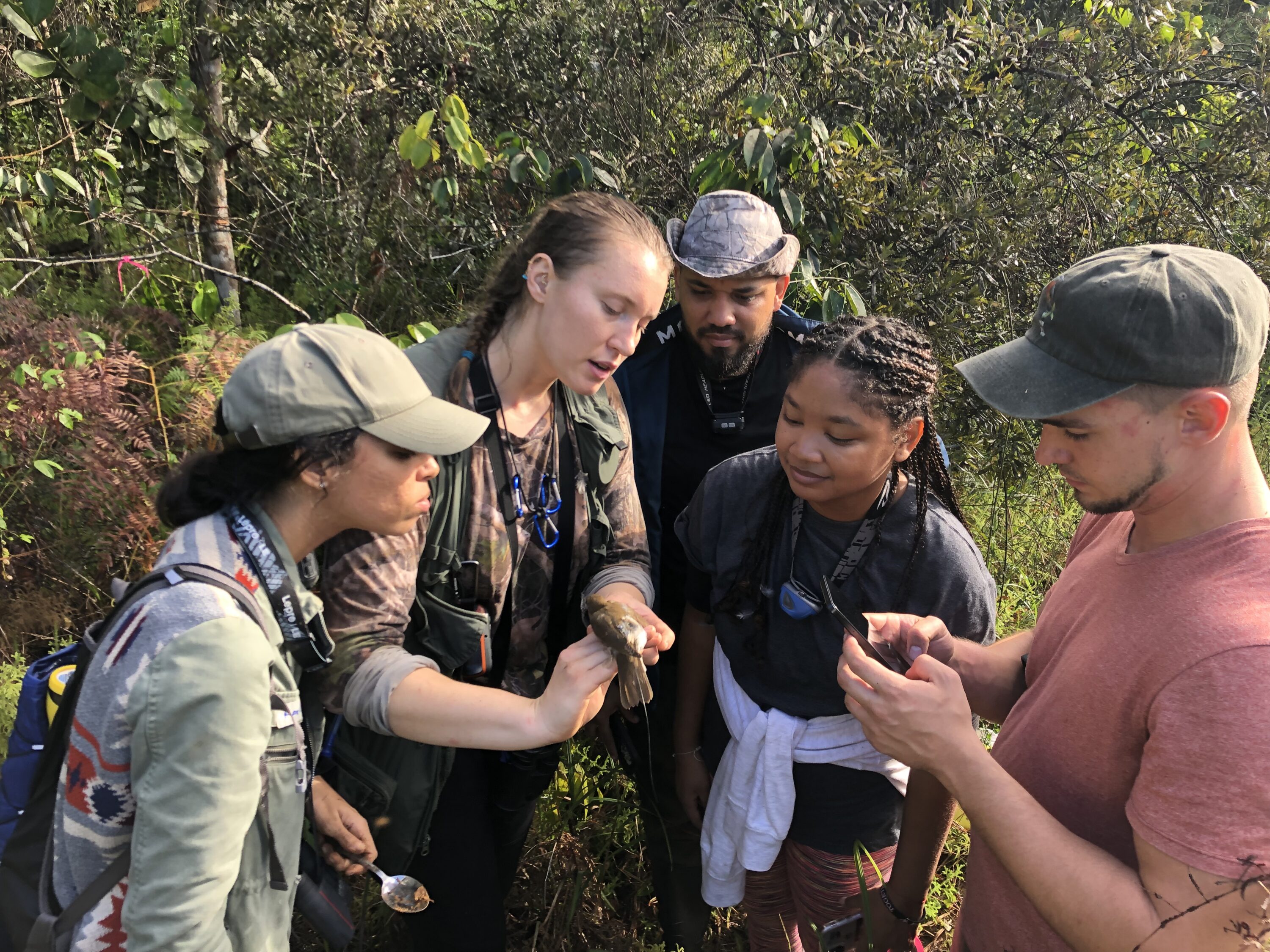
In the Caribbean, Jim Goetz leads field training for the next generation of biologists. The students install pitfall traps which will collect leaf litter insects at each survey point, and measure the structure of the forest and the amount of fruit in the regenerating habitat of the reserve, comparing it to a non-sustainably-managed nearby plantation.
They conduct surveys for Bicknell’s Thrush, using audio playback to call in Bicknell’s Thrush from the regenerating forest of the private reserve. Mist nets are hung to catch birds so they can be measured, banded, and fitted with a backpack receiver for tracking.
Hopefully, the tagged BITH will pass close to one or more Motus receiving stations, so we can track their movements to the U.S. mainland, up the coast, and to its breeding grounds in the Northeast.
Publications on Bicknell’s Thrush in the Caribbean
Hobson, K. A., McFarland, K. P., Wassenaar, L. I., Rimmer, C. C., & Goetz, J. E. (2001). Linking breeding and wintering grounds of Bicknell’s thrushes using stable isotope analyses of feathers. The Auk, 16–23.
Latta, S. C., Rimmer, C. C., & McFarland, K. P. (2003). Winter bird communities in four habitats along an elevational gradient on Hispaniola. The Condor, 105(2), 179–197.
Latta, S. C., Rimmer, C. C., Keith, A., Wiley, J. W., Raffaele, H., McFarland, K. P., & Fernandez, E. (2006). Birds of the Dominican Republic & Haiti. Princeton University Press.
Lloyd, J. D., Rimmer, C. C., & McFarland, K. P. (2016). Assessing conservation status of resident and migrant birds on Hispaniola with mist-netting. PeerJ, 4, e1541. https://doi.org/10.7717/peerj.1541
Lloyd, J. D., Rimmer, C. C., & Salguero-Faría, J. A. (2019). Short-term effects of hurricanes Maria and Irma on forest birds of Puerto Rico. PloS One.
McFarland, K. P., Rimmer, C. C., Goetz, J. E., Aubry, Y., Wunderle Jr., J. M., Sutton, A., Townsend, J. M., Sosa, A. L., & Kirkconnell, A. (2013). A Winter Distribution Model for Bicknell’s Thrush (Catharus bicknelli), a Conservation Tool for a Threatened Migratory Songbird. PloS One, 8(1), e53986. https://doi.org/10.1371/journal.pone.0053986.t002
Rimmer, C. C. (2005). Bird Conservation in Haiti: It’s now or never to save Haiti’s birds. Journal of Caribbean Ornithology, 1–2.
Rimmer, C. C., Goetz, J. E., Gomez, E. G., Bayard, P., & Hilaire, J. V. (2010). Avifaunal Surveys in La Visite National Park—Last Vestiges of Montane Broadleaf Forest in Eastern Haiti. Journal of Caribbean Ornithology, 23(1), 31.
Rimmer, C. C., Goetz, J. E., & McFarland, K. P. (1998). Bird observations in threatened forest fragments of Sierra de Neiba, Dominican Republic. El Pitirre, 11, 38–39.
Rimmer, C. C., Lloyd, J. D., & Salguero, J. A. (2019). Overwintering Bicknell’s Thrush (Catharus bicknelli) in Puerto Rico—rare and local. Journal of Caribbean Ornithology, 32, 34–38.
Rimmer, C. C., Townsend, J. M., Townsend, A. K., Fernandez, E., & Almonte, J. (2005). Avian diversity, abundance, and conservation status in the Macaya Biosphere Reserve of Haiti. 219–230.
Rimmer, C. C., Viña Davila, N., Lloyd, J. D., Aubry, Y., Segovia Vega, Y., Placencia León, C., Rodríguez Santana, F., & Ramon Fuentes, J. (2024). Overwinter Status of Bicknell’s Thrush (Catharus bicknelli) in Eastern Cuba. Journal of Caribbean Ornithology, 37, 1–11.
Townsend, J. M., Rimmer, C. C., Driscoll, C. T., McFarland, K. P., & Inigo-Elias, E. (2013). Mercury concentrations in tropical resident and migrant songbirds on Hispaniola. Ecotoxicology, 22(1), 86–93. https://doi.org/10.1007/s10646-012-1005-1
Townsend, J. M., Rimmer, C. C., & McFarland, K. P. (2010). Winter Territoriality and Spatial Behavior of Bicknell’s Thrush (Catharus bicknelli) at Two Ecologically Distinct Sites in the Dominican Republic. The Auk, 127(3), 514–522. https://doi.org/10.1525/auk.2010.09160
Townsend, J. M., Rimmer, C. C., & McFarland, K. P. (2008). Investigating the limiting factors of a rare, vulnerable species: Bicknell’’s thrush. Proceedings of the Fourth International Partners in Flight Conference: Tundra to Tropics, 91–95.