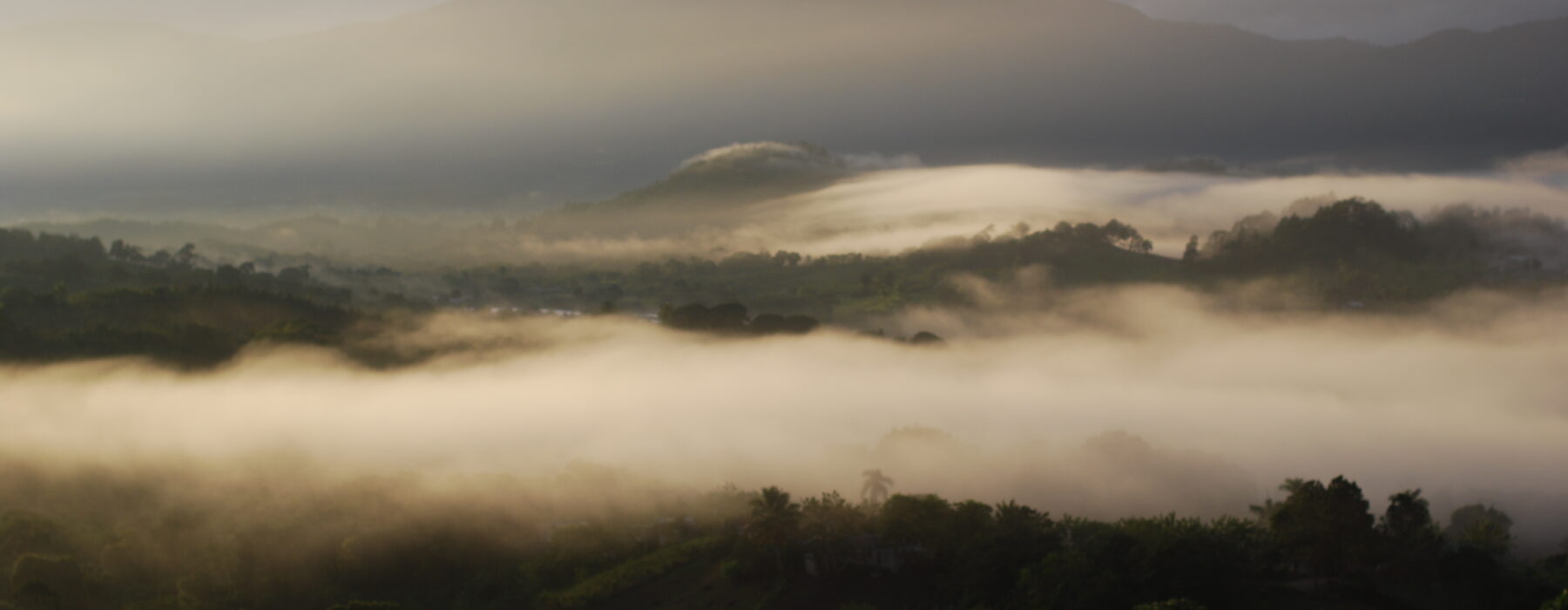
Studying Bicknell’s Thrush led VCE Director Emeritus Rimmer and his colleagues to the Caribbean, where they’ve worked closely with locals in Cuba and Hispaniola to study, monitor, and protect this migratory songbird, plus other endemic birds.
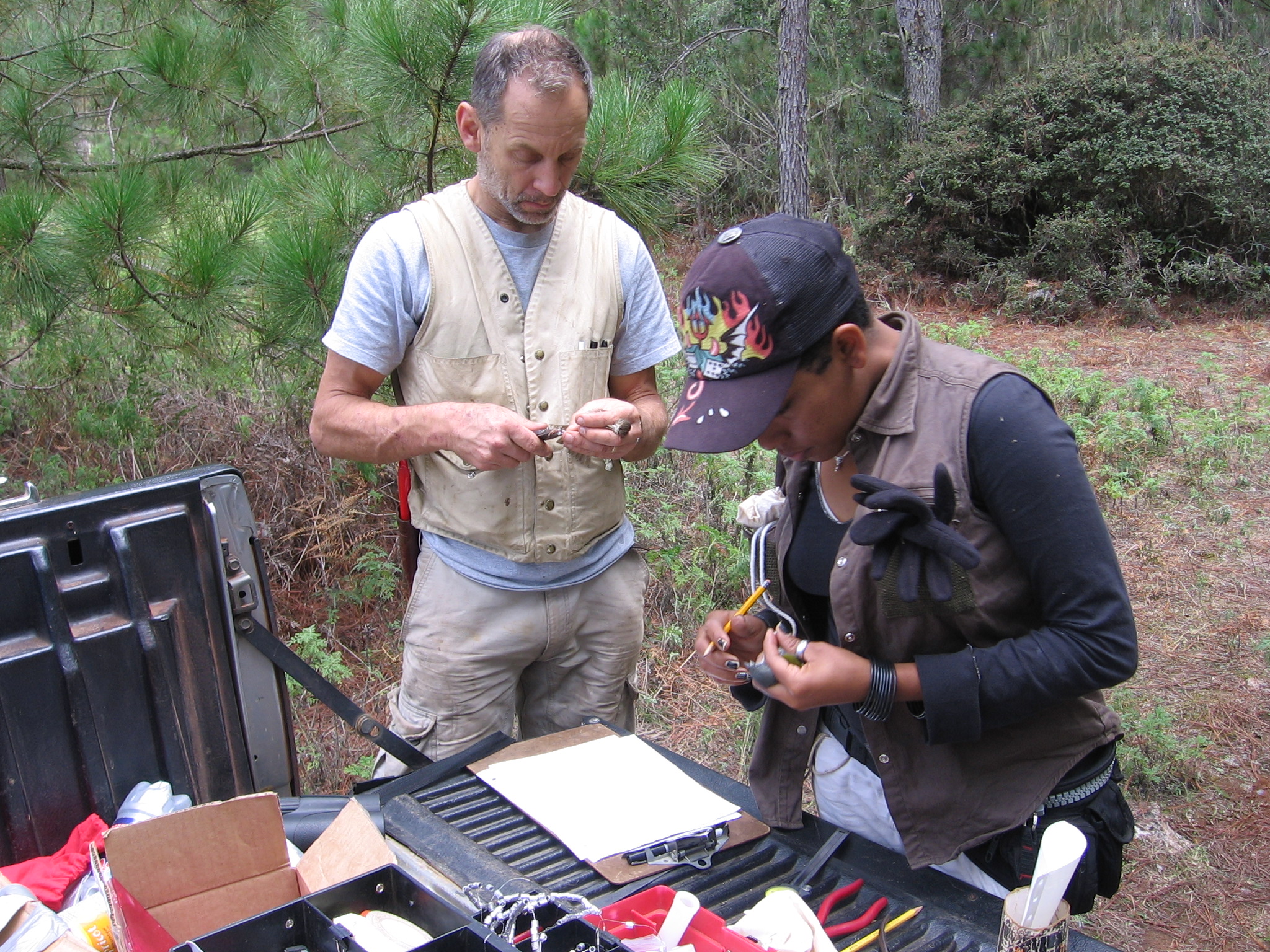
Bahoruco Bird Banding Station
We monitored bird populations in the cloud forest of Bahoruco National Park, southwest Dominican Republic for nearly two decades. This forest is home to several critically endangered, endemic birds that have been rarely studied as well as migrants such as Bicknell’s Thrush and Ovenbird.
Since our first field trip to the Sierra de Bahoruco in 1994, VCE has concentrated research and monitoring efforts in montane forests of both the Dominican Republic and Haiti. At our two long-term Bahoruco study sites, Pueblo Viejo and Palo de Agua, we have conducted standardized midwinter monitoring with mist nets since 1995. These two sites feature some of Hispaniola’s most spectacular tracts of montane rain forest.
Our banding data have yielded new insights into the site fidelity and longevity of Hispaniolan montane forest birds. Among migrant species, Bicknell’s Thrush shows an average annual return rate of 25%, and we have recaptured several birds up to 7 years old in Sierra de Bahoruco. Resident species show very high site fidelity–during the winter of 2008 we mist-netted an 11-year old Green-tailed Ground-Tanager, an 11-year old Western Chat-Tanager, and a 10-year old Greater Antillean Bullfinch.
The banding station has also been a teaching facility. Over the years, hundreds of students and biologists have received hands-on training about ecology and conservation here. Interns have always been a vital component of our work at the Bahoruco Bird Banding Station.
From 2002 to 2004, with colleague Steve Latta of the National Aviary, VCE embarked on a pioneering three-year study of avian breeding ecology in Sierra de Bahoruco.
This research, the first of its kind in the Caribbean, investigated the little-known nesting biology of birds in four habitat types from sea level to nearly 1500 m elevation: desert scrub, dry broadleaf forest, pine forest, and montane broadleaf forest. Our field crews of Dominican colleagues found over 1,000 nests and closely monitored their success. Our most exciting discovery was of two nests previously undescribed to science: those of the Hispaniolan Highland-Tanager and Western Chat-Tanager.
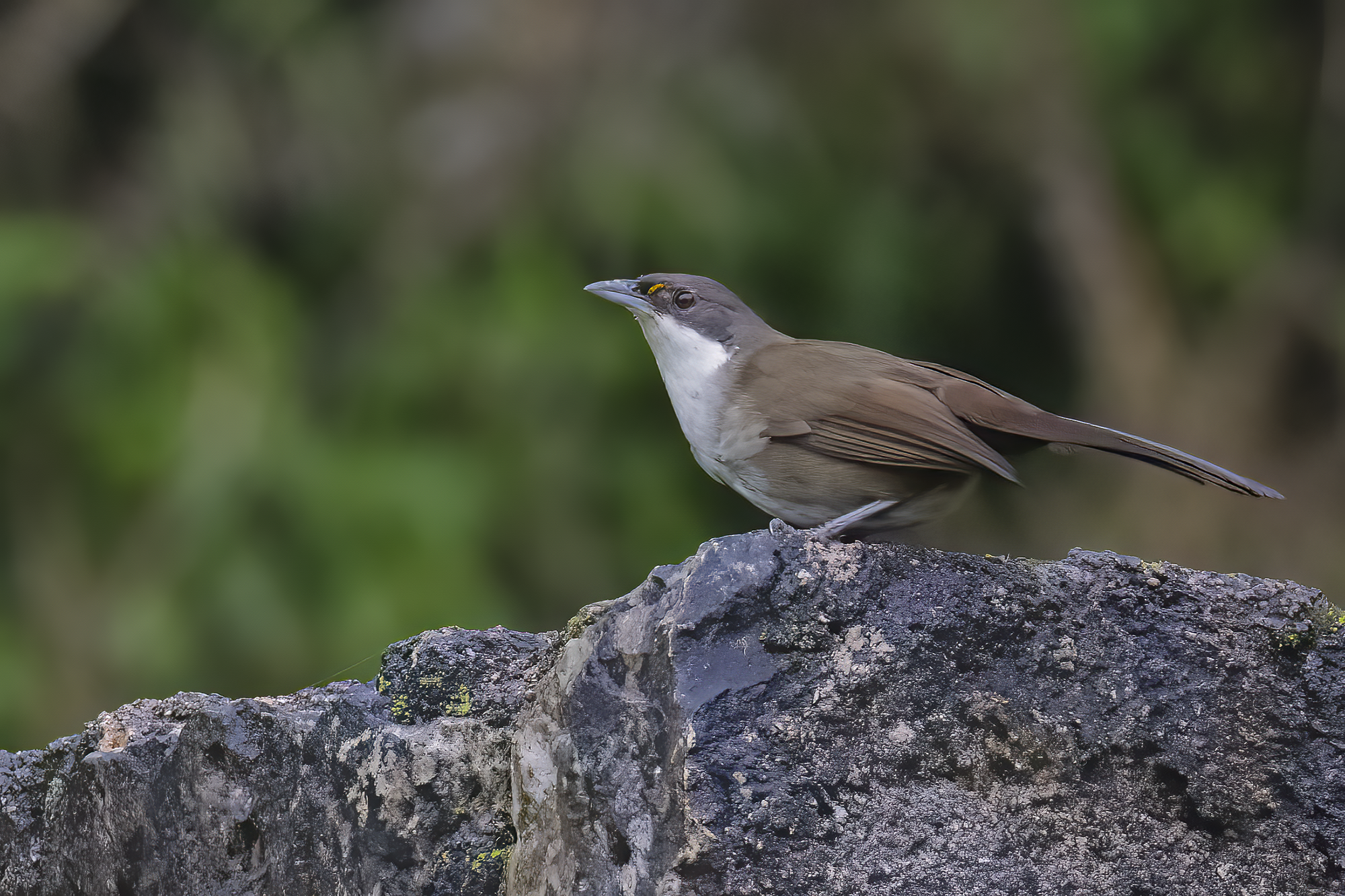
Western Chat-Tanager © Pedro Genaro Rodriguez on iNaturalist. Some rights reserved CC-BY-NC
Protected Acres for BITH and Other Birds
The growth of coffee and cacao cultivation can be done responsibly and with biodiversity conservation in sharp focus. A great case study for integrating conservation into sustainable development is Reserva Privada Zorzal , which means thrush in Spanish, and is the Dominican Republic’s first private reserve.
The Bicknell’s Thrush Conservation group partnered with a young anthropologist and forester named Chuck Kerchner and a Dominican family to protect 1,019 acres. Seventy-five percent of those acres have been designated as forever wild and carefully restored to a lush Bicknell’s Thrush habitat, while the rest have been turned over to bird-friendly cacao farming, which generates revenue and creates jobs.
One local ornithologist, Hodali Almonte, did her master’s research on Reserva Zorzal and found that the population of BITH in the reserve has increased in the past seven years.
The conservation inspired by Bicknell’s Thrush has benefited many other species that also rely on high-elevation habitats. Data collected by Mountain Birdwatch, a monitoring program for ten montane songbirds that grew out of the BITH study, has led to the delineation of Bird Conservation Areas in the Adirondacks and Catskills, and spurred conservation of important properties in Vermont, New Hampshire, and Maine. Other North American wildlife that have benefited from BITH-focused conservation include Canada Lynx, Northern Spring Salamanders, American Three-toed Woodpeckers, Blackpoll Warblers, Boreal Chickadees, Olive-sided Flycatchers, and Purple Finches.
Mercury in the Caribbean
From 2005 to 2011, we measured mercury levels in 365 individual birds of nine species occupying a range of sites and habitats in the Caribbean. Every individual of all nine species showed elevated blood concentrations of mercury.
Birds in remote, mountainous cloud forests showed much higher mercury levels, on the order of two- to 20-times higher, than birds in lower-elevation rain forests. One possible explanation is that these cloud-forest sites are essentially bathed year-round in atmospheric moisture, where mercury can be more concentrated and then deposited in forests. By contrast, the researchers say, heavy rains in the lowland rainforests may rinse these sites of higher mercury levels and prevent its accumulation in the terrestrial food chain.
Birds ingest mercury through their food. So the researchers correlated mercury levels with what the birds typically ate and where in the forest they foraged. Ground-feeding species in the study showed higher mercury levels than birds gleaning food from foliage. The research team suspects that ground-dwelling spiders and other arthropods higher on the food chain accumulate more mercury than the fruits and foliage-eating insects that birds glean from mid-canopy trees.
The lone raptor in the study, Sharp-shinned Hawk, which preys on songbirds, showed the highest blood mercury level of any species. That suggests amplification of the toxin as it passes up the food web – from plant to insect to songbird and finally to the hawk – a process known as biomagnification.
Two songbird species featured in the study, Bicknell’s Thrush and Ovenbird, winter on Hispaniola and migrate to North America in spring. Blood mercury concentrations in each were higher than levels researchers typically find in either species when they are on breeding grounds in North America.
Local sources of mercury, from cement factories or smelters, may account for some of the exposure in the Dominican birds. But scientists also implicate a global reservoir of mercury, generated at industrial sources and transported in the atmosphere to distant ecosystems.
The levels of elevated mercury found in the Caribbean are probably not killing birds outright, but the toxin is known to impair reproductive performance, growth and development, motor skills, and survivorship in some birds and other wildlife. Mercury can also concentrate progressively over time in the tissues of an organism, presenting risks even if environmental levels of the toxin are low — a process known as bioaccumulation.
VCE and other mercury experts say the findings support the need for tighter controls on mercury emissions and more research, including investigations into modes of mercury transport in the atmosphere.
Publications
Our staff biologist Kent McFarland and Director Emeritus Chris Rimmer collaborated on a field guide to the more than 300 species of birds found on the island, with an updated edition in 2022 .
Townsend, J.M., C.C. Rimmer, C.T. Driscoll, K.P. McFarland, and E.E. Iñigo-Elias. 2013. Mercury concentrations in tropical resident and migrant songbirds on Hispaniola. Ecotoxicology Volume 22 (1): 86-93. DOI 10.1007/s10646-012-1005-1. (Abstract)
McFarland, K.P., C.C. Rimmer, J.E. Goetz, Y. Aubry, J.M. Wunderle Jr., A. Sutton, J.M. Townsend, A. Llanes Sosa, and A. Kirkconnell. 2013. A Winter Distribution Model for Bicknell’s Thrush (Catharus bicknelli), a conservation tool for a threatened migratory songbird. PLOS ONE 8(1): e53986. doi:10.1371/journal.pone.0053986. (Abstract)
Townsend, J.M., C.C. Rimmer, K.P. McFarland, and J.E. Goetz. 2012. Site-specific variation in food resources, sex ratios and body condition of an overwintering migrant songbird. Auk 129: 683-690. (Abstract)
McKinnon, E.A, K.C. Fraser, A.W. Diamond, C.C. Rimmer, and J.M. Townsend. 2012. Stable-hydrogen isotope turnover in red blood cells of two migratory thrushes: application to studies of connectivity and carry-over effects. Journal of Field Ornithology 83:306-314. (Abstract)
Townsend, J.M., C.C. Rimmer, and K.P. McFarland. 2012. Radio-transmitters do not affect seasonal mass change or annual survival of wintering Bicknell’s Thrushes. Journal of Field Ornithology 83:295-301. (Abstract)
Townsend, J.M., C.C. Rimmer, A.T. Townsend, and K.P. McFarland. 2011. Sex and age ratios of Bicknell’s Thrush wintering in Hispaniola. Wilson Journal of Ornithology 123:367-372. (Abstract)
Townsend, J.M, C.C. Rimmer, and K.P. McFarland. 2010. Winter territoriality and spatial behavior of Bicknell’s Thrush (Catharus bicknelli) at two ecologically distinct sites in the Dominican Republic. Auk 127:514-522. (Abstract)
Kerchner, C., M. Homzak, R. Kemkes, A. Richardson, J.M. Townsend, and C.C. Rimmer. 2010. Designing spatially explicit incentive programs for habitat conservation: a case study of the Bicknell’s Thrush winter grounds. Ecological Economics 69:2018-2015. (Abstract)
Townsend, J.M., C.C. Rimmer, and K.P. McFarland. 2009. Investigating the limiting factors of a rare, vulnerable species: Bicknell’s Thrush. Proceedings of the Fourth International Partners in Flight Conference: Tundra to Tropics: 91-95.
Townsend, J.M., C.C. Rimmer, J. Brocca, K.P. McFarland, and A. K. Townsend. 2009. Predation of a wintering migratory songbird by introduced rats: can nocturnal roosting behavior serve as predator avoidance? Condor 111(3): 565-569.
Townsend, J.M. and C.C. Rimmer. 2006. Known natal and wintering sites of a Bicknell’s Thrush. Journal of Field Ornithology 77: 452-454. (Abstract)
Christopher C. Rimmer, Jason M. Townsend, Andrea K. Townsend, Eladio M. Fernández, & Jesus Almonte. 2005. Avian diversity, abundance, and conservation status in the Macaya Biosphere Reserve of Haiti. Ornitologia Neotropical 16: 219–230.
Rimmer, C.C. 2005. Bird conservation in Haiti: it’s now or never to save Haiti’s birds. Journal of Caribbean Ornithology 18:86-87.
Rimmer, C.C. and K.P. McFarland. 2001. Known breeding and wintering sites of Bicknell’s Thrush. Wilson Bull.113: 234-236. (Abstract)
Hobson, K.A., K.P. McFarland, L.I. Wassenaar, C.C. Rimmer and J.E. Goetz. 2001. Linking breeding and wintering grounds of Bicknell’s Thrushes using stable isotope analyses of feathers. Auk 118:16-23. (Abstract)