In 1992, VCE cofounder and Director Emeritus Chris Rimmer was a songbird specialist working at Vermont Institute of Natural Science (VINS) when he attended an annual meeting of the American Ornithologists Union (now the American Ornithological Society) in Montreal. A Canadian zoogeographer named Henri Ouellet presented a paper exploring whether Bicknell’s Thrush, which had been categorized as a subspecies of Gray-cheeked Thrush, should be classified as a distinct species.
Discovered by amateur ornithologist Eugene Bicknell in the Catskills in June 1881, Bicknell’s Thrush looks so similar to Gray-cheeked that it’s impossible to tell them apart visually. But Ouellet’s research into their non-overlapping ranges, museum specimens, field recordings of their songs, and DNA led him to conclude they were different species.
Rimmer was intrigued. Bicknell’s Thrush (birder shorthand BITH) bred nearby in the Green and White Mountains, but it was a mystery how many there were and how they were doing. Meanwhile, these rare mountaintop ecosystems that this little brown bird relies on—island like habitats of spruce-fir forest above 3,000 feet in the Catskills, Adirondacks, Green Mountains, and White Mountains—were getting doused with acid precipitation and mercury pollution as developers were trying to expand ski resorts and site wind turbines.
Rimmer and his colleagues, including Kent McFarland, scoured the literature to come up with 73 mountain peaks where Bicknell’s Thrush had historically been documented. They then invited community scientists to perform hiking surveys in June during 1992 and 1993 on 100 different peaks to see if the species was there, equipping the volunteers with playback (BITH song tapes and speakers) to tease them out of hiding.
Together they found Bicknell’s Thrush on 63 peaks, which was encouraging. Surveying by ear didn’t tell them how many birds each peak had, but at least the birds were still there.
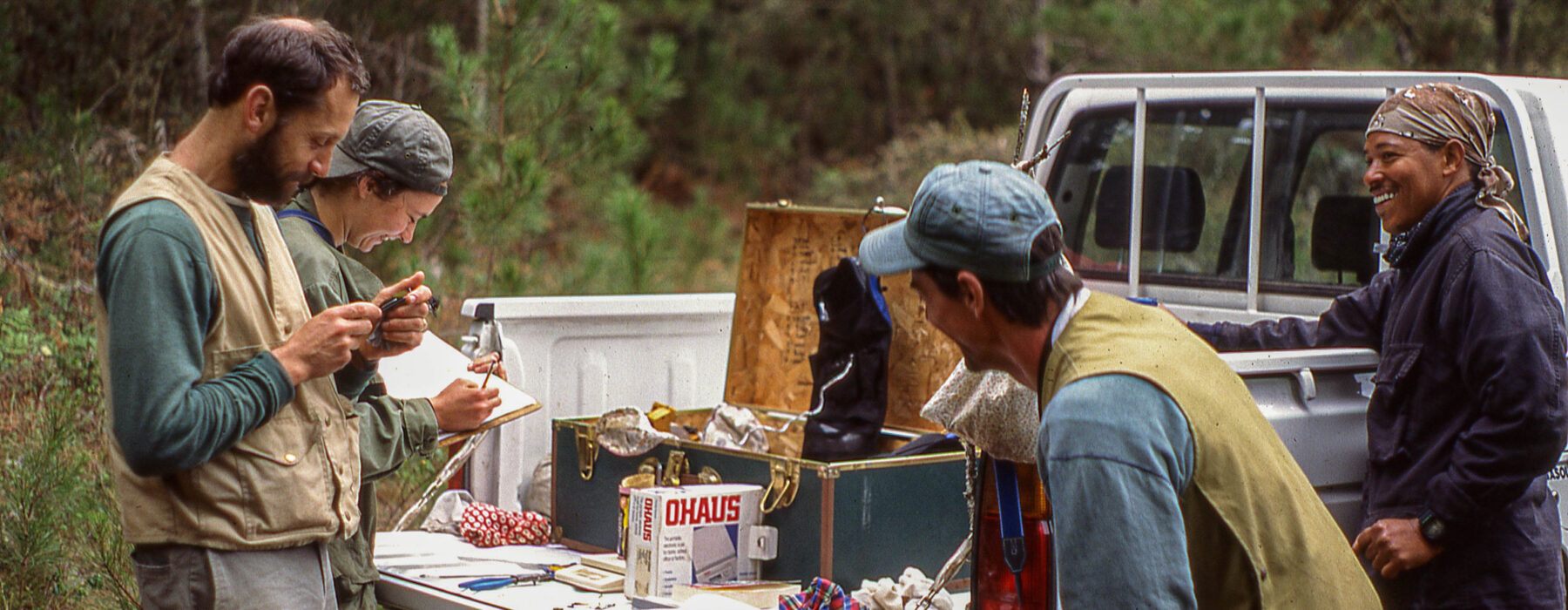
Rimmer and McFarland then established a study site on Mount Mansfield to study the bird’s breeding ecology, which resulted in a couple of early papers, before expanding to Stratton for an annual eight-week period of intensive study on each peak. Many young biologists and ornithologists, including VCE Associate Director Dan Lambert and Caribbean Conservation Coordinator Jim Goetz, got their start on those mountaintops, bonding over the grueling work. But it could also be transcendent. During courtship, the male BITHs will put on a moving show, tracing big circles 50 to 100 feet up in the sky as they sing.
The scientists captured and tagged birds, color-banding them so they could count them and track individuals, and placing lightweight backpacks with radio telemetry tags to monitor their activities on the mountain and in the D.R. Later, they added GPS tags to track their precise movements during migration, and followed them down to to the Caribbean for more study.
In 2007, Chris Rimmer and Kent McFarland established the International Bicknell’s Thrush Conservation Group, which included partners from the Dominican Republic, American government agencies, and academia. They quickly established an action plan for Bicknell’s Thrush conservation. The goal was to increase the population of BITH by 50% by 2060 and not suffer any net loss of its breeding range. The action plan has been through two revisions, and Goetz, who is now IBTCG’s head, is working on a third.
Now Bicknell’s Thrush faces the metathreat: climate change. As the world warms, the conifers necessary for Bicknell’s Thrush reproduction are expected to retreat up the mountain, shrinking these islands of habitat until some disappear. Rimmer worries that in 100 years, only the highest, most northern mountain peaks will still hear the song of this rare little brown bird.
Chris Rimmer has retired, and Kent McFarland’s research interests led him to butterflies and other pollinators. But a new BITH team is now camping at the top of Mount Mansfield all summer long and traveling to the D.R. Principal Investigator Desirée Narango, along with Mike Hallworth and Goetz, are building on the foundational work from Rimmer, McFarland, and others to fill in some of the gaps in our understanding of Bicknell’s Thrush.