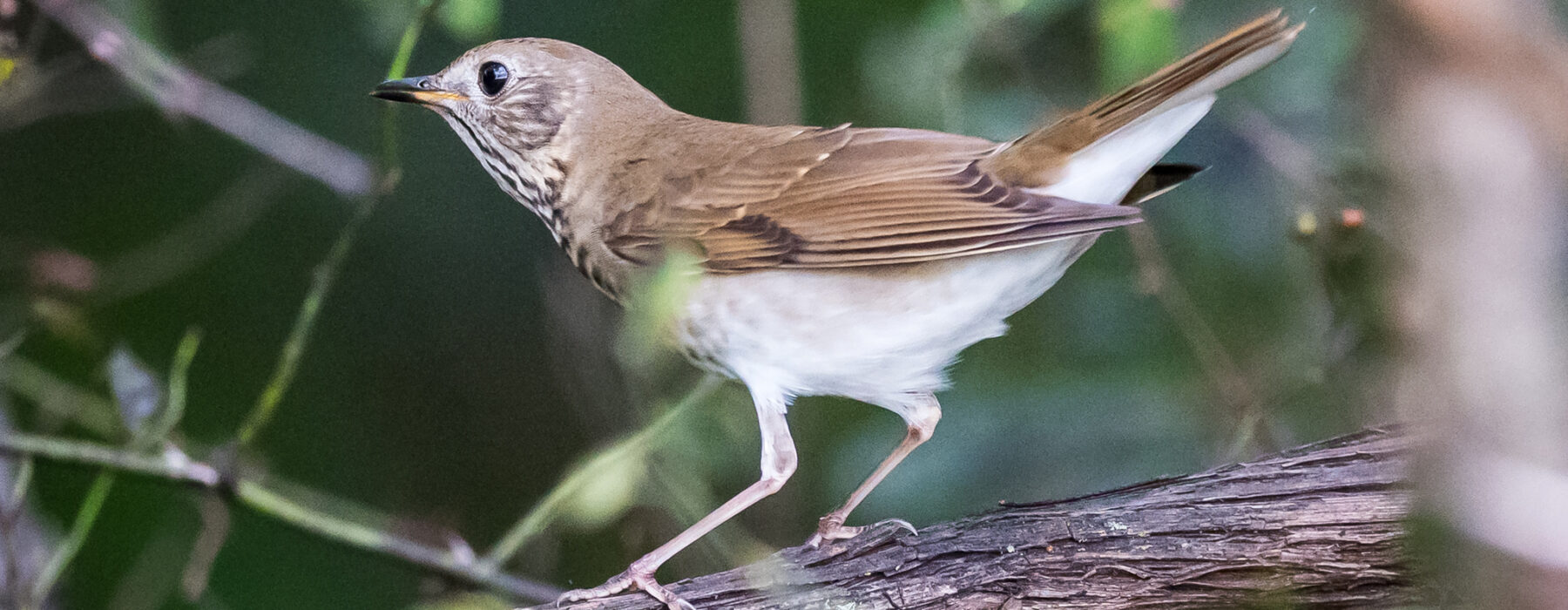
At the end of September or the beginning of October, the wind will change and Bicknell’s Thrush will take to the air.
Recent data indicates the thrushes will touch down somewhere on the East Coast to rest and refuel for a few weeks, building up fat and muscle for a trans-Atlantic flight. They congregate at rest stops in the Delmarva Peninsula, and in some parts of coastal North Carolina. This is densely-populated and highly fragmented suburban and agricultural habitat, very unlike the rarified peaks of New England.
Scientists suspect that birders have been mistaking stop-over Bicknell’s Thrush in the region for Gray-cheeked Thrush. That means the wealth of eBird or iNaturalist data, which scientists typically use to look at habitat use, probably underrepresents Bicknell’s Thrush in the area. However, it’s likely that Bicknell’s and Gray-cheeked Thrushes use similar habitat, and crowd-sourced observations of migrating Gray-cheeked Thrushes have put them in both heavy agricultural areas such as the Eastern Shore of Maryland, and along the highly developed I-95 corridor, which runs through the Mid-Atlantic’s largest cities like Washington D.C.
VCE has been studying Bicknell’s Thrush on Mount Mansfield and in the Dominican Republic for decades, but the species’ use of this stopover area—in particular, its habitat and diet preferences while there—remains a mystery. This is an especially important area of study, because VCE’s recent research on female thrushes suggests that something is working against their survival during fall migration. Evidence suggests that an equal proportion of male and female fledglings hatch in the Northeast, but in the adult population the following year, there are two or even four males for every female.
In short, the team wants to figure out: Where the birds are dying and what we can we do to help?
The BITH team at VCE, including Narango, Michael Hallworth, Ph.D., and Jim Goetz, partnered with bird banders in the Mid-Atlantic Region in 2025 to collect blood samples and precise body measurements of Gray-cheeked/Bicknell’s Thrushes to determine which bird species they caught. They also recorded characteristics of the habitat at the location of capture. With funding from the USFS International Program, VCE’s BITH team also tested out some new methods of detecting Bicknell’s and Gray-cheeked Thrushes during migration, including using audioplayback and autonomous recording units.
Take Off to the Caribbean
To identifying why many individuals appear to perish during migration, it’s critical to locate where Bicknell’s Thrush initiate their trans-Atlantic flights.
The Automated Motus Tracking Network provides valuable data as Bicknell’s Thrush—fitted with a Motus coded radio-frequency backpack— migrate. However, there are two gaps in the Motus Network with respect to Bicknell’s Thrush that allow them to migrate through key areas undetected. More towers in the coastal Carolinas region would likely help close the gap.