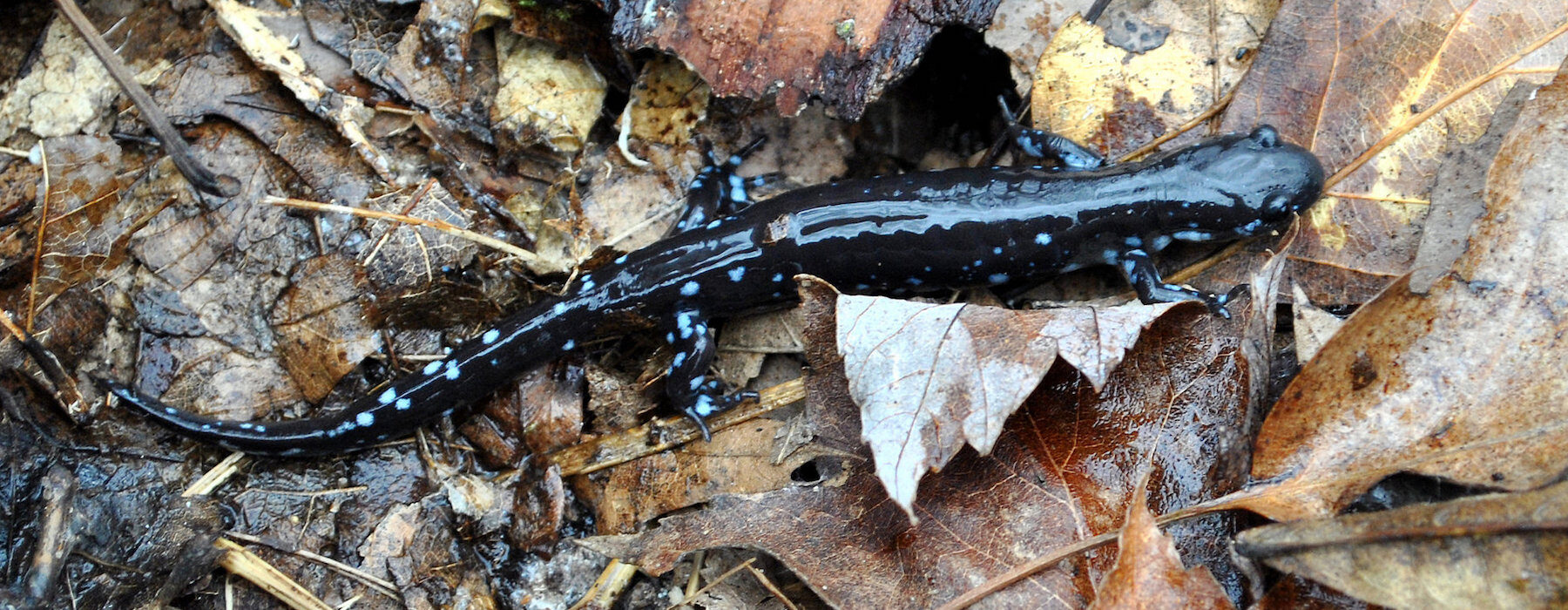
Ambystoma laterale
The Blue-spotted Salamander is a species of “Medium Priority” under Vermont’s Wildlife Action Plan. Please follow forestry Best Management Practices around breeding pools to help sustain viable populations.
Scientists are uncertain about the exact number of Blue-spotted Salamanders. However, they estimate that over 100,000 exist.
Blue-spotted Salamanders are found in forests throughout southeastern Quebec to Lake Winnipeg, south through the Great Lakes region and New England to northern Indiana and New Jersey. They breed in vernal pools and shallow wetlands. See species distribution in Vermont here.
Want to know even more about the Blue-spotted Salamander? Visit Encyclopedia of Life to learn more about this species’ natural history and identification.
The Blue-spotted Salamander is the smallest of the three mole salamanders found in Vermont — Blue-spotted, Jefferson, and Spotted Salamanders. With a slender body measuring up to five inches long, the Blue-spotted Salamander sports a grayish-black coloring with blue-white flecks or splotches on its sides and belly.
Blue-spotted Salamanders typically emerge from underground hibernacula on rainy nights from late March to early April, when they migrate to vernal pools and shallow swamps to begin their elaborate and energetic underwater mating dance. Male salamanders drop spermatophores (packets of sperm) into the water, at which point the female picks them up with her cloaca, fertilizing her eggs internally.
Blue-spotted Salamanders historically hybridized with Jefferson salamanders, creating all-female populations of unisexual hybrids (read more about unisexual hybrids on our Jefferson Salamander page). Typically, hybrid females will lay small egg masses containing two or three embryos, while pure Blue-spotted Salamanders will lay single eggs. Depending on water temperatures, eggs hatch in one or two months.
In New England, Blue-spotted are found in upland forests and breed in lowland swamps, marshes, and vernal pools. As with all adult mole salamanders, Blue-spotteds spend much of their time underground, preferring moist sandy or loamy soils.
The species is listed as “Medium Priority” under Vermont’s Wildlife Action Plan and threats include destruction to vital habitat such as vernal pools.
VCE Project
If learning more about the Blue-spotted Salamander has left you wondering how you can contribute to its conservation, please consider becoming a community scientist, making a gift, or keeping up with the latest VCE news! We also encourage you to report any sightings to iNaturalist Vermont, which helps us better understand this species throughout its range.