Sturnella magna
The New England/Mid-Atlantic population has declined by over 95%, and the overall U.S. population has likely declined by approximately 80% over the last 50 years (source North American Breeding Bird Survey).
Global Eastern Meadowlark estimates are around 30,000,000 (source: Partners in Flight).
Eastern Meadowlark’s breeding habitat is quite variable but includes native grasslands, pastures, hayfields, and even the occasional roadside or golf course. Their breeding range stretches from Minnesota east to Quebec and south through Cuba to Northern South America. This species winters in open grasslands, cultivated fields, feedlots, and some marshes. They are year-round residents, except in the Upper Midwest, Canada, and most of New England. Explore a dynamic eBird range map for this species.
Want to know even more about the Bobolink? Visit All About Birds to learn more about this species’ natural history and identification.
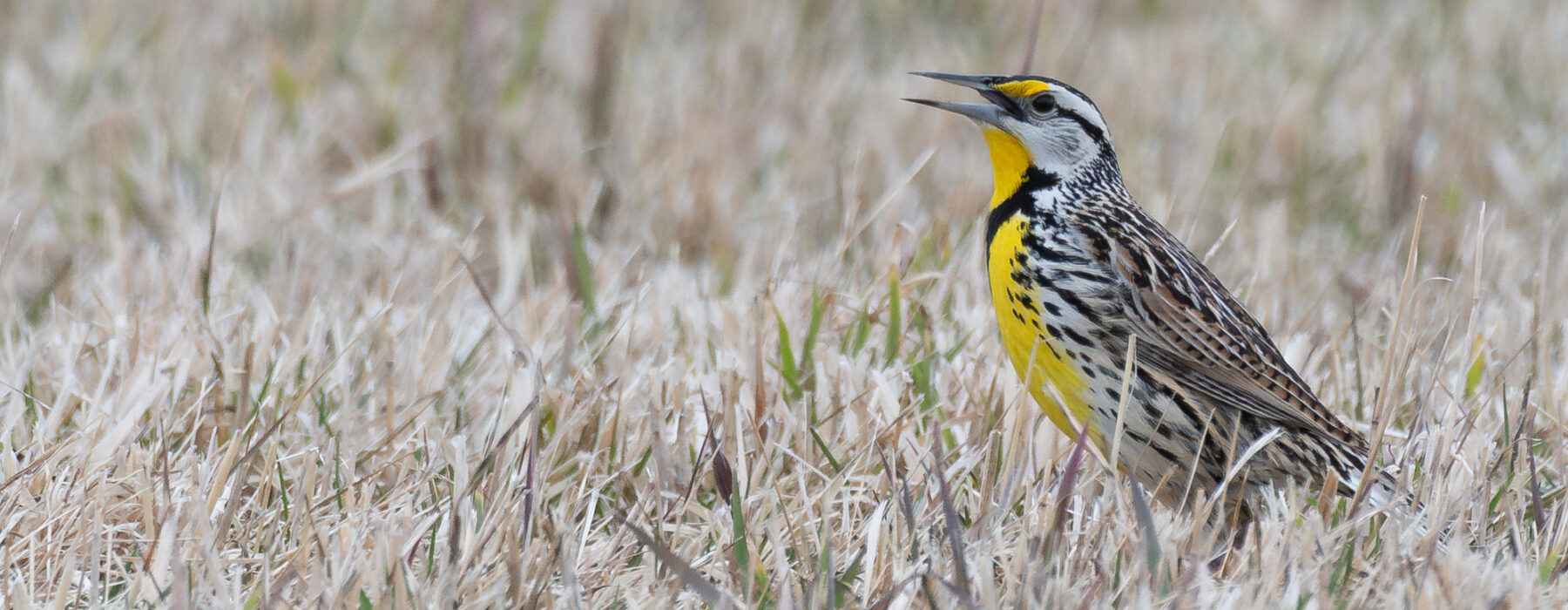
Our most brightly-colored Icterid (blackbirds and allies) in New England, the Eastern Meadowlark (Sturnella magna) is a striking grassland bird with a yellow breast. Often observed perched on barbed wire and fence posts, the male Eastern Meadowlark conspicuously sings a series of descending slurred whistles.
The Eastern Meadowlark greatly benefited from land clearing in the Northeast, but the New England/Mid-Atlantic population has declined by >95% over the last 50 years (source: North American Breeding Bird Survey). The causes of these declines in our region are likely related to the reforestation of abandoned farmlands and the intensification of agricultural practices on existing agricultural lands.
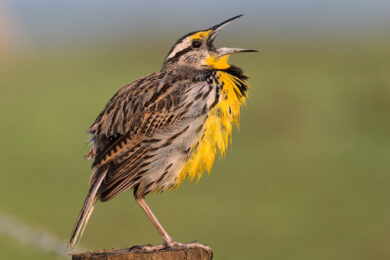
Eastern Meadowlark singing. © Matthew Paulson
Much remains to be learned about Eastern Meadowlark migration, but only meadowlarks occupying the northern most sections of their range (Upper Midwest, Canada, and most of New England) are known to be migratory. Recaptures of banded birds reveal that some Eastern Meadowlarks migrate >1,000 km to their wintering areas (e.g., from Wisconsin to Mississippi). Some Eastern Meadowlarks are present year round from Iowa to New England and south to northern South America, so does that mean that mean that meadowlarks are sedentary in that portion of their range?
Not necessarily.
While some individual Eastern Meadowlarks may remain year-round in Tennessee, for example, other individual meadowlarks that breed in Tennessee may indeed migrate—some existing band recovery data supports this theory. This cryptic migration pattern would be difficult to detect unless individual meadowlarks are either uniquely marked or fitted with year-round tracking devices. What proportion of Eastern Meadowlarks migrate, and how far do they go?
Through collaboration with the Department of Defense (DoD) Legacy Program, VCE is attempting to shed light on those questions using sophisticated satellite tracking tags. In 2016 VCE deployed these tags on Eastern Meadowlarks, and Upland Sandpipers, across their range. The discoveries from this project will lead to a more comprehensive understanding of the seasonal movements of Eastern Meadowlark populations. Such findings will be a critical step towards developing a year-round and range-wide approach to the conservation and management of Eastern Meadowlarks. Read a recap of our 2015 research efforts with Grasshopper Sparrows (here).
Natural History
One of our most recognizable birds inhabiting open grasslands in New England, the Eastern Meadowlark is found in large fallow fields, hayfields, pastures, and meadows. Male Eastern Meadowlarks are often observed giving their twittering flight song, or when aggressively chasing intruder males or potential mates. Meadowlarks are ground-foraging, and largely insectivorous birds, that favor agricultural pests like grasshoppers, caterpillars, and grubs. Eastern Meadowlarks are early migrants to Vermont (mid-March to April), and nesting likely begins at the end of April.
Eastern Meadowlarks are polygynous, and males generally have two mates concurrently. Male Eastern Meadowlarks provide very little parental care, compared to females, and males only occasionally deliver food to nestlings. Fledglings are flightless initially, and are dependent upon their parents for ~two weeks. Mortality during the postfledging period is greatest during the first week, and approximately 60-70% of fledglings survive for the first 90 days after leaving the nest.
Conservation Actions
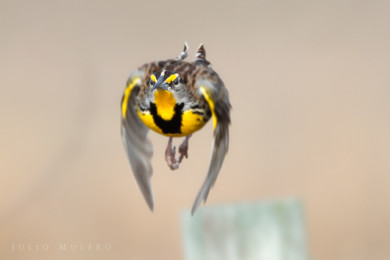
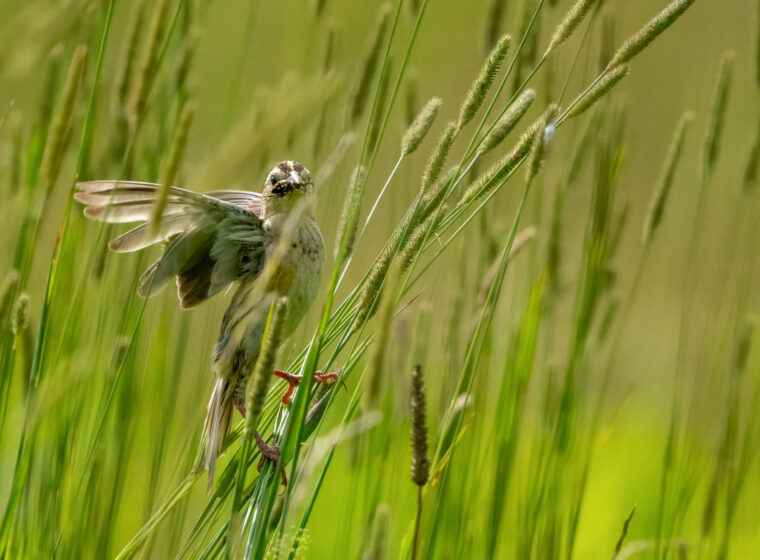
Eastern Meadowlark in flight. © Julio Mulero
Like most species of North American grassland birds, Eastern Meadowlarks have substantially declined throughout their range over the last 50 years. In Vermont, the Eastern Meadowlark population has largely retracted to the Champlain Valley, where it occurs in low density. These declines in the U.S. are likely tied directly to grassland loss through agricultural conversion, reforestation of abandoned farmlands, and through the intensification of agricultural practices (read more here)—including on their migration and wintering grounds. Conserving Eastern Meadowlark populations will likely require preserving the remaining large tracts of open grasslands throughout their breeding range.

If learning more about the Eastern Meadowlark has left you wondering how you can contribute to its conservation, please consider becoming a community scientist, making a gift, or keeping up with the latest VCE news! We also encourage you to report any sightings to eBird, which helps us better understand this species throughout its range.