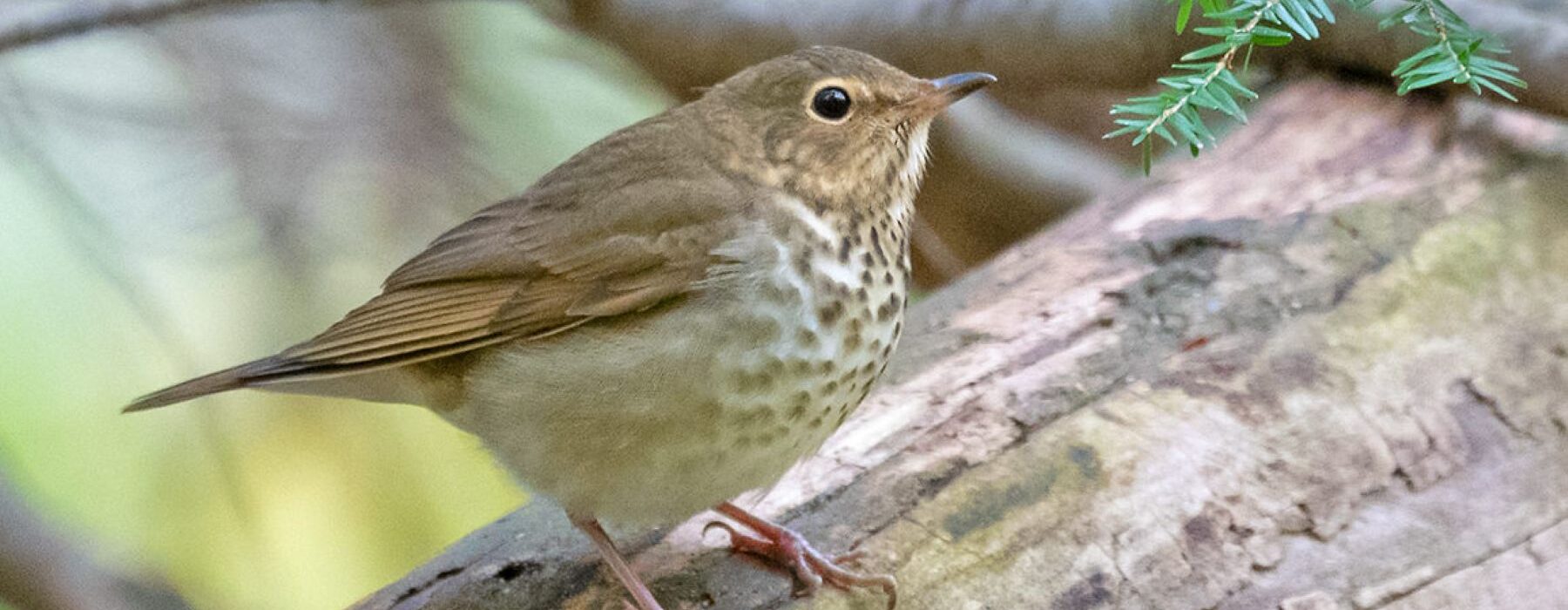
Catharus ustulatus
Swainson’s Thrush is apparently secure throughout its range.
Approximately 100 million Swainson’s Thrush exist. However, this species has been gradually declining across its range, losing about 30% of its population between 1966 and 2010, according to the North American Breeding Bird Survey.
Swainson’s Thrush mainly breed in conifer forests throughout northern North America and along the Pacific Coast. The exception is along the California coast, where they are found primarily in deciduous streamside woodlands, alder or willow thickets, and occasionally in coastal scrub. This species winters in mature tropical forests in Central and South America. Explore a dynamic eBird range map for this species.
Want to know even more about the Swainson’s Thrush? Visit All About Birds to learn more about this species’ natural history and identification.
During the breeding season, when the sun is hanging on the horizon, the upward-spiraling, flutelike songs of Swainson’s Thrush can be heard echoing across the evergreen-covered hills.
Named after the English naturalist William Swainson (1789-1855), the ‘russet-backed’ Pacific population has more reddish plumage and a slightly different song than the ‘olive-backed’ birds that occupy the rest of the breeding range. The russet-backed birds winter in Central America, while the olive-backed population winters in South America. VCE has monitored and studied the olive-backed population in the mountains of the Northeast for over two decades.
Natural History
Swainson’s Thrush is best identified by its distinctive “spectacles” and the warm buffy tones suffusing its face and upper chest. Like other thrushes, Swainson’s Thrush is omnivorous. It eats mostly insects during the breeding season and fruits in fall and winter. Although Swainson’s Thrush may be seen occasionally standing or running on the forest floor, these birds spend less time on the ground than other thrushes.
They lay three to four pale green-blue eggs that are finely spotted with light brown in a well-built cup of moss and strengthened with twigs, leaves, and grass. The nest is usually well concealed in a forest shrub or tree.
Cool Facts
- VCE biologists discovered that in montane fir forests in the Northeast the nests of Swainson’s Thrushes are often lined with root-like strings of horsehair fungus. The fungal filaments may have antibiotic effects and help deter nest pathogens.
- The longest-lived Swainson’s Thrush on record was at least 12 years old when it was caught and re-released in Montana in 2006.
- DNA analysis shows that Swainson’s Thrush is the most ancient North American species of its genus.
- Research by scientists at Penn State University suggests that during migration, they take hundreds of ‘power naps’ that last only a few seconds at a time.
Conservation Action
Population declines cloud the future of this melodious species. According to the Boreal Songbird Initiative, an estimated 73% of the species’ North American population breeds within the Boreal Forest. VCE’s Mountain Birdwatch project monitors songbirds that breed in the montane fir and spruce forests of the Northeast, such as Swainson’s Thrush. Our data provide the only region-wide source of population information on these high-elevation breeding birds.
VCE Projects
VCE has several research programs that gather data and explore conservation strategies for Bicknell's Thrush. You can learn more about each of them below.
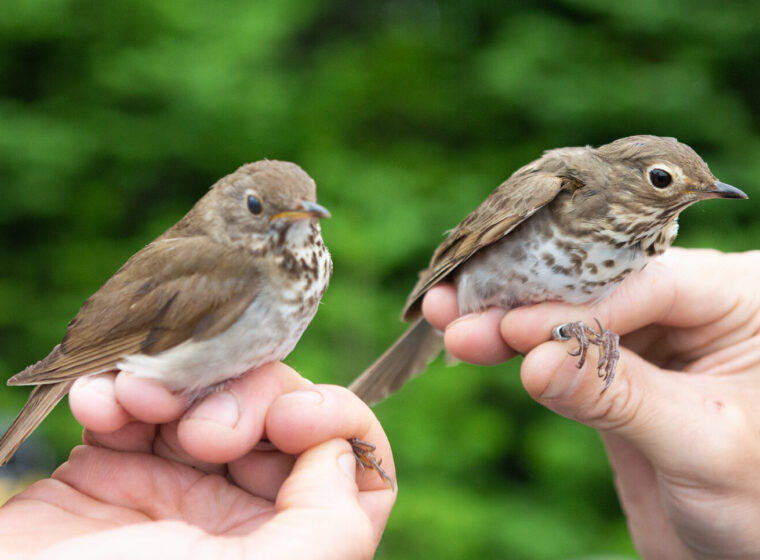

If learning more about the Swainson’s Thrush has left you wondering how you can contribute to its conservation, please consider becoming a community scientist, making a gift, or keeping up with the latest VCE news! We also encourage you to report any sightings to eBird, which helps us better understand this species throughout its range.