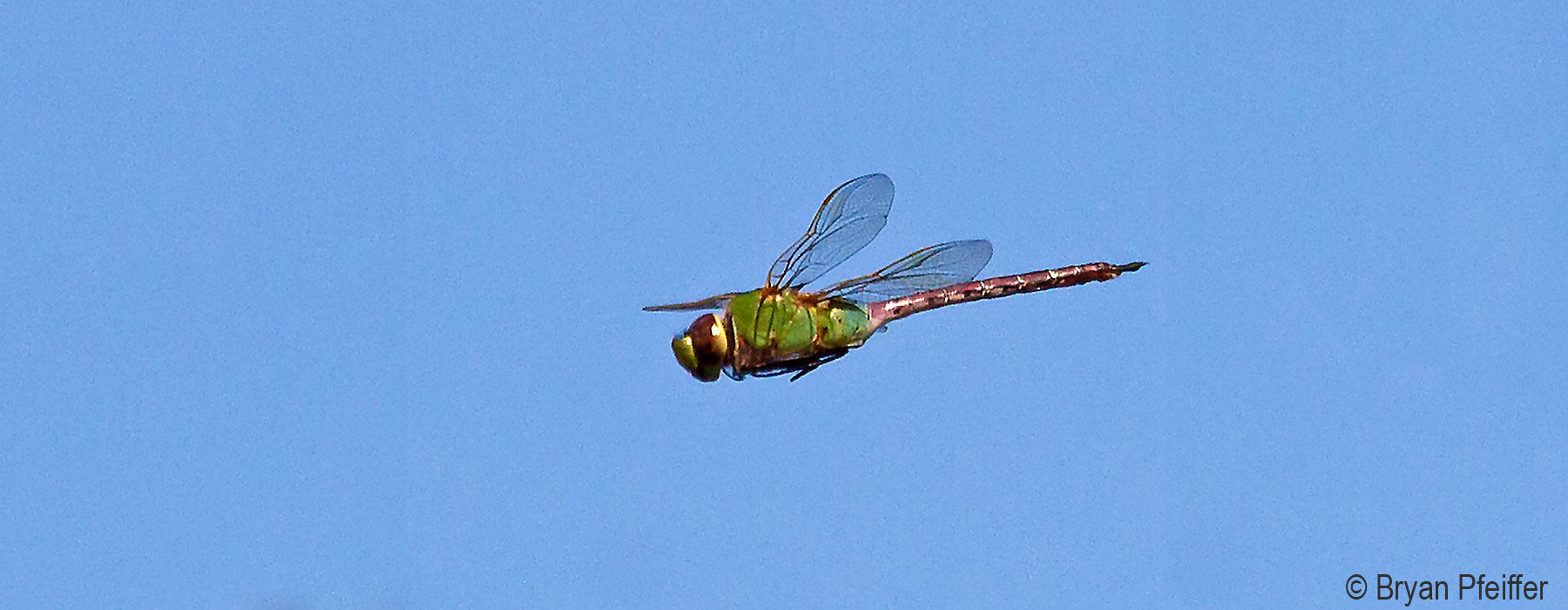
Anax junius
Common Green Darners are considered stable throughout their range.
Common Green Darners breed on lakes and ponds throughout the U.S., in the southern portions of Canadian provinces, and in Mexico. Experts have yet to determine their wintering range.
Want to know even more about the Common Green Darner? Visit iNaturalist to learn more about this species’ natural history and identification.
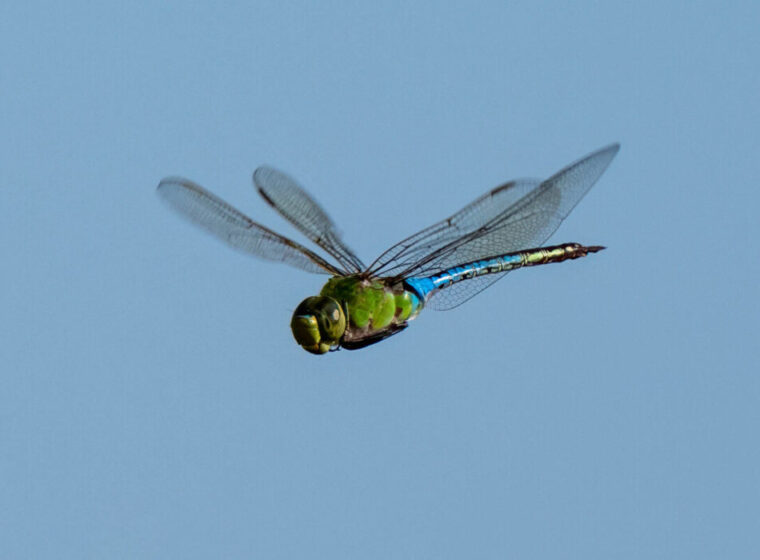
Flying at a pond in your own backyard or among hawks past a mountain, Common Green Darner is probably America’s most cosmopolitan dragonfly. It is also a migrant.
VCE is a partner is the most ambitous efforts to learn about the status and habits of migratory North American dragonflies. We’re tracking Common Green Darners with help from volunteers and some novel chemistry.
Although biologists know plenty about the fall raptor and Monarch migrations, we are only beginning to discover investiage the conservation status of migratory dragonflies. VCE, a parner of the Migratory Dragonfly Partnership (MDP), helps to organize the citizen science portion of this project.
Dragonflies migrate for the same reasons other animals migrate: to avoid inhospitable conditions, in this case habitats that freeze or become too cold for the dragonflies themselves or their insect prey. Where they go, we’re not sure. But we’re looking. And it turns out that we can track dragonflies without tags or leg bands or radio telemetry.
Our marker is water, more to the point the two hydrogen atoms in water. Recall from high school chemistry that hydrogen nucleus normally contains a single proton and no neutron. But a tiny fraction of hydrogen atoms around the world carry one proton and one neutron. We call it “heavy hydrogen,” or deuterium. And unlike other such atomic variations among elements (which can be radioactive), deuterium is stable in the environment – a “stable isotope”– and stable in the wing of a dragonfly.
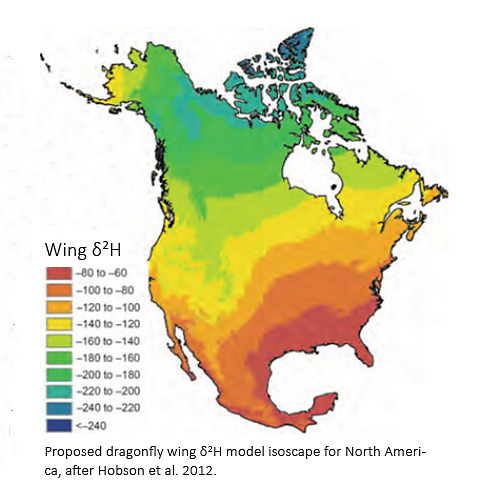
Credit: Migratory Dragonfly Partnership
The amount of deuterium in water varies somewhat predictably in North America. You can map it. The ratio of deuterium to hydrogen in water falling as rain or snow changes on a gradient corresponding roughly with latitude. Water in Alberta, for example, carries a different deuterium-to-hydrogen ratio than water in Alabama.
Because dragonflies grow up as nymphs in water, they incorporate the local deuterium ratio into their tissue. It’s like a dialect that a dragonfly bears for life – whether as a nymph in water or a free-flying adult in migration. A Common Green Darner on the wing over Mt. Philo or Miami unwittingly carries a particular deuterium ratio, a birth certificate that tells us generally where it grew up. You are what you eat – or drink.
This science isn’t perfect. We can’t pinpoint a dragonfly’s natal waters in the way we know where a banded bird hatched or a tagged Monarch emerged. But stable isotopes are helping us track the range of migrating dragonflies. It’s “better living through chemistry.” After all, we can’t really know a bird or butterfly or a dragonfly – and what it might need in the way of conservation – until we know all the places it lives or wanders.
If learning more about the Common Green Darner has left you wondering how you can contribute to its conservation, please consider becoming a community scientist, making a gift, or keeping up with the latest VCE news! We also encourage you to report any sightings to the Vermont Atlas of Life on iNaturalist, which helps us better understand this species throughout its range.