Betula
Paper Birches are considered secure throughout their range.
Want to know even more about Paper Birches? Visit Go Botany to learn more about White Birch
and Heart-leaved Paper Birch natural history and identification.
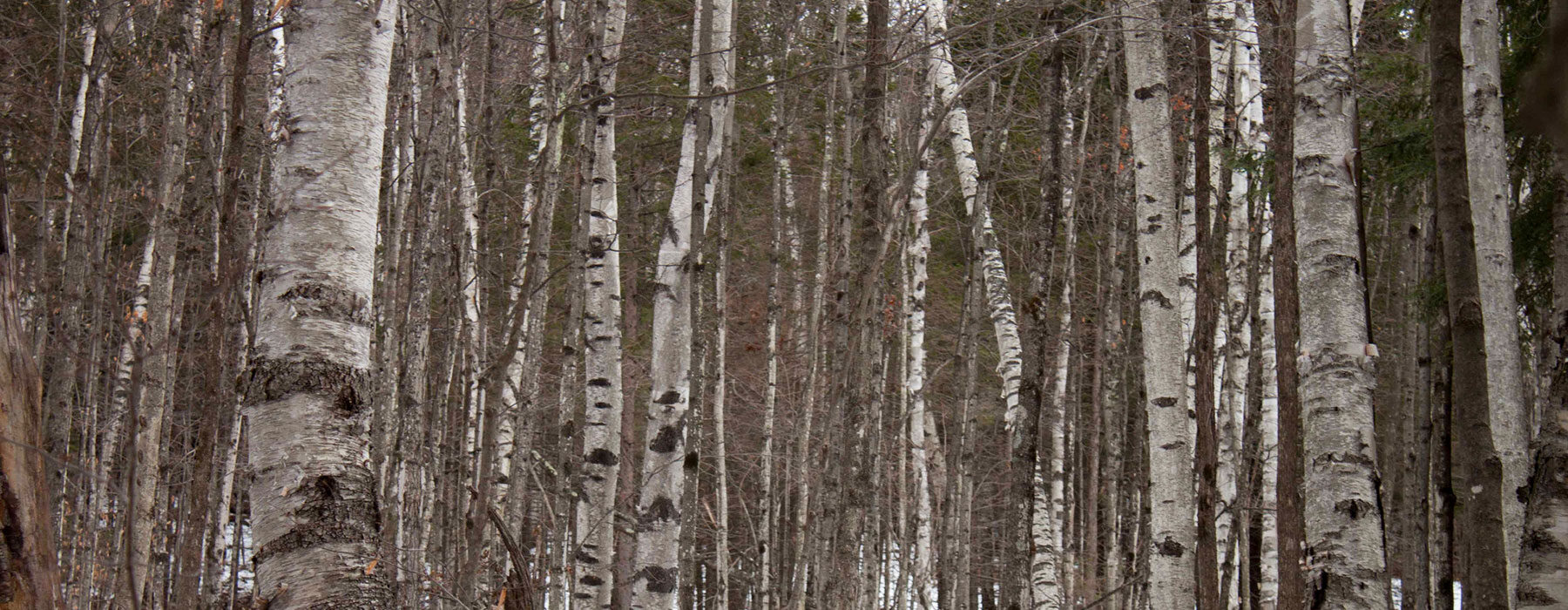
Many people don’t realize that two species of paper birch trees grow in northeastern North America: Paper or White Birch (Betula papyrifera) and Heart-leaved Paper Birch (B. cordifolia), which was once considered a variety of Paper Birch.
As its name suggests, the latter species has distinctive heart-shaped, many-veined leaves, and it is restricted to mid- to high-elevation Appalachian and northern forests.
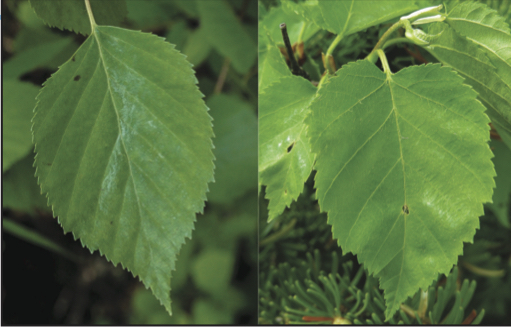
White Birch leaf (left) compared to Heart-leaved Paper Birch (right).
The primary means of distinguishing Heart-leaved Paper Birch from Paper Birch include:
- The leaf base is heart-shaped (cordate)
- Its leaves are dotted with resin glands
- Young shoots are not hairy
- A bronze or pinkish inner bark shows when the outer bark peels
- It is genetically diploid (28 chromosomes), making it unlikely that these two species will readily hybridize
We know surprisingly little about the exact range of these two species. How low in elevation does Heart-leaved Paper Birch grow? How high does Paper Birch climb into the mountains? Do they overlap in some areas? And how will these species respond to climate change, or have they already? Observers adding records to the Vermont Atlas of Life on iNaturalist are helping to map these and many other species. We hope you will add your observations too.
Although VCE doesn’t research Paper Birches directly, we do have several studies that monitor species in fir forests. These include our Mount Mansfield Songbird Research and Mountain Birdwatch.
If learning more about Paper Birches has left you wondering how you can contribute to the conservation of species in its habitat, please consider becoming a community scientist, making a gift, or keeping up with the latest VCE news! We also encourage you to report any sightings to iNaturalist Vermont, which helps us better understand this species throughout its range.