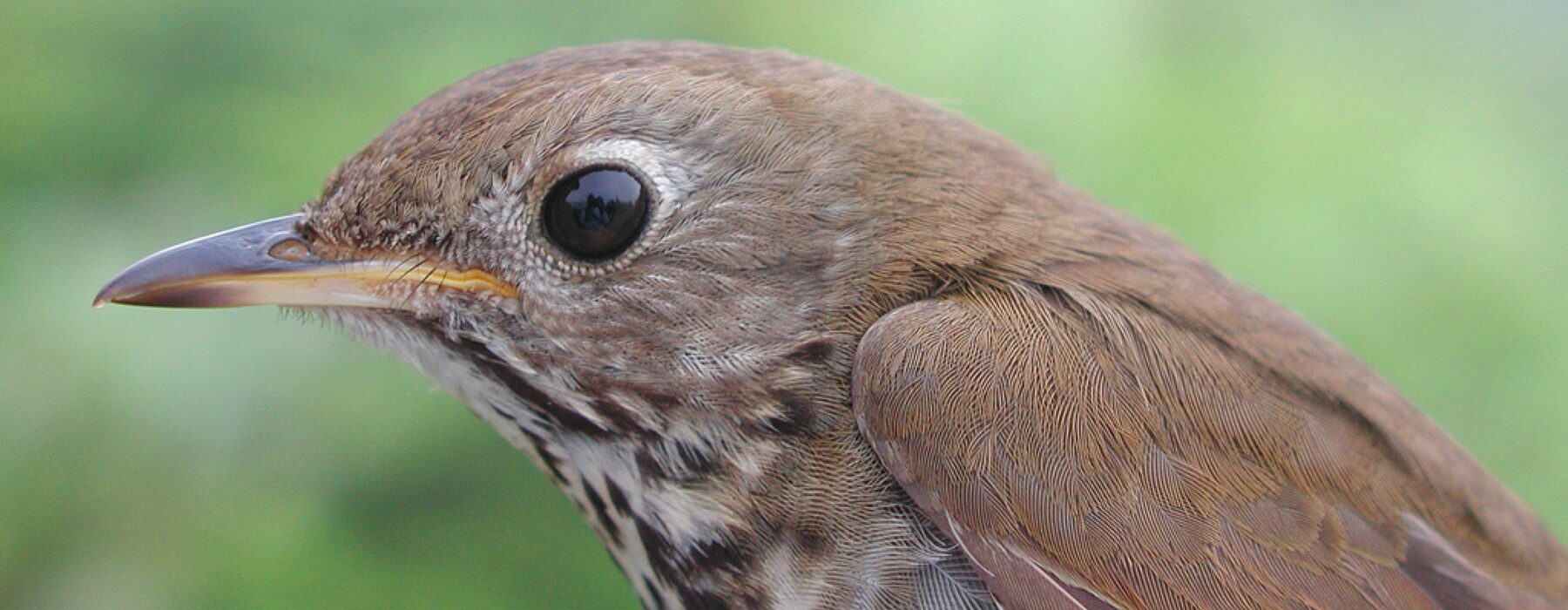
Catharus bicknelli
The Bicknell’s Thrush is listed as Threatened in Canada and as Vulnerable on the IUCN Red List.
Scientists estimate that anywhere from 56,100 to 89,750 Bicknell’s Thrush live in the U.S., with the number likely falling around 71,300. They believe there are less than 120,000 Bicknell’s Thrush worldwide.
The Bicknell’s Thrush breeds in northeastern North America during the summer months and migrates to the Greater Antilles for the winter. This species resides in montane and maritime fir forests throughout its range. Explore a dynamic eBird range map for this species.
Want to know even more about the Bicknell’s Thrush? Visit All About Birds to learn more about this species’ natural history and identification.
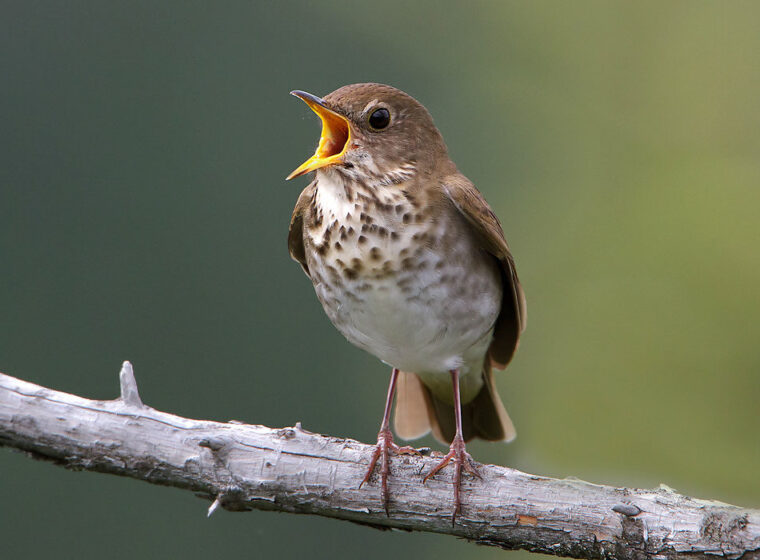
Nearly half a century has passed since the gyrating song and piercing nasal calls of Bicknell’s Thrush rang from the summit of Mount Greylock in northwestern Massachusetts. The disappearance of the species from this peak, its only known haunt in the state, was well documented by birders during the 1900s and provided one of the earliest warning signals that all might not be well.
Over twenty years ago, we rang a cautionary alarm for Bicknell’s Thrush: one of eastern North America’s rarest and poorly known songbirds. Now one of the region’s highest conservation priorities, Bicknell’s Thrush has been the subject of ongoing intensive study by the Vermont Center of Ecostudies and our colleagues. Yet, it remains as rare and vulnerable as ever, likely more so.
Twenty years after our initial foray into the realm of Bicknell’s Thrush, one conclusion is clear: we humans have stacked the deck decidedly against this globally rare and vulnerable species. Our warming climate threatens to push the Northeast’s montane spruce-fir forests to extinction, with predicted losses of >50% within the next several hundred years. We’ve fragmented its mountaintop breeding haunts with ski areas, towers, and turbines. We’ve discovered surprisingly high burdens of toxic mercury from atmospheric pollution in the blood and feathers of every thrush sampled from Canada and the Catskills to its wintering grounds in Cuba and Hispaniola. We’re watching its limited winter habitats disappear before our eyes due to illegal deforestation.
Current Research
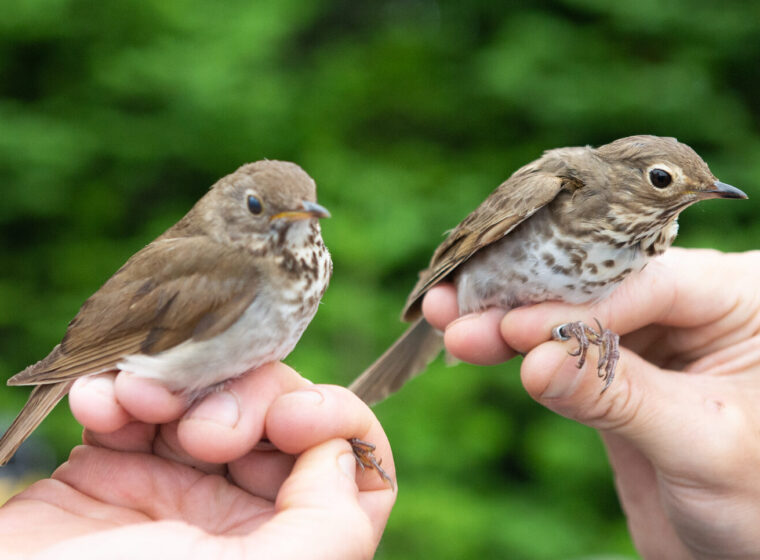
We’re tracking Bicknell’s Thrush to their wintering grounds using light-level geolocators and working with our Canadian colleague Junior Tremblay (Research scientist – Boreal birds & Ecosystems) to track their migratory movements using nanotags and the Motus network. We’re just finished a long-term survival analysis of Bicknell’s Thrush, looking at the effects of summer weather and hurricanes and deforestation on the wintering grounds (more to come soon).
Thanks largely to a legion of Mountain Birdwatch citizen scientists, we’re able to monitor breeding populations across the northeastern U.S. and we recently release a comprehensive State of the Mountain Birds report. Our recent research in Ecosphere, estimated only ~71,000 adult birds in the U.S., and likely <120,000 globally. We estimated that just three public lands (White Mountain National Forest [NH & ME], Baxter State Park [ME], and the High Peaks Wilderness Area (NY) harbor >50% of the U.S. Bicknell’s Thrush population. Our abundance map of Bicknell’s Thrush can be downloaded or viewed online at Data Basin. We anticipate that these findings will prove useful in generating statistically defensible estimates of the conservation status of the species, evaluating conservation actions, and identifying segments of the Bicknell’s Thrush population that occur on lands vulnerable to future development.
Conservation Actions
Concerted on-the-ground actions are now underway to conserve Bicknell’s Thrush. A coalition of scientists, natural resource managers, and conservationists from across the hemisphere are now translating knowledge into action via the International Bicknell’s Thrush Conservation Group (IBTCG). Nearly one hundred members strong, the IBTCG released a formal action plan in 2010, with an ambitious goal “to increase the global population of Bicknell’s Thrush by 25% over the next fifty years (2011-2060), with no further net loss of distribution.” Recommended actions concentrate on range-wide research, monitoring, and habitat conservation. Importantly, the plan directs foremost attention to better protection of its dwindling winter habitats.
We are meeting these goals with winter habitat surveys for Bicknell’s Thrush in Cuba and Puerto Rico. In the heart of the Bicknell’s Thrush winter range, VCE is supporting the creation of a strategic conservation plan for the Sierra de Bahoruco National Park in the Dominican Republic. With funding from a US Fish and Wildlife Service Neotropical Migratory Bird Conservation Act grant, we are hosting workshops with community members and farmers, government officials and scientists. These meetings are organized in collaboration with our local partner, Grupo Jaragua, and the Dominican Republic’s Ministry of the Environment and Natural Resources.
VCE Projects
VCE has several research programs that gather data and explore conservation strategies for Bicknell's Thrush. You can learn more about each of them below.

If learning more about the Bicknell’s Thrush has left you wondering how you can contribute to its conservation, please consider becoming a community scientist, making a gift, or keeping up with the latest VCE news! We also encourage you to report any sightings to eBird, which helps us better understand this species throughout its range.